
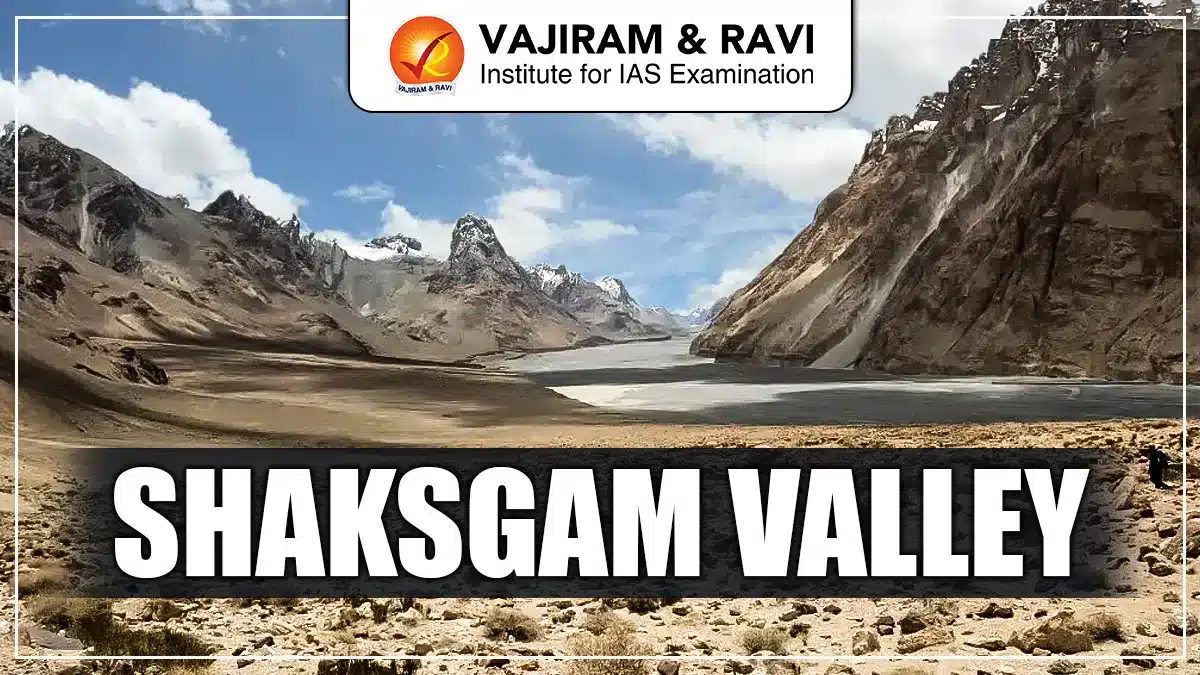
Why Shaksgam Valley in News?
China has rejected India’s territorial claim over the Shaksgam Valley in the Jammu & Kashmir region, insisting the area is part of Chinese territory.
About Shaksgam Valley
- The Shaksgam Valley, or Trans Karakoram Tract, is part of the Hunza-Gilgit region of Pakistan-Occupied Kashmir (POK) and is a disputed territory claimed by India but controlled by Pakistan.
- It borders Xinjiang Province of the People’s Republic of China (PRC) to the north, the Northern Areas of POK to the south and west, and the Siachen Glacier region to the east.
- It was ceded to China by Pakistan in 1963, when both countries signed a boundary agreement to settle their border differences.
- However, Article 6 of the agreement clearly stated that “the two parties have agreed that after the settlement of the Kashmir dispute between Pakistan and India, the sovereign authority concerned will reopen negotiations with the Government of the People's Republic of China, on the boundary as described in Article Two of the present agreement, so as to sign a formal Boundary Treaty to replace the present agreement.”
- The agreement laid the foundation of Karakoram highway, which was built jointly by Chinese and Pakistani engineers in the 1970s.
Source: IE
Shaksgam Valley FAQs
Q1: Why is the issue in the news now?
Ans: China recently rejected India’s claim and defended its infrastructure work in the valley, including projects linked to the China-Pakistan Economic Corridor (CPEC).
Q2: Where is the Shaksgam Valley located which recently became the site of dispute between India and China?
Ans: The Shaksgam Valley also known as Trans Karakoram Tract is located in the northernmost part of the Jammu & Kashmir region, north of the Siachen Glacier
Q3: Why is Shaksgam Valley strategically important?
Ans: The valley lies north of the Siachen Glacier and near China’s Xinjiang region, making it critical for military logistics, regional security, and connectivity, despite being sparsely populated.
