
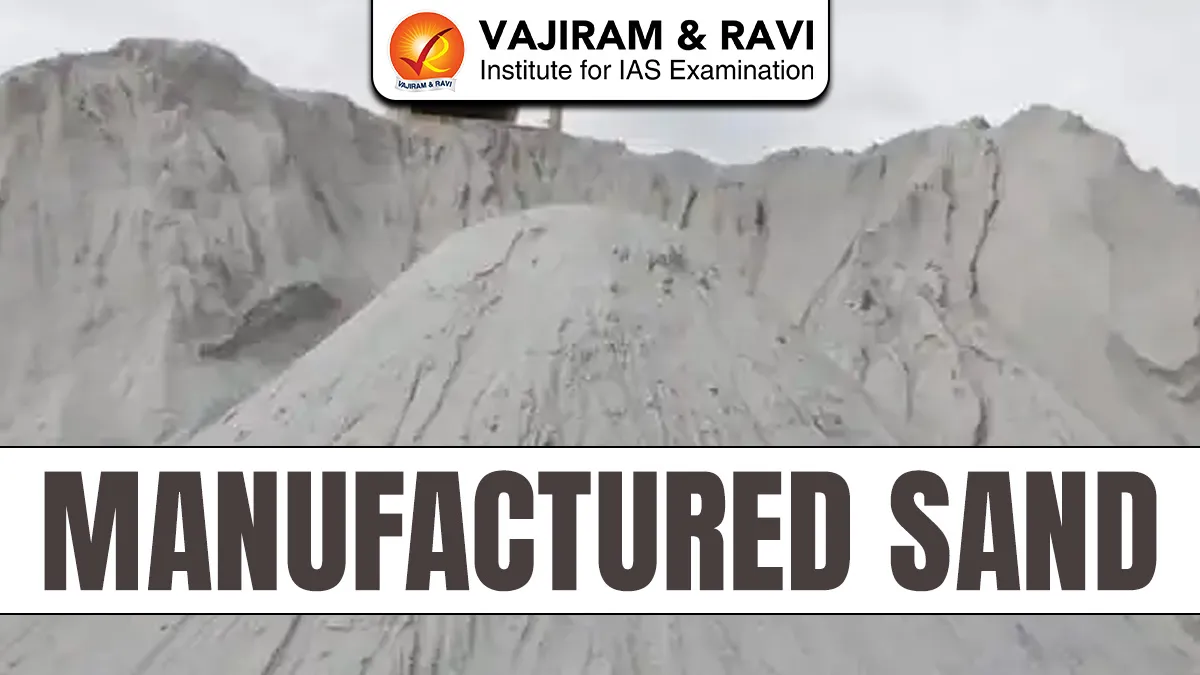
Sand is a naturally occurring granular material formed from the weathering and erosion of rocks over thousands of years and is a critical input for construction, infrastructure, glass and industrial processes. With rapid urbanisation and infrastructure growth, natural river sand availability has declined sharply. Manufactured Sand, commonly known as M-Sand, is an engineered alternative produced by crushing hard rocks, quarry stones, or mining overburden into sand sized particles. It is designed to match construction requirements while reducing pressure on rivers, ecosystems and groundwater resources.
Manufactured Sand
Manufactured Sand is an artificially produced fine aggregate obtained by crushing rocks, crusher dust, or mining waste such as coal mine overburden and processing it to achieve controlled particle size, shape and grading. Unlike river sand, M-Sand is produced in a regulated industrial environment, ensuring uniform quality and zero silt content. In India, Coal India Limited has emerged as a key producer by converting overburden rocks from opencast coal mines, particularly where sandstone content reaches nearly 60%, into usable construction grade sand.
Manufactured Sand Need
The need for Manufactured Sand arises due to rapidly declining river sand availability, environmental damage from illegal mining, and rising construction demand driven by urbanisation and infrastructure growth.
- Severe River Sand Shortage: Construction demand has increased sharply, while natural sand sources are limited, seasonal, and insufficient to meet housing, road and infrastructure requirements.
- Environmental Degradation: Excessive river sand mining causes riverbed erosion, bank collapse, habitat destruction, groundwater depletion, and increased flood risks in river systems like Kosi and Yamuna.
- Regulatory Restrictions: Monsoon bans on sand mining and stricter enforcement under environmental laws often disrupt supply, making manufactured alternatives essential for continuity in construction activities.
- Mining Waste Utilisation: Manufactured Sand enables productive use of crusher dust and coal mine overburden, converting waste materials into valuable construction inputs.
- Quality and Strength Requirements: Modern construction needs uniform particle size and low silt content for higher concrete strength, which Manufactured Sand provides through controlled production.
- Water Conservation Needs: Unlike river sand, Manufactured Sand does not require extensive washing, helping reduce freshwater consumption in water stressed regions.
Manufactured Sand Project
Manufactured Sand projects focus on converting mining waste and crushed rock into construction grade sand through mechanised processing and quality control systems.
- Coal India Limited Initiative: CIL has conceptualised overburden-to-M-Sand projects in opencast mines where sandstone constitutes about 60% of overburden volume, enabling large scale sand recovery.
- Overburden Processing Plants: These projects install crushers, screens and grading units at mine sites, transforming waste rock into fine aggregates suitable for concrete and masonry use.
- Revenue Generation Model: Commercial sale of M-Sand provides an additional revenue stream for coal companies while reducing costs associated with overburden storage and land reclamation.
- Sand Stowing in Underground Mines: A portion of manufactured sand is used for sand stowing in underground coal mines, improving roof stability, enhancing worker safety and conserving surface land.
- Alignment with Sand Mining Framework 2018: The Ministry of Mines promotes M-Sand from crushed rock fines and coal mine overburden as a strategic alternative to river sand under national mineral planning.
- Reduced Environmental Footprint: On site processing minimises transportation emissions and prevents further land degradation caused by external sand quarrying activities.
- Scalable Production Potential: With India’s annual sand and gravel consumption estimated at tens of billions of tonnes globally, coal mine overburden offers a scalable domestic alternative source.
Manufactured Sand Applications
Manufactured Sand is widely used across construction, mining and infrastructure sectors due to its strength, availability and environmental advantages.
- Concrete Production: M-Sand provides higher concrete strength due to angular particles and controlled grading, improving load bearing capacity in buildings, bridges and flyovers.
- Masonry and Plastering: Zero silt content enhances bonding with cement, resulting in smoother finishes and reduced cracking in walls and plaster surfaces.
- Road and Highway Construction: Manufactured Sand is used in bituminous mixes, embankments and pavement layers, supporting national highway and expressway expansion projects.
- Infrastructure Projects: Metro rail, airports, ports and industrial corridors rely on consistent sand supply, which M-Sand provides without seasonal disruptions.
- Mining Safety Operations: Sand stowing using M-Sand in underground mines improves structural stability and reduces subsidence risks in coal bearing regions.
- Environmental Restoration Works: Reduced river sand extraction helps protect river ecosystems, fisheries and groundwater recharge zones essential for rural livelihoods.
- Urban Housing Demand: Affordable housing schemes benefit from cost effective and locally available M-Sand, reducing construction delays and price volatility.
Manufactured Sand Significance
Manufactured Sand addresses sand scarcity while supporting environmental protection, mining waste utilisation and infrastructure demand through scientifically controlled production systems.
- Environmental Protection: M-Sand reduces excessive river sand extraction, which otherwise causes riverbed erosion, bank collapse, aquatic habitat destruction and groundwater depletion across major river systems like Ganga, Yamuna and Kosi.
- Waste Utilisation: Coal India Limited uses crusher dust, sandstone rich overburden and soil removed during opencast mining, converting mining waste into productive material instead of dumping it in overburden dumps.
- Legal and Regulatory Support: Sand is classified as a minor mineral under the Mines and Minerals Development and Regulation Act, 1957, allowing states to promote alternatives like M-Sand under Sustainable Sand Mining Management Guidelines 2016.
- Cost Efficiency: Large scale production of M-Sand reduces dependence on seasonal river sand supply, particularly during monsoon bans, lowering transportation costs and stabilising market prices.
- Quality Consistency: Manufactured Sand offers uniform grain size, cubic particle shape and zero silt content, improving concrete bonding strength compared to natural sand with variable silt levels ranging from 3 to 20%.
- Water Conservation: M-Sand does not require extensive washing before use, reducing freshwater consumption in construction activities, especially important in water stressed states like Rajasthan and Gujarat.
- Infrastructure Growth Support: India’s rapid highway, housing, metro and industrial corridor expansion requires reliable sand supply, which M-Sand ensures without ecological damage.
Manufactured Sand Challenges
Despite its benefits, Manufactured Sand faces technical, regulatory and perception based challenges that affect its widespread adoption.
- Initial Capital Investment: Setting up crushing, screening and grading plants requires significant upfront investment, which can discourage small scale producers.
- Market Acceptance Issues: Many contractors still prefer river sand due to familiarity, despite evidence showing superior strength and consistency of manufactured sand.
- Quality Control Gaps: Poorly processed M-Sand without proper grading can affect workability, highlighting the need for strict production standards.
- Transportation Constraints: M-Sand plants located far from consumption centres may face higher logistics costs, reducing price competitiveness in certain regions.
- Regulatory Variations: Different state level minor mineral rules create inconsistencies in approval processes, pricing controls and market access for M-Sand producers.
- Awareness Deficit: Limited awareness among small builders and rural construction sectors slows adoption of M-Sand despite environmental and economic benefits.
Way forward
- Policy Promotion: State governments should actively promote M-Sand through procurement policies, infrastructure tenders and incentives aligned with Sustainable Sand Mining Management Guidelines 2016.
- Strict Enforcement Against Illegal Mining: Strong penalties and monitoring mechanisms can reduce illegal river sand mining, increasing demand for manufactured alternatives.
- Technological Monitoring: Use of drones, satellite imagery and digital tracking can improve oversight of sand mining and encourage legal M-Sand adoption.
- Community Participation: Involving local communities in decision making ensures livelihoods are protected while transitioning from river sand extraction to M-Sand production.
- Standardisation and Certification: Uniform national quality standards for M-Sand will build confidence among builders, engineers and infrastructure agencies.
- Integration with Circular Economy: Converting mining overburden and crusher dust into M-Sand aligns with circular economy principles by transforming waste into valuable resources.
- Capacity Expansion by CIL: Scaling up Coal India Limited’s overburden-to-M-Sand projects can significantly reduce India’s dependence on river sand while generating sustainable revenue and protecting ecosystems.
Manufactured Sand FAQs
Q1: What is Manufactured Sand (M-Sand)?
Ans: Manufactured Sand is an artificial sand produced by crushing rocks or mining overburden into fine, uniformly graded particles for construction use.
Q2: Why is Manufactured Sand important for India?
Ans: M-Sand reduces river sand mining, protects ecosystems, manages mining waste and supports growing construction demand sustainably.
Q3: How is Coal India Limited producing M-Sand?
Ans: Coal India Limited processes sandstone rich overburden and crusher dust from opencast coal mines to manufacture construction grade sand.
Q4: Is Manufactured Sand better than natural river sand?
Ans: Yes, M-Sand has controlled quality, zero silt content, better concrete strength and requires less water than river sand.
Q5: Does Manufactured Sand help the environment?
Ans: Manufactured Sand reduces river erosion, groundwater depletion, habitat loss and promotes reuse of mining waste materials.
