
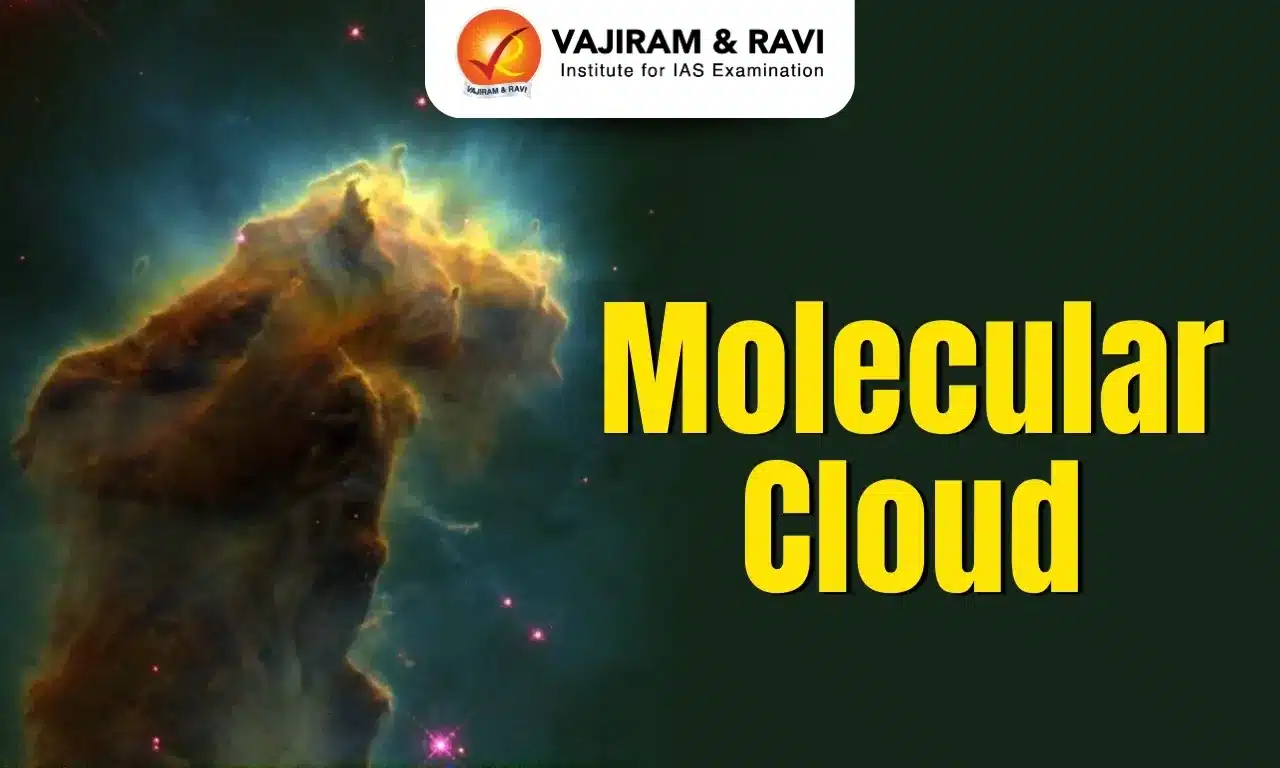
Molecular Cloud Latest News
Recently, astronomers studied the L328 molecular cloud, located around 700 light years away, to map the magnetic fields at multiple scales.
About Molecular Cloud
- It is an interstellar cloud of gas and dust in which molecules can form, the most common of which is hydrogen (H2).
Properties of Molecular Cloud
- These are characterized by their low temperatures (below 40 K, colder than liquid nitrogen) and relatively high densities (103–104 particles per cubic cm).
- Size: The size of these clouds can be from a few light years up to 600 light years. Their total mass can reach several million solar masses.
- Molecular clouds with dimensions of more than about 15 light years are also called giant molecular clouds.
- The complex interplay between three key forces, namely gravity, magnetic fields, and turbulence, determines how these clouds collapse to form stars.
- The central regions of these clouds are completely hidden from view by dust.
- They are the raw material of stars and planets. These clouds do not last for a very long time.
- After the new stars are born, their solar winds blow away the remaining gas and dust.
Significance of Molecular Cloud
- Molecular clouds are so important because they are the raw material of stars and planets.
- It is thought to be the birthplace of stars and planetary systems through processes of contraction, condensation, and accretion.
Source: PIB
Molecular Cloud FAQs
Q1: What is the primary component of molecular clouds?
Ans: Molecular hydrogen
Q2: What is a molecular cloud?
Ans: A region of space with cold, dense molecular gas and dust
