
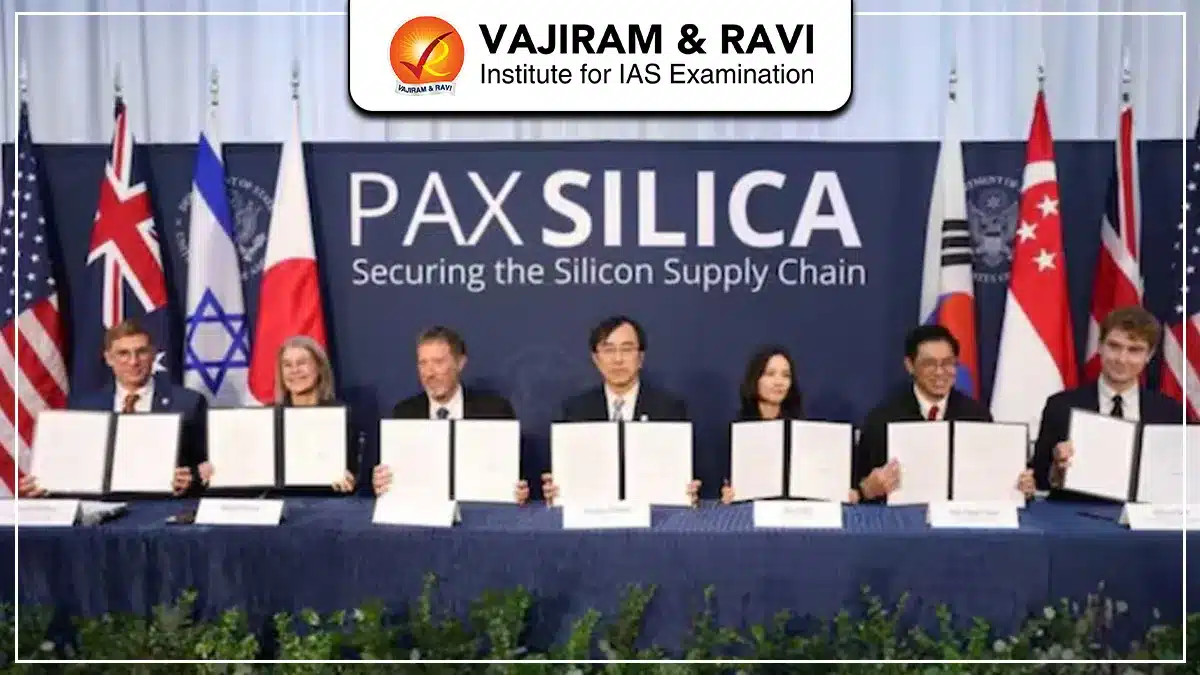
Why Pax Silica is in News?
The United States’ new Ambassador to India, Sergio Gor, announced that India will be invited to join Pax Silica.
What is Pax Silica?
Pax Silica is a US-led international coalition designed to build a secure, resilient, and innovation-driven silicon and AI supply chain ecosystem. It focuses on collaboration among trusted global partners to safeguard critical materials and ensure the development and deployment of advanced technologies.
Features of Pax Silica
The features of Pax Silica have been discussed below:
- Objective: Reduce reliance on a single country for critical minerals and AI technology, while protecting sensitive materials and promoting innovation.
- Inaugural Summit: Held in Washington, D.C., December 2025.
- Critical Minerals: China dominates over 60% of lithium, cobalt, and rare earth production, which are crucial for semiconductors and AI hardware. Pax Silica aims to diversify supply chains globally.
- Participating Nations: Japan, Republic of Korea, Singapore, Netherlands, United Kingdom, Israel, United Arab Emirates, and Australia.
- Core Commitments: Joint projects covering semiconductor design, fabrication, packaging, compute infrastructure, energy grids, and protection of sensitive technologies.
Impact on Global Trade and Economy
Pax Silica has significant implications for global trade and the economy:
- Diversification of Supply Chains: Reduces dependency on China for critical minerals, minimizing supply disruptions.
- Boost to Innovation: Collaboration allows member countries to develop AI and semiconductor technologies at scale.
- Economic Security: Joint projects ensure that sensitive technologies remain protected from countries of concern.
- Job Creation: Strengthening AI and semiconductor industries could generate employment in high-tech sectors globally.
- Trade Partnerships: Encourages deeper trade ties among coalition members, including technology sharing and joint investments.
India’s Initiatives to Strengthen the Silicon and AI Supply Chain
India has launched several initiatives to develop its semiconductor and AI capabilities and enhance critical mineral self-reliance: The key initiatives includes:
1. India Semiconductor Mission (ISM, 2021)
- Objective: The mission aims to build a robust indigenous semiconductor ecosystem in India, reducing dependence on imports and strengthening national security in technology-critical sectors.
- Investment: The Government of India has committed USD 10 billion to support semiconductor manufacturing, research, and development projects across the country.
- Approved Projects: Currently, 10 major projects have been approved, covering:
- Fabrication Units (Fabs): Manufacturing chips domestically to reduce reliance on foreign suppliers.
- Packaging and Testing: Ensuring high-quality standards and global competitiveness.
- Chip Design: Supporting startups and established companies in advanced semiconductor design.
- Impact: Once implemented, ISM is expected to create over 50,000 direct and indirect jobs, boost high-tech manufacturing, and make India a significant player in the global semiconductor supply chain.
2. IndiaAI Mission (2024)
- Focus: The mission emphasizes the development of indigenous Large Language Models (LLMs), AI algorithms, and foundational AI infrastructure. This supports India’s goal of becoming a global AI innovation hub.
- Infrastructure Expansion:
- GPU capacity has been expanded to 34,333 GPUs, almost doubling previous capacity.
- This allows faster AI model training and reduces reliance on foreign cloud platforms.
- Shared Compute Platform:
- Provides cloud-based resources for AI research, model training, and inference.
- Tailored to Indian data and context, enabling AI solutions suitable for local languages, governance, healthcare, and industry needs.
- Expected Outcome: Encourages the growth of AI startups, supports research in generative AI, and strengthens India’s digital sovereignty.
3. National Critical Mineral Mission (NCMM)
- Objective: To achieve self-reliance in critical minerals essential for high-tech manufacturing, clean energy, and defense applications.
- Scope: The mission covers the entire mineral lifecycle, including:
- Exploration: Identifying domestic sources of lithium, cobalt, rare earths, and other strategic minerals.
- Mining and Processing: Developing modern mining and refining capabilities in India.
- Recycling and Circular Economy: Promoting sustainable use of minerals through recycling and recovery.
- Key Initiatives:
- Establish mineral parks to support industrial clustering and infrastructure development.
- Promote mineral recycling and reuse to reduce imports and environmental impact.
- Support research and innovation, including setting up Centres of Excellence for advanced mineral technologies.
- Impact: Enhances India’s strategic autonomy, supports high-tech manufacturing, and aligns with global initiatives like Pax Silica and MSP.
4. Minerals Security Partnership (MSP)
- Objective: The MSP is a US-led initiative that aims to strengthen global critical mineral supply chains while supporting India’s domestic strategy.
- Key Benefits to India:
- Encourages overseas mineral asset acquisition to secure long-term supply.
- Strengthens international trade ties, facilitating partnerships with leading mining and technology firms.
- Complements NCMM objectives, ensuring India can both produce and process strategic minerals efficiently.
- Strategic Importance: Participation in MSP helps India reduce supply chain risks, access advanced technologies, and position itself as a trusted partner in global high-tech ecosystems.
Pax Silica FAQs
Q1: What is Pax Silica?
Ans: Pax Silica is a US-led coalition to secure and strengthen the global silicon and AI supply chain.
Q2: Why was Pax Silica formed?
Ans: It was formed to reduce dependency on a single country for critical minerals and AI technologies.
Q3: Which countries are part of Pax Silica?
Ans: Japan, South Korea, Singapore, Netherlands, UK, Israel, UAE, and Australia are members.
Q4: What is India’s role in Pax Silica?
Ans: India is expected to join the coalition to strengthen its AI, semiconductor, and critical minerals capabilities.
Q5: How does Pax Silica impact the global economy?
Ans: It diversifies supply chains, promotes innovation, and boosts economic and technological security.
