
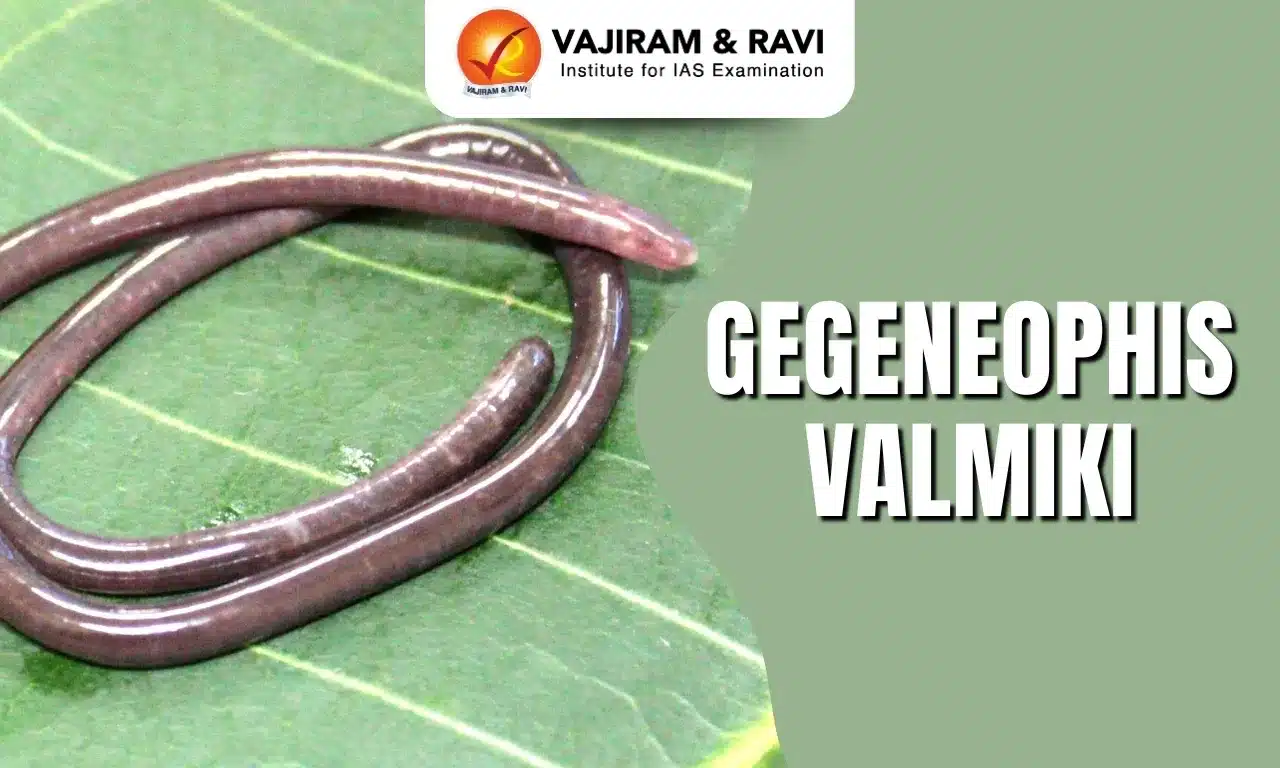
Gegeneophis Valmiki Latest News
Indian scientists recently discovered a rare subterranean amphibian species in the northern Western Ghats of Maharashtra and named it Gegeneophis valmiki.
About Gegeneophis valmiki
- It is a rare, subterranean amphibian species, discovered in the northern Western Ghats of Maharashtra.
- The name Gegeneophis valmiki honors the historic Maharshi Valmiki Mandir located near the discovery site.
- It belongs to the genus Gegeneophis, commonly called blind caecilians.
- Caecilians, often called “hidden amphibians”, are limbless, worm-like creatures that spend most of their lives underground.
- They look and move so much like earthworms.
- They do not croak or call like frogs, and their eyes are buried beneath layers of skin and bone, making field identification exceptionally difficult.
- Beyond rarity, caecilians play an important ecological role.
- Their burrowing improves soil aeration and structure, their feeding helps regulate soil invertebrates, and they form part of the food web for birds, reptiles and small mammals.
- They also represent a key evolutionary link between aquatic and terrestrial vertebrates.
- Globally, caecilians account for just 231 of the world’s 8,983 known amphibian species.
- India records 42 caecilian species among its 457 amphibians.
- The Western Ghats alone are home to 26 endemic caecilians, with 11 belonging to the Gegeneophis group.
- Gegeneophis valmiki is the first addition to its genus in more than a decade.
Source: TOI
Gegeneophis Valmiki FAQs
Q1: What is Gegeneophis valmiki?
Ans: It is a rare, subterranean amphibian species.
Q2: Where was Gegeneophis valmiki discovered?
Ans: In the northern Western Ghats of Maharashtra.
Q3: To which genus does Gegeneophis valmiki belong?
Ans: The genus Gegeneophis.
Q4: What are members of the genus Gegeneophis commonly called?
Ans: Blind caecilians.
Q5: What type of animals are caecilians?
Ans: Limbless, worm-like amphibians that live mostly underground.
