Chang’e 6 Mission

What is Chang’e 6 Mission?

Chang'e-6 Mission Latest News

Lunar regolith brought from the Moon by China's Chang'e 6 mission has revealed that the Moon is formed from the remains of an ancient collision between an object with Earth.

About Chang'e-6 Mission

  • It is the first human sampling and return mission from the far side of the moon.
  • It is part of the broader Chang’e lunar exploration program, named after a Chinese goddess of the Moon. 
  • It was launched by a Chinese Long March-5 rocket from Wenchang Space Launch Center on the southern island of Hainan on May 3, 2024.
  • Chang’e-6 consists of an orbiter, a returner, a lander, and an ascender.
    • The lander was equipped with multiple sensors, including microwave, laser, and optical imaging sensors which can measure distance and speed, and identify obstacles on the lunar surface.
  • The probe has adopted two methods of moon sampling, which include:
    • Using a drill to collect subsurface samples
    • Grabbing samples on the surface with a robotic arm.
  • It marks the second time a mission has successfully reached the far side of the moon. China first completed that historic feat in 2019 with its Chang’e-4 probe.
    • Though the far side of the Moon holds great scientific promise, it is harder to explore the far side of the Moon than the near side. 
    • Communication signals from Earth can’t directly reach the far side, so relay satellites have to be launched ahead of any mission.
  • The Chang'e-6 landed on the lunar far side on June 1, 2024, collected rock and regolith samples, and launched them to eventually return to Earth nearly a month later.
  • Chang’e-6 landed in the South Pole-Aitken Basin, a massive and roughly 4-billion-year-old crater covering a vast portion of the far side of the Moon. 
  • The samples Chang’e-6 collected there could include pieces of the Moon’s interior that would have been excavated by the giant impact that formed the basin, which stretches over roughly 2,500 kilometers (1,600 miles). 

Source: MSN


Chang'e-6 Mission FAQs

Q1: What is the Chang’e-6 mission known for?

Ans: Chang’e-6 is the first human mission to collect and return samples from the far side of the Moon.

Q2: Which country launched the Chang’e-6 mission?

Ans: Chang’e-6 was launched by China.

Q3: When was the Chang’e-6 mission launched?

Ans: It was launched on May 3, 2024.

Q4: Where exactly did Chang’e-6 land on the Moon?

Ans: It landed in the South Pole–Aitken Basin.

Q5: Why is exploring the far side of the Moon more difficult than the near side?

Ans: Because communication signals from Earth cannot directly reach the far side, requiring relay satellites.

Neknampur Lake

Key Facts about Neknampur LakeKey Facts about Neknampur Lake

Neknampur Lake Latest News

Dismissing viral social media claims, a flight safety chief said that the hot air balloon landing near Neknampur Lake in Hyderabad recently was a routine and controlled landing, standard in balloon operations, and not an emergency.

About Neknampur Lake

  • Neknampur Lake, also known as Ibrahim Bagh Cheruvu, is a historic man-made reservoir situated in the southern part of Hyderabad, Telangana.
  • It was constructed during the Qutb Shahi dynasty in the 16th century.
  • Initially commissioned by Sultan Ibrahim Qutb Shah and later revitalized under Sultan Abdullah Qutb Shah through a channel built by nobleman Neknam Khan (the lake was renamed in his honor), it became part of Hyderabad’s water network. 
  • Once vital to the city’s water supply until urban shifts in the mid-20th century, the lake has since deteriorated due to urbanization and pollution. 
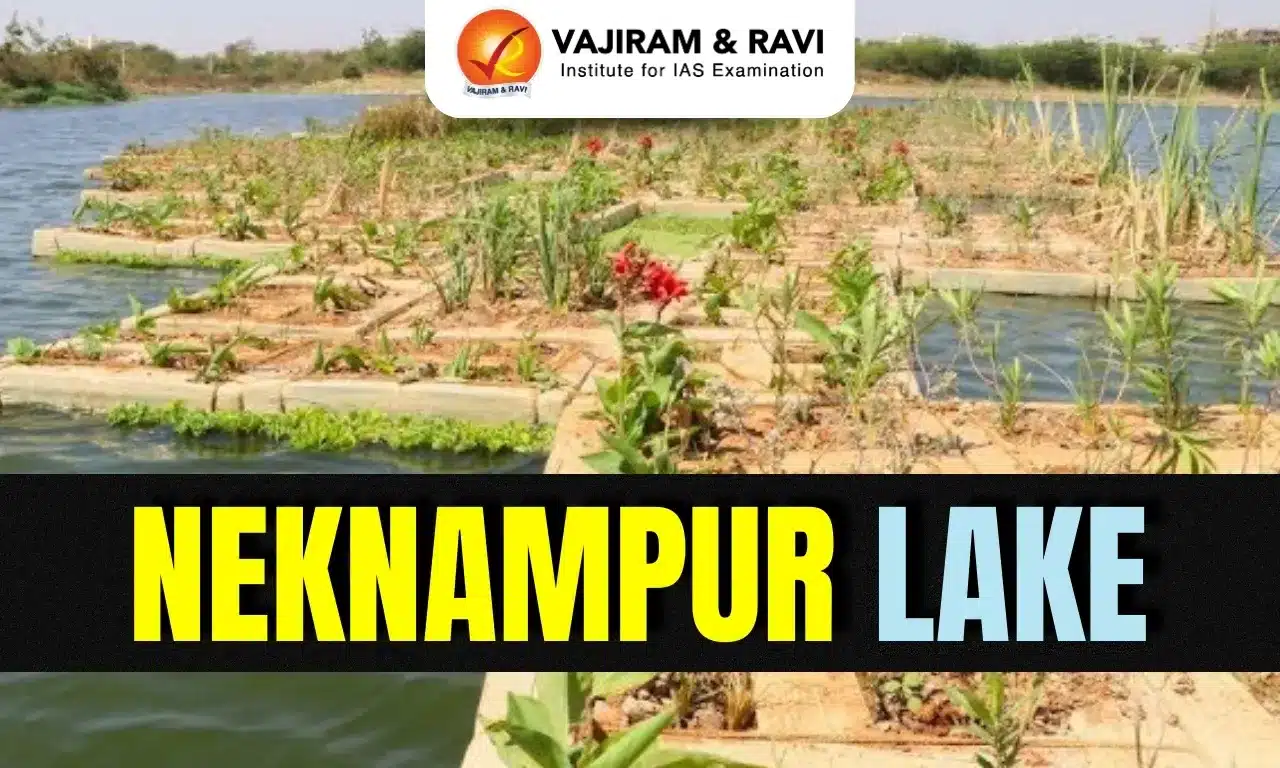
  • Restoration efforts since the 2010s include a large floating treatment wetland installed in 2018, recognized as India’s largest, which has improved water quality and revived biodiversity.

Source: TH


Neknampur Lake FAQs

Q1: Where is Neknampur Lake located?

Ans: Neknampur Lake is located in the southern part of Hyderabad, Telangana.

Q2: During which dynasty was Neknampur Lake constructed?

Ans: It was constructed during the Qutb Shahi dynasty in the 16th century.

Q3: What major restoration effort was undertaken at Neknampur Lake in 2018?

Ans: A large floating treatment wetland was installed in 2018, recognized as India’s largest.

Royle’s Pika

Royle’s Pika

Royle’s Pika Latest News

Scientists said that climate change threatens creatures like Royle’s pika that have weathered extreme environments for thousands of years.

About Royle’s Pika

  • Royle's pika (Ochotona roylei), also called the Himalayan mouse hare or hui shutu, is a species of pika.
  • Habitat: It is found in open rocky landscapes and rhododendron forests at 2,400–5,000 m elevation in the Himalayan region.
  • Distribution: It is found in northwestern Pakistan to Jammu and Kashmir, Himachal Pradesh, Uttarakhand, Sikkim and Arunachal Pradesh in India to Nepal and Tibet.
  • Characteristics of Royle’s pika
    • It does not hibernate. Instead it relies on a thick winter snowpack to act as an insulating blanket, shielding it from brutal sub-zero temperatures.
    • It does not make its own nest; rather, it takes narrow creeks and existing burrow systems as its nest.
    • Diet: Its primary food plants include alpine herbs and forbs, particularly moisture-loving Himalayan plants efficient at photosynthesis in cool wet climates.
    • Reproduction: Pikas breed between late spring and summer. Sexual maturity is reached between 7-10 months.
  • Conservation Status: IUCN: Least Concern
  • Threats: Climate change and population isolation.

Source: DTE

Royle’s Pika FAQs

Q1: What is the primary habitat of Royle's Pika?

Ans: Open rocky landscapes and rhododendron forests

Q2: How does Royle's Pika adapt to harsh winters?

Ans: Relies on winter snowpack for insulation

Irrawaddy Dolphin

Key Facts about Irrawaddy Dolphin

Irrawaddy Dolphin Latest News

The Union Ministry of Environment, Forest and Climate Change recently launched the second nationwide range-wide estimation of riverine and estuarine dolphins under Project Dolphin, which, for the first time, includes the estimation of the Irrawaddy dolphin in the Sundarbans and in Odisha.

About Irrawaddy Dolphin

  • It is a euryhaline species of oceanic dolphin found in discontinuous subpopulations near sea coasts and in estuaries and rivers in parts of the Bay of Bengal and Southeast Asia.
    • Euryhaline organisms survive in a range of salinity. These organisms thrive in saltwater, freshwater, and brackish water.
  • Scientific Name: Orcaella brevirostris

Irrawaddy Dolphin Habitat and Distribution

  • It is found in three rivers in South and Southeast Asia: the Irrawaddy (Myanmar), the Mahakam (Kalimatan, Indonesia), and the Mekong (Cambodia). 
  • Indian presence: Occurs mainly in Chilika Lake (Odisha); also reported in the Sundarbans region.
  • Irrawaddy dolphins prefer coastal areas, particularly muddy, brackish waters at river mouths and deltas, and do not appear to venture far offshore.

Irrawaddy Dolphin Features

  • It has an instantly recognisable, charismatic rounded face and head with no beak; they look like baby belugas, only with a dorsal fin. 
  • They have expressive faces thanks to their moveable lips and have creases around their necks as they are able to move their heads in all directions. 
  • They are grey all over but lighter on the belly.  
  • The dorsal fin is small; their flippers are long and large, with curved leading edges and rounded tips, and their tails are also large.
  • Irrawaddy dolphins have narrow, pointed, peg-like teeth about 1 cm in length in both the upper and lower jaws. 

Irrawaddy Dolphin Conservation Status

It is classified as 'Endangered' under the IUCN Red List.

Source: NIE


Irrawaddy Dolphin FAQs

Q1: What type of dolphin is the Irrawaddy dolphin?

Ans: It is a euryhaline species of oceanic dolphin.

Q2: Which three rivers in South and Southeast Asia are home to Irrawaddy dolphins?

Ans: The Irrawaddy River (Myanmar), Mahakam River (Indonesia), and Mekong River (Cambodia).

Q3: Where is the Irrawaddy dolphin found in India?

Ans: It occurs mainly in Chilika Lake, Odisha, and has been reported in the Sundarbans region.

Q4: What type of habitat do Irrawaddy dolphins prefer?

Ans: They prefer coastal areas with muddy, brackish waters, especially river mouths and deltas.

Q5: What is the conservation status of the Irrawaddy dolphin according to the IUCN Red List?

Ans: The Irrawaddy dolphin is listed as Endangered.

Mt Elbrus

Mt Elbrus

Mt Elbrus Latest News

Recently, an artificially-triggered avalanche was filmed cascading down Russia's highest mountain, Mount Elbrus.

About Mt Elbrus

  • Location: It is located in southwest Russia and is part of the Caucasus Mountains.
  • Formation of Mt Elbrus
    • It is believed that the Caucasus Mountains were formed due to the northward collision of the Arabian Plate with the Eurasian Plate.
    • Geological studies have revealed that Mount Elbrus was formed over 2.5 million years ago and the volcano had been most active during the Holocene Epoch. 
  • It is the highest point in Russia as well as the highest point in all of Europe.
  • It has an elevation of 18,510 feet (5,642 meters). It makes up part of the Prielbrusye National Park.
  • It is one of the Seven Summits of the world, which are the tallest mountains on each of the seven continents.
  • Mount Elbrus is an inactive volcano that consists of two principal summits, both of which are dormant volcanic domes.
  • Climate: The climate of Elbrus is generally cold. Even during summer, nighttime temperatures are around -8°C (18°F).
  • Major Glaciers: Bolshoi Azaou and Irik Glacier
  • Major Rivers: Many Russian rivers like the Baksan, Malka, and Kuban rivers originate from Bolshoi Azaou and Irik Glacier glaciers.

Source: BBC

Mt Elbrus FAQs

Q1: What type of mountain is Mt Elbrus?

Ans: Dormant volcano

Q2: Where is Mt Elbrus located?

Ans: Caucasus Mountain ranges.

Sammakka-Saralamma Jatara

Sammakka-Saralamma Jatara

Sammakka-Saralamma Jatara Latest News

Telangana is getting prepared for the biennial Sammakka-Saralamma Jatara, one of the world’s largest indigenous spiritual gatherings.

About Sammakka-Saralamma Jatara

  • It is also known as Medaram Jatara.
  • It is a tribal festival of honouring the goddesses celebrated in the state of Telangana, India.
  • Location: Medaram is a remote place in the Eturnagaram Wildlife Sanctuary, a part of Dandakaranya, the largest surviving forest belt in the Mulugu.
  • It is held every two years (biannually). It is celebrated during the time the goddesses of the tribals are believed to visit them.
  • In this festival people from all walks of life join together to commemorate the revolt led by Sammakka and Saralamma, a mother-daughter duo, against imposing taxes on the tribal populace during a period of drought by the Kakatiya rulers in the 12th century.
  • Ritual: People offer bangaram/gold (jaggery) of a quantity equal to their weight to the goddesses and take holy bath in Jampanna Vagu, a tributary to River Godavari.
  • The rituals related to the Goddesses are entirely conducted by Koya tribe priests, in accordance with Koya customs and traditions.
  • Significance: It serves as a platform for understanding and fostering harmony between the people and tribal communities.

Source: TH

Samakka-Saralamma Jatara FAQs

Q1: Where is Sammakka Saralamma Jatara held?

Ans: Medaram, Telangana

Q2: What is a key ritual in Sammakka Saralamma Jatara?

Ans: Offering jaggery equal to one's weight

Bagurumba Dance

Bagurumba Dance

Bagurumba Dance Latest News

Recently, the Prime Minister of India witnessed a performance of the traditional Bagurumba dance of the Bodo community in Assam with over 10,000 artistes participating in the programme.

About Bagurumba Dance

  • It is one of the folk dances of the Bodo community, deeply inspired by nature.
  • It represents peace, fertility, joy and collective harmony, and is closely associated with festivals such as Bwisagu, the Bodo New Year, and Domasi.
  • Features of Bagurumba Dance
    • The dance symbolises blooming flowers and reflects harmony between human life and the natural world.
    • It features gentle, flowing movements that imitate butterflies, birds, leaves and flowers. Performances are usually organised in groups, forming circles or lines that enhance its visual elegance.
    • It is traditionally performed only by women of the Bodo community, with the musical instruments being played by their male counterparts.
  • Dance Attire: The dancers dress in handwoven, bright red, yellow, and green dokhna, jwmgra, and aronai, dancing to the beautiful beats of the handmade percussion instruments.
  • Musical Instruments used: The musical instruments include the traditional kham (a drum made of wood and goatskin), including sifung (a bamboo flute), and other wooden instruments like jota, gongwna and tharkha.

Source: TME

Bagurumba Dance FAQs

Q1: The Bagurumba Dance is a folk dance of which Indian state?

Ans: Assam

Q2: Which community performs the Bagurumba Dance?

Ans: Bodo

Sukhatme National Award in Statistics

Sukhatme National Award in Statistics 2026

Sukhatme National Award in Statistics Latest News

Recently, nominations have been invited online for Sukhatme National Award in Statistics – 2026 through the National Awards Portal.

About Sukhatme National Award in Statistics 

  • It has been instituted by the Ministry of Statistics and Programme Implementation in the memory of Prof. P.V. Sukhatme.
  • It is given to the senior Indian Statisticians for their lifetime contributions and achievements in the field of Statistics.
  • It recognizes the exceptional/ outstanding contribution made by the individuals in terms of high-quality research work, to improve the system of official statistics.
  • This prestigious award is given in alternate years since the year 2000.
  • The Award carries a citation, shawl and memento
  • Eligibility: It is given to eminent Indian Statisticians of the age 45 years and above for their Lifetime Contributions and Achievements in the field of Statistics.
  • Nomination: The eligible candidates can nominate themselves or the names can also be proposed by institution.
  • Award Presentation: The Award will be presented during Statistics Day function on 29th June.
  • Posthumous Cases: If the person proposed to be honoured, has passed away recently (say within a year), the award may be given posthumously.

Source: PIB

Sukhatme National Award in Statistics FAQs

Q1: The Sukhatme National Award in Statistics is instituted by which ministry?

Ans: Ministry of Statistics and Programme Implementation

Q2: What is the eligibility criteria for the Sukhatme National Award in Statistics?

Ans: Indian statisticians above 45 years

Pratas Islands

Pratas Islands

Pratas Islands Latest News

A Chinese reconnaissance drone briefly flew ‍over the Taiwan-controlled Pratas Islands at the top end of ​the South China Sea recently, in ‌what Taiwan’s defence ministry called a “provocative and irresponsible” ​move.

About Pratas Islands

  • The Pratas Islands, also known as the Dongsha Islands, are a small group of three islands located in the northern part of the South China Sea.
  • These islands are characterized by a circular atoll structure, with Dongsha Island being the only island above sea level, while the other two are submerged. 
  • They are composed primarily of clastic coral and reef flats approximately 15 miles (24 kilometers) in diameter, enclosing a lagoon about 10 miles (16 kilometers) in diameter.
  • Once discovered during the ancient Han Dynasty, Dongsha Island became an important point along trade and fishing routes through the Taiwan Strait, which separates Taiwan from mainland China, and the Bashi Channel between Y'Ami Island of the Philippines and Orchid Island of Taiwan.
  • They are strategically important positions along the major sea route connecting the Pacific and Indian ocean.
  • It lies approximately 445 km southwest of Kaohsiung, Taiwan, and 320 km southeast of Hong Kong.
  • The People’s Republic of China claims them, but Taiwan controls them and has declared them part of the Dongsha Atoll National Park. 
  • There are no permanent residents. But Taiwanese marines are stationed there.
  • The region is notable for its rich biodiversity, supporting a variety of flora and fauna, including numerous fish species, coral, and migratory birds like the Chinese Egret.
  • The ongoing tensions between Taiwan and China, along with the impacts of global warming, continue to pose risks to the islands and their biodiversity.

Source: TH


Pratas Islands FAQs

Q1: Where are the Pratas Islands located?

Ans: The Pratas Islands are located in the northern part of the South China Sea.

Q2: What is the other name of the Pratas Islands?

Ans: They are also known as the Dongsha Islands.

Q3: What is the geomorphological structure of the Pratas Islands?

Ans: They have a circular atoll structure.

Q4: Which country claims the Pratas Islands, and who currently controls them?

Ans: The People’s Republic of China claims them, but Taiwan controls them.

Q5: Why are the Pratas Islands strategically important?

Ans: They lie along a major sea route connecting the Pacific and Indian Oceans.

Reserve Bank – Integrated Ombudsman Scheme, 2026

Reserve Bank – Integrated Ombudsman Scheme, 2026

Reserve Bank–Integrated Ombudsman Scheme,2026 Latest News

The revised Reserve Bank - Integrated Ombudsman Scheme, 2026, unveiled by the central bank recently, aims to enhance complaint resolution efficiency for bank customers.

About Reserve Bank – Integrated Ombudsman Scheme, 2026

  • It is aimed at further improving the efficiency of the resolution of complaints filed by aggrieved customers of banks and other regulated entities.
  • It will come into force on July 1, 2026, replacing the existing Integrated Ombudsman Scheme of 2021.
  • The proceedings under the Scheme shall be summary in nature and shall not be bound by any rules of evidence.
  • The Reserve Bank of India (RBI) will appoint one or more of its officers as RBI Ombudsman and RBI Deputy Ombudsman to carry out the functions entrusted to them under the Scheme.
    • The appointments will be made generally for a period of three years at a time.
  • The RBI will establish a Centralised Receipt and Processing Centre at one or more locations, as may be decided, to receive complaints filed under the Scheme and process them.
  • Who does it cover?
    • The entities covered under the new scheme include commercial banks, regional rural banks, state and central co-operative banks, and urban co-operative banks with deposits of Rs 50 crore or more.
    • Additionally, NBFCs that accept deposits or have assets over Rs 100 crore and engage in customer dealings are also included. 
    • Furthermore, all non-bank prepaid payment issuers, such as digital wallets, and credit information companies that handle credit scores, are part of this list.
    • The scheme excludes housing finance and core investment companies. 
  • What kind of complaints can be filed?
    • Customers can file complaints related to deficiency in service, such as delays, failure to follow RBI directions, or inadequate customer service.
    • However, issues involving commercial judgment of institutions, disputes between regulated entities, employer–employee matters, or cases already before courts or tribunals are excluded.
    • A key condition for filing a complaint with the ombudsman is that the customer must first approach the concerned entity. 
    • The ombudsman can be approached only if there is no response within 30 days or if the customer is dissatisfied with the reply.
  • Is there a cap on compensation?
    • There is no limit on the value of the dispute that can be brought before the ombudsman.
    • RBI Ombudsman can award compensation of up to ₹30 lakh for consequential financial loss and up to ₹3 lakh for non-financial losses such as harassment, mental anguish, or loss of time.
  • How can complaints be filed?
    • Complaints can be filed online through the RBI’s Complaint Management System portal, or sent by email or post to a centralised receipt and processing centre.
  • The complaint handling process:
    • The RBI Ombudsman (or Deputy) acts like a judge for these disputes. 
    • The process emphasises conciliation and settlement between the customer and the regulated entity.
    • If a settlement cannot be reached, the ombudsman can pass an award after giving both sides an opportunity to be heard.
    • If a customer is unhappy with the decision of the Ombudsman, she can appeal to the appellate authority (RBI's executive director) within 30 days. 
    • Entities can appeal too, but only with senior approval and not if they ignored document requests.
    • The authority can uphold, change, or send back the case.

Source: DEVD


Reserve Bank – Integrated Ombudsman Scheme 2026 FAQs

Q1: What is the objective of the Reserve Bank – Integrated Ombudsman Scheme, 2026?

Ans: It aims to improve the efficiency of resolving complaints filed by aggrieved customers of banks and other regulated entities.

Q2: When will the Integrated Ombudsman Scheme, 2026 come into force?

Ans: It will come into force on July 1, 2026.

Q3: What institutional mechanism will RBI set up to receive complaints under the Integrated Ombudsman Scheme, 2026?

Ans: RBI will establish a Centralised Receipt and Processing Centre.

Q4: Which banking entities are covered under the Reserve Bank – Integrated Ombudsman Scheme 2026 ?

Ans: Commercial banks, regional rural banks, state and central co-operative banks, and urban co-operative banks with deposits of ₹50 crore or more.

Q5: What is the maximum compensation that the Ombudsman can award under the Reserve Bank – Integrated Ombudsman Scheme 2026 ?

Ans: RBI Ombudsman can award compensation of up to ₹30 lakh for consequential financial loss and up to ₹3 lakh for non-financial losses.

Debate Over ISTS Connectivity – Balancing Grid Efficiency and Renewable Energy Growth

Debate Over ISTS Connectivity Rules - Balancing Grid Efficiency and Renewable Energy Growth

ISTS Connectivity Latest News

  • India’s renewable energy sector (private developers, Renewable Energy Implementing Agencies (REIAs), industry bodies) has raised strong objections to a proposed regulatory framework by the Central Electricity Regulatory Commission (CERC).
  • The proposed framework could lead to the forfeiture of Inter-State Transmission System (ISTS) connectivity if developers fail to execute long-term Power Purchase Agreements (PPAs) within a stipulated time.
  • The issue is significant in the context of India’s ambitious target of 500 GW of non-fossil fuel capacity by 2030 and ongoing challenges of grid congestion, transmission bottlenecks, and delays in project execution.

Background

  • Existing framework:
    • Under General Network Access (GNA) regulations, renewable projects can secure connectivity through Letters of Award (LoAs), signed PPAs, partial land acquisition, bank guarantees in lieu of land documents.
    • This flexibility aimed to facilitate early-stage project development.
  • How the current model works:
    • REIAs like SECI, NTPC, NHPC, and SJVN act as intermediary procurers - buy power from developers via PPAs, sell to discoms through Power Sale Agreements (PSAs).
    • Typically, PPAs are signed only after PSAs, making early PPA linkage difficult.
  • CERC’s proposal:
    • PPA-linked connectivity: Grant future transmission connectivity only against signed PPAs, not LoAs.
    • Auction-based allocation: Introduce auctions for allocating connectivity, along with firm commissioning timelines.
  • Rationale behind these proposals
    • Address underutilisation of transmission infrastructure. 
    • Nearly 31.8 GW of renewable capacity already has connectivity but lacks PPAs. 
    • Around 42 GW of RE capacity remains without PPAs, making PPA delays a systemic bottleneck (ICRA).

Key Concerns Raised by the Renewable Energy Sector

  • Penalising developers for factors beyond control:
    • Industry associations argue that PPA delays are largely due to procedural inefficiencies and slow tariff approvals by state-owned DISCOMs, not developer inaction.
    • Penalising developers undermines the principle of regulatory certainty.
  • Impact on India’s clean energy targets:
    • The proposed measures could slow capacity addition, threatening the 2030 non-fossil energy target.
    • Despite rapid renewable growth, transmission infrastructure (495,000 circuit-km grid) has struggled to keep pace.
  • Risk of higher tariffs and market concentration:
    • The National Solar Energy Federation of India (NSEFI) opposed auctioning grid connectivity at a premium, warning it would - 
      • Increase renewable energy tariffs.
      • Favour large, cash-rich players, marginalising smaller developers.
    • Grid connectivity, they argued, should not become a tradable asset.

Sector-Specific Issues

  • Solar energy sector: Emphasised that delays stem from state-level regulatory and approval bottlenecks. Warned against market distortion through premium-based auctions.
  • Wind energy sector: 
    • Wind associations termed proposed timelines unrealistic, citing long manufacturing cycles, import dependence for turbines and key components.
    • Opposed the 18-month project completion deadline, seeking a 24–30 month timeframe.

SECI’s (Solar Energy Corporation of India) Position

  • Warned that auctioning connectivity would push up future tariffs.
  • Recommended reallocation based on project readiness, such as land acquisition, financial closure, and equipment procurement.
  • This approach prioritises execution capability over bidding power.

Challenges and Way Ahead

  • Transmission bottlenecks and idle capacity: Accelerated transmission infrastructure development - Proactive expansion of ISTS to match renewable ambitions.
  • Delayed PPAs: Due to DISCOM inefficiencies. Reform DISCOM processes - Time-bound tariff approvals and PPA execution, strengthening financial health of DISCOMs.
  • Mismatch between generation growth and grid expansion: Flexible, technology-specific timelines - Differentiated norms for solar, wind, and hybrid projects.
  • Risk of policy uncertainty and investor confidence erosion: Integrated policy coordination - Closer coordination between CERC, Ministry of Power, and MNRE, align transmission planning with renewable capacity addition.
  • Potential monopolisation of grid access: Non-market-based allocation of connectivity - Prioritise project readiness and execution milestones, avoid auctioning connectivity as a revenue-maximising tool.

Conclusion

  • The controversy over ISTS connectivity rules highlights the broader tension between grid efficiency and renewable energy expansion. 
  • While addressing idle transmission capacity is necessary, punitive measures risk undermining investor confidence and slowing India’s clean energy transition. 
  • A coordinated, flexible, and developer-sensitive regulatory approach, focused on structural reforms rather than penalties, is essential to achieve India’s renewable energy and climate commitments.

Source: IE

ISTS Connectivity FAQs

Q1: What is the rationale behind CERC’s proposal to lapse ISTS connectivity for renewable projects without PPAs?

Ans: To prevent blocking of transmission bays by over 45 GW of idle renewable capacity holding grid connectivity without signed PPAs.

Q2: How could CERC’s proposed ISTS connectivity rules impact India’s renewable energy goals?

Ans: By slowing project execution and undermining the target of 500 GW non-fossil capacity by 2030 due to regulatory uncertainty.

Q3: Why do renewable energy developers oppose auctioning of vacated ISTS connectivity?

Ans: Because it could raise tariffs, favour cash-rich players, and convert grid access into a tradable asset.

Q4: What role do state DISCOMs play in delaying renewable energy projects?

Ans: Procedural delays and slow tariff approvals by DISCOMs are the primary cause of delayed PPA execution.

Q5: Why does the wind energy sector seek longer project completion timelines?

Ans: Due to long manufacturing cycles and import dependence for turbines.

Arbitration Council of India: Why It Still Doesn’t Exist

Status of the Arbitration Council

Arbitration Council Latest News

  • Nearly six years after the Arbitration and Conciliation Act, 1996 was amended in 2019, the Union government has still not constituted the Arbitration Council of India (ACI). 
  • The ACI was envisaged as a central body to regulate, grade, and promote institutional arbitration in India, but its absence has delayed reforms aimed at strengthening India’s arbitration ecosystem.

Mandate of the Arbitration Council of India

  • The 2019 amendments to the Arbitration and Conciliation Act, 1996 proposed the creation of the Arbitration Council of India as a central body to promote, reform, and strengthen arbitration in India. 
  • The framework was based on recommendations of the High-Level Committee on Arbitration chaired by B. N. Srikrishna, which submitted its report in July 2017.
  • The proposed ACI was entrusted with key functions such as grading arbitral institutions, recognising professional bodies that accredit arbitrators, and maintaining a repository of arbitral awards made in India. 
  • It was to be headed by a Chairperson appointed by the Union government in consultation with the Chief Justice of India, with eligibility extending to former Supreme Court judges, former High Court Chief Justices or judges, or eminent experts in arbitration. 
  • The Council was also envisaged to include ex officio members from the executive, giving it a broad institutional and regulatory role.

Concerns Over Institutional Independence

  • A key criticism of the Arbitration Council of India is its perceived lack of independence. 
  • Since most members are appointed or nominated by the Union government—India’s largest litigant—experts fear undue executive influence over arbitration, undermining neutrality.

Government Dominance and Conflict Risks

  • Critics argue that a government-heavy regulator empowered to grade arbitral institutions, accredit arbitrators, and advise on policy poses conflicts of interest. 
  • Such a model has limited precedent in arbitration-friendly jurisdictions that prioritise institutional autonomy.

Accreditation Model: Quality and Capacity Issues

  • While inspired by Singapore and Hong Kong, India’s approach differs significantly. 
  • Those jurisdictions rely on a single, centralised arbitral institution, not a regulator overseeing many. 
  • The 2019 amendments allow the ACI to accredit an unlimited number of institutions, risking diluted standards, heavy administrative burdens, and higher public costs.

Impact on Global Attractiveness

  • Another concern is the exclusion of foreign legal professionals from the arbitrator pool. 
  • This could reduce India’s appeal as an international arbitration seat, especially for foreign parties seeking globally familiar expertise.

Draft Arbitration Law Reform: Key Proposals

  • In October 2024, the Union government released the draft Arbitration and Conciliation (Amendment) Bill, 2024, inviting public comments. 
  • The Bill aims to revitalise institutional arbitration through structural reforms.

Redefining Arbitral Institutions

  • The draft Bill introduces a revised definition of an “arbitral institution” as any body or organisation that conducts arbitration under its own procedural rules or as agreed by parties. 
  • This departs from the 2019 framework, which required formal designation by the Supreme Court or High Courts.

Shifting Powers from Courts to Institutions

  • To reduce judicial intervention, the Bill proposes granting arbitral institutions powers currently exercised by courts. 
  • These include extending timelines for awards, reducing arbitrators’ fees where delays are attributable to tribunals, and substituting arbitrators.

Status of the Bill

  • Despite these proposals, the Bill remains under consideration. 
  • In March 2025, Arjun Ram Meghwal informed Parliament that the draft had not yet been finalised or introduced.

Recalibrating Courts’ Role in Arbitration

  • Under the Arbitration and Conciliation Act, 1996, courts currently have wide powers to grant interim measures before, during, and even after arbitral proceedings (until enforcement). 
  • The 2024 draft Bill seeks to narrow this role to reduce delays and judicial overreach.

Limiting Interim Relief by Courts

  • The draft Bill proposes restricting courts’ power to grant interim measures to two stages only: before arbitration commences and after an arbitral award is rendered. 
  • This change aims to minimise prolonged court involvement during ongoing arbitration.

Tweaking the 90-Day Rule

  • A key amendment targets Section 9(2). 
  • Presently, arbitration must commence within 90 days of a court granting pre-arbitral interim relief. 
  • The draft Bill shifts this clock to start from the date the interim application is filed, discouraging parties from stalling arbitration through extended court proceedings.

Introducing Emergency Arbitration

  • The Bill also proposes a new Section 9-A, allowing parties to seek interim relief from an emergency arbitrator once arbitration has begun but before the arbitral tribunal is constituted. 
  • This move is designed to provide swift, arbitration-led remedies while keeping courts at arm’s length.

Objective: Fewer Delays, Less Intervention

  • Collectively, these changes aim to curb pre-arbitral delays, strengthen institutional arbitration, and ensure courts play a supportive—not supervisory—role in the arbitral process.

The Way Forward for Institutional Arbitration in India

  • The report of the B. N. Srikrishna–headed committee notes that ad hoc arbitration continues to dominate in India due to parties’ strong preference for procedural autonomy and lingering scepticism toward domestic arbitral institutions. 
  • Concerns about institutional independence and administrative competence have eroded confidence. 
  • Addressing this trust deficit—by strengthening autonomy, credibility, and governance of arbitral institutions—is essential if Indian centres are to compete with established global arbitration bodies.

Source: TH

Arbitration Council FAQs

Q1: What is the arbitration council proposed in India?

Ans: The arbitration council refers to the Arbitration Council of India, envisaged as a central body to regulate, grade, and promote institutional arbitration.

Q2: Why has the arbitration council not been constituted yet?

Ans: The arbitration council remains unformed due to concerns over institutional independence, government dominance, and ongoing reconsideration of arbitration reforms by the Union government.

Q3: What powers were proposed for the arbitration council?

Ans: The arbitration council was proposed to grade arbitral institutions, accredit arbitrators, maintain award repositories, and advise on arbitration policy reforms.

Q4: Why is the arbitration council criticised by experts?

Ans: Experts argue the arbitration council lacks independence since government appointees dominate it, creating conflicts of interest as the state is India’s largest litigant.

Q5: How does the draft 2024 Bill affect the arbitration council debate?

Ans: The draft 2024 Bill shifts powers from courts to arbitral institutions, reopening questions on whether the arbitration council model is necessary or appropriate.

Crypto KYC in India: How Exchanges Vet Users

How Indian Crypto Exchanges Vet Users

Crypto KYC Latest News

  • Recently, Financial Intelligence Unit–India (FIU-I) updated its AML/CFT (Anti-Money Laundering/Countering the Financing of Terrorism) guidelines for entities providing services related to Virtual Digital Assets
  • The revised norms apply to cryptocurrency exchanges and lay down stricter requirements for customer due diligence, mandating how platforms must vet users and monitor transactions to prevent money laundering and terror financing.

Stricter KYC and Due Diligence Norms for Crypto Exchanges

  • Enhanced Customer Verification - Under the updated guidelines issued by FIU-I, cryptocurrency exchanges must conduct robust Know-Your-Customer (KYC) checks.
    • This includes collecting verified identity details, contact information, occupation, income range, and a selfie with liveness detection.
  • Location and Bank Account Authentication - Exchanges are required to record the customer’s onboarding location using latitude–longitude data, along with date, timestamp, and IP address. 
    • Bank accounts must be verified through the penny drop method, ensuring the account belongs to the customer and is operational.
      • Penny drop method is a bank account verification technique where a tiny amount of money (like ₹1) is sent to an account to confirm its validity and match the account holder's name against provided details.
  • Risk-Based Monitoring - Platforms must identify high-risk clients and transactions and apply enhanced due diligence. High-risk customers must update KYC details every six months, while others must do so annually.
  • Restrictions on ICOs and Registration Requirements - The guidelines strongly discourage Initial Coin Offering (ICO) and Initial Token Offering (ITO) activities. They also urge all virtual digital asset service providers to register with FIU-IND as reporting entities.
  • Ban on Anonymity-Enhancing Tools - Exchanges are barred from facilitating transactions involving privacy-focused tokens and crypto mixers, which obscure transaction trails and hinder traceability, reinforcing India’s AML–CFT compliance framework.

KYC Practices Across Cryptocurrency Exchanges

  • Centralised Exchanges and Compliance - Most centralised cryptocurrency exchanges already conduct KYC procedures to ensure lawful use, deter criminal activity, freeze offending accounts, and trace fraudulent transactions. These checks support AML–CFT compliance to prevent misuse of fiat-to-crypto conversions.
  • Why Regulators Insist on KYC - Regulators fear cryptocurrencies could be used to evade reporting requirements or finance terrorism. AML laws and Countering the Financing of Terrorism (CFT) rules aim to curb such risks. 
    • In 2023, Binance settled with U.S. regulators over failures to prevent and report suspicious transactions.
  • Evidence of Illicit Use – It has been reported that groups such as Hezbollah, Hamas, and the Houthis have used crypto at unprecedented scales, reinforcing regulatory concerns.
  • The Challenge of Decentralised Exchanges - Not all exchanges enforce stringent KYC. Decentralised exchanges (DEXs) allow anonymous, unregulated transactions with minimal controls. 
    • While DEXs have legitimate uses—privacy, avoiding repression, and asset self-custody—they are also attractive to money launderers, scammers, hackers, and terror financiers.
  • The Road Ahead for India - To effectively address these risks, Indian regulators will need to go beyond issuing guidelines—strengthening enforcement, oversight, and international cooperation to curb illicit crypto activity without stifling legitimate use.

How Indian Crypto Exchanges Vet Customers

  • Leading Indian exchanges already follow global best practices and bank-level compliance, with the Financial Intelligence Unit–India rules largely formalising existing processes.
  • Indian exchanges typically conduct core identity checks, selfie-based face match with liveness detection, and bank account verification under FIU/PMLA norms.
  • Some of them also uses geo-tagging to match user location with ID details (with exceptions) and instant KYC via DigiLocker for Aadhaar and PAN.
  • Overall, FIU-IND’s updated guidelines do not introduce drastic changes; they codify practices already in place across major Indian crypto exchanges, including DigiLocker-based KYC and periodic re-verification.

Unclear Legal Status of Cryptocurrency in India

  • Cryptocurrency in India operates in a regulatory grey zone, with investors and industry leaders repeatedly seeking clearer rules. 
  • While debates continue, policy responses have largely focused on legality and security, lagging behind comprehensive crypto frameworks emerging in the US, Europe, and East Asia.
  • Although virtual digital assets are taxed at 30% on capital gains with a 1% TDS, India offers little investor protection against scams, hacks, or unfair practices by private platforms. 
  • Many users choose Indian exchanges to comply with tax and legal norms, but face uncertainty and a discouraging regulatory environment due to the absence of a clear, investor-friendly legal framework.

Source: TH

Crypto KYC FAQs

Q1: What is crypto KYC in India?

Ans: Crypto KYC in India refers to mandatory identity verification by exchanges, including personal details, liveness checks, bank verification, and location data to comply with AML–CFT norms.

Q2: Why did FIU-IND strengthen crypto KYC rules?

Ans: Crypto KYC rules were tightened to prevent money laundering, terror financing, and misuse of digital assets, ensuring exchanges can trace transactions and identify high-risk users.

Q3: What customer details are collected under crypto KYC?

Ans: Under crypto KYC, exchanges collect identity details, occupation, income range, selfie with liveness detection, geo-location, IP address, and bank account verification via penny drop.

Q4: Do all crypto platforms follow crypto KYC norms?

Ans: Crypto KYC is followed by centralised exchanges, but decentralised exchanges often allow anonymous trading, posing challenges for regulators seeking to curb illicit crypto activity.

Q5: Does crypto KYC give investors legal protection in India?

Ans: Despite strict crypto KYC, India lacks strong investor protection laws, leaving users vulnerable to hacks, scams, and unfair practices in a still-unclear regulatory environment.

Datacentres in Orbit – Exploring Space-Based Solutions for AI Energy Demand

Datacentres in Orbit - Exploring Space-Based Solutions for AI Energy Demand

Datacentres Latest News

  • Technology firms and space agencies are exploring space-based datacentres to address the rapidly rising energy demand of artificial intelligence workloads.

Rising Energy Demand from Artificial Intelligence

  • Datacentres are becoming one of the fastest-growing consumers of electricity worldwide, and artificial intelligence is significantly accelerating this trend. 
  • Modern AI systems rely on large clusters of graphics processing units (GPUs) and specialised accelerators to train and deploy machine learning models. 
  • These systems require continuous, high-density computing, leading to enormous power consumption.
  • Unlike traditional datacentres that primarily support content delivery and cloud services, AI datacentres consume large amounts of energy internally. 
  • High-speed data exchange between servers within the same facility or across nearby facilities is essential for training large language models. 
  • As the adoption of generative AI expands across sectors, concerns over sustainability, carbon emissions, and grid stress are becoming increasingly prominent.

Concept of Space-Based Datacentres

  • To address these challenges, researchers are exploring the idea of placing datacentres in low-Earth orbit. 
  • The central idea is to power datacentres entirely using solar energy available in space, where sunlight is uninterrupted and more intense than on Earth. 
  • This approach aims to bypass terrestrial constraints such as land availability, cooling limitations, and dependence on fossil fuel-based electricity grids.
  • Google Research’s Project Suncatcher proposes deploying clusters of satellites equipped with computing hardware that can process AI workloads in space. 
  • These satellites would operate in carefully choreographed orbits that maintain constant exposure to sunlight, ensuring an uninterrupted power supply through solar panels.

Technical Architecture and Design Principles

  • A key feature of orbital datacentres is their reliance on dense inter-satellite communication rather than high-speed connections with Earth. 
  • AI workloads require extremely high internal bandwidth to allow different processors to work in parallel. 
  • In space-based systems, this would be achieved through closely spaced satellites communicating with one another using advanced multiplexing and high-frequency links.
  • Since most data movement occurs within the system itself, the bandwidth required to communicate with ground stations is relatively modest. 
  • This mirrors terrestrial AI systems, where user queries require limited bandwidth compared to internal data transfers during model training.

Engineering Challenges in Space Deployment

  • Despite the conceptual promise, several technical challenges remain. One major concern is exposure to solar and cosmic radiation. 
  • Long-term radiation can degrade semiconductor components, affecting performance and reliability. 
  • Initial tests conducted by Google indicate that some specialised AI chips can tolerate higher radiation levels than expected, but long-duration missions still pose risks.
  • Thermal management presents another major challenge. On Earth, datacentres rely on air or liquid cooling systems. 
  • In space, where there is no atmosphere, dissipating heat becomes significantly more complex. 
  • Datacentres in orbit would continuously absorb solar radiation while lacking conventional cooling mechanisms, requiring advanced heat dissipation technologies.
  • Maintenance is also a critical issue. Unlike terrestrial facilities, repairing or replacing faulty hardware in space is expensive and logistically difficult. 
  • This raises concerns about system resilience and long-term operational reliability.

Economic Viability and Cost Considerations

  • The economic feasibility of space-based datacentres depends heavily on launch costs and hardware durability. 
  • Currently, launching equipment into orbit is expensive, but projections suggest that satellite launch costs may decline substantially in the coming decades. 
  • Google estimates that costs could fall to around $200 per kilogram by the mid-2030s, potentially improving the commercial viability of orbital datacentres.
  • However, space-based solutions must remain competitive with rapidly advancing ground-based technologies. 
  • Improvements in renewable energy integration, cooling efficiency, and energy storage on Earth could reduce the relative advantage of orbital systems. 
  • Past experiments, such as underwater datacentres, demonstrated technical promise but were eventually discontinued due to economic constraints.

India’s Interest in Space-Based Datacentres

  • India is also showing interest in this emerging domain. 
  • The Indian Space Research Organisation (ISRO) is reportedly studying space-based data centre technologies as part of broader efforts to explore commercial and strategic uses of space infrastructure. 
  • Given India’s growing AI ecosystem and renewable energy ambitions, space-based computing could become a long-term area of research and collaboration.
  • This aligns with India’s broader push towards leveraging space technology for civilian, scientific, and commercial applications, while also addressing sustainability challenges associated with digital expansion.

Source: TH

Datacentres FAQs

Q1: Why are datacentres consuming more energy today?

Ans: AI workloads require dense, continuous computing using GPUs, significantly increasing electricity consumption.

Q2: What is a space-based datacentre?

Ans: It is a computing facility placed in orbit that uses solar energy to run AI workloads.

Q3: Why is internal bandwidth more important than ground connectivity for AI datacentres?

Ans: AI systems require extremely high-speed data exchange within the computing infrastructure itself.

Q4: What are the major challenges of datacentres in space?

Ans: Radiation exposure, thermal management, maintenance, and high launch costs are key challenges.

Q5: Is India exploring space-based datacentres?

Ans: Yes, ISRO is reportedly studying the feasibility of space-based datacentre technology.

Enquire Now