
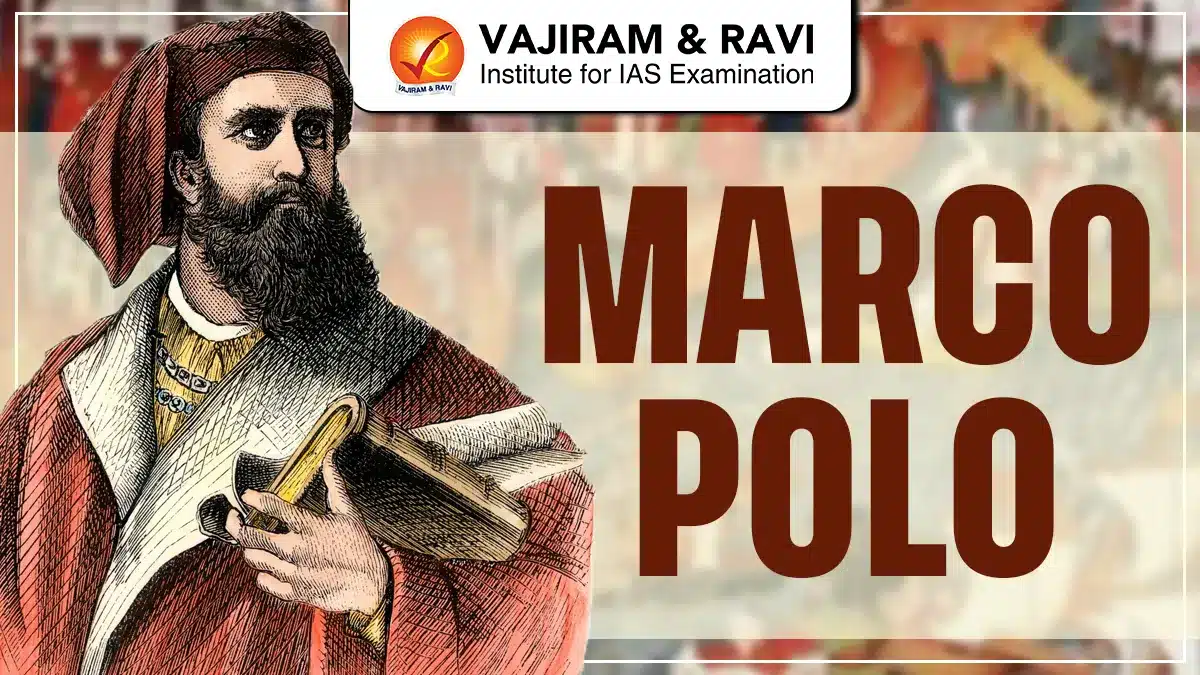
Marco Polo was one of the most important European travelers of the medieval world. Born in Venice around 1254 CE, he journeyed across Asia along the Silk Road between 1271 and 1295 CE. His travels opened a new window for Europe to understand Asia, especially the Mongol Empire, China, India and Southeast Asia. At a time when Asia was largely unknown to Europeans, Marco Polo provided detailed descriptions of geography, administration, economy, culture and customs. His experiences were recorded in The Travels of Marco Polo, which became a landmark work in world history.
Marco Polo Biography
Marco Polo was born around 1254 in Venice to a merchant family deeply involved in long distance Asian trade networks. His father Niccolò Polo and uncle Maffeo Polo were experienced traders who had already travelled across Asia and met the Mongol ruler Kublai Khan before Marco joined them. In 1271, at about seventeen years of age, Marco travelled with them along the Silk Road to China. He spent nearly seventeen years in the Mongol Empire under the Yuan dynasty, serving as a trusted emissary of Kublai Khan. After returning to Venice in 1295, he was captured during a war with Genoa, where he narrated his experiences to Rustichello da Pisa. Marco Polo died in 1324, leaving behind a legacy that reshaped Europe’s understanding of Asia.
Marco Polo’s Book
Marco Polo’s book records his experiences across Asia and became Europe’s primary source of information about the Eastern world.
- Title and composition: Written around 1300, dictated to Rustichello da Pisa during Genoese imprisonment, using Franco-Italian literary language.
- Alternate names: Known as The Travels of Marco Polo, Book of the Marvels of the World and Il Milione.
- Purpose of the book: Served as a guide for merchants describing distances, trade routes, currencies and regional products.
- Geographical coverage: Describes China, India, Persia, Japan, Southeast Asia and the Mongol Empire.
- Unique contributions: First European record of paper money, porcelain, gunpowder and salt revenue systems.
- Historical impact: Influenced European cartography, including the Catalan Atlas and Fra Mauro Map.
- Cultural significance: Inspired explorers such as Christopher Columbus and later European travellers.
- Manuscript spread: Over 150 manuscript versions exist across Latin, French, Italian and other languages.
- Reliability: Many details verified later by Chinese records and archaeological evidence.
- Enduring value: Remains a cornerstone source for understanding medieval Asia through European eyes.
Marco Polo Expeditions
Marco Polo undertook one of the longest and most detailed journeys of the medieval world, spanning nearly 24 years across continents.
- Departure year: Began journey in 1271 with father and uncle from Venice.
- Route taken: Travelled via Acre, Persia, Hormuz, Central Asia and the Silk Road.
- Arrival in China: Reached Kublai Khan’s court at Shangdu between 1271-1275.
- Service under Kublai Khan: Appointed foreign emissary due to linguistic skills and administrative abilities.
- Diplomatic missions: Travelled across China, Myanmar, Vietnam, Indonesia and Sri Lanka.
- Duration in China: Lived within the Yuan Empire for about 17 years.
- Return journey: Left China in 1292 escorting Mongol princess Kököchin to Persia.
- Maritime route: Sailed through South China Sea, Sumatra, Indian Ocean and Arabian Sea.
- Journey risks: Out of 600 travellers, only 18 survived the dangerous sea voyage.
- Total distance: Covered approximately 15,000 miles before returning to Venice in 1295.
Marco Polo Visit to India
Marco Polo visited India during his return journey from China, offering rare European observations of medieval Indian society.
- Period of visit: Travelled to India between 1292 and 1294 CE.
- Entry point: Landed on the Coromandel Coast of southern India.
- Regions visited: Travelled through Tamil Nadu, Kerala and parts of southern India.
- Pandyan kingdom: Visited the prosperous Pandya territory near present day Thanjavur.
- Kakatiya rule: Travelled during the reign of Queen Rudramma Devi (1261-1295 CE).
- Trade focus: Observed thriving trade networks involving pearls, gems, textiles and spices.
- Horse imports: Noted large scale import of horses for South Indian rulers.
- Religious sites: Visited the tomb of St. Thomas near present day Chennai.
- Maritime trade: Documented India’s strong connections with China and Southeast Asia.
- Strategic importance: Recognised southern India as a key link in Indian Ocean trade.
Marco Polo Accounts of India
Marco Polo provided detailed descriptions of Indian society, economy, customs, religion and natural environment.
- Social customs: People sat on the ground to eat, using only the right hand for food.
- Travel safety: Reported that travelling with valuables at night was safe.
- Dietary habits: Rice was the staple grain, while meat consumption was limited in many communities.
- Alcohol consumption: Noted widespread use of beer and fermented beverages.
- Hygiene practices: Drinking vessels were personal and never shared.
- Chewing habits: Described chewing of betel leaves and tambur leaves mixed with spices and lime.
- Religious beliefs: Mentioned cow worship, astrology, omens and temple rituals.
- Status of women: He observed female rulers like Rudramma Devi, rare in medieval societies.
- Royal wealth: Described Pandyan rulers wearing immense quantities of gold, pearls and gemstones.
- Trade activities: Horse imports, pepper, indigo, incense and textiles were major economic goods.
- Economic prosperity: Identified South India as one of the richest regions globally.
- Natural diversity: Documented elephants, peacocks, parrots, lions and exotic flora, larger and richer than Europe.
- Agricultural products: Noted cultivation of pepper, indigo, incense and date wine.
- Religious sites: He visited the tomb of St. Thomas near modern Chennai, a shared pilgrimage center.
- Dress and climate: Light clothing was common due to hot climate conditions.
- Belief systems: Astrology and horoscope consultations influenced decisions and daily actions.
- Cultural values: Observed preference for dark skin and local beauty standards.
- Ascetic practices: Mentioned naked holy men following non violence.
- Urban organisation: Highlighted busy ports and well developed trade towns.
- Historical importance: Provides invaluable foreign perspective on 13th century India.
Marco Polo FAQs
Q1: Who was Marco Polo?
Ans: Marco Polo was a Venetian merchant and explorer who travelled across Asia in the 13th century and documented his experiences.
Q2: Why is Marco Polo famous?
Ans: He is famous for his book The Travels of Marco Polo, which gave Europeans detailed knowledge about Asia, China and India.
Q3: Which Asian ruler did Marco Polo serve?
Ans: Marco Polo served Kublai Khan, the Mongol ruler and founder of the Yuan Dynasty in China, as a foreign emissary.
Q4: When did Marco Polo visit India?
Ans: Marco Polo visited India between 1292 and 1294 CE during his return journey from China by sea.
Q5: What is the historical importance of Marco Polo’s accounts?
Ans: His writings provide valuable information on Asian geography, trade, culture, economy and societies of the 13th century.
