
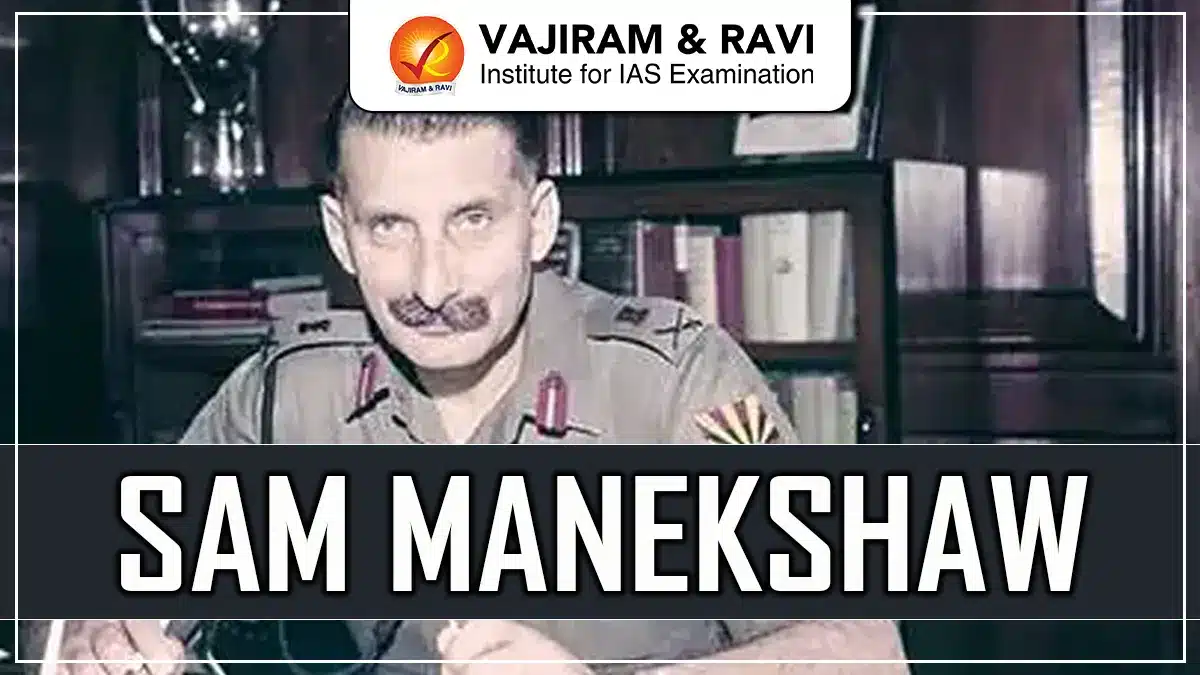
Field Marshal Sam Hormusji Framji Jamshedji Manekshaw, popularly known as Sam Bahadur, remains one of India’s most respected military leaders. He was born on 3 April 1914 and by serving the nation for nearly four decades, he shaped India’s military history through courage, clarity of command and strategic vision. As the Chief of the Army Staff during the 1971 conflict, he led India to a decisive victory that resulted in the creation of Bangladesh. He was also the first Indian Army officer to be elevated to the rank of Field Marshal, symbolising a lifetime of distinguished service.
Sam Manekshaw Biography
Sam Manekshaw was born in Amritsar to Parsi parents, Dr Hormusji Manekshaw and Hilla Mehta, who had migrated from Valsad in Gujarat. Educated at Sherwood College, Nainital and Hindu College, Amritsar, he initially aspired to study medicine in London. When that plan failed, he joined the first batch of the Indian Military Academy in 1932, graduating in 1935. Known for discipline, humour and intellectual sharpness, he developed leadership traits early. His personal values, multilingual skills and cultural openness shaped his long and effective military journey until his death on 27 June 2008 at the age of 94.
Sam Manekshaw Military Career
A four decade long military career defined by frontline bravery, staff excellence and top level command made Manekshaw a unique figure in Indian military history.
- Commission and Early Service: Commissioned in 1935, he initially served with the Royal Scots before joining the 4/12 Frontier Force Regiment in Burma, gaining operational exposure under British Indian Army structures.
- World War II Experience: During the Burma campaign of 1942, he displayed exceptional courage at the Battle of Pagoda Hill, sustaining severe injuries yet continuing command, earning the Military Cross for gallantry.
- Post War Staff Roles: After recovery, he attended the Staff College at Quetta and later served in key planning roles, including supervising the disarmament of over 10,000 Japanese prisoners without incident.
- Post Independence Transition: Following Partition in 1947, he chose the Indian Army over Pakistan and was reassigned to the 8th Gorkha Rifles, becoming deeply respected among Gorkha troops.
- Operational Planning Roles: He played a vital role during the Kashmir conflict and Hyderabad crisis, serving in the Military Operations Directorate, though he never commanded a battalion in combat post Independence.
- Senior Command Appointments: Rising to brigadier and major general, he commanded the 26th Infantry Division and later headed training institutions, modernising Indian Army manuals and doctrines.
- Political Trial and Vindication: In 1962, he faced a politically motivated treason inquiry, was exonerated fully, but missed active participation in the Sino-Indian War, a major career setback.
- Army Commander Roles: From 1963 onwards, he led Western and Eastern Commands, restoring morale and readiness and successfully managing insurgencies in Nagaland and Mizoram.
Battles Fought by Sam Manekshaw
Though not always in battlefield command, Manekshaw’s involvement shaped outcomes in several key military engagements.
- World War II Burma Campaign: At Pagoda Hill near the Sittang River, he led a counter attack against Japanese forces despite 30 percent casualties, altering local tactical balance.
- 1947-48 Kashmir Conflict: He conducted aerial reconnaissance with V P Menon and advised rapid troop deployment, influencing India’s timely military intervention in Jammu and Kashmir.
- Hyderabad Police Action: As a planner, he supported integration operations, ensuring minimal resistance and swift restoration of Indian authority over the princely state.
- Nathu La and Cho La Clashes 1967: As Eastern Army Commander, he endorsed firm military responses, resulting in India’s first clear tactical victory against Chinese forces post 1962.
- 1971 Indo-Pak War: As Chief of the Army Staff, he oversaw all land operations, leading to Pakistan’s decisive defeat in the eastern theatre.
Sam Manekshaw Role in 1971 Indo-Pak War
Manekshaw’s leadership during the 1971 conflict combined strategic patience, joint operations and psychological warfare to secure a historic victory.
- He advised delaying war until December 1971, citing monsoon floods, troop readiness and Chinese threat, ensuring optimal military preparedness.
- In response to Pakistan's Operation Searchlight, He assessed Pakistan’s crackdown in East Pakistan and prepared India for a decisive military response.
- Under his direction, about 75,000 Bangladeshi guerrillas were trained and armed in Mukti Bahini through Operation Jackpot, which weakened the Pakistani forces before formal hostilities began.
- He coordinated Army, Navy and Air Force operations under Operation Trident and Operation Python, ensuring air superiority, naval blockades and rapid ground advances across multiple fronts.
- Four Indian formations advanced simultaneously into East Pakistan, isolating Dhaka within 12 days and preventing organised Pakistani resistance.
- His radio messages to Pakistani troops emphasised inevitable defeat and honourable surrender, significantly lowering enemy morale.
- On 16 December 1971, 93,000 Pakistani soldiers surrendered at Dhaka, marking the largest capitulation since World War II and the birth of Bangladesh.
Sam Manekshaw Awards and Honours
Sam Manekshaw received some of India’s highest military and civilian honours for bravery, leadership and national service.
- Military Cross 1942: Awarded for gallantry at Pagoda Hill in Burma, recognising leadership under fire despite life threatening injuries.
- Padma Bhushan 1968: Conferred for effective handling of insurgencies in Nagaland and Mizoram while commanding Eastern Army.
- Padma Vibhushan 1972: Awarded for exceptional service during the 1971 war and his contribution to national security.
- Field Marshal Rank 1973: Promoted on 1 January 1973, becoming India’s first Field Marshal, a ceremonial yet historic five star rank.
- International Recognition: Honoured as an honorary General of the Nepalese Army and awarded Nepal’s Order of Tri Shakti Patta
Sam Manekshaw Quotes
Sam Manekshaw’s wit and clarity made his words as influential as his commands. Few of his major sayings and quotes are:
“Give me a man or a woman with common sense and who is not an idiot and I assure you can make a leader out of him or her.”
“If a man says he is not afraid of dying, he is either lying or is a Gurkha.”
“Professional knowledge has to be acquired the hard way. It is a continuous study and you never acquire it in today’s fast moving technological world that you are living in.”
“He who neither drinks, nor smokes, nor dances, he who preaches & even occasionally practices piety, temperance and celibacy, is generally a saint, or a mahatma or more likely a humbug, but he certainly won’t make a leader or for that matter, a good soldier.”
Sam Manekshaw FAQs
Q1: Why is Sam Manekshaw called Sam Bahadur?
Ans: He earned the nickname “Sam Bahadur” from Gurkha soldiers, reflecting bravery, affection and fearless leadership.
Q2: What was Sam Manekshaw’s role in the 1971 Indo-Pak war?
Ans: He served as Chief of the Army Staff and planned India’s overall military strategy leading to Pakistan’s surrender.
Q3: Which rank made Sam Manekshaw unique in Indian history?
Ans: He became India’s first Field Marshal in 1973.
Q4: How many Pakistani soldiers surrendered in 1971?
Ans: About 93,000 Pakistani troops surrendered at Dhaka on 16 December 1971.
Q5: What leadership quality defined Sam Manekshaw most?
Ans: Strategic clarity combined with moral courage and professional integrity.
