
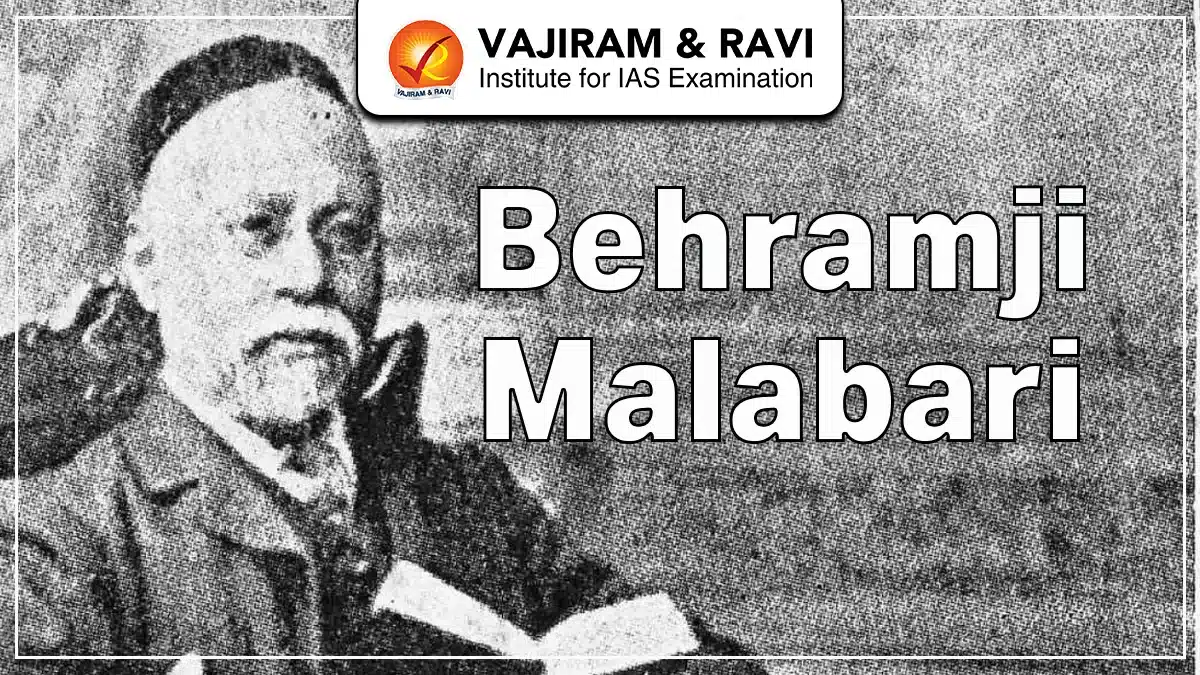
Behramji Merwanji Malabari was one of the most influential Indian social reformers, writers and public intellectuals of the late nineteenth century. He emerged as a powerful voice against deeply rooted social evils, especially child marriage and enforced widowhood during British Rule. Through journalism, poetry, public campaigns and international advocacy, Malabari connected Indian social reform debates with British liberal opinion, making women’s rights a central public issue. His work combined moral conviction, factual argument and sustained public engagement to challenge orthodox practices.
Behramji Malabari Biography
Behramji Malabari was born on 18 May 1853 in Baroda, present day Vadodara, Gujarat, into a Parsi family. His father, Dhanjibhai Mehta, worked as a clerk in the Baroda State administration and died when Behramji was only six or seven years old. After his father’s death, his mother Bhikhibai moved him to Surat, where he received early education at an Irish Presbyterian mission school, exposing him to Western education and liberal ideas.
He was later adopted by Merwanji Nanabhai Malabari, a businessman trading in sandalwood and spices from the Malabar Coast, from whom he derived the surname “Malabari.” He later shifted to Bombay, the administrative and commercial hub of western India, where his public life as a writer, editor and reformer fully developed. Malabari died on 12 July 1912 at Simla, leaving behind a lasting intellectual and social legacy.
Behramji Malabari Author Career
Behramji Malabari used literature and journalism as primary tools to influence public opinion and policy debates on Indian society and reforms. Through his writing, activism and institution building, he laid a strong intellectual and moral foundation for later social reform movements.
- Early Gujarati Poetry: He published a volume of Gujarati poems in 1875, reflecting social sensitivity, moral concerns and early reformist thinking shaped by both Indian tradition and Western liberal thought.
- English Literary Recognition: His book The Indian Muse in English Garb published in 1877 attracted attention in Britain from figures like Alfred Tennyson, Max Müller and Florence Nightingale, giving him international literary credibility.
- Satirical Social Writing: In 1882, he published Gujarat and the Gujaratis, a socially observant and mildly satirical work that analyzed customs, behavior and social attitudes and went through five editions.
- Journalistic Leadership: In 1880, he acquired and edited the English language daily Indian Spectator for nearly twenty years, shaping liberal Indian opinion on reform and governance.
- Collaborative Editorial Work: From 1883, he jointly edited Voice of India with Dadabhai Naoroji and William Wedderburn, linking Indian reform debates with British political circles.
- Later Editorial Contributions: In 1901, he became editor of the monthly East and West, holding the position until shortly before his death, continuing dialogue between Indian and Western reform thinkers.
- Travel and Reform Writing: His book The Indian Eye on English published in 1893 documented his three visits to England, analyzing British society through an Indian reformer’s perspective across four editions.
Behramji Malabari Social Reforms
Behramji Malabari’s reform work focused on women’s rights, legal protection for minors and challenging orthodox interpretations of religious customs.
- Campaign Against Child Marriage: In 1884, he published Notes on Infant Marriage and Enforced Widowhood and circulated it to nearly 4,000 influential Indians and Englishmen, strongly condemning early marriage.
- Advocacy on Widow Remarriage: He criticized the prohibition of widow remarriage, blaming rigid priestly interpretations and social monopolies for enforcing lifelong suffering on widowed women.
- Role in Public Debate: His writings triggered a nationwide debate lasting over seven years, making child marriage and widowhood central social issues discussed across newspapers and public platforms.
- Rukhmabai Case Intervention: In 1885, he actively wrote editorials on the Rukhmabai case, where a young woman was ordered by court to return to her husband, highlighting women’s lack of consent.
- Age of Consent Act Influence: His sustained agitation contributed significantly to the passage of the Age of Consent Act of 1891, which raised the legal age for sexual consent for girls in British India.
- British Public Mobilization: He uniquely mobilized British public opinion through reformist networks, influencing colonial lawmakers by presenting Indian social reform as a moral responsibility.
- Engagement with Scholars: He collaborated with Max Müller to translate the Hibbert Lectures into Gujarati, promoting reinterpretation of Hindu scriptures to counter orthodox misuse.
- Balanced Nationalism: Though not formally aligned with political organizations, he maintained close ties with leaders like Dadabhai Naoroji while keeping reform work independent of party politics.
Behramji Malabari's Seva Sadan
Seva Sadan represented Behramji Malabari’s practical commitment to social welfare beyond advocacy and legislation.
- In 1908, he co-founded Seva Sadan in Bombay with Diwan Dayaram Gidumal to support women abandoned or exploited by society.
- The institution focused on women who were deserted, widowed, or socially ostracized, providing them safety and dignity.
- Seva Sadan offered basic education and vocational training to help women become self reliant and economically independent.
- It provided access to healthcare and welfare services at a time when women’s medical needs were largely neglected.
- Unlike charity based models, Seva Sadan aimed at long term rehabilitation and social reintegration of women.
- It became a model for organized women centric social welfare institutions in early twentieth century India.
- The initiative reflected Malabari’s belief that social reform required both legal change and institutional support for affected individuals.
Behramji Malabari FAQs
Q1: Who was Behramji Malabari?
Ans: Behramji Malabari was an Indian social reformer, writer and journalist known for campaigning against child marriage and enforced widowhood.
Q2: When and where was Behramji Malabari born?
Ans: He was born on 18 May 1853 in Baroda, present-day Vadodara, Gujarat, during British rule in India.
Q3: Why is Behramji Malabari famous in Indian history?
Ans: He is famous for his major role in influencing the Age of Consent Act of 1891 and advocating women’s rights.
Q4: What was Behramji Malabari’s role in journalism?
Ans: He edited newspapers like Indian Spectator, Voice of India and East and West to promote social reform ideas.
Q5: What was Seva Sadan founded by Behramji Malabari?
Ans: Seva Sadan, founded in 1908, was an institution providing education, medical care and rehabilitation to destitute women.
