
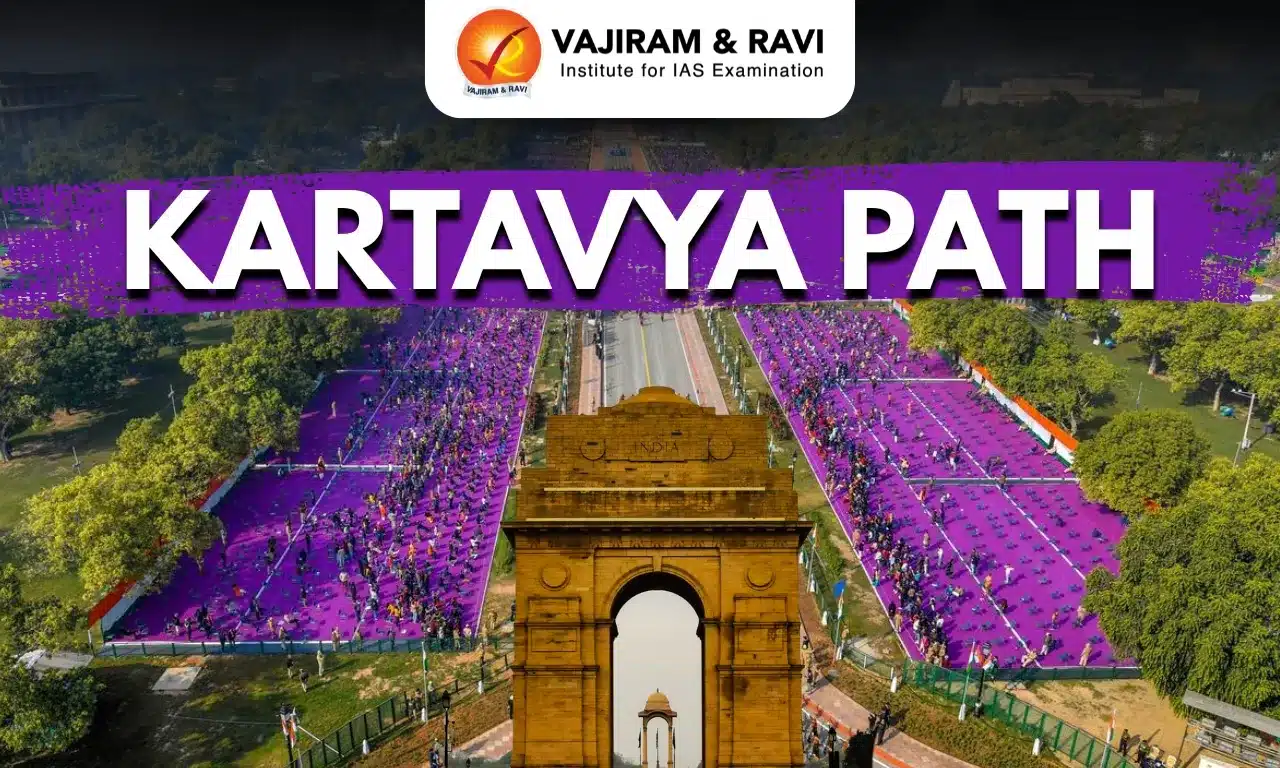
Kartavya Path is one of the most important national landmarks of India. It represents India’s journey from colonial rule to a confident and responsible democracy. Earlier known as Rajpath, it was renamed Kartavya Path in September 2022 to highlight the importance of duty in nation-building. It is located in the heart of New Delhi, Kartavya Path connects Rashtrapati Bhavan to India Gate and serves as the main ceremonial boulevard of the country.
Historical Evolution From Rajpath to Kartavya Path
Rajpath was originally built during British rule as a symbol of imperial power and authority, connecting the Viceroy’s House with India Gate. After independence, it became the venue for national celebrations like the Republic Day parade, reflecting India’s sovereignty but still carrying colonial symbolism
Colonial Period
- Rajpath was designed during British rule by architects Edwin Lutyens and Herbert Baker.
- It was originally called King’s Way, symbolizing British power and authority.
- The road was meant to showcase the grandeur of the British Empire.
- The capital of the Raj moved to New Delhi from Calcutta in 1911, and construction continued for several years thereafter.
- It connected the Viceroy’s House (now Rashtrapati Bhavan) to India Gate.
Post-Independence Period
- After independence in 1947, King’s Way was renamed Rajpath.
- Rajpath became the venue for:
- Republic Day Parade
- Beating Retreat Ceremony
- National celebrations
- Though India became independent, the colonial symbolism of power remained.
Transformation into Kartavya Path (2022)
- In 2022, Rajpath was renamed Kartavya Path, meaning “Path of Duty”.
- The renaming was part of the Central Vista Redevelopment Project.
- It marked a shift from colonial thinking to democratic responsibility.
- The focus changed from rulers to citizens and their duties.
Symbolism of ‘Kartavya’ (Duty) in Indian Governance
The idea of ‘Kartavya’ highlights the importance of duty, responsibility, and moral conduct in Indian governance. It reflects the belief that rights can be meaningful only when citizens and institutions perform their duties sincerely.
- The concept of Kartavya is deeply rooted in Indian philosophy and ancient texts like the Bhagavad Gita.
- It emphasizes performing one’s duty selflessly for the welfare of society.
- Reflected in Article 51A of the Indian Constitution, which lists Fundamental Duties of citizens.
- Encourages citizens to respect the Constitution, national symbols, and unity of the country.
- Highlights that governance is a shared responsibility of both the state and citizens.
- Promotes ethical leadership, accountability, and transparency in administration.
- Reinforces the idea that rights must be balanced with responsibilities.
- The naming of Kartavya Path symbolizes a shift from authority-based rule to duty-based democracy.
Kartavya Path and Central Vista Redevelopment Project
Kartavya Path is a key component of the Central Vista Redevelopment Project, which aims to modernize India’s administrative and ceremonial infrastructure while preserving its historical importance.
- The Central Vista Redevelopment Project was launched to redevelop the central administrative area of New Delhi, including Parliament, government buildings, and public spaces.
- Kartavya Path forms the central axis of this project, stretching from Rashtrapati Bhavan to India Gate.
- The redevelopment aimed to replace colonial-era infrastructure with modern, functional, and sustainable facilities.
- The project focuses on improving public accessibility, safety, and aesthetics of the area.
- Wide pedestrian pathways, green lawns, seating areas, and water features have been added to make it citizen-friendly.
- Underground utilities were developed to reduce visual clutter and improve maintenance.
- Eco-friendly measures such as energy-efficient lighting and better drainage systems were included.
- The redevelopment supports smooth conduct of national events like the Republic Day Parade.
Kartavya Path FAQs
Q1: What is Kartavya Path?
Ans: Kartavya Path is the ceremonial boulevard in New Delhi that stretches from Rashtrapati Bhavan to India Gate. It was earlier known as Rajpath and was renamed in 2022 to reflect the idea of duty-based governance.
Q2: When was Rajpath renamed as Kartavya Path?
Ans: Rajpath was officially renamed as Kartavya Path on 8 September 2022.
Q3: Why was Rajpath renamed Kartavya Path?
Ans: The renaming was done to remove colonial symbolism and promote the idea of duty (Kartavya) over authority.
Q4: What does the word ‘Kartavya’ mean?
Ans: ‘Kartavya’ means duty or responsibility. It signifies moral obligation, ethical conduct, and service to the nation.
Q5: Who designed the original Rajpath?
Ans: Rajpath was designed by British architects Edwin Lutyens and Herbert Baker during the British colonial period.
