
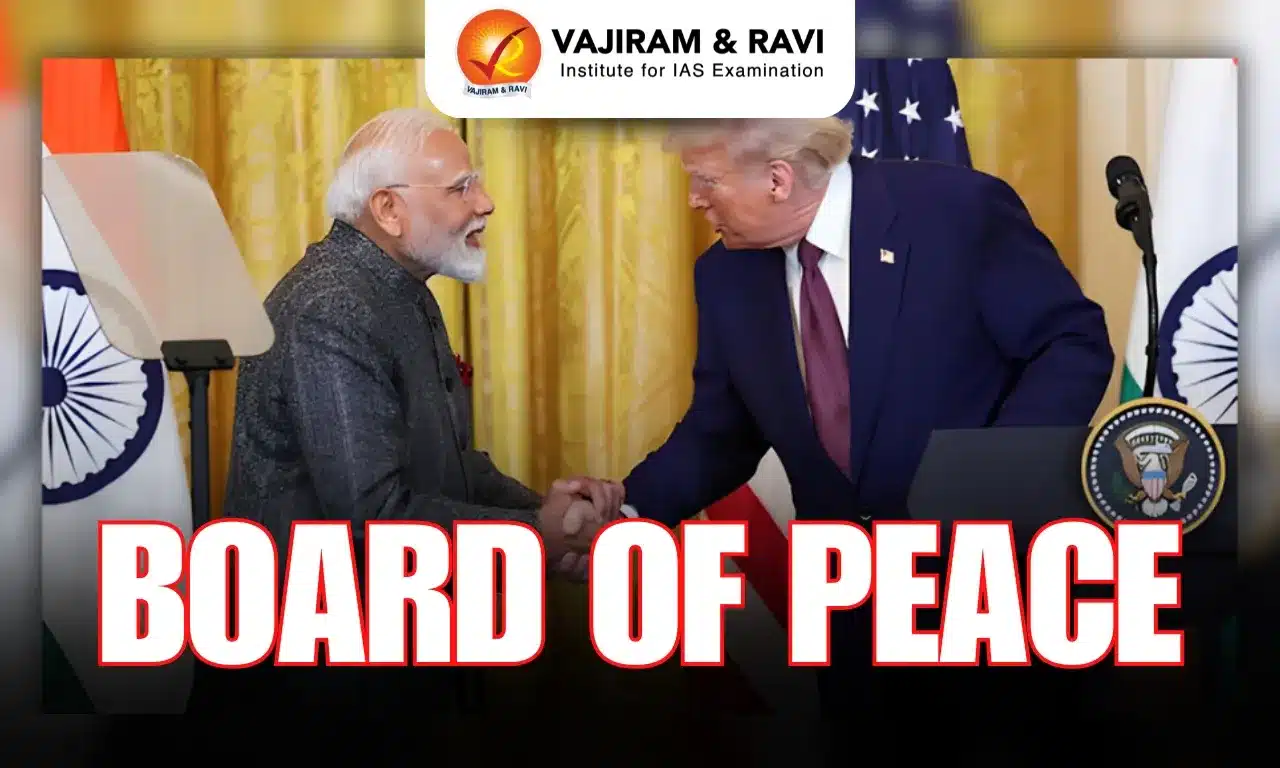
Board of Peace Latest News
- India has chosen to stay away, for now, from US President Donald Trump’s proposed Board of Peace, unveiled at Davos, opting for a cautious “wait and watch” approach despite an invitation to Prime Minister Narendra Modi.
About Trump’s Board of Peace
- The Board of Peace is a US-led intergovernmental body established by Donald Trump to manage global conflict resolution and post-war reconstruction.
- Origin and Purpose - Proposed in September 2025, the board was created to oversee “Phase Two” of the US-brokered ceasefire in Gaza following the 2023–2025 conflict.
- Immediate Mandate - Its primary role is to supervise the National Committee for the Administration of Gaza (NCAG) — a Palestinian technocratic authority — while managing Gaza’s reconstruction and the disarmament of Hamas.
- Leadership and Composition - Chaired by Donald Trump, the board includes prominent figures such as Jared Kushner, former UK Prime Minister Tony Blair, and US Secretary of State Marco Rubio.
- Countries that have accepted the invitation include: Argentina, Saudi Arabia, Israel, UAE, Egypt, Turkey, Qatar, Pakistan, Indonesia, Vietnam, among others.
- Notable absentees: Major European powers such as France, Germany, the UK and Italy. Permanent members of the UN Security Council — Russia, China, France and the UK.
India’s Immediate Response on Joining the Board of Peace
- India neither accepted nor declined the invitation at Davos.
- New Delhi is assessing strategic, political and diplomatic implications before taking a decision.
Why Trump’s Board of Peace Puts India in a Tight Spot
- An Exclusive, Pay-to-Enter Peace Club - Permanent membership reportedly requires a $1-billion contribution to a reconstruction fund, effectively turning peace-making into a pay-to-enter arrangement.
- Unclear Scope, Expanding Concerns: Uncertainty over the Board of Peace’s mandate deepens India’s unease.
- Though Gaza is the immediate focus, reports suggest the charter avoids explicit territorial limits, using broad phrases like “world peace,” raising fears of mission creep and expansion into other conflicts.
- Fragmented Peace-Making, Outside the UN - The board’s design risks selective and fragmented conflict resolution.
- Unlike the UN General Assembly or Security Council, it excludes many stakeholders, raising concerns about arbitrariness in conferring “peace” through a restricted forum.
- India’s Multilateral Principles at Stake - India has long defended multilateralism and the primacy of the United Nations, even while pushing for UN reform to reflect Global South realities.
- Joining a US-led body seen as bypassing the UN could undercut India’s credibility on this front.
- The Cost of Staying Out - Avoiding the Board of Peace is not risk-free. India seeks a seat where global security, conflict resolution, and reconstruction are discussed.
- Opting out could mean ceding strategic space and appearing passive as new power structures take shape.
- The Palestine–Israel Balancing Act - India has consistently supported a two-state solution and Palestinian rights while strengthening strategic ties with Israel.
- Joining a West-centric, Trump-driven Gaza platform risks upsetting this delicate balance and complicating India’s Global South positioning.
- Sharing the Platform With Pakistan - Pakistan’s reported invitation creates a fresh dilemma.
- Sharing a high-profile forum with Islamabad could trigger domestic backlash, particularly as India maintains a firm stance against engaging with sponsors of terror.
- At the same time, India fears that staying out could exclude it from future deliberations affecting India–Pakistan crises.
- Security and Military Red Lines - Reports that Pakistan may offer troops for a Gaza stabilisation force further complicate matters. India has ruled out participation in non-UN military missions, reinforcing its preference for UN legitimacy.
A High-Stakes Strategic Choice
- India is unlikely to ignore the platform entirely, yet joining carries reputational and political risks.
- The challenge lies in balancing engagement with caution—protecting India’s multilateral principles, domestic politics, and global credibility in a Trump-led forum.
Board of Peace FAQs
Q1: What is Trump’s Board of Peace?
Ans: The Board of Peace is a US-led intergovernmental body created to manage conflict resolution and reconstruction, starting with Gaza after the Israel-Hamas war.
Q2: Why is India cautious about the Board of Peace?
Ans: India is concerned about the Board of Peace bypassing the UN, unclear mandate, pay-to-enter structure, and implications for multilateral credibility.
Q3: How does the Board of Peace differ from the UN?
Ans: Unlike the UN, the Board of Peace is selective, contribution-based and lacks universal participation, raising concerns over legitimacy and inclusiveness.
Q4: Why is Pakistan’s presence in the Board of Peace sensitive for India?
Ans: Pakistan’s inclusion could force India to share diplomatic space despite no-talks policy, while staying out risks exclusion from future security discussions.
Q5: What is India’s likely approach to the Board of Peace?
Ans: India is expected to balance engagement with caution, prioritising UN-based multilateralism while avoiding isolation from emerging global security platforms.
