
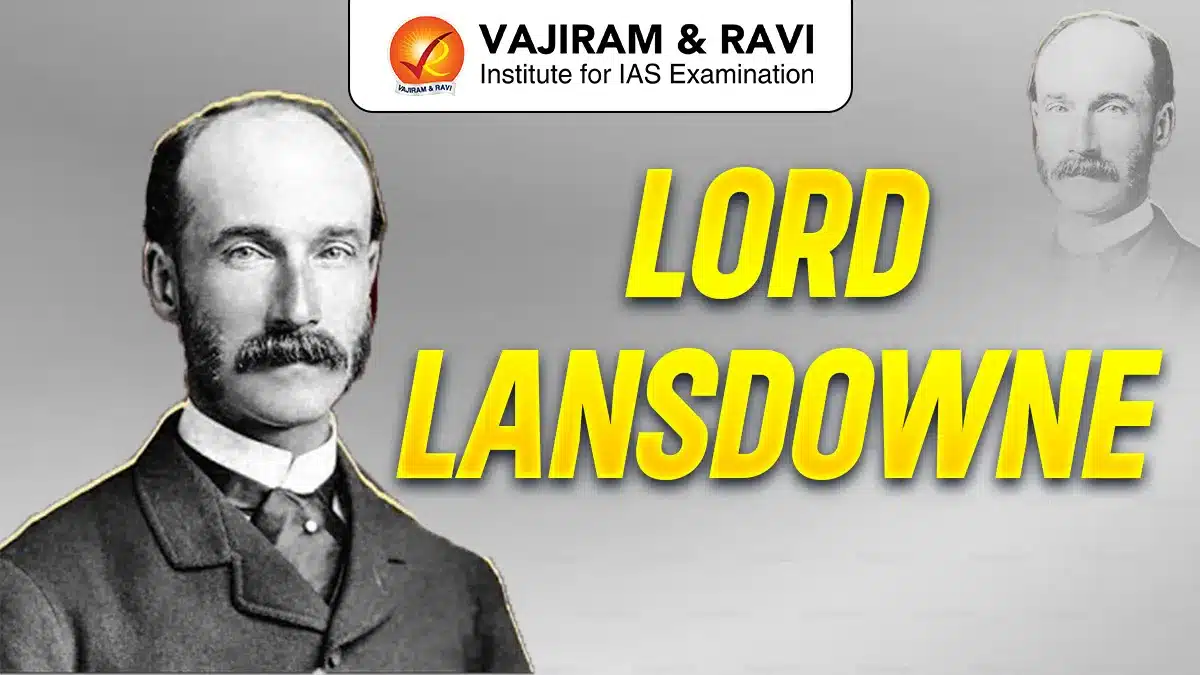
Lord Lansdowne, formally Henry Charles Keith Petty-Fitzmaurice, 5th Marquess of Lansdowne, was a prominent British statesman who served the British Empire at its administrative peak. He held some of the highest offices including Governor General of Canada, Viceroy of India, Secretary of State for War and Secretary of State for Foreign Affairs. Lansdowne was the 9th Viceroy of India from December 1888 to October 1894 under Queen Victoria.
Lord Lansdowne Biography
Lord Lansdowne was born on 14 January 1845 into a wealthy aristocratic family and inherited immense political influence and financial resources. Before arrival in India, he served as Governor General of Canada and later became a senior leader of the Conservative Party in Britain. His appointment as Viceroy of India in 1888 by Prime Minister Robert Gascoyne-Cecil placed him at the center of British India’s governance during a relatively stable but politically sensitive phase. Lansdowne left India in October 1894 and later served as Secretary of State for War from 1895 to 1900.During World War I, he authored the Lansdowne Letter advocating a negotiated peace, though it was politically rejected.
Lord Lansdowne Contributions
Lord Lansdowne inherited financial stress from his predecessor which limited the scale of political and economic reforms. The major works during his tenure were:
- Indian Factory Act 1891: The act raised the minimum working age of children from 7 to 9 years and reduced daily working hours for children to 7 hours, marking early labor regulation.
- The Act limited women’s work to 11 hours per day with mandatory rest intervals, introducing gender based labor safeguards in Indian industries.
- British owned tea and coffee plantations were excluded from labor protections, allowing continued exploitation through penal contract laws enforced by colonial authorities.
- Categorization of Civil Services: On Aitchison Commission Recommendations, civil services were divided into Imperial, Provincial and Subordinate services, restructuring colonial administration in 1891.
- Provincial and Subordinate Services were recruited within India, increasing Indian entry into lower administrative ranks despite higher services remaining England based.
- He faced opposition from the Indian Civil Service, which he criticized for lacking empathy toward Indians under its administration.
- Indian Councils Act 1892: The act expanded central and provincial legislative councils and allowed members to ask questions, introducing indirect elections via institutions like municipalities and universities.
- Although limited, the 1892 Act laid the structural base for future parliamentary development and gradual Indian political participation.
- Recognition of Indian National Congress: In an official circular, Lansdowne accepted Congress activities as a natural outcome of British rule, legitimizing early Indian nationalism.
- Military Infrastructure Expansion: Strategic military infrastructure was strengthened to secure British interests, especially along vulnerable frontier regions.
- Strong cantonments were developed at Rawalpindi, Peshawar and Attock to secure the Indus and Khyber regions.
- Age of Consent Act 1891: The law raised the age of consent for girls from 10 to 12 years, amending IPC Section 375 and criminalizing violations as rape across British India.
- Opium Commission 1893: A royal commission examined opium use in India and concluded against prohibition, leading to the continuation of opium trade policies.
- Administrative Reforms: Lansdowne worked to reform the army, police, mint and local government systems, strengthening fiscal and institutional efficiency.
- Economic Reforms: During his tenure the value of silver was decreasing, to overcome the challenges he increased the taxes which adversely affected India.
Events during Lord Lansdowne Tenure
The tenure of Lord Lansdowne was marked by frontier conflicts, legislative experiments and administrative challenges. The significant events occurred during him were:
- Anglo-Manipur War 1891: A short conflict from March to April 1891 ended in British victory and execution of Tikendrajit. Despite conquest, Manipur was not annexed but governed as a princely state until 1947, reflecting indirect rule strategy.
- Frontier Security Policy: Lansdowne adopted an active north-west frontier strategy to counter Russian influence, reinforcing British military preparedness.
- Durand Commission 1893: A mission led by Sir Mortimer Durand fixed the Durand Line with Afghanistan, defining India’s north-west boundary for strategic defense.
- Jury Reforms 1893: Lansdowne sought to limit trial by jury in India, but the proposal was overruled by the British home government.
- Communal Tensions: Some policies indirectly intensified Hindu-Muslim tensions, reflecting limits of colonial governance in managing social diversity.
Lansdowne Town: The hill station of Lansdowne in present day Uttarakhand was established in 1887 and named in his honor.
Lord Lansdowne FAQs
Q1: Who was Lord Lansdowne?
Ans: Lord Lansdowne was a British statesman who served as the Viceroy of India from 1888 to 1894 under Queen Victoria.
Q2: Which major laws were passed during Lord Lansdowne’s tenure?
Ans: Important laws passed during the tenure of Lord Lansdowne included the Indian Factory Act 1891, the Age of Consent Act 1891, and the Indian Councils Act 1892.
Q3: What was the Anglo-Manipur War of 1891?
Ans: It was a short conflict between British forces led by Viceroy Lord Lansdowne and Manipur rulers that ended in British victory and Manipur becoming a princely state.
Q4: What was the Durand Commission of 1893 established during Lord Lansdowne?
Ans: The Durand Commission fixed the Durand Line between British India and Afghanistan to secure the north-west frontier.
Q5: What role did Lord Lansdowne play in Civil Service reforms in India?
Ans: He implemented the Aitchison Commission recommendations, dividing civil services into Imperial, Provincial and Subordinate categories.
