
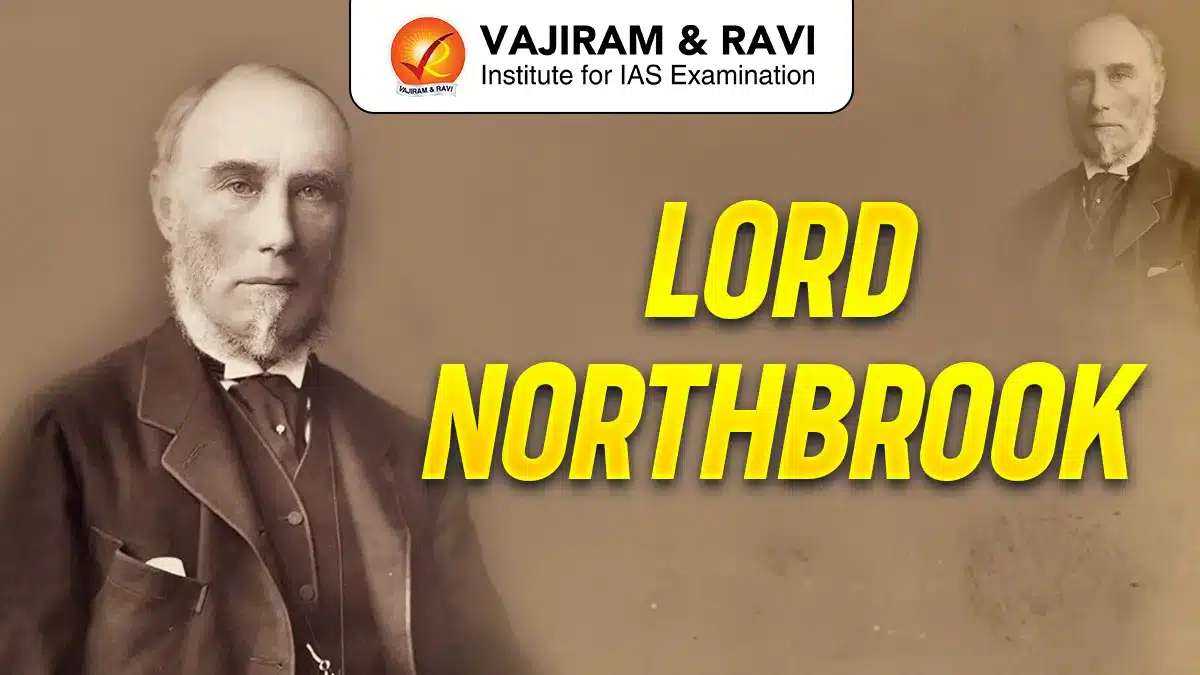
Lord Northbrook, formally known as Thomas George Baring, 1st Earl of Northbrook, was a prominent British Liberal statesman who served as the Viceroy of India from 1872 to 1876 during the British Raj. Appointed by Prime Minister William Ewart Gladstone after the assassination of Lord Mayo, his tenure focused on administrative efficiency, tax reduction, famine relief and social stability. He is remembered for handling major political, social and economic challenges in India with a reform oriented and pragmatic approach rooted in liberal governance principles.
Lord Northbrook Biography
Thomas George Baring was born on 22 January 1826 in London to Francis Baring, 1st Baron Northbrook and Jane Grey, daughter of Sir George Grey, 1st Baronet. He was educated at Twyford School and later at Christ Church, Oxford, graduating with honours in 1846. Before becoming Viceroy, he held several key administrative posts in Britain, including Under-Secretary of State for India and War. Northbrook served as Viceroy of India from 1872 to 1876 and eventually became First Lord of the Admiralty from 1880 to 1885. Later in November 1904 he died at his home in Hampshire.
Lord Northbrook Contributions
Lord Northbrook’s work as Viceroy reflected his belief in fiscal prudence, administrative reform and social moderation as highlighted below:
- Tax Reduction Policy: Lord Northbrook reduced land revenue demands and lightened taxation to ease peasant distress, reflecting his belief that excessive revenue extraction intensified rural poverty and social unrest.
- Abolition of Income Tax: He repealed the unpopular income tax introduced during Lord Canning’s period, responding to widespread opposition from Indian society and reducing administrative friction between the government and taxpayers.
- Famine Relief Administration: During the Bihar famine of 1873-74, he sanctioned large scale relief operations coordinated by the Bengal government, ensuring food supply and employment, resulting in almost zero recorded famine deaths.
- Infrastructure Development: He approved relief-related infrastructure projects such as the Sone Canal and North Bengal Railway, combining famine mitigation with long-term agricultural and transport development.
- Free Trade Measures: A strong supporter of free trade, Northbrook abolished most export duties and reduced import duties to promote commercial activity and stabilize prices in Indian markets.
- Administrative Simplification: He reduced bureaucratic hurdles within the colonial administration, speeding up decision-making and improving coordination between provincial and central governments.
- Legal Recognition of Marriages: His tenure supported progressive social measures such as permitting inter-caste marriages, recognition of Civil and Arya Samaj Marriages and the Native Marriage Act of 1872.
- Administrative Stability: Despite disagreements with the Secretary of State for India, Lord Salisbury, Northbrook maintained administrative balance until resigning in 1876 over Afghan policy differences.
Events during Lord Northbrook
Lord Northbrook’s tenure witnessed several major political, social and ceremonial events that significantly influenced British imperial policy and Indian society.
- Deposition of Gaikwad of Baroda (1875): Malhar Rao Gaekwad was deposed after allegations of misrule and the mysterious death of the British Resident, demonstrating British use of paramount power to punish princely misconduct. Following deposition, Malhar Rao was exiled to Madras under orders from Lord Salisbury, later dying in obscurity in 1882, marking firm imperial control over princely states.
- Visit of the Prince of Wales (1876): Queen Victoria’s eldest son Albert Edward toured India to reinforce loyalty among Indian Princes, visiting Bombay, Madras, Ceylon and Calcutta with a large royal entourage. Indian Princes presented jewels, artworks, weapons, animals and textiles, filling an entire ship, while the Prince gifted translated copies of the Rig Veda by Max Müller.
- Kuka Movement: The Namdhari or Kuka movement, founded by Balak Singh and later led by Baba Ram Singh, emphasized chanting God’s name and rejecting ritualism, blending religious reform with social protest.
- Under Baba Ram Singh, the movement adopted a militant stance against cow slaughter, opposing both Muslims and British policies permitting slaughter.
- Kukas attacked Muslim communities after the Maghi festival, leading to harsh reprisals where 50 followers were executed without trial and 17 more the following day.
- Accused of instigating violence, Baba Ram Singh was transported to Rangoon, where he died in 1885, effectively ending the organized Kuka resistance.
- Mainstream Sikh communities largely distanced themselves from the Kukas and remained loyal to British authority during the unrest.
- Bihar Famine (1873-74): A severe drought caused food shortages, but unprecedented relief measures prevented mass mortality, making it a rare famine without large-scale deaths. The success of Bihar famine relief contrasted sharply with the Great Famine of 1876-78 under Lord Lytton, which killed approximately ten million people across southern India.
- Indian Meteorological Department: On 15 January 1875, the Indian Meteorological Department was established in Kolkata, strengthening scientific weather observation crucial for agriculture and famine preparedness.
- Resignation: After resigning, he was elevated as Earl of Northbrook in 1876, marking recognition of his service despite political disagreements.
Lord Northbrook FAQs
Q1: What is Lord Northbrook best known for?
Ans: Lord Northbrook is best known for effective famine relief, tax reduction, administrative reforms, and handling major political events during his viceroyalty.
Q2: What were the acts implemented by Lord Northbrook?
Ans: The major acts implemented during the tenure of Lord Northbrook were: Dramatic Performances Act of 1876 and Native Marriage Act of 1872.
Q3: Which canal was started by Lord Northbrook?
Ans: The Sone Canal project was sanctioned during Lord Northbrook’s tenure as a famine relief and irrigation measure in Bihar.
Q4: When did Lord Northbrook serve as Viceroy of India?
Ans: He served as Viceroy of India from 1872 to 1876, appointed by Prime Minister William Ewart Gladstone after Lord Mayo’s assassination.
Q5: Which major events occurred during Lord Northbrook’s tenure?
Ans: Key events included the deposition of the Gaikwad of Baroda, the Kuka Movement, the Bihar Famine of 1873-74 and the visit of the Prince of Wales.
