
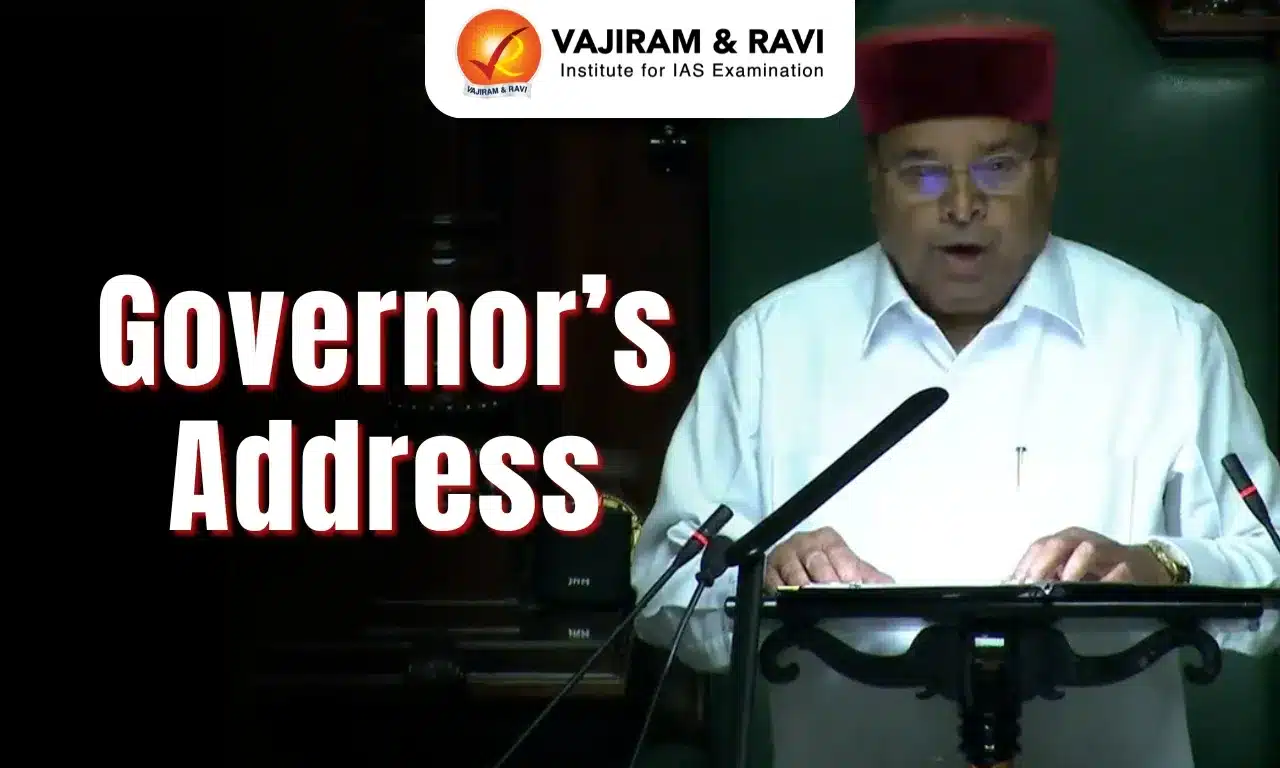
Governor’s Address Latest News
- Recent walkouts by Governors during inaugural sessions of State Legislative Assemblies in Opposition-ruled States like Karnataka, Tamil Nadu and Kerala have triggered a constitutional debate.
- These incidents relate to the Governor’s refusal to read or complete the customary address under Article 176(1), prompting concerns over the erosion of constitutional conventions and federal balance.
- The Karnataka government is reportedly considering approaching the Supreme Court (SC) for a judicial declaration on the issue, which is required to touch upon key constitutional principles of -
- Parliamentary democracy,
- Collective responsibility of the Cabinet,
- Federalism,
- Constitutional morality, and
- Limited discretion of constitutional authorities.
Constitutional Position of the Governor
- Article 176(1):
- It mandates that the Governor “shall” address the Legislative Assembly (or both Houses where a Legislative Council exists) at the beginning of the first session every year.
- The address reflects the policies and programmes of the elected State Cabinet, not the personal views of the Governor.
- The Governor acts indirectly as a communicator to the people, through their elected representatives.
- Aid and advice of the Council of Ministers:
- A Council of Ministers, led by the Chief Minister, must aid and advise the Governor in performing their functions, except where the Constitution requires the Governor to act in their discretion (Article 163).
- Selective reading, skipping paragraphs, or walking out amounts to constitutional impropriety.
Constituent Assembly Debates - Ambedkar’s Vision
- The Governor has no independent functions.
- He is a constitutional head, not a political actor.
- He represents the people of the State as a whole, not any party or ideology.
Judicial Interpretation and Key SC Judgements
- Shamsher Singh vs State of Punjab (1974) – Seven-Judge Bench:
- Governors cannot take public stances critical of Cabinet policy. Any such conduct is an “unconstitutional faux pas”.
- Even the limited discretion is not personal, but effectively “remote-controlled” by the Union Council of Ministers, which is accountable to Parliament.
- Nabam Rebia vs Deputy Speaker (2016) – Five-Judge Constitution Bench:
- The Constitution explicitly defines areas of limited gubernatorial discretion, such as appointment of Chief Minister, dissolution of the House, Governor’s report under Article 356, and granting or withholding assent to Bills.
- Addressing the House under Articles 175(1) and 176(1) is an executive function, not a discretionary one.
- Tamil Nadu Governor case:
- The Supreme Court held that discretionary powers cannot be exercised to negate the authority of an elected government.
- A subsequent Presidential Reference described the Governor as a “guide, philosopher and friend”, not an adversary.
Challenges Highlighted and Way Ahead
- Politicisation of the Governor’s office: Centre–State friction especially in Opposition-ruled States.
- Reinforcing constitutional morality - Governors must act as neutral constitutional heads, not political actors.
- Erosion of constitutional conventions: Codification of conventions - development of binding guidelines for gubernatorial conduct, possibly through an Inter-State Council or SC jurisprudence.
- Risk of turning the Governor into a parallel power centre: Judicial clarification - a clear SC declaration on the mandatory and non-discretionary nature of Article 176(1).
- Undermining the authority of elected State governments: Strengthening federalism - Respect for State autonomy and Cabinet supremacy in policy matters.
Conclusion
- The recent gubernatorial walkouts mark a troubling departure from India’s parliamentary and federal ethos.
- The Constitution envisages the Governor as a constitutional sentinel, not a veto-wielding authority.
- Judicial precedents—from Shamsher Singh to Nabam Rebia—clearly establish that discretionary power is limited, defined, and non-personal.
- Upholding constitutional morality and democratic accountability is essential to prevent the Governor’s office from becoming, as the SC warned, a “reincarnation of colonial authority” inimical to responsible government.
Source: TH
Governor’s Address FAQs
Q1: What is the constitutional mandate of the Governor under Article 176(1)?
Ans: Article 176(1) mandates that the Governor shall address the State Legislature at the beginning of the first session each year.
Q2: Why is the Governor not permitted to exercise discretion while delivering the address to the Legislature?
Ans: Articles 175(1) and 176(1) entails that the Governor's executive function must be performed strictly on the aid and advice of the Council of Ministers.
Q3: What the SC said in the Shamsher Singh vs State of Punjab case (1974)?
Ans: The Court held that Governors cannot publicly oppose Cabinet policy.
Q4: What are the key areas where the Constitution allows limited discretion to the Governor as per Nabam Rebia (2016)?
Ans: Limited discretion exists in appointment of the CM, assent to Bills, dissolution of the House, Article 356 reports, and specific gubernatorial responsibilities.
Q5: Why are recent gubernatorial walkouts during Assembly addresses seen as a threat to parliamentary democracy?
Ans: They undermine Cabinet supremacy, violate constitutional conventions, and risk converting the Governor into a parallel political authority.
