
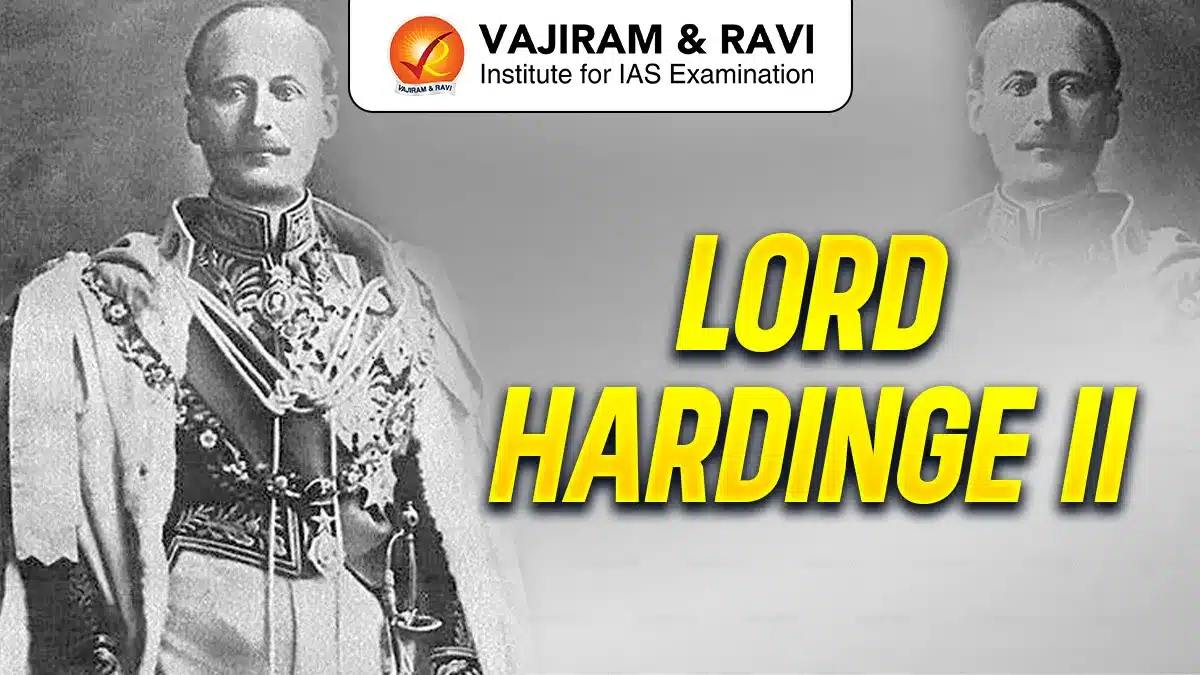
Lord Hardinge II, formally known as Charles Hardinge, 1st Baron Hardinge of Penshurst. He was one of the most significant British Viceroys of India in the early twentieth century. He served as Viceroy and Governor General of India from 1910 to 1916. This period was marked by major political, administrative and nationalist developments. His tenure witnessed historic decisions such as the annulment of the Partition of Bengal, the transfer of India’s capital from Calcutta to Delhi and India’s entry into the First World War, making his administration highly consequential.
Lord Hardinge II Biography
Lord Hardinge II was born on 20 June 1858 into an influential British aristocratic family with deep imperial connections. He was the second son of Charles Hardinge, 2nd Viscount Hardinge and the grandson of Henry Hardinge, a former Governor General of India. He was educated at Cheam School, Harrow School and Trinity College, Cambridge, he entered the British diplomatic service in 1880. He was appointed as the Viceroy and Governor General of India in 1910. In 1916, Hardinge returned to Britain as Permanent Under-Secretary for Foreign Affairs, later serving at the Paris Peace Conference and as Ambassador to France before retiring in 1922. He was attacked with a bomb in 1912 but survived all assassination attempts and later died peacefully on 2 August 1944.
Lord Hardinge II Contributions
Lord Hardinge II is famous for balancing imperial interests with cautious accommodation of Indian political opinion during a sensitive phase of colonial rule.
- Cancellation of Bengal Partition (1911): He officially reversed Lord Curzon’s 1905 Partition of Bengal, responding to sustained Indian protests such as Swadeshi Movement and unrest, thereby restoring Bengal as a single administrative unit and easing nationalist resentment.
- Transfer of Capital to Delhi (1911): Hardinge oversaw the historic decision to shift the capital from Calcutta to Delhi, reviving Delhi’s imperial significance and laying the foundation for New Delhi as a planned administrative city.
- Support to Morley-Minto Reforms: He implemented the constitutional reforms of 1909, which expanded legislative councils and introduced limited Indian representation, improving dialogue between the colonial state and Indian elites.
- Improved Nationalist Relations: Hardinge maintained comparatively cordial relations with Indian leaders, openly admiring Mahatma Gandhi’s moral approach and criticizing racial discrimination against Indians in South Africa.
- World War I Mobilisation: His policies enabled Britain to deploy nearly all European troops from India and over one million Indian soldiers abroad, significantly strengthening the British war effort between 1914 and 1918.
- Educational Initiatives: During his tenure, the BHU Act of 1915 was passed, enabling Pandit Madan Mohan Malviya to establish Banaras Hindu University, one of India’s most prominent educational institutions.
- Infrastructure Development: The Hardinge Railway Bridge over the Padma River, inaugurated in 1915, enhanced rail connectivity in eastern India and remains vital for regional transport even today.
Events during Lord Hardinge II Tenure
Lord Hardinge II’s tenure was marked by dramatic political events, revolutionary activity and global conflict, including a Bomb attack that nearly claimed his life.
- Delhi Durbar of 1911: The grand imperial assembly marked King George V and Queen Mary’s coronation, witnessed by nearly five lakh people, during which the annulment of Bengal’s partition and capital transfer to Delhi were proclaimed.
- Hardinge Bomb Case (1912): It was also known as Delhi Conspiracy Case and Delhi-Lahore Conspiracy Case. Revolutionary nationalists detonated a bomb at Chandni Chowk targeting the Viceroy; Hardinge survived with injuries, but his mahout was killed by the blast.
- Delhi-Lahore Conspiracy Trial: The assassination attempt was linked to Rash Behari Bose, with Basanta Kumar Biswas, Amir Chand and Avadh Behari convicted and executed, intensifying Revolutionary Underground Movements.
- Formation of Ghadar Party (1913): Lal Hardayal founded the Pacific Coast Hindustan Association in San Francisco, later known as the Ghadar Party, mobilising Indian immigrants in the US and Canada against British rule.
- Outbreak of World War I (1914): Following the war’s start on 28 June 1914, India automatically became belligerent, contributing men, money and material to Britain’s global military campaigns.
- Indian Army in Mesopotamia: Indian troops played a decisive, though initially mismanaged, role in the Mesopotamian campaign, reflecting India’s strategic importance to the British Empire.
- Return of Mahatma Gandhi (1915): Gandhi returned to India on 8 January 1915 and established Sabarmati Ashram, beginning a new phase in Indian politics that Hardinge’s administration largely tolerated.
- Establishment of Hindu Mahasabha (1915): Pandit Madan Mohan Malviya founded the Hindu Mahasabha, aiming to consolidate Hindu social and political interests during a period of rising communal awareness.
Opposition to Racial Laws Abroad: Hardinge publicly opposed the Union of South Africa’s Anti-Indian Legislations, earning goodwill among Indians for challenging racial discrimination within the Empire.
Lord Hardinge II FAQs
Q1: Who was Lord Hardinge II?
Ans: Lord Hardinge II, Charles Hardinge, was the Viceroy and Governor General of India from 1910 to 1916 and a senior British diplomat.
Q2: What were the significant events that happened during the tenure of Lord Hardinge II
Ans: He is famous for annulling the Partition of Bengal, shifting India’s capital from Calcutta to Delhi and managing India during the First World War.
Q3: What was the Delhi Conspiracy Case 1912 related to Lord Hardinge II?
Ans: It was a revolutionary Bomb attack in Delhi aimed at killing Lord Hardinge; he survived, but his elephant keeper was killed in the explosion.
Q4: What role did Lord Hardinge II play during World War I?
Ans: He facilitated large scale deployment of Indian and British troops from India, strengthening Britain’s global war effort after 1914.
Q5: Which major institutions were established during the tenure of Lord Hardinge II?
Ans: Banaras Hindu University was founded under the BHU Act of 1915 and major infrastructure like the Hardinge Railway Bridge was completed during his tenure.
