
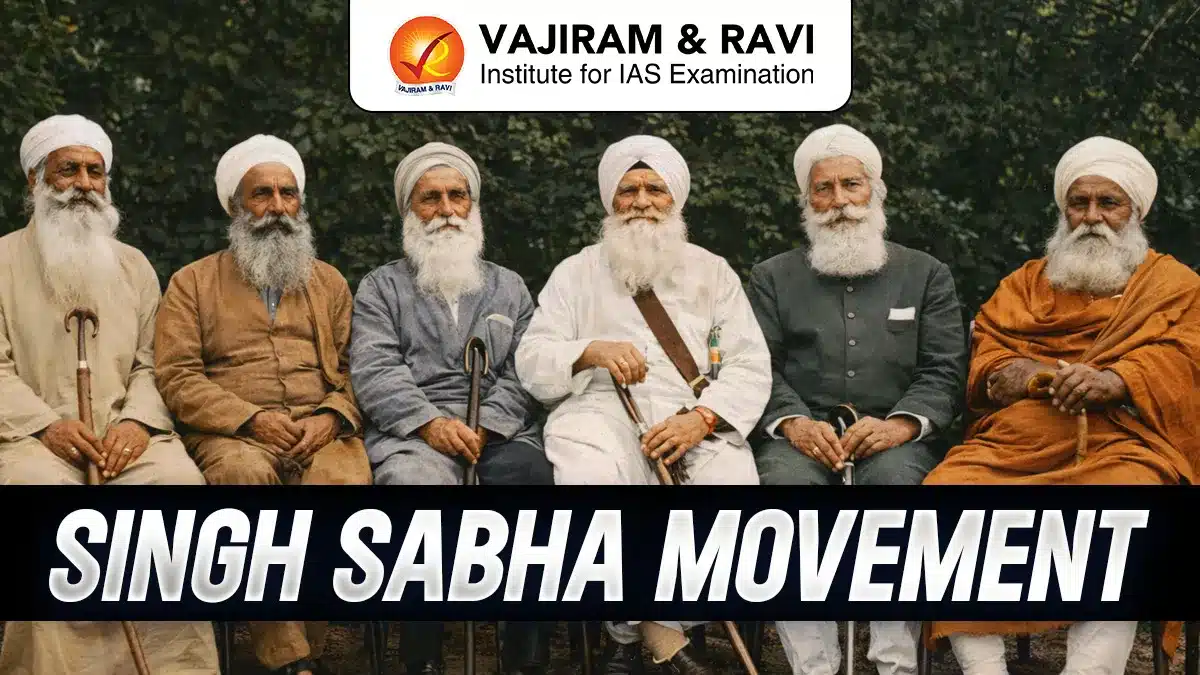
The Singh Sabha Movement was a collective effort to reform Sikh religious life, protect Sikh distinctiveness and modernize community institutions without political confrontation during the colonial period. It arose after the fall of the Sikh Empire in 1849, when Sikh institutions weakened, gurdwaras declined under mahant control and many Sikhs faced conversions due to Christian missions as well as Hindu and Muslim reform movements.
Singh Sabha Movement
The Singh Sabha Movement was founded in 1873 along with the establishment of the Amritsar Singh Sabha by a group of Sikh Socio-Religious Reformers. The movement aimed to revive the authentic Sikh beliefs, restore religious discipline and strengthen Sikh identity. It emphasized the authority of the Guru Granth Sahib, rejection of non-Sikh rituals and education through Punjabi language and Gurmukhi script. The first meeting of the movement was held on October 1st 1873, in Amritsar, near the Akal Takht, followed by the establishment of the Gurudwara Sri Guru Singh Sabha.
Read about: MeToo Movement
Singh Sabha Movement Organizations
Over time, the Singh Sabha Movement developed into organized bodies across Punjab and beyond which differed in ideology, social composition and interpretation of Sikh identity but shared reformist goals. The list of Singh Sabha Organizations is given below:
- Amritsar Singh Sabha: Founded in 1873, it was led mainly by elite Sikh families and descendants of Gurus, supporting Sanatan Sikh views, limited Khalsa initiation, caste influence and seeing Sikhism closely aligned with broader Hindu traditions.
- Lahore Singh Sabha: Established in 1879, it was dominated by educated middle class Sikhs and Tat Khalsa reformers, strongly advocating Sikhism as a distinct religion based on Guru Granth Sahib, Khalsa discipline, equality and rejection of Brahmanical practices.
- Tat Khalsa Group: Emerging within the Lahore Singh Sabha, it represented the most influential reformist wing, emphasizing monotheism, five Ks, Sikh identity markers, standardized rituals and removal of non-Sikh customs from gurdwaras.
- Provincial and Local Singh Sabhas: By the late nineteenth century, over 100 local Singh Sabhas existed across Punjab towns and villages, adapting reform goals locally while promoting education, preaching and Sikh social discipline.
- Panch Khalsa Diwan Bhasaur: Founded in 1893, it was a strict and militant reform group stressing compulsory Khalsa initiation, egalitarianism and aggressive removal of un-Sikh practices, though it later diverged from mainstream Singh Sabha leadership.
Singh Sabha Movement Historical Timeline
The Singh Sabha Movement developed through key phases between the 1870s and early twentieth century in the below detailed manner:
- Foundation Phase: The first Singh Sabha was founded at Amritsar in 1873, following Sikh youth conversions and rising missionary pressures, marking organized Sikh reform.
- Expansion Phase: Between 1879 and 1890, Lahore Singh Sabha and Tat Khalsa leadership expanded reform through print media, schools and ideological clarity.
- Consolidation Phase: By 1902, over 150 Singh Sabhas and Khalsa Diwans existed, unified partially under the Chief Khalsa Diwan for coordinated action.
- Transition Phase: Early twentieth century reforms influenced the Akali Movement, leading to legal control of gurdwaras and institutional self governance by Sikhs.
Read about: Non-Aligned Movement
Singh Sabha Movement Objectives
The objectives of the Singh Sabha Movement focused on religious purification, educational upliftment and preservation of Sikh identity in a competitive colonial religious environment as highlighted below:
- Religious Revival: To restore Sikh practices based strictly on Guru Granth Sahib, removing idol worship, caste rituals and Brahmanical customs from gurdwaras.
- Identity Protection: To clearly define Sikhism as a distinct religion, separate from Hindu and Muslim traditions, through doctrine, symbols and initiation practices.
- Educational Reform: To establish Sikh schools and colleges teaching Sikh history, ethics and Punjabi language using Gurmukhi script.
- Literary Development: To publish Sikh scriptures, histories and newspapers for mass awareness, including early Punjabi printing presses and journals.
- Social Discipline: To reform Sikh social life by encouraging Khalsa discipline, ethical conduct and community service without political agitation.
Singh Sabha Movement Reforms
The Singh Sabha Movement introduced wide ranging reforms that reshaped Sikh religious institutions and daily practices as listed below:
- Gurdwara Reforms: Singh Sabha reformers opposed mahant corruption, non-Sikh rituals and misuse of offerings, advocating clean worship spaces and community accountability.
- Scriptural Authority: The Guru Granth Sahib was reaffirmed as the sole spiritual authority, rejecting living gurus, astrology and priest dominated interpretations.
- Khalsa Revival: Emphasis was placed on Khande di Pahul initiation, five Ks and Sikh surnames Singh and Kaur as symbols of equality and discipline.
- Language Reform: Punjabi in Gurmukhi was promoted for education, worship and literature, countering Hindi, Urdu and Braj dominance in public life.
- Educational Institutions: Schools and Colleges runned by Sikhs, including Khalsa College Amritsar established in 1892, institutionalized modern and religious education together.
- Social Equality: Caste discrimination was actively opposed, reinforcing Sikh egalitarian ideals, especially under Tat Khalsa leadership and Lahore Singh Sabha influence.
Singh Sabha Movement Leaders
The Singh Sabha Movement was led by educated Sikh intellectuals, reformers and patrons including:
- Sardar Thakur Singh Sandhawalia: He was the Chairman of the Amritsar Singh Sabha and is widely considered as the co-founder of the Singh Sabha Movement along with other sikh reformers.
- Giani Gian Singh: He was appointed as the Secretary of the Singh Sabha at Amritsar.
- Khem Singh Bedi: Leader of Amritsar Singh Sabha, emphasizing Sanatan interpretations and elite leadership, though later overshadowed by Tat Khalsa reformers.
- Professor Gurmukh Singh: Founder of Lahore Singh Sabha, championed Sikh distinctiveness, egalitarianism and modern education rooted in Sikh principles.
- Giani Ditt Singh: Influential Tat Khalsa ideologue, writer and debater, who strongly defended Sikh identity against Arya Samaj polemics.
- Harsha Singh Arora: Early supporter of Lahore Singh Sabha, contributed to organizational development and intellectual articulation of Sikh reform.
- Kahn Singh Nabha: Scholar and author who clarified Sikh doctrine, history and identity through influential writings under Singh Sabha patronage.
- Teja Singh Bhasaur: Leader of Panch Khalsa Diwan Bhasaur, promoted strict Khalsa discipline and mass initiation among rural and lower caste Sikhs.
Read about: Ahrar Movement
Singh Sabha Movement Impacts
The Singh Sabha Movement produced long lasting religious, social and institutional impacts that reshaped Sikh society in modern times.
- Population Growth: Sikh population nearly doubled between 1901 and 1941 as Jats, OBCs and Dalits entered Sikh fold through organized outreach.
- Religious Standardization: Sikh rituals, life cycle ceremonies and codes of conduct were standardized, later codified in the Sikh Rehat Maryada.
- Institutional Strengthening: Singh Sabha reforms led to formation of Chief Khalsa Diwan, SGPC and Akali Movement, ensuring Sikh self governance.
- Educational Advancement: Widespread literacy, women’s education initiatives and Sikh controlled institutions created an educated Sikh middle class.
- Identity Consolidation: The movement firmly established Sikhism as a distinct religious tradition with clear doctrines, symbols and historical consciousness.
Singh Sabha Movement FAQs
Q1: What was the Singh Sabha Movement?
Ans: It was a Sikh reform movement started in the 1870s to revive Sikh religion, identity, education and institutions under British rule.
Q2: Why did the Singh Sabha Movement begin?
Ans: It began to counter religious conversions, decline of Sikh practices, mahant corruption and growing influence of Christian and Hindu reform movements.
Q3: Which Singh Sabha faction became most influential?
Ans: The Lahore Singh Sabha and Tat Khalsa faction became dominant due to mass support, education focus and clear Sikh identity vision.
Q4: How did the Singh Sabha Movement affect Sikh population?
Ans: It significantly increased Sikh numbers by reconverting and attracting Jats, OBCs and Dalits between 1901 and 1941.
Q5: What was the major outcome of the Singh Sabha Movement?
Ans: It laid the foundation for Sikh institutions like SGPC, Akali Movement, standardized Sikh practices and modern Sikh identity.
