
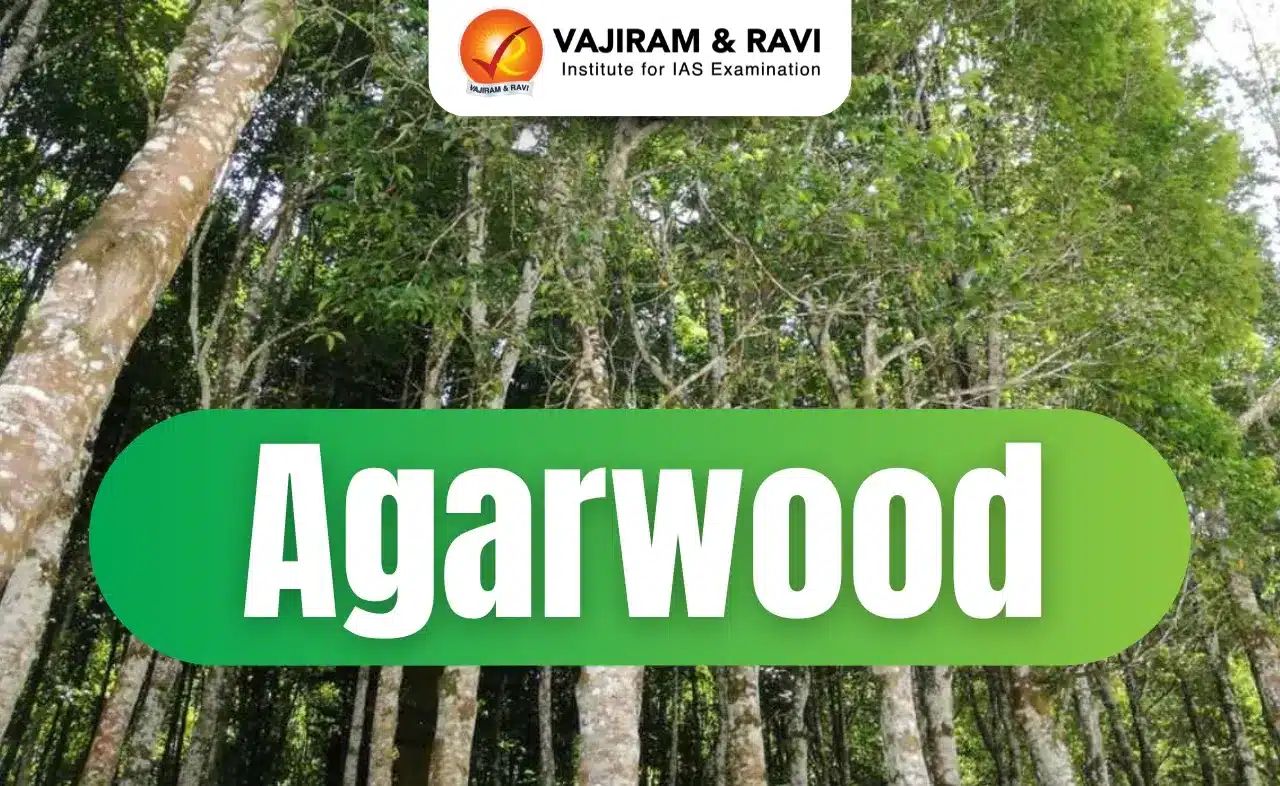
Agarwood Latest News
Recently, the union Minister for Development of North Eastern Region laid the foundation stone for the ₹80 crore Agarwood Value Chain Development Scheme.
About Agarwood
- Aquilaria malaccensis, commonly known as agarwood, is a species of tree belonging to the Thymelaeaceae family.
- It is also known as Oud, Gaharu or Agar is prized as the world’s most valuable incense.
- The resin is produced as a defence mechanism due to the intense stress suffered by the trees when they are infected by a type of mold belonging to the Phaeoacremonium species (Phialophora parasitica).
- The Aquilaria tree is a fast-growing, subtropical forest tree.
- Distribution: It is mainly found in South Asia’s Himalayan foothills, throughout Southeast Asia, and into the rainforests of Papua New Guinea.
- In India, it grows in the wild in the Northeast, especially in Assam, Tripura, Arunachal Pradesh, Nagaland, Mizoram and Manipur.
- Soil: Aquilaria can grow on a wide range of soils, including poor sandy soil.
- Applications of Agarwood: The resinous wood is used as incense, for medicinal purposes, and pure resin in distilled form is used as an essential oil as well as a perfume component.
Characteristics of Agarwood
- It grows at elevations from a few meters above sea level to about 1000 meters, with approx. 500 meters being most ideal.
- Seedlings require a great deal of shade and water but will grow rapidly, producing flowers and seeds as early as four years old.
- In the wild, it takes nearly a decade for a tree to mature.
Source: PIB
Agarwood FAQs
Q1: Agarwood is primarily found in which region?
Ans: Southeast Asia
Q2: What is the main use of Agarwood?
Ans: Perfume and incense

