
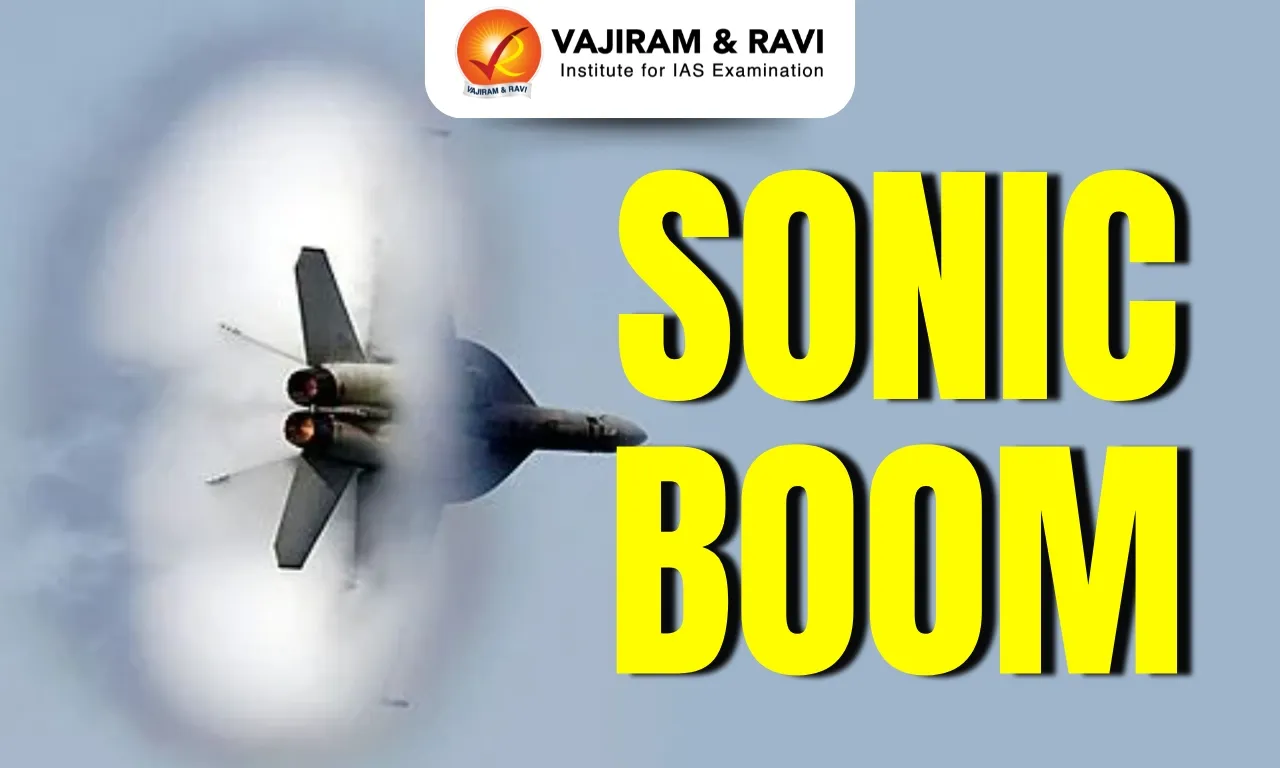
Sonic Boom Latest News
Researchers have used seismometers to detect the sonic booms created by debris from orbit falling back to the earth.
About Sonic Boom
- A sonic boom is a thunderous noise caused by an object, like an aircraft, moving faster than the speed of sound.
- How is it Formed?
- As the object zooms through the sky, the air molecules around it are pushed aside with tremendous force, generating shock waves along its flight path.
- The release of pressure, following the shock waves’ buildup, is heard as the sonic boom.
- Sonic booms create huge amounts of sound energy.
- The intensity of the sonic boom is determined not only by the distance between the craft and the ground but also by the size and shape of the aircraft, the types of maneuvers that it makes, and the atmospheric pressure, temperature, and winds.
- A larger and heavier aircraft must displace more air and create more lift to sustain flight, compared with small, light aircraft.
- Therefore, they will create sonic booms stronger and louder than those of smaller, lighter aircraft.
- The larger and heavier the aircraft, the stronger the shock waves will be.
- Generally, the higher the aircraft, the greater the distance the shock wave must travel, reducing the intensity of the sonic boom.
- If the aircraft is especially long, double sonic booms might be detected, one emanating from the leading edge of the plane and one from the trailing edge.
- Visible Effects:
- Sometimes, you can see a cloud or a cone shape around an aircraft making a sonic boom. This isn't the sound itself.
- It's water vapor in the air that suddenly cools down due to the pressure changes from the shock wave. This makes a temporary cloud.
- Sonic booms can shatter glass, but there is generally little risk for people on the ground.
Source: TH
Sonic Boom FAQs
Q1: What is a sonic boom?
Ans: A sonic boom is a thunderous noise produced when an object, such as an aircraft, travels faster than the speed of sound.
Q2: What causes the sound heard as a sonic boom?
Ans: The sound is caused by the sudden release of pressure following the buildup of shock waves.
Q3: Do sonic booms involve large amounts of sound energy?
Ans: Yes, sonic booms create huge amounts of sound energy.
Q4: Why do larger and heavier aircraft create stronger sonic booms?
Ans: Because they displace more air and generate greater lift, producing stronger shock waves.
Q5: How does altitude affect the intensity of a sonic boom?
Ans: Greater altitude reduces the intensity because the shock waves travel a longer distance before reaching the ground.

