Shaheed Diwas 2026, Background, Mahatma Gandhi Death Anniversary

Shaheed Diwas 2026

Shaheed Diwas 2026, also known nationally as Martyrs’ Day or Sarvodaya Diwas, is observed on 30 January to honour the supreme sacrifice of India’s martyrs, especially Mahatma Gandhi. This day commemorates the assassination of Gandhi in 1948 and serves as a reminder of the cost of freedom and the values of truth, non violence and national unity. Across India, citizens remember martyrs who laid down their lives for the nation’s independence, integrity and democratic ideals.

Shaheed Diwas 2026 Background

Shaheed Diwas is observed on 30 January due to Mahatma Gandhi’s assassination in 1948. The background of this day has been highlighted below:

  • The Government of India declared 30 January as Martyrs’ Day to honour Mahatma Gandhi’s martyrdom and acknowledge countless freedom fighters who sacrificed their lives for India’s independence and unity during colonial rule.
  • The observance began after 1948, when Gandhi’s assassination shocked the nation.
  • The day is also called Sarvodaya Day, reflecting Gandhi’s vision of upliftment of all sections of society, social justice and moral governance rooted in truth and non violence.
  • Shaheed Diwas institutionalised remembrance through state ceremonies, educational programs and public participation, ensuring intergenerational awareness of sacrifices behind India’s freedom and constitutional order.
  • While centred on Gandhi, the day honours all recognised martyrs, reinforcing the idea that freedom was achieved through collective sacrifice across regions, communities and ideologies.

Shaheed Diwas 2026 Observation

Shaheed Diwas 2026 is observed nationwide on 30 January through official ceremonies, silence, prayers and public tributes honouring India’s martyrs.

  • Two Minute Silence: At 11:00 AM, a two minute silence is observed across India, encouraging citizens to pause, reflect and pay collective respect to martyrs who sacrificed their lives for the nation.
  • National Ceremonies: The President, Vice President, Prime Minister, Defence Minister, Chief of Defence Staff and three Service Chiefs participate in official ceremonies, reflecting unified civil-military respect.
  • Bugle and Last Post: Armed forces personnel sound the Last Post using bugles, a traditional military honour signifying final respect to fallen soldiers and national martyrs.
  • Inter Services Tribute: The inter services contingent reverses arms during ceremonies, a symbolic military gesture representing mourning, humility and deep respect for supreme sacrifice.
  • All Religion Prayers: Multi faith prayer meetings are organised to reflect India’s pluralistic ethos and Gandhi’s belief in communal harmony and spiritual unity.
  • Educational Participation: Schools and institutions conduct assemblies, speeches, patriotic songs and poetry to instill historical awareness and civic values among students.
  • Community Service: Many organisations undertake cleanliness drives and social service activities inspired by Gandhian ideals of selfless service and national responsibility.

Mahatma Gandhi

Mahatma Gandhi was born on 2 October 1869 in Gujarat. He led India’s freedom struggle through non violence, civil disobedience and moral resistance. His principles of Ahimsa and Satyagraha shaped movements like the Salt March, Non Cooperation and Quit India. His teachings influenced global leaders such as Martin Luther King Jr. and Nelson Mandela. 

Mahatma Gandhi Death

Mahatma Gandhi was assassinated on 30 January 1948 in New Delhi, while walking to a prayer meeting.

  • Gandhi was shot by Nathuram Vinayak Godse at Birla House, now known as Gandhi Smriti, marking a tragic moment in independent India’s early history.
  • Nathuram Godse, born in 1910 in Pune, was associated with Hindu nationalist organisations and opposed Gandhi’s views on partition and communal reconciliation.
  • Godse was tried, convicted and executed in 1949, reaffirming the rule of law and constitutional justice in independent India.
  • Gandhi’s death triggered nationwide mourning, reinforcing commitment to peace, unity and democratic governance despite deep emotional loss.
  • International leaders and institutions paid tribute, recognising Gandhi as a universal symbol of peace and non violent resistance.

Shaheed Diwas 2026 Samadhi

Shaheed Diwas ceremonies are centred at Raj Ghat, Mahatma Gandhi’s samadhi, located on the banks of the Yamuna River in Delhi.

  • Raj Ghat is the cremation site of Mahatma Gandhi, featuring a simple black marble platform inscribed with his last words, “Hey Ram.”
  • It is situated along the Yamuna River, Raj Ghat reflects simplicity, serenity and ecological harmony, mirroring Gandhi’s austere lifestyle and ethical philosophy.
  • National leaders lay wreaths decorated with multi colour flowers, symbolising respect, gratitude and remembrance of Gandhi’s supreme sacrifice.
  • Interfaith prayers held at Raj Ghat emphasise peace, tolerance and unity, aligning with Gandhi’s lifelong advocacy for communal harmony.
  • Citizens from across India visit Raj Ghat on Shaheed Diwas to offer floral tributes, observe silence and reflect on Gandhian values.

Shaheed Diwas 2026 FAQs

Q1: What is Shaheed Diwas 2026?

Ans: Shaheed Diwas 2026 is observed on 30 January to honour Mahatma Gandhi and all martyrs who sacrificed their lives for India.

Q2: Why is 30 January observed as Shaheed Diwas?

Ans: Mahatma Gandhi was assassinated on January 30th in 1948, making it a national day of remembrance and tribute on the death anniversary of Gandhi.

Q3: Where is the main Shaheed Diwas 2026 ceremony held?

Ans: The main national ceremony is held at Raj Ghat in New Delhi, the samadhi of Mahatma Gandhi.

Q4: What is the significance of the two minute silence on Shaheed Diwas?

Ans: A two minute silence at 11 AM symbolises collective respect, reflection and remembrance of India’s martyrs.

Q5: Who participates in Shaheed Diwas 2026 national observances?

Ans: The President, Prime Minister, senior ministers, armed forces chiefs and citizens participate in Shaheed Diwas observances.

Mahatari Vandana Yojana, Eligibility, Benefits, State Level & Central Level

Mahatari Vandana Yojana

Women’s economic empowerment has become a key focus area for state governments to promote inclusive development and strengthen family welfare. In this context, the Chhattisgarh government has introduced a direct cash transfer scheme aimed at providing regular financial support to women, especially from economically vulnerable households.

Mahatari Vandana Yojana 

Mahatari Vandana Yojana is a monthly cash assistance scheme launched by the Chattisgarh government in March 2024. It has been envisioned to ensure economic empowerment of women, provide them financial security, promote gender equality and strengthen the decisive role of women in the family. Around 70 lakh women will benefit from the scheme.

Mahatari Vandana Yojana Eligibility

Any female resident of Chhattisgarh who is married and above 21 years of age as of January 1, 2024, is eligible for the benefits. These include widowed, divorced, and abandoned women.

Mahatari Vandana Yojana Benefits

  • Under the Mahatari Vandana Yojana, a monthly financial assistance of ₹1,000 is provided to eligible married women in Chattisgarh through Direct Benefit Transfer (DBT).
  • Under the scheme, women who are receiving less than ₹1,000 per month from other pension schemes will be eligible for additional funds to ensure a minimum monthly benefit of ₹1,000. 

Other Schemes for Women Empowerment at State Level 

Schemes for women empowerment at the state level are as follows:

Ladli Behna Yojana in Madhya Pradesh, Mahalakshmi Scheme in Telangana, Kanya Sumangala Yojana in Uttar Pradesh, Shakti Fund in Odisha etc 

Other Schemes for Women Empowerment at Central Level

Schemes for women empowerment at the central level are categorised into following : 

Economic & Financial Empowerment

  • PM Matru Vandana Yojana (PMMVY): Cash support for pregnant and lactating women - ₹5,000 in three installments for the first child and ₹6,000 for the second child if it is a girl. 
  • Mahila Samman Savings Certificate: Small savings scheme for women
  • Stand-Up India: Bank loans for women entrepreneurs

Education & Skill Development

  • Beti Bachao Beti Padhao: Aimed at addressing declining child sex ratio through awareness, education, and institutional support for the girl child.
  • Sukanya Samriddhi Yojana: Encourage savings for girl child’s education and marriage through long-term, high-interest savings.
  • Skill India (Women-focused programs): To increase employability and entrepreneurship among women by providing market-relevant skill training. 

Health & Nutrition

  • Janani Suraksha Yojana (JSY): Provide cash assistance ranging from ₹600 to ₹1,400 to encourage institutional deliveries, especially among poor and vulnerable women.
  • POSHAN Abhiyaan: To provide nutrition for women and children
  • Mission Indradhanush: Immunisation of mothers and children against tuberculosis, diphtheria, pertussis, tetanus, polio, measles, hepatitis-B, and Haemophilus influenzae type-B. 

Safety & Legal Support

  • One Stop Centre Scheme (Sakhi): Support for women facing violence
  • Women Helpline (181): A 24×7 toll-free emergency support service providing immediate assistance, counselling, rescue, and referral services to women facing violence, distress, or harassment.
  • Nirbhaya Fund: For Women safety infrastructure

Political & Social Empowerment

  • Reservation for Women in Panchayats: Political participation at grassroots

Women’s Reservation Bill (108th Constitutional Amendment): proposes 33% reservation in Lok Sabha and State Assemblies

Mahatari Vandana Yojana FAQs

Q1: What is Mahatari Vandana Yojana?

Ans: It is a monthly cash assistance scheme launched by the Chhattisgarh government in March 2024 to promote women’s economic empowerment, financial security, and gender equality.

Q2: Who is eligible for the scheme?

Ans: Married women aged 21 years and above as of 1 January 2024, including widows, divorced, and abandoned women who are residents of Chhattisgarh.

Q3: Which state government has launched the Mahtari Vandana Yojana?

Ans: Chattisgarh government has launched the Mahatari Vandana Yojana

Q4: How much assistance is given under the scheme?

Ans: ₹1,000 per month through Direct Benefit Transfer (DBT).

Q5: Are beneficiaries of other schemes eligible?

Ans: Yes. Women receiving less than ₹1,000 from other schemes get a top-up to reach ₹1,000.

Appropriation Bill, Provisions, Procedure, President’s Role

Appropriation Bill

The Appropriation Bill authorises the Government of India to withdraw money from the Consolidated Fund of India to meet expenditure for a financial year, as provided under Article 114 of the Constitution. It is introduced in the Lok Sabha after the Budget is discussed and Demands for Grants are approved, and its passage is essential for the functioning of the government. 

What is an Appropriation Bill?

An Appropriation Bill is a legislative proposal that authorizes the government to withdraw funds from the Consolidated Fund of India to meet its expenditure. It is introduced in the Lok Sabha after the annual budget is presented and approved. Without the passage of this bill, government departments cannot legally spend money, making it a critical tool for financial accountability.

Legal Provisions Governing the Appropriation Bill

The Appropriation Bill is governed primarily by Article 114 of the Indian Constitution, which states that no money can be withdrawn from the Consolidated Fund of India except under appropriation made by law. Key legal aspects include:

  • Article 114(3) of the Constitution mandates that no money can be withdrawn from the Consolidated Fund of India except under an appropriation made by law passed by Parliament.
  • Article 110 classifies the Appropriation Bill as a Money Bill, allowing its introduction only in the Lok Sabha and limiting the Rajya Sabha to making recommendations.
  • Article 116 provides for the Vote on Account, enabling the Lok Sabha to grant funds in advance when the Appropriation Bill is yet to be enacted.
  • The Speaker of the Lok Sabha has the final authority to decide whether a bill qualifies as a Money Bill, and this decision is binding on both Houses.

Procedure for Passing the Appropriation Bill

The Appropriation Bill is a vital part of the budgetary process, as it grants legal authority to the government to incur expenditure for a financial year. It is introduced only after Parliament has discussed the Budget and approved the Demands for Grants.

  • The Appropriation Bill is introduced in the Lok Sabha by the Finance Minister after the completion of Voting on Demands for Grants.
  • It includes all expenditure charged on the Consolidated Fund of India, both voted and charged expenditures, for the financial year.
  • The Lok Sabha discusses the bill, but no amendments can be proposed that alter the amount or purpose of any grant.
  • Once passed by the Lok Sabha, the bill is transmitted to the Rajya Sabha, which can only make recommendations and must return the bill within 14 days.
  • The Lok Sabha may accept or reject the recommendations made by the Rajya Sabha.
  • After parliamentary approval, the bill is sent to the President of India for assent.
  • On receiving presidential assent, the bill becomes the Appropriation Act, authorising the government to withdraw funds from the Consolidated Fund of India.

Appropriation Bill Amendment

No amendment can be moved to an Appropriation Bill that seeks to change the amount or purpose of any grant, or to vary the expenditure charged on the Consolidated Fund of India. The Speaker of the Lok Sabha has the final authority to decide whether an amendment is admissible, and this decision is binding. 

Any amendment proposing the omission of a demand already voted by the House is considered out of order. In all other respects, the legislative procedure followed for an Appropriation Bill is the same as that applicable to other Money Bills.

Role of the President in the Appropriation Bill

The President of India plays a constitutionally mandated role in the Appropriation Bill, ensuring that government expenditure receives formal executive approval. Although the President does not participate in the drafting or discussion of the bill, the assent of the President is essential for the bill to acquire legal validity.

After the Appropriation Bill is passed by both Houses of Parliament, it is presented to the President for assent under Article 111 of the Constitution. Only after receiving the President’s assent does the bill become an Appropriation Act, authorising the government to withdraw money from the Consolidated Fund of India.

Difference between Appropriation Bill and Finance Bill

The Appropriation Bill provides legal authority to withdraw money from the Consolidated Fund of India to meet government expenditure, while the Finance Bill deals with raising revenue through taxation and other financial measures. The difference between the Appropriation Bill and Finance Bill is given below.

Difference between Appropriation Bill and Finance Bill
Basis of Comparison Appropriation Bill Finance Bill

Primary Objective

Authorises withdrawal of funds from the Consolidated Fund of India

Proposes taxation and revenue-raising measures

Constitutional Basis

Article 114 of the Indian Constitution

Article 110 and Article 117 of the Indian Constitution

Nature of Expenditure

Deals with government spending for approved demands

Deals with sources of government income

Timing of Introduction

Introduced after Voting on Demands for Grants

Introduced along with or immediately after the Union Budget

Scope

Specifies the amount and purpose of expenditure

Specifies tax rates, duties, cess, and fiscal policies

House of Introduction

Lok Sabha only

Lok Sabha only

Role of Rajya Sabha

Can discuss and recommend changes but cannot amend or reject

Can discuss and recommend changes but cannot amend or reject

End Result

Becomes an Appropriation Act

Becomes a Finance Act

UPSC Prelims PYQs

  1. Which of the following are the methods of Parliamentary control over public finance in India? (2012)
  1. Placing Annual Financial Statement before the Parliament
  2. Withdrawal of moneys from Consolidated Fund of India only after passing the Appropriation Bill
  3. Provisions of supplementary grants and vote-on account
  4. A periodic or at least a mid-year review of programme of the Government against macroeconomic forecasts and expenditure by a Parliamentary Budget Office
  5. Introducing Finance Bill in the Parliament

Select the correct answer using the codes given below:

(a) 1, 2, 3 and 5 only

(b) 1, 2 and 4 only

(c) 3, 4 and 5 only

(d) 1, 2, 3, 4 and 5

Ans: (a)

  1. What is the difference between “vote-on-account” and “Interim Budget”? (2011)
  1. The provision of a “vote-on-account” is used by a regular Government while an “interim budget” is a provision used by a caretaker Government.
  2. A “vote-on-account” only deals with the expenditure in the Government's budget, while an “interim budget” includes both expenditure and receipts.

Which of the statements given above is/are correct?

(a) 1 only

(b) 2 only 

(c) Both 1 and 2

(d) Neither 1 nor 2

Ans: (b)

Appropriation Bill FAQs

Q1: Can the Rajya Sabha reject an Appropriation Bill?

Ans: No, the Rajya Sabha can only make recommendations; it cannot reject or amend the bill.

Q2: What happens if the Appropriation Bill is not passed?

Ans: Without it, the government cannot legally spend money from the Consolidated Fund of India, leading to a constitutional crisis.

Q3: Can the Appropriation Bill be amended?

Ans: Yes, minor adjustments can be made through a Supplementary Appropriation Bill if additional expenditure is required.

Q4: Is the Appropriation Bill a money bill?

Ans: Yes, as it exclusively deals with government expenditure, it is classified as a money bill under Article 110.

Q5: Who introduces the Appropriation Bill?

Ans: The Finance Minister introduces it in the Lok Sabha after the budget presentation.

Women Empowerment, Need, Legal Framework, Achievements

Women Empowerment

Women Empowerment is the process of reducing and eliminating social, economic and political inequalities between men and women. The concept gained prominence in the 19th century, where empowerment meant enabling individuals with rights and authority. Historically, women have been regarded as the weaker gender worldwide and, even after India’s independence, they remained deprived of equal socio-economic status. To address this imbalance, the Government of India and various non-governmental organizations initiated multiple women development programmes. At the global level, the United Nations declared 1975-1985 as the "Decade for Women", and 2001 as the "International Year for Women’s Empowerment", a resolution adopted by India.

Women Empowerment in India

In India, Women constitute nearly 48% of the population which makes the Woman Empowerment central to inclusive national development. Over the past decade, improvements in female literacy, workforce participation, entrepreneurship, political representation and health indicators show steady progress. At the same time, persistent challenges such as patriarchy, violence, informal employment and moral policing continue to restrict women’s autonomy.

Women Empowerment Need

Women Empowerment is essential for equality, economic growth, democratic strength, social justice and sustainable development in a diverse and populous society.

  • Reduction of Violence Against Women: Empowerment strengthens legal awareness, economic independence and social support, enabling women to resist domestic violence, sexual abuse and exploitation while improving reporting and justice delivery.
  • Addressing Feminization of Poverty: Women form a disproportionate share of the poor due to low wages, informal work and unpaid care responsibilities; empowerment expands income access and financial security.
  • Economic Productivity: Greater female workforce participation increases national productivity, household incomes and economic resilience, directly supporting inclusive growth.
  • Social Justice: Empowerment corrects historical discrimination by ensuring equal rights, opportunities and dignity across social, economic and political spheres.
  • Democratic Strengthening: Women’s participation in governance improves policy inclusiveness, accountability and responsiveness, reflecting grassroots realities and social diversity.

Women Empowerment Legal Frameworks

In India, Women Empowerment is backed by Constitutional Provisions, Government Schemes and Initiatives and other Legal Aspects as highlighted below:

1. Constitutional Provisions

Article 14 guarantees equality before law, while Article 15 prohibits discrimination and allows special provisions for women. Article 16 ensures equal opportunity in public employment, forming the legal foundation for gender justice. Article 39(d) mandates equal pay for equal work and Article 42 directs the state to ensure humane working conditions and maternity relief.

2. Government Initiatives

Various Government Schemes and Initiatives help in the eradication of discrimination against woman at various levels of society and administrations. The major initiatives include:

  • The Protection of Women from Domestic Violence Act 2005: provides legal remedies against abuse, the Nirbhaya Scheme improved legal deterrence, though enforcement gaps remain a concern.
  • Maternity Benefit (Amendment) Act 2017: extended paid maternity leave to 26 weeks and mandated crèche facilities, supporting women’s workforce continuity and child care responsibilities.
  • Beti Bachao Beti Padhao Scheme: addresses declining child sex ratios and promotes girls’ education, contributing to rising female literacy and increased school enrollment across states.
  • Pradhan Mantri Mudra Yojana: expanded credit access, with 68% of loans in 2024 issued to women. Stand-Up India and Mahila E-Haat further support women-led enterprises and market access.
  • Mission Shakti: integrates safety, security and empowerment schemes, including One Stop Centres. Over 725 centres offer legal aid, medical support and counselling to women facing violence.
  • The Nari Shakti Vandan Adhiniyam 2023: mandates 33% reservation for women in Parliament and state assemblies, marking a historic step toward balanced political representation after delimitation.
  • Digital and Technology Initiatives: Programs like Drone Didis promote technology adoption and digital entrepreneurship among rural women, expanding income opportunities beyond traditional sectors.
  • Other Scheme: The Government of India has brought various other schemes for the upliftment and protection of the Females, such as: Beti Bachao Beti Padhao, Ujjawala Scheme, Sakhi Niwas, SWADHAR Greh, Nari Shakti Puruskar, POSH Act, Vishaka Guidelines,  etc.

Women Empowerment Challenges

Women empowerment in India faces structural, social, economic and cultural barriers that limit women’s freedom, safety and participation despite visible progress in education and employment. Some of the major Women Empowerment Difficulties are:

  • Labour Force Exclusion: About 90% of working women remain in informal employment without social security, maternity benefits, or job stability. Although female labour force participation rose to 41.7% in 2023-24, it remains far below male participation and the global average of 48.7%, reinforcing economic vulnerability.
  • Feminisation of Agriculture: Women constitute over 42% of India’s agricultural workforce in 2025, marking a 135% rise in a decade. However, most lack land ownership, access to credit and decision-making power, resulting in unpaid or underpaid labour despite increased responsibility in food production.
  • Political Underrepresentation: Women hold only about 13.6% of seats in the 18th Lok Sabha, with limited representation in state legislatures. Practices like the “sarpanch-pati” system undermine elected women leaders, while delays in implementing the 33% reservation law weaken meaningful political empowerment.
  • Health Inequality: NFHS-5 reports that 57% of women aged 15-49 are anaemic, affecting productivity and maternal health. Despite maternal mortality declining to 97 per 100,000 live births, malnutrition and inadequate preventive care continue to undermine women’s physical well-being.
  • Educational and Skill Gaps: Higher education enrollment stands at about 28.5%, with women underrepresented in STEM fields. Early marriage, care burdens and limited career guidance restrict skill development, preventing education from translating into quality employment opportunities.
  • Digital and Infrastructure Exclusion: Around 51.6% of rural women do not own a mobile phone, limiting access to digital education, banking and e-governance. This digital divide reduces participation in the modern economy and increases dependence on intermediaries for essential services.
  • Cyber Abuse and Online Harassment: Growing digital access has introduced cyberstalking, bullying, AI manipulation of Photos and Videos and doxing, discouraging women from using online platforms for education and work. Fear of online violence creates a chilling effect, reinforcing digital exclusion rather than empowerment.
  • Gender-Based Violence: More than 4,45,000 crimes against women were reported in 2022, including domestic violence and sexual assault. Weak enforcement and social stigma reduce reporting, affecting women’s mobility, confidence and participation in public life.

Women Empowerment International Measures

Global conventions and development goals provide normative guidance and accountability mechanisms supporting women’s rights and gender equality across nations.

  • CEDAW: India ratified the Convention on the Elimination of All Forms of Discrimination against Women, committing to eliminate legal and social discrimination and ensure equal political, economic and social rights.
  • Beijing Platform for Action: The 1995 declaration emphasised women’s economic participation, education, health and freedom from violence, shaping national gender policies and monitoring frameworks worldwide.
  • Sustainable Development Goal 5: SDG 5 aims to achieve gender equality by 2030, linking women empowerment with education, health, decent work, leadership and access to resources, influencing national planning priorities.
  • International Labour Standards: ILO conventions on equal remuneration, maternity protection and workplace safety inform labour reforms and gender-sensitive employment policies in developing economies.
  • Global Advocacy and Reporting: UN Women and global indices on gender inequality highlight gaps and best practices, encouraging evidence-based policymaking and cross-country learning for women empowerment.

Women Empowerment Achievements

India’s progress in women empowerment is reflected in measurable gains across education, economy, health, leadership and social visibility over the past decade.
Rising Female Literacy: Female literacy reached about 70.3% in 2025, while youth literacy stands at 96%. States like Kerala and Mizoram approach universal literacy, showing the impact of sustained educational investments.

  • Workforce Participation Growth: Female labour force participation rose to 41.7% in 2023-24, with increased presence in IT, healthcare, education and the gig economy, signalling gradual economic integration.
  • Entrepreneurship Expansion: Women-led MSMEs nearly doubled to 1.92 crore enterprises in 2023-24. Women-owned proprietary establishments increased from 17.4% to 26.2%, reflecting growing economic independence.
  • Self-Employment Rise: Self-employment among women increased from 51.9% in 2017 to 67.4% in 2024, supported by microcredit, SHGs and digital marketplaces.
  • Local Governance Leadership: Women constitute nearly 46% of representatives in Panchayati Raj Institutions, supported by state-level reservations up to 50%, strengthening grassroots democracy.
  • Health Outcome Improvements: Maternal mortality declined and institutional deliveries exceeded 88%, reflecting expanded healthcare access and maternal support schemes.
  • Political Visibility: Women leaders like Nirmala Sitharaman and Mamata Banerjee influence national and state governance, while the reservation law signals future gains in legislative representation.
  • Cultural and Sports Achievements: Athletes like Smriti Mandhana and Harmanpreet Kaur led historic cricket victories in 2025, while Olympic performances by women enhanced national pride and challenged gender stereotypes.


Women Empowerment FAQs

Q1: What is Women Empowerment?

Ans: Women Empowerment means enabling women to participate equally in decision-making, education, employment and social life with dignity and rights.

Q2: Why is women empowerment important?

Ans: It reduces gender inequality, boosts economic growth, improves family health and strengthens democratic participation.

Q3: What are the key areas of women empowerment?

Ans: Education, health, political participation, economic independence, legal rights and social equality.

Q4: What challenges hinder women empowerment in India?

Ans: Patriarchy, gender-based violence, wage gap, limited access to education and underrepresentation in politics and leadership roles.

Q5: What government schemes promote women empowerment?

Ans: Beti Bachao Beti Padhao, Ujjwala Yojana, Sukanya Samriddhi Yojana, Mahila E-Haat and One Stop Centre Scheme.

Economic Survey 2025-26 Out, Key Highlights, Features, PDF Download

Economic Survey 2026 Out

The Economic Survey 2026 is one of the most important official documents released by the Government of India every year. It acts as a comprehensive report card of the Indian economy and provides a clear picture of economic performance, challenges, opportunities, and future policy directions. It is released just before the Union Budget, the Economic Survey plays a crucial role in shaping fiscal decisions and long-term economic planning.

What is the Economic Survey?

The Economic Survey is an annual document prepared by the Department of Economic Affairs, Ministry of Finance, under the supervision of the Chief Economic Adviser (CEA) of India. It presents a detailed analysis of the Indian economy’s performance during the previous financial year.

Features of the Economic Survey

  • Economic Survey 2026 provides a comprehensive analysis of India’s economic performance, including growth, inflation, employment, and fiscal trends.
  • It evaluates sector-wise performance such as agriculture, industry, services, and infrastructure.
  • It is released every year before the Union Budget to provide an economic background for policy formulation.
  • The document is data-driven and analytical in nature, based on official statistics and economic indicators.
  • It reviews government policies and reforms while suggesting future economic strategies.
  • The Economic Survey serves as an important reference for policymakers and researchers.

Economic Survey 2026 History

The Economic Survey was first presented in 1950–51 as a part of the Union Budget documents to provide an overview of India’s economic performance. However, in 1964, it was separated from the Budget and began to be presented as an independent document. This change was introduced to ensure a more detailed and objective review of economic developments before the presentation of the Union Budget. The separation allowed policymakers and Parliament to analyze economic trends, challenges, and opportunities in advance, thereby enabling better-informed fiscal decisions. 

In line with this tradition, the Economic Survey 2026 has been released on 29th January 2026, before the Union Budget 2026-27, which will be presented on 1st February 2026.

Economic Survey 2025-26 PDF Download

The Economic Survey 2025-26 PDF is officially released by the Government of India for public access. It provides a detailed review of the country’s economic performance, sector-wise analysis, and policy recommendations. This year, the Economic Survey 2026 has been released on 29th January 2026, ahead of the Union Budget. The PDF can be downloaded from the official government portals for reference by students, researchers, and policymakers.

Download Economic Survey 2025-26 PDF

Economic Survey 2026 Key Highlights

The Economic Survey 2026 highlights India’s continued macroeconomic resilience, with FY26 real GDP growth estimated at 7.4%, low inflation, improved fiscal consolidation, and a strong banking and external sector despite global uncertainties. It underscores structural transformation driven by robust services growth, manufacturing revival, infrastructure expansion, digital and financial inclusion, poverty reduction, and a long-term vision of strategic resilience and strategic indispensability under the Viksit Bharat 2047 framework.

1. Overall State of the Economy

  • India remained the fastest-growing major economy for the fourth consecutive year, despite global headwinds such as geopolitical tensions, trade fragmentation and financial instability.
  • As per First Advance Estimates, real GDP growth for FY26 is projected at 7.4%, while GVA growth is estimated at 7.3%, indicating broad-based economic expansion.
  • Potential growth rate of the Indian economy is assessed at around 7%, with FY27 real GDP growth projected between 6.8–7.2%.

2. Consumption and Investment

  • Private Final Consumption Expenditure (PFCE) grew by 7% in FY26, reaching 61.5% of GDP, the highest level since 2012, reflecting strong domestic demand.
  • Rural consumption improved due to a good agricultural performance, while urban demand was supported by stable employment and tax rationalisation.
  • Gross Fixed Capital Formation (GFCF) rose by 7.8%, remaining steady at 30% of GDP, driven by sustained public capital expenditure and revival of private investment.

3. Fiscal Developments

  • Centre’s revenue receipts increased to 9.2% of GDP in FY25, up from the pre-pandemic average of about 8.5%, reflecting improved tax buoyancy.
  • The direct tax base expanded, with income tax return filers increasing from 6.9 crore in FY22 to 9.2 crore in FY25, indicating better compliance and formalisation.
  • Gross GST collections during April–December 2025 stood at ₹17.4 lakh crore, registering a 6.7% year-on-year growth.
  • Effective capital expenditure of the Centre rose to about 4% of GDP in FY25, reinforcing growth through infrastructure creation.
  • India reduced its general government debt-to-GDP ratio by 7.1 percentage points since 2020, while maintaining high public investment.

4. Monetary Management and Banking Sector

  • The banking system showed strong resilience, with Gross NPAs declining to 2.2% in September 2025, a multi-decadal low.
  • Net NPAs declined further to 0.5%, reflecting improved asset quality and stronger balance sheets.
  • Credit growth of scheduled commercial banks accelerated to 14.5% (YoY) by December 2025, supporting economic activity.

5. Financial Inclusion and Capital Markets

  • Under PM Jan Dhan Yojana, 55.02 crore bank accounts were opened by March 2025, with 36.63 crore accounts in rural and semi-urban areas.
  • The number of unique investors crossed 12 crore in September 2025, with nearly 25% being women, highlighting widening financial participation.
  • Mutual fund penetration expanded beyond metros, with a growing share of investors from non-tier I and II cities.
  • GIFT City is emerging as an international financial hub, helping channel global capital into India.

6. External Sector Performance

  • India’s share in global merchandise exports nearly doubled from 1% in 2005 to 1.8% in 2024, while services export share rose from 2% to 4.3%.
  • Total exports reached a record USD 825.3 billion in FY25, driven mainly by services exports.
  • Services exports touched an all-time high of USD 387.6 billion, growing by 13.6%.
  • India remained the largest recipient of remittances globally, with inflows of USD 135.4 billion in FY25, approximately 3.5% of GDP.
  • Foreign exchange reserves rose to USD 701.4 billion (January 2026), providing import cover of about 11 months and covering 94% of external debt.

7. Inflation Trends

  • India recorded the lowest average CPI inflation (1.7%) for April–December 2025 since the beginning of the CPI series.
  • The sharp decline in inflation was mainly due to moderation in food and fuel prices, strengthening household purchasing power.

8. Agriculture and Allied Sectors

  • Foodgrain production reached 3,577.3 LMT in AY 2024–25, an increase of 254.3 LMT over the previous year.
  • Horticulture, contributing about one-third of agricultural GVA, produced 362.08 MT, surpassing foodgrain outp ut.
  • Livestock and fisheries sectors showed strong long-term growth with fish production increasing by more than 140 per cent during 2014-2024, compared to the increase from 2004-14, reflecting diversification of rural incomes.
  • Under PM-KISAN, more than ₹4.09 lakh crore has been transferred to farmers, strengthening income support.
  • e-NAM enhanced price discovery by integrating farmers, traders and FPOs across States.

9. Services Sector

  • Services accounted for 53.6% of GDP and 56.4% of GVA, the highest ever, reflecting India’s shift towards a service-led economy.
  • India emerged as the 7th largest services exporter globally, driven by IT, business services and digitally delivered services.
  • The services sector attracted over 80% of total FDI inflows during FY23–FY25.

10. Industry and Manufacturing

  • Industry GVA (in real terms) grew by 7% in H1 FY26, despite global slowdown pressures.
  • Manufacturing GVA accelerated to 7.72% in Q1 and 9.13% in Q2 FY26, indicating structural recovery.
  • PLI schemes across 14 sectors attracted over ₹2 lakh crore in investment, generated ₹18.7 lakh crore in output, and created 12.6 lakh jobs.
  • The India Semiconductor Mission advanced domestic manufacturing with ₹1.6 lakh crore investment across 10 projects.

11. Infrastructure and Connectivity

  • Central government capital expenditure increased over four times since FY18, reaching ₹11.21 lakh crore in FY26 (BE).
  • High-speed highway corridors expanded nearly ten-fold to 5,364 km.
  • Railway network expanded with near-total electrification (99.1%).
  • India became the 3rd largest domestic aviation market, with airports increasing from 74 (2014) to 164 (2025).
  • Power sector reforms led to DISCOMs recording a positive PAT of ₹2,701 crore in FY25 for the first time.

12. Social Sector: Education, Health and Employment

  • School enrolment improved with GERs exceeding 90% at primary and upper primary levels.
  • Expansion of premier institutions: 23 IITs, 21 IIMs and 20 AIIMS, including overseas IIT campuses.
  • India achieved faster reduction in maternal and child mortality than global averages since 1990.
  • Employment (15 years & above) stood at 56.2 crore persons in Q2 FY26, with new job creation supported by manufacturing and services.
  • e-Shram portal registered over 31 crore unorganised workers, with women forming 54%.

13. Poverty Reduction and Rural Development

  • Multidimensional Poverty Index (MPI) declined sharply from 55.3% (2005–06) to 11.28% (2022–23) as per NITI Aayog.
  • Social Services Expenditure increased to 7.9% of GDP in FY26 (BE).
  • SVAMITVA scheme improved rural asset ownership through drone-based property mapping.

14. Strategic Vision: From Swadeshi to Strategic Indispensability

  • The Survey advocates “Disciplined Swadeshi” through a three-tier framework focusing on strategic urgency, feasibility and cost-effectiveness.
  • Emphasises reducing input costs, strengthening advanced manufacturing, and integrating India into global value chains.
  • The long-term goal is to make India strategically indispensable in the global economic system.

Why is the Economic Survey 2026 Released Before the Union Budget?

The Economic Survey 2026 is released before the Union Budget to provide a detailed review of India’s economic performance and trends. It helps policymakers and Parliament understand the current economic situation and challenges. The Survey acts as a guide for budget formulation and prioritizing government spending. Releasing it beforehand ensures informed decision-making and transparency in fiscal planning.

Difference Between Union Budget and Economic Survey

The Economic Survey is an analytical document that reviews India’s economic performance and provides policy insights, while the Union Budget is a financial statement outlining government revenue, expenditure, and fiscal priorities. The Survey is presented before the Budget to guide policy decisions. Together, they provide a complete picture of India’s economic strategy and planning

Difference Between Union Budget and Economic Survey
Aspect Economic Survey Union Budget

Nature

Analytical document assessing the economy

Financial and legal statement of government’s revenue and expenditure

Purpose

Review past economic performance and provide policy recommendations

Allocate resources, announce taxes, and set fiscal priorities

Content

GDP trends, inflation, employment, sector-wise performance, and policy suggestions

Tax proposals, government spending, fiscal deficit, and schemes

Timing

Released before the Budget

Released after the Economic Survey

Binding Nature

Non-binding, advisory in nature

Legally binding financial plan for the fiscal year

Prepared by

Chief Economic Adviser and Ministry of Finance

Finance Minister with Ministry of Finance support

Focus

Economic trends, challenges, and future outlook

Financial planning, allocation of resources, and fiscal management

Usefulness

Helps policymakers, researchers, and analysts understand economic conditions

Directly affects citizens, businesses, and government programs

Political Nature

Objective and neutral

Policy-oriented and may include government priorities

Frequency

Annually

Annually

Economic Survey 2026 FAQs

Q1: What is the Economic Survey 2026?

Ans: The Economic Survey 2026 is an annual report that reviews India’s economic performance over the past year, highlights trends and challenges, and offers analytical insights before the Union Budget.

Q2: Who prepares the Economic Survey?

Ans: It is prepared by the Ministry of Finance under the guidance of the Chief Economic Adviser (CEA).

Q3: When is the Economic Survey 2026 released?

Ans: The Economic Survey 2026 has been released on 29th January 2026, ahead of the Union Budget.

Q4: Why is the Economic Survey released before the Union Budget?

Ans: It is released because it provides a detailed economic review and context that helps policymakers and Parliament make informed budgetary decisions.

Q5: What does the Economic Survey include?

Ans: It includes economic data, macroeconomic trends, sector‑wise analysis, policy insights, projections, and recommendations for future growth.

Taj Trapezium Zone, Background, Industries Classification

Taj Trapezium Zone

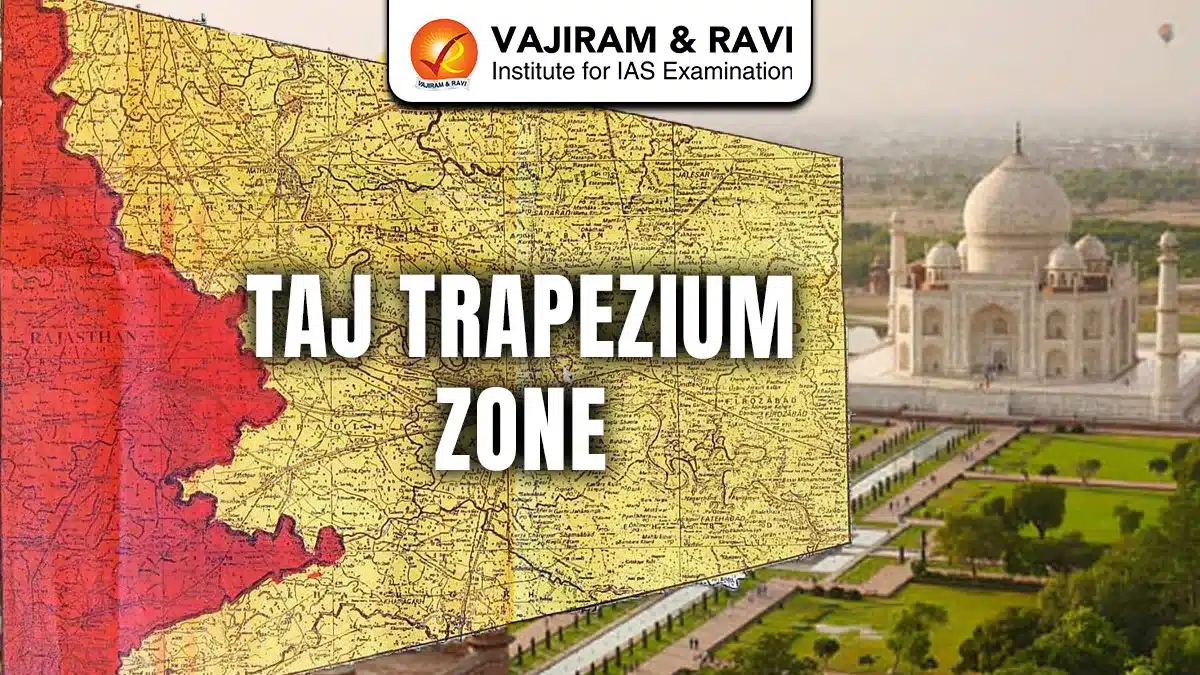
Taj Trapezium Zone (TTZ) is a defined area of 10,400 sq km around the Taj Mahal to protect the monument from pollution. 

It spread across 10,400 sq km in Agra, Firozabad, Mathura, Hathras and Etah district, and Rajasthan's Bharatpur District. It comprises monuments including three World Heritage Sites, the Taj Mahal, Agra Fort and Fatehpur Sikri. Taj Trapezium Zone is so named since it is located around the Taj Mahal and is shaped like a trapezoid.

Taj Trapezium Zone Background 

Taj Trapezium Zone was created by the supreme court in M.C. Mehta v. Union of India & Ors. Case 1996 in response to a public interest litigation (PIL) filed in supreme court to protect the Taj Mahal from environmental pollution. The Supreme Court banned the use of coal/ coke in industries located in the TTZ with a mandate for switching over from coal/ coke to natural gas, and relocating them outside the TTZ or shutting down. The Supreme Court also directed the creation of the Taj Trapezium Zone Pollution (Prevention and Control) Authority under the Environment (Protection) Act, 1986. The Authority was entrusted with regulating industrial activity, construction practices, vehicular emissions, and other pollution-generating sources in the ecologically sensitive Taj region.

Taj Trapezium Zone Industries Classification 

For effective pollution control, industries under the Taj Trapezium Zone have been classified into four categories based on the pollution potential of industries namely Red, Orange, Green, and White. 

Highly polluting industries under the Red category are strictly restricted, while only environmentally friendly, non-polluting small, tiny, and micro-scale industries are permitted to operate within the zone, ensuring a balance between conservation and limited economic activity.

The classification is based on a Pollution Index (PI), which considers water pollution, air pollution, and hazardous waste generation :  

  • Red Category (High Pollution Potential - PI ≥ 60) : These are highly polluting industries. Generally, no new, highly polluting red-category industries are permitted in the TTZ.
  • Orange Category (Medium Pollution Potential - PI 41–59) : Moderately polluting industries.
  • Green Category (Low Pollution Potential - PI 21–40) : Low pollution potential industries.
  • White Category (Practically Non-Polluting - PI ≤ 20) : These industries are allowed to operate with mandatory intimation to the State Pollution Control Board (SPCB) and are considered environment-friendly. 

Further in 2015, SC banned felling of trees within a 5 km aerial distance from the Taj Mahal without its prior permission of the Supreme Court.

Taj Trapezium Zone (TTZ) FAQs

Q1: What is the Taj Trapezium Zone (TTZ)?

Ans: TTZ is a 10,400 sq km protected area around the Taj Mahal created to prevent air and environmental pollution that could damage the monument.

Q2: Why is it called the “Taj Trapezium Zone”?

Ans: It is named so because the protected area around the Taj Mahal is trapezoidal in shape.

Q3: Which areas are covered under TTZ?

Ans: It spans parts of Uttar Pradesh—Agra, Firozabad, Mathura, Hathras and Etah districts—and Bharatpur district of Rajasthan.

Q4: Which important monuments lie within the TTZ?

Ans: It includes three UNESCO World Heritage Sites : Taj Mahal, Agra Fort, Fatehpur Sikri

Q5: Which case led to the creation of TTZ?

Ans: TTZ was created following the Supreme Court judgment in MC Mehta v. Union of India (1996) based on a Public Interest Litigation (PIL).

Allotropes of Carbon, Meaning, Classification, Applications

Allotropes of Carbon

Carbon is a unique non-metal element that exhibits an exceptional ability to form multiple structural forms known as allotropes. These allotropes differ in atomic arrangement, bonding, and physical properties, leading to wide variations in hardness, conductivity, and applications. The allotropes of carbon range from naturally occurring substances like diamond and coal to advanced nanomaterials such as graphene and carbon nanotubes. Due to their scientific, industrial, and technological significance, carbon allotropes hold an important place in chemistry.

What are Allotropes?

Allotropes are different physical forms of the same element that exist in the same physical state but have distinct atomic structures. Although they are made of the same element, allotropes show different physical and chemical properties due to variations in bonding and arrangement of atoms. Carbon shows allotropy mainly because of its tetravalency and strong covalent bonding ability. The phenomenon of allotropy explains why carbon can exist as both the hardest natural substance and a soft, slippery material.

Classification of Carbon Allotropes

Carbon allotropes are classified based on the degree of atomic order present in their structure. Some allotropes have a regular and repeating arrangement of atoms, while others have a random arrangement. On this basis, carbon allotropes are divided into crystalline and amorphous forms. This classification helps in understanding their properties and industrial uses.

Crystalline Allotropes of Carbon

Crystalline Allotropes of Carbon have atoms arranged in a well-ordered, repeating three-dimensional structure. This regular arrangement gives them unique mechanical, thermal, and electrical properties, making them highly valuable in industry and technology.

  • Well-ordered Structure: Atoms are arranged in a regular, repeating three-dimensional lattice.
  • Definite Geometry: Each allotrope has a fixed geometric shape (tetrahedral in diamond, planar in graphite).
  • High Melting and Boiling Points: Strong covalent bonding gives them very high thermal stability.
  • Hardness Variation: Hardness varies widely (diamond is extremely hard, graphite is soft).
  • Electrical Conductivity: Some conduct electricity (graphite, graphene, carbon nanotubes), while others do not (diamond).
  • Good Thermal Conductivity: Most crystalline forms conduct heat efficiently.
  • Distinct Physical Appearance: Diamond is transparent, graphite is opaque and flaky.
  • High Strength: Strong covalent bonding makes them mechanically strong (diamond and nanotubes).
  • Chemical Stability: Resistant to chemical attack under normal conditions.
  • Industrial and Technological Applications: Used in cutting tools, lubricants, electronics, nanotechnology, and more.

1. Diamond

Diamond is the hardest naturally occurring allotrope of carbon, with each carbon atom covalently bonded to four others in a tetrahedral structure.

  • Structure: Each carbon atom is sp³ hybridized, forming a strong 3D tetrahedral lattice.
  • Hardness: Hardest known natural material, resistant to scratching.
  • Electrical Conductivity: Poor conductor of electricity due to absence of free electrons.
  • Thermal Conductivity: Excellent conductor of heat.
  • Uses: Cutting and drilling tools, jewelry, high-precision instruments, and heat sinks.

2. Graphite

Graphite is a soft, slippery allotrope of carbon with carbon atoms arranged in hexagonal layers. Its layers are held together by weak van der Waals forces, allowing them to slide over each other easily.

  • Structure: Each carbon atom is sp² hybridized, forming planar hexagonal sheets.
  • Electrical Conductivity: Good conductor due to delocalized electrons within layers.
  • Lubricating Property: Soft and slippery; used as a dry lubricant.
  • Thermal Stability: High melting point and can withstand high temperatures.
  • Uses: Pencil leads, electrodes in batteries, lubricants, and nuclear reactor moderators.

3. Graphene

Graphene is a single layer of carbon atoms arranged in a two-dimensional hexagonal lattice. It is extremely strong, lightweight, and has exceptional electrical and thermal conductivity.

  • Structure: One-atom-thick planar sheet of sp²-hybridized carbon atoms.
  • Strength: Extremely strong and flexible; over 100 times stronger than steel by weight.
  • Electrical & Thermal Conductivity: Excellent conductor of electricity and heat.
  • Transparency: Almost transparent, allowing light to pass through.
  • Uses: Flexible electronics, sensors, energy storage devices, and advanced composites.

4. Fullerenes

Fullerenes are carbon molecules arranged in hollow spherical, ellipsoidal, or tubular structures. The most common is C₆₀, known as Buckminsterfullerene, resembling a soccer ball.

  • Structure: Cage-like, hollow molecule made of carbon atoms in pentagons and hexagons.
  • Stability: Lightweight and chemically stable structure.
  • Unique Properties: Distinct electrical and chemical reactivity.
  • Electrical Conductivity: Can behave as semiconductors or superconductors in certain conditions.
  • Uses: Drug delivery systems, superconductors, lubricants, and catalysts in chemical reactions.

5. Carbon Nanotubes

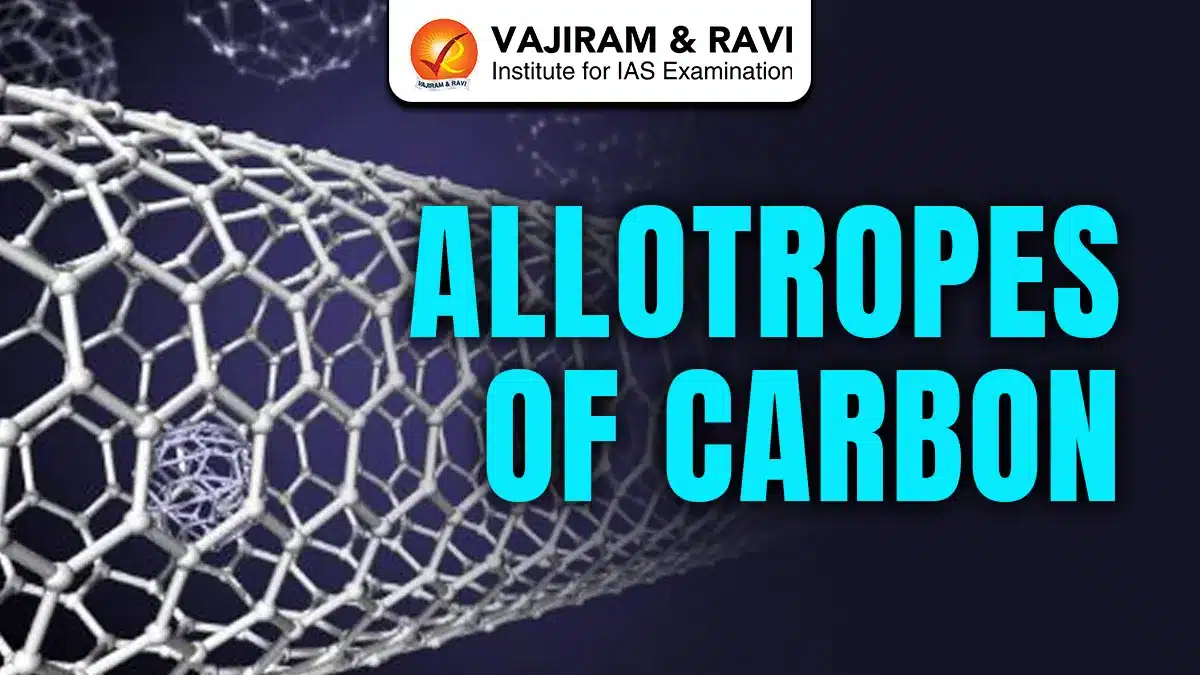
Carbon nanotubes are cylindrical structures formed by rolling graphene sheets into seamless tubes. They exhibit extraordinary strength, lightweight nature, and exceptional electrical and thermal conductivity, making them important nanomaterials.

  • Structure: Cylindrical tubes of carbon atoms arranged in a hexagonal lattice; can be single-walled (SWCNT) or multi-walled (MWCNT).
  • Strength: Extremely high tensile strength, stronger than steel by weight.
  • Electrical Conductivity: Excellent conductor of electricity; can also act as semiconductors.
  • Thermal Conductivity: Excellent heat conductors along the tube axis.
    Uses: Nanoelectronics, aerospace materials, drug delivery, reinforced composites, and energy storage devices.

Amorphous Allotropes of Carbon

Amorphous allotropes of carbon lack a regular crystalline structure and have carbon atoms arranged randomly. They are usually softer, porous, and contain impurities, unlike crystalline forms. These allotropes are primarily used as fuels, adsorbents, and industrial materials. Common examples include coal, coke, charcoal, and carbon black.

  • Irregular Structure: Lack long-range crystalline order; carbon atoms are randomly arranged.
  • Variable Hardness: Softer than crystalline allotropes; texture ranges from brittle (charcoal) to hard (coke).
  • Porous and High Surface Area: Makes them excellent adsorbents (e.g., activated charcoal).
  • Contains Impurities: Often includes hydrogen, oxygen, nitrogen, or sulfur from source material.
  • Combustible and Less Dense: Burns easily and generally lighter than crystalline forms.
  • Industrial Uses: Used as fuel, pigments, lubricants, purification agents, and in metallurgy.

1. Coal

Coal is a natural amorphous carbon formed from the remains of ancient plants over millions of years. It contains carbon along with hydrogen, oxygen, nitrogen, and sulfur, which influence its properties and combustion behavior.

  • Composition: Contains 60–90% carbon, along with hydrogen, oxygen, sulfur, and nitrogen.
  • Appearance: Black, brittle, and solid.
  • Combustibility: Burns easily, releasing energy.
  • Density & Structure: Irregular, porous, lower density than crystalline carbon.
  • Uses: Fuel in thermal power plants, steel and cement production, and precursor for coke.

2. Coke

Coke is a nearly pure form of carbon obtained by destructive distillation of coal in the absence of air. It is harder and more porous than coal and widely used in metallurgy.

  • Composition: Almost pure carbon with very low impurities.
  • Structure: Porous and hard, irregular amorphous structure.
  • Combustibility: Burns at high temperature; used as fuel.
  • Chemical Role: Acts as a reducing agent in metallurgy.
  • Uses: Fuel in blast furnaces, steel production, and chemical industries.

3. Charcoal

Charcoal is produced by heating wood or other organic matter in limited oxygen, a process called pyrolysis. It is lightweight, porous, and a good adsorbent.

  • Composition: Mainly carbon with small amounts of volatile compounds.
  • Appearance: Black, brittle, porous material.
  • Combustibility: Burns easily and provides steady heat.
  • Adsorption: Excellent for purifying water, gases, and medicinal applications.
  • Uses: Fuel, water purification, gas masks, medicinal purposes, and art supplies.

4. Carbon Black

Carbon black is produced by incomplete combustion of heavy petroleum products. It is a fine black powder with high surface area, widely used in industry.

  • Composition: Almost pure carbon in finely divided form.
  • Appearance: Fine black powder, highly porous.
  • Conductivity: Slightly conductive due to surface carbon particles.
  • Industrial Use: Reinforcing agent in rubber and plastics, pigment in inks and paints.
  • Special Applications: Used in batteries, tires, and as a conductive filler.

Allotropes of Carbon Applications

Carbon allotropes have a wide range of applications due to their diverse structures, bonding, and properties. From industry and electronics to medicine and nanotechnology, these allotropes are indispensable in modern science and technology.

  • Industrial Uses: Carbon allotropes like diamond and graphite are extensively used in industries. Diamond is used in cutting, drilling, and grinding tools, while graphite is used in electrodes, crucibles, and lubricants.
  • Energy Production: Coal and coke serve as primary fuels in thermal power plants, steel production, and cement industries. Amorphous carbon forms are also used for gasification and chemical energy sources.
  • Electronics and Nanotechnology: Graphene, carbon nanotubes, and fullerenes are used in flexible electronics, sensors, conductive films, and nano-devices due to their excellent electrical and thermal conductivity.
  • Medical and Pharmaceutical Applications: Fullerenes and carbon nanotubes are used in drug delivery systems, biomedical imaging, and controlled release of medications. Activated charcoal is used to treat poisoning and purify water.
  • Environmental Applications: Charcoal and activated carbon are used in water and air purification, gas masks, and removal of pollutants due to their high adsorption capacity.
  • Materials and Composites: Graphene, carbon nanotubes, and diamond are used in advanced composite materials for aerospace, defense, automotive, and construction industries due to their strength and lightweight properties.
  • Jewelry and Ornamentation: Diamond is highly valued in jewelry for its brilliance, transparency, and hardness.
  • Lubricants and Additives: Graphite and carbon black are used as dry lubricants, reinforcing agents in rubber and plastics, and pigments in paints, inks, and coatings.
  • Research and Scientific Applications: Diamond is used in high-pressure experiments, graphene in photonics and optoelectronics, and carbon nanomaterials in superconductivity and advanced nanoscience research.

Energy Storage: Graphene, carbon nanotubes, and carbon black are widely used in batteries, ultracapacitors, and hydrogen storage devices for renewable and efficient energy solutions.

UPSC Prelims PYQs

Q.With reference to carbon nanotubes, consider the following statements: (2020) 

  1. They can be used as carriers of drugs and antigens in the human body.
  2. They can be made into artificial blood capillaries for an injured part of human body.
  3. They can be used in biochemical sensors.
  4. Carbon nanotubes are biodegradable.

Which of the statements given above are correct? 

(a) 1 and 2 only  

(b) 2, 3 and 4 only 

(c) 1, 3 and 4 only  

(d) 1, 2, 3 and 4 

Ans: (c)

  1. Graphene is frequently in news recently. What is its importance? (2012) 
  1. It is a two-dimensional material and has good electrical conductivity.
  2. It is one of the thinnest but strongest materials tested so far.
  3. It is entirely made of silicon and has high optical transparency
  4. It can be used as ‘conducting electrodes’ required for touch screens, LCDs and organic LEDs.

Which of the statements given above are correct? 

(a) 1 and 2 only 

(b) 3 and 4 only 

(c) 1, 2 and 4 only 

(d) 1, 2, 3 and 4 

Ans: (c)

Allotropes of Carbon FAQs

Q1: Why does carbon show allotropy?

Ans: Carbon shows allotropy due to its tetravalency and strong catenation property.

Q2: Which allotrope of carbon is hardest?

Ans: Diamond is the hardest allotrope of carbon.

Q3: Why is graphite used as a lubricant?

Ans: Because its layers can easily slide over each other due to weak intermolecular forces.

Q4: What is the difference between graphene and graphite?

Ans: Graphene is a single layer of carbon atoms, while graphite consists of many layers of graphene.

Q5: Name three amorphous allotropes of carbon.

Ans: Coal, coke, and charcoal are common amorphous allotropes of carbon.

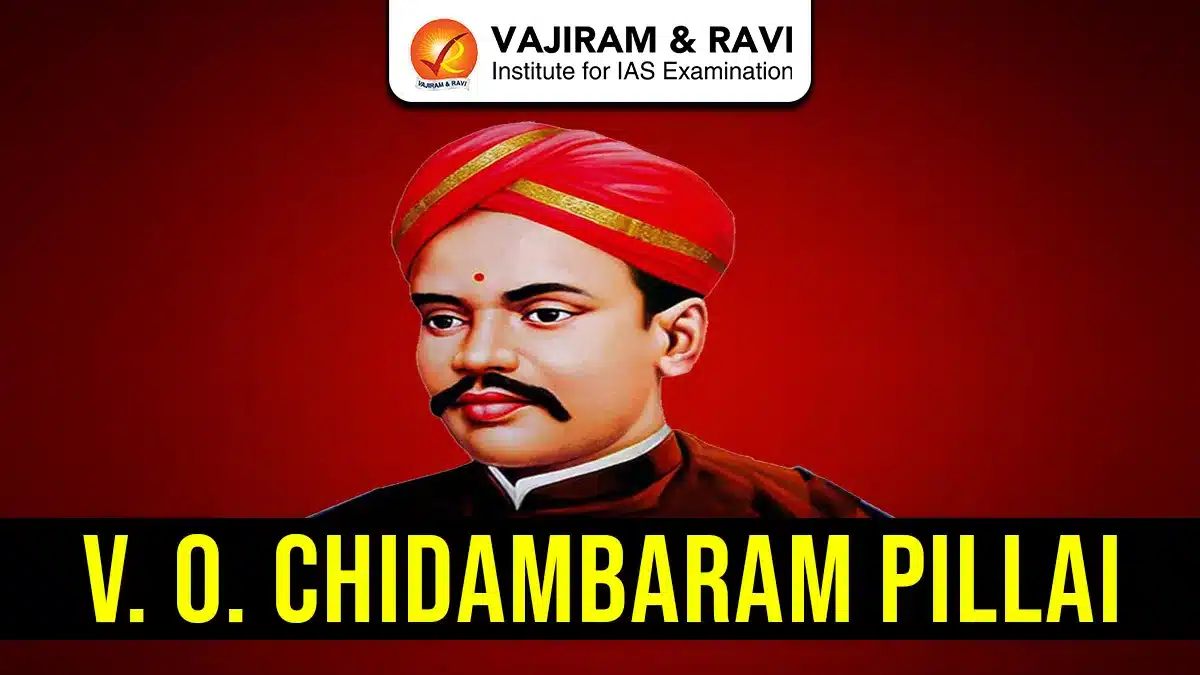
V. O. Chidambaram Pillai (1872-1936), Biography, Political Career

V. O. Chidambaram Pillai

Vallinayagam Olaganathan Chidambaram Pillai was popularly known as V. O. Chidambaram Pillai, Kappalottiya Tamizhan and Sekkizuththa Semmal. He was one of the earliest and most dynamic nationalist leaders from Tamil Nadu. He combined law, business, politics, labour activism and Tamil scholarship into a single life of sacrifice. He challenged British economic dominance by founding India’s first Swadeshi shipping company and mobilised workers much before organised labour movements became common. His life stands as a powerful example of economic nationalism, courage and uncompromising patriotism during the Indian freedom struggle.

V. O. Chidambaram Pillai Biography

V. O. Chidambaram Pillai was born on 5 September 1872 at Ottapidaram in Tirunelveli district to Olaganathan Pillai and Paramayee Ammal in a Tamil Vellalar family. From childhood, he was trained in Tamil literature, Hindu epics, martial arts and physical disciplines. His education was completed at CEOA High School, Caldwell High School and Hindu College High School in Thoothukudi. After working briefly as a Taluk Office Clerk, he pursued law at Tiruchirappalli and cleared the pleadership examination in 1894, beginning legal practice in 1895. His meeting with Swami Ramakrishnananda in Madras deeply influenced him to dedicate his life to national service. He passed away on 18 November 1936 at the Indian National Congress office in Tuticorin.

V. O. Chidambaram Pillai Political Career

Chidambaram Pillai’s political career began during the peak of Swadeshi nationalism after Bengal’s partition in 1905.

  • Influence of Extremist Leaders: He was deeply inspired by Bal Gangadhar Tilak and Lala Lajpat Rai, adopting assertive nationalism over moderate constitutional methods and became Tilak’s ideological disciple.
  • Association with Tamil Nationalists: Along with Subramanya Siva and Subramanya Bharathi, he emerged as a leading nationalist voice in the Madras Presidency, using powerful public speeches to mobilise masses.
  • Indian National Congress: He joined the Indian National Congress and presided over the Salem District Congress session, representing the extremist faction within the organisation.
  • Swadeshi Ideology: His politics focused on economic self reliance, labour rights and Indian owned enterprises rather than only political petitions to the British government.

V. O. Chidambaram Pillai Role in Freedom Struggle

V. O. Chidambaram Pillai played a direct, mass based role in India’s freedom movement through economic and labour resistance.

  • Swadeshi Steam Navigation Company: In October 1906, he founded the Swadeshi Steam Navigation Company with ₹10 lakh capital to break the monopoly of British India Steam Navigation Company on Tuticorin-Colombo routes.
  • Indigenous Shipping Service: The company purchased S.S. Gallia and S.S. Lavo, reducing fares to 8 annas against British rates of 1 rupee, making nationalist enterprise accessible to common people.
  • Tuticorin Coral Mill Strike 1908: He led nearly 1,700 mill workers demanding higher wages, reduced hours and weekly holidays, achieving success after a nine day strike.
  • Political Strike in India: The protest following his arrest in March 1908 led to the early organised political strike in Indian history, shutting shops, schools and offices in Thoothukudi.

V. O. Chidambaram Pillai Contributions

Chidambaram Pillai’s contributions extended beyond politics into labour welfare, institutions and literature. Major works of Pillai has been highlighted below:

  • Institution Building: He established Yuvanesh Prachar Sabha, Dharmasanga Nesavu Salai, Desabimana Sangam and Madras Agro-Industrial Society to promote Swadeshi and self reliance.
  • Labour Movement: Decades before formal labour laws, he fought for humane working hours, fair wages and weekly rest, influencing later labour reforms in India.
  • Literary Work: He authored works like Meyyaram (1914), Meyyarivu (1915) and produced commentaries on Tirukkural and Tolkappiam, showcasing deep Tamil scholarship.
  • Personal Sacrifice: After imprisonment, loss of livelihood and revocation of his law license, he lived in poverty but continued writing and nationalist engagement without compromise.

V. O. Chidambaram Pillai Awards and Honors

V. O. Chidambaram Pillai received enduring recognition for his sacrifices and nationalist legacy. The major achievements of Pillai has been listed below:

  • Honorary Titles: He is remembered as Kappalottiya Tamizhan for pioneering Swadeshi shipping and Sekkizuththa Semmal for enduring brutal oil-press labour in prison.
  • Postal Recognition: India Post issued a commemorative postage stamp on 5 September 1972, marking his birth centenary and national contribution.
  • Port Renaming: Tuticorin Port was renamed V. O. Chidambaranar Port Trust and later V. O. Chidambaranar Port Authority, permanently linking his name with maritime nationalism.
  • Statues and Cultural Memory: Statues across Chennai, Madurai, Thoothukudi and Tirunelveli, along with films and biographies, continue to keep his legacy alive in public memory.

V. O. Chidambaram Pillai Books

V. O. Chidambaram Pillai was a prolific Tamil scholar whose writings covered philosophy, ethics, grammar, autobiography and translations. He regularly wrote articles on nationalism, social reform and Tamil culture, using journalism as a tool to awaken political consciousness such as:

  • Meyyaram (1914): This work reflects V. O. Chidambaram Pillai’s philosophical thinking, written in simple Tamil style, focusing on truth, moral clarity and intellectual self awareness.
  • Meyyarivu (1915): In this book, he explored rational thought and ethical reasoning, encouraging readers to develop independent thinking rooted in Indian cultural values.
  • Anthology (1915): This collection compiled his selected literary writings, showcasing his command over Tamil language, ideas on nationalism and reflections on society.
  • Thirukkural with Literary Notes of Manakudavar (1917): He produced detailed literary notes on the ancient Thirukkural text, explaining meanings clearly for common readers and scholars.
  • Tolkappiam with Literary Notes of Ilampooranar (1928): This work presented explanations on classical Tamil grammar, highlighting his deep scholarship in ancient linguistic traditions.
  • Autobiography (1946): Written in Tamil verse and completed after his prison life, this autobiography records his struggles, imprisonment, nationalism and personal sacrifices.
  • Literary Notes on Tirukkural: Apart from published editions, he worked extensively on commentaries of Tirukkural, parts of which were fully published later, showing lifelong dedication to Tamil ethics.

V. O. Chidambaram Pillai FAQs

Q1: Who was V. O. Chidambaram Pillai?

Ans: V. O. Chidambaram Pillai was an Indian freedom fighter, lawyer, nationalist leader, Swadeshi entrepreneur and Tamil scholar from Tamil Nadu.

Q2: Why was V. O. Chidambaram Pillai called Kappalottiya Tamizhan?

Ans: He earned the title for founding the Swadeshi Steam Navigation Company and operating Indian owned ships against British monopoly.

Q3: What was the Swadeshi Steam Navigation Company founded by V. O. Chidambaram Pillai?

Ans: It was an Indian owned shipping company started in 1906 to challenge the British India Steam Navigation Company.

Q4: What punishment was given to V. O. Chidambaram Pillai by the British?

Ans: He was convicted of sedition, sentenced to life imprisonment and forced to perform hard labour in prison.

Q5: When did V. O. Chidambaram Pillai die?

Ans: V. O. Chidambaram Pillai died on 18 November 1936 at the Indian National Congress office in Tuticorin.

Union Budget 2026, Date, Constitutional Provisions, Stages

Union Budget 2026-27

The Union Budget 2026 is India’s annual financial statement presented by the Central Government that lays down plans for revenue and expenditure for the next financial year from 1 April 2026 to 31 March 2027. It is the most important financial instrument of the government, reflecting priority sectors, economic strategy, taxation policy, social welfare, and fiscal discipline.

The budget determines how India mobilises resources, spends on defence, health, education, infrastructure, and social sectors, and balances growth with fiscal prudence.

What is Union Budget of India?

The Union Budget of India is the annual financial statement of the Government of India, which presents a detailed account of the estimated revenues and expenditures of the Central Government for a particular financial year, running from 1st April to 31st March.

The Union Budget is presented every year by the Union Finance Minister in the Lok Sabha, usually on 1st February, and it requires approval from Parliament before implementation.

Finance Budget 2026 Date

Finance Budget 2026 will be presented by Finance Minister Nirmala Sitharaman on 1st Februaury, 2026 (Sunday). The upcoming Union Budget 2026 presented by Finance Minister Nirmala Sitharaman is expected to prioritise tax relief, infrastructure expansion, and overall economic growth, even as India navigates global tariff disputes and regional diplomatic challenges. Aligned with the Viksit Bharat@2047 vision, the budget seeks to balance fiscal discipline with strategic investments that promise strong long-term economic returns.

Union Budget Constitutional Provisions

The Union Budget of India is prepared, presented, and implemented strictly according to the constitutional framework laid down in the Indian Constitution. These provisions ensure financial accountability, legislative control, and transparency in the use of public money.

Note: The term ‘budget’ is nowhere mentioned in the Constitution of India.

Union Budget Constitutional Provisions
Article Provision Explanation

Article 112

Annual Financial Statement

Mandates the presentation of the Union Budget showing estimated receipts and expenditures of the Government of India for the financial year.

Article 113

Voting on Demands for Grants

Requires Lok Sabha approval for all expenditure demands of ministries; Rajya Sabha has no voting power.

Article 114

Appropriation Bill

Authorizes withdrawal of money from the Consolidated Fund of India after demands are passed.

Article 110

Finance Bill (Money Bill)

Contains tax proposals; can be introduced only in Lok Sabha and cannot be rejected by Rajya Sabha.

Article 117

Financial Bills

Deals with bills involving expenditure from the Consolidated Fund other than Money Bills.

Article 266

Consolidated Fund of India

All revenues, loans, and repayments go into this fund; money can be withdrawn only with parliamentary approval.

Article 267

Contingency Fund of India

Used to meet unforeseen expenditure, placed at the disposal of the President.

Article 109

Role of Rajya Sabha

Rajya Sabha can only discuss the Budget and must return Money Bills within 14 days.

Article 111

Presidential Assent

Budget becomes law only after President gives assent to Appropriation and Finance Bills.

Article 116

Vote on Account

Allows government to meet expenses temporarily if Budget is not passed in time.

Stages of Budget Session in Indian Parliament

The Budget Session of the Indian Parliament is a special session conducted to discuss, scrutinize, and approve the Union Budget for the upcoming financial year. The stages of Budget Session 2026-27 have been discussed below.

  1. Presentation of the Budget: The Union Budget is presented in the Lok Sabha on 1st February every year by the Finance Minister of India. During the presentation, the Finance Minister delivers the budget speech. After the speech, the budget is formally laid before both Houses of Parliament.
  2. General Discussion: Members of the Lok Sabha discuss the budget as a whole or on any principle involved in it. However, no cut motions can be moved, and the budget is not submitted to a vote at this stage. The Finance Minister has the right to reply at the end of the discussion, clarifying policies and addressing members’ concerns.
  3. Scrutiny by Departmental Committees: Each departmental standing committee conducts an in-depth examination of the Demands for Grants of its respective ministry. This process lasts three to four weeks, during which the House remains in recess. At the end of this period, the committees submit their reports to Parliament, suggesting reductions, modifications, or reallocations if necessary.
  4. Voting on Demands for Grants: The Lok Sabha votes on the individual demands for grants of each ministry. Only Lok Sabha members can vote on these demands. Expenditure charged on the Consolidated Fund of India is excluded and does not require voting.
  5. Passing of Appropriation Bill: No money can be withdrawn from the Consolidated Fund of India except through an Appropriation Bill. This bill authorises the government to withdraw funds and meet its approved expenditures for the financial year.
  6. Passing of Finance Bill: The Finance Bill is introduced to give legal effect to the financial proposals of the government, including taxation and revenue measures, for the upcoming year. It is presented as a Money Bill under Article 110 and requires Lok Sabha approval followed by Presidential assent to become the Finance Act.

Documents Presented in Parliament Along with the Union Budget

When the Union Budget is presented in Parliament, it is accompanied by several mandatory documents that provide detailed information on government finances, allocations, and fiscal policies. These documents ensure transparency, accountability, and detailed scrutiny of government expenditure and revenue.

Budget Documents:

  • Annual Financial Statement (AFS): The primary budget document detailing the estimated receipts and expenditures of the Government of India, prepared under Article 112 of the Constitution.
  • Demands for Grants (DGs): Ministry-wise requests for funds for specific services and schemes, which must be voted upon by the Lok Sabha.
  • Finance Bill: Introduces new taxes or amendments to existing tax laws to implement the government’s revenue proposals.
  • Appropriation Bill: Authorizes the withdrawal of funds from the Consolidated Fund of India to meet expenditure approved through the budget.

FRBM Act Mandated Statements (Fiscal Responsibility and Budget Management)

  • Macro-Economic Framework Statement (MEFS): Evaluates economic growth prospects, fiscal balance, and external sector position for the upcoming year.
  • Fiscal Policy Strategy Statement (FPSS): Outlines the government’s fiscal policies and priorities for the financial year.
  • Medium-Term Fiscal Policy Statement (MTFPS): Presents medium-term fiscal targets and strategies to ensure sustainable public finances over the next 3 years.
Other Related Posts
National Income UPSC Economy Notes 2026
Inflation Monetary Policy in India
Sectors of Indian Economy Balance of Payments
Economic Growth and Development Indirect Tax
Fiscal Policy in India Financial Market
Reserve Bank of India MSME
Poverty and Developmental Issues Green GDP

Union Budget 2026 FAQs

Q1: What is the Union Budget 2026-27?

Ans: The Union Budget 2026-27 is the annual financial statement of the Government of India for the fiscal year 1st April 2026 to 31st March 2027.

Q2: Who presents the Union Budget 2026-27?

Ans: The Finance Minister of India, currently Nirmala Sitharaman, presents the budget in the Lok Sabha.

Q3: When is the Union Budget 2026-27 presented?

Ans: It is scheduled to be presented on 1st February 2026, keeping the tradition of presenting the budget before the start of the new financial year.

Q4: Under which Article of the Constitution is the Union Budget presented?

Ans: The budget is presented under Article 112 (Annual Financial Statement) of the Indian Constitution.

Q5: What are Demands for Grants?

Ans: Demands for Grants (DGs) are ministry-wise requests for funds for specific services or schemes. The Lok Sabha votes on them to authorise spending; the Rajya Sabha can only discuss them.

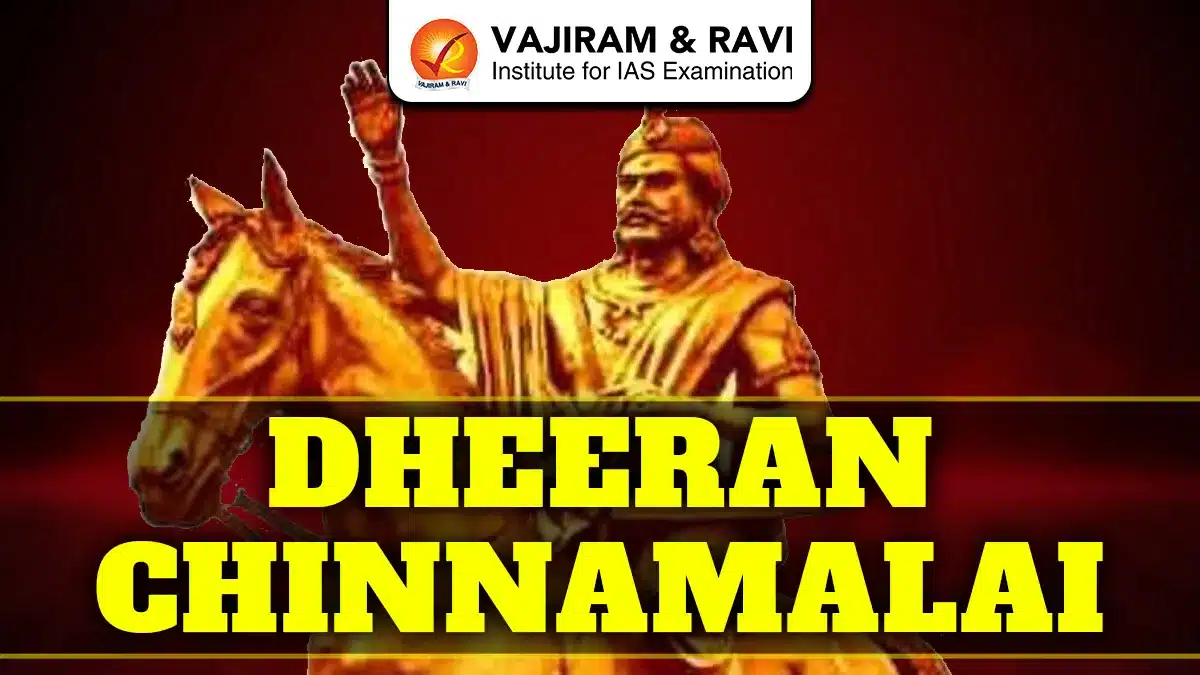
Dheeran Chinnamalai (1756-1805), Biography, British Conquest, Polygar War

Dheeran Chinnamalai

Dheeran Chinnamalai was one of the earliest and most formidable anti-colonial warriors of South India who challenged the British East India Company much before 1857. He was born in 1756 in the Kongu region of present day western Tamil Nadu. He emerged as a powerful Palayakkarar and military leader known for his mastery of Guerrilla Warfare. He resisted both Mysore’s exploitative tax system and British political domination. As a key commander during the Second Polygar War, Chinnamalai inflicted repeated military defeats on British forces. His execution in 1805 reveals the brutal suppression of indigenous resistance movements.

Dheeran Chinnamalai Biography

Dheeran Chinnamalai was born as Theerthagiri Sarkarai Manradiar on 17 April 1756 near Kangeyam in present day Tiruppur district.

  • He belonged to the Kongu Vellalar clan and was born to Rathnasamy Manradiar and Periyatha. His family controlled land and local administration in the Kongu Nadu region, giving him early exposure to governance and rural defense.
  • Theerthagiri earned the title “Chinnamalai” after asserting sovereignty between Sennimalai and Shivamalai hills. This title symbolized his authority over the Kongu region against external rulers and tax collectors.
  • He was skilled in archery, horse riding, weapon handling and guerrilla tactics, later strengthened by exposure to French style military training during his association with Tipu Sultan.
  • As a local chieftain as ‘Palayakkarar’, he protected villages, resolved disputes and organized armed resistance while functioning as both administrator and military leader in western regions of Tamil Nadu.

Dheeran Chinnamalai British Conquest

Dheeran Chinnamalai directly confronted British expansion after resisting Mysore’s tax exploitation in Kongu Nadu.

  • He forcibly collected taxes from Diwan Muhammad Ali. This resulted in the Battle of Noyyal River, where Chinnamalai defeated Mysore forces, asserting Kongu’s autonomy.
  • He supported Tipu Sultan during the Third and Fourth Anglo Mysore Wars.
  • After Tipu Sultan’s death in 1799, Chinnamalai built the Odanilai Fort, transforming it into a strategic resistance base against the British East India Company.
  • British officers repeatedly attempted treaties and military assaults, but Chinnamalai refused submission, forcing the Company to deploy large troops and artillery to neutralize him.

Dheeran Chinnamalai Role in Polygar War

Dheeran Chinnamalai was a central military leader in the Second Polygar War between 1800 and 1805.

  • After the deaths of Kattabomman and Tipu Sultan, Chinnamalai emerged as a key commander, coordinating resistance across Kongu Nadu during the British campaign.
  • He defeated British forces at the Cauvery River in 1801, Odanilai in 1802 and Arachalur in 1804 using jungle warfare, surprise attacks and terrain advantage.
  • British columns suffered heavy losses and repeatedly failed to capture him, forcing prolonged and costly military operations in western Tamil Nadu.
  • In 1805, he was betrayed by his cook, captured along with his brothers and hanged at Sankagiri Fort on 31 July 1805, with some records noting 02 August.
  • His resistance during the Polygar Wars exposed British vulnerability and highlighted the intensity of pre 1857 regional revolts against colonial rule in India.

Dheeran Chinnamalai FAQs

Q1: Who was Dheeran Chinnamalai?

Ans: Dheeran Chinnamalai was a Palayakkarar and freedom fighter from Kongu Nadu who resisted British East India Company rule in the late 18th and early 19th century.

Q2: What was the real name of Dheeran Chinnamalai?

Ans: His original name was Theerthagiri Sarkarai Manradiar, born on 17 April 1756 near present day Kangeyam in Tamil Nadu.

Q3: How did Dheeran Chinnamalai oppose the British East India Company?

Ans: He used guerrilla warfare, built the Odanilai fort and defeated British forces in battles at Cauvery (1801), Odanilai (1802) and Arachalur (1804).

Q4: What was the role of Dheeran Chinnamalai in the Polygar War?

Ans: He was a key commander in the Second Polygar War, leading armed resistance in western Tamil Nadu against British military campaigns.

Q5: When and where was Dheeran Chinnamalai executed?

Ans: He was captured in 1805 and hanged by the British at Sankagiri Fort, however some sources cite 31 July or 2 August 1805.

Republic Day 2026, Chief Guest, Theme, History, Significance

Republic Day 2026

India celebrates Republic Day every year on 26 January to mark the historic day when the Constitution of India came into force in 1950, transforming the nation into a sovereign democratic republic. Republic Day 2026 will mark the 77th anniversary of the Republic of India and holds immense constitutional, political, and cultural importance for citizens

Republic Day 2026

Republic Day 2026 will be celebrated across the country with patriotism, discipline, and national pride. The main celebration takes place at Kartavya Path, New Delhi, featuring a grand parade that showcases India’s military strength, cultural diversity, technological achievements, and federal unity.

Schools, colleges, government institutions, and Indian missions abroad also observe the day by hoisting the national flag, singing the national anthem, and organizing cultural programs.

Why is Republic Day 2026 celebrated?

Republic Day 2026 is celebrated to commemorate the adoption and implementation of the Indian Constitution on 26 January 1950. Although India attained independence on 15 August 1947, it did not have a permanent constitution until 1950.

The date 26 January was deliberately chosen to honor the Purna Swaraj Declaration of 1929 at Lahore Session on December 19, 1929, when the Indian National Congress proclaimed complete independence from British rule. Republic Day symbolizes:

  • Supremacy of the Constitution
  • Rule of law
  • Democratic governance
  • Equality, liberty, and justice for all citizens

Republic Day 2026 Chief Guests

The Chief Guests for India’s 77th Republic Day celebrations on 26 January 2026 will be the top leadership of the European Union, namely Ursula von der Leyen, President of the European Commission, and António Costa, President of the European Council. Their presence reflects a significant deepening of India–EU strategic and diplomatic relations. The EU leaders will be on an official visit to India from 25 to 27 January 2026, during which they will also co-chair the 16th India–EU Summit, underscoring growing cooperation in areas such as trade, technology, security, and global governance.

Other leaders across various countries will also be invited to participate in India’s Republic  Day 2026 celebration.

Beating Retreat Ceremony 2026

The Beating Retreat Ceremony 2026 is a solemn and dignified tradition that formally concludes the Republic Day 2026 celebrations. The ceremony embodies national pride and India’s military heritage, showcased against the majestic setting of Vijay Chowk in New Delhi.

Republic Day 2026 Theme

The Republic Day 2026 theme continues to echo India’s long-term national vision of “Viksit Bharat” (Developed India) and “Bharat – Loktantra ki Matruka” (India – The Mother of Democracy). These themes underscore India’s commitment to achieving comprehensive development by 2047 while reaffirming its deep-rooted democratic traditions that date back to ancient times.

The spirit of these themes is vividly showcased through tableaux presented by States, Union Territories, and central Ministries, highlighting governance reforms, cultural heritage, technological progress, and inclusive growth.

Republic Day History

  • Lahore Session of the INC (1929): The Indian National Congress, at its historic Lahore Session on 19 December 1929 under the leadership of Jawaharlal Nehru, formally adopted the resolution of Purna Swaraj (Complete Independence), rejecting dominion status under British rule.
  • Proclamation of Complete Independence: The Purna Swaraj resolution declared that British rule in India was illegitimate and affirmed the Indian people’s inalienable right to self-governance and sovereignty.
  • Observance of Independence Day Before 1947: Between 1930 and 1947, 26 January was observed as Independence Day by freedom fighters across India, with public meetings, oath-taking ceremonies, and hoisting of the tricolour.
  • Formation of the Constituent Assembly (1946): The Constituent Assembly of India was constituted in December 1946 to draft a permanent constitution for independent India, representing diverse regions, communities, and political ideologies.
  • Adoption of the Constitution (1949): After nearly 2 years, 11 months, and 18 days of deliberations, the Constitution of India was adopted on 26 November 1949, establishing the :framework of governance and fundamental values.
  • Choice of 26 January as Republic Day: The date 26 January 1950 was chosen for the enforcement of the Constitution to honor the historic Purna Swaraj resolution of 1930, linking constitutional governance with the freedom struggle.
  • India Becomes a Republic (1950): On 26 January 1950, the Constitution came into force, India officially became a Sovereign Democratic Republic, and Dr. Rajendra Prasad was sworn in as the first President of India.
  • First Republic Day Celebration: The first Republic Day parade was held at Rajpath (now Kartavya Path), New Delhi, symbolizing the transfer of power from colonial rule to the people of India through constitutional democracy.
  • Evolution of Republic Day Celebrations: Over the decades, Republic Day celebrations have evolved to showcase India’s military strength, cultural diversity, technological progress, and federal unity, making it a powerful symbol of national integration.
  • Constitutional and Democratic Legacy: Republic Day serves as an annual reminder of the supremacy of the Constitution, the rule of law, and the commitment to justice, liberty, equality, and fraternity enshrined in the Preamble.

Role of the Constitution in Strengthening Indian Democracy

  • The Constitution of India establishes India as a Sovereign, Socialist, Secular, Democratic Republic, ensuring that ultimate authority rests with the people, which is the foundation of democratic governance.
  • It provides Universal Adult Franchise, granting voting rights to all citizens above 18 years of age, enabling political equality and mass participation regardless of caste, gender, religion, or economic status.
  • The Constitution guarantees Fundamental Rights (Articles 12–35), including equality before law, freedom of speech and expression, and protection against discrimination, empowering citizens to actively participate in democracy.
  • It enshrines the Rule of Law, ensuring that all individuals and institutions, including the government, are subject to the Constitution, thereby preventing arbitrary exercise of power.
  • An independent judiciary with powers of judicial review safeguards the Constitution, protects citizens’ rights, and acts as a check on the legislature and executive.
  • The principle of separation of powers among the Legislature, Executive, and Judiciary creates a system of checks and balances, strengthening accountability and preventing concentration of power.
  • The federal structure divides powers between the Union and the States through the Seventh Schedule, allowing democratic governance at multiple levels while maintaining national unity.
  • The Directive Principles of State Policy (Part IV) guide the state to achieve social and economic justice, helping transform political democracy into a welfare-oriented democracy.
  • Constitutional bodies such as the Election Commission, Comptroller and Auditor General (CAG), Finance Commission, and UPSC ensure free elections, financial transparency, and administrative neutrality.
  • The 73rd and 74th Constitutional Amendments (1992) strengthened grassroots democracy by empowering Panchayats and Municipalities, bringing governance closer to the people.
  • Provisions for reservation and affirmative action for SCs, STs, OBCs, women, and minorities promote inclusive representation and social justice in democratic institutions.

Republic Day Awards and Civil Honours

Republic Day Awards and Civil Honours recognize individuals for exceptional service and achievements in fields such as public service, arts, science, social work, sports, and national security, reflecting the nation’s gratitude and constitutional values.

Civilian Awards (Highest Honours):

  • Bharat Ratna – India’s highest civilian award for exceptional service in art, literature, science, or public service; a maximum of three awards per year
  • Padma Vibhushan – Conferred for exceptional and distinguished service
  • Padma Bhushan – Awarded for distinguished service of a high order
  • Padma Shri – Given for distinguished service in any field

Gallantry and Service Awards (Police and Forces):

  • President’s Police Medal (PPM) – For distinguished service
  • Police Medal (PM) for Gallantry – For acts of exceptional bravery
  • Police Medal (PM) for Meritorious Service – For sustained dedication and service
  • Fire Services, Home Guards, and Correctional Services Awards – For bravery and distinguished service

Other Important Awards:

  • Jeevan Raksha Padak – For acts of courage and life-saving by civilians
  • Pradhan Mantri Rashtriya Bal Puraskar – For children showing exceptional achievement and bravery

Republic Day 2026 Significance

Republic Day 2026 marks the celebration of India’s constitutional governance and reaffirms the ideals of sovereignty, democracy, and rule of law as the nation progresses through the Amrit Kaal towards a developed India by 2047.

  • Celebrates the enforcement of the Indian Constitution (26 January 1950)
  • Reinforces democratic values and constitutional morality
  • Highlights unity in diversity and national integration
  • Showcases India’s defence strength and cultural heritage
  • Inspires citizens to uphold fundamental rights and duties

Republic Day 2026 FAQs

Q1: When is Republic Day 2026 celebrated?

Ans: Republic Day 2026 is celebrated on 26 January 2026.

Q2: Why is 26 January important in Indian history?

Ans: 26 January marks both the Purna Swaraj Declaration (1930) and the enforcement of the Constitution (1950).

Q3: Who drafted the Indian Constitution?

Ans: The Constitution was drafted by the Constituent Assembly, with Dr. B.R. Ambedkar as Chairman of the Drafting Committee.

Q4: What is the significance of the Republic Day parade?

Ans: The parade showcases India’s military strength, cultural diversity, and developmental progress.

Q5: Which awards are announced on Republic Day?

Ans: Major awards include Padma Awards, Bharat Ratna, and Gallantry Awards.

Female Genital Mutilation, Meaning, Practice in India, Eradication Measures

Female Genital Mutilation

Female Genital Mutilation (FGM) refers to all non medical procedures that partially or totally remove or injure the external female genital organs. It has no health benefits and causes serious physical, psychological and reproductive harm. Globally, over 230 million girls and women alive today have undergone FGM across 30 countries in Africa, the Middle East and Asia. 

Female Genital Mutilation

The Female Genital Mutilation practice is usually performed on girls between infancy and 15 years of age. FGM is internationally recognized as a violation of human rights, reflecting deep gender inequality and discrimination against women and girls. Health systems worldwide spend an estimated US$ 1.4 billion annually treating FGM related complications, a cost projected to rise without urgent abandonment efforts.

Female Genital Mutilation in India

Female Genital Mutilation exists in India in limited communities, with no specific national law banning it, making eradication legally and socially complex.

  • Prevalence: Locally it is called khatna or khafz, among sections of the Dawoodi Bohra community in Maharashtra, Gujarat, Rajasthan, Kerala and Madhya Pradesh, usually on girls aged six to seven years.
  • Legal Status: India currently has no standalone law criminalizing FGM. However several activists and social reformers have demanded a legal framework against the practice.
  • Judicial Developments: A Public Interest Litigation filed in the Supreme Court in 2017 argued FGM violates Articles 14 and 21 of the Constitution, while opposing arguments cited religious freedom under Articles 25 and 26.
  • Health Impacts: Various Gynaecologists have reported cases of infections, urinary problems, childbirth complications and even sepsis linked to FGM procedures.
  • Civil Society Action: Survivor-led groups such as Sahiyo and We Speak Out have documented experiences, with most expressing a desire to end the practice.

Female Genital Mutilation Eradication Measures

Global and Indian initiatives focus on legal reform, health sector action and social norm change to eliminate FGM by 2030.

  • United Nations Action: UNFPA and UNICEF have jointly led the largest global FGM elimination programme since 2008, aiming to meet SDG 5.3, which targets ending harmful practices.
  • International Day: The UN designated 6 February as the International Day of Zero Tolerance for FGM.
  • WHO Role: The World Health Organization passed WHA Resolution 61.16 and urges health workers not to perform FGM, countering medicalization through global training and guidelines.
  • Risk Reduction Efforts: UN agencies estimate 4.4 million girls were at risk globally in 2024, prompting expanded community education and child protection interventions.
  • India-Specific Measures: Advocacy groups demand explicit legislation banning FGM, integration of FGM awareness into child protection laws and nationwide education campaigns to challenge harmful social norms.

Female Genital Mutilation FAQs

Q1: What is Female Genital Mutilation (FGM)?

Ans: Female Genital Mutilation involves non-medical injury or removal of female genital organs and is a serious human rights violation.

Q2: How many women are affected by Female Genital Mutilation worldwide?

Ans: More than 230 million girls and women alive today have undergone Female Genital Mutilation across Africa, the Middle East and Asia.

Q3: At what age is Female Genital Mutilation usually performed?

Ans: Female Genital Mutilation is mostly carried out on girls between infancy and 15 years, often before adolescence.

Q4: Is Female Genital Mutilation illegal in India?

Ans: India has no specific law banning Female Genital Mutilation, though it is challenged under constitutional rights and child protection laws.

Q5: Why is Female Genital Mutilation harmful?

Ans: Female Genital Mutilation causes severe pain, infections, childbirth complications, psychological trauma and costs global health systems US$ 1.4 billion annually.

UPSC Daily Quiz 29 January 2026

UPSC Daily Quiz

[WpProQuiz 79]

UPSC Daily Quiz FAQs

Q1: What is the Daily UPSC Quiz?

Ans: The Daily UPSC Quiz is a set of practice questions based on current affairs, static subjects, and PYQs that help aspirants enhance retention and test conceptual clarity regularly.

Q2: How is the Daily Quiz useful for UPSC preparation?

Ans: Daily quizzes support learning, help in revision, improve time management, and boost accuracy for both UPSC Prelims and Mains through consistent practice.

Q3: Are the quiz questions based on the UPSC syllabus?

Ans: Yes, all questions are aligned with the UPSC Syllabus 2025, covering key areas like Polity, Economy, Environment, History, Geography, and Current Affairs.

Q4: Are solutions and explanations provided with the quiz?

Ans: Yes, each quiz includes detailed explanations and source references to enhance conceptual understanding and enable self-assessment.

Q5: Is the Daily UPSC Quiz suitable for both Prelims and Mains?

Ans: Primarily focused on Prelims (MCQ format), but it also indirectly helps in Mains by strengthening subject knowledge and factual clarity.

Palghat Gap, Origin, Map, Location, Features, Biodiversity

Palghat Gap

Gaps and passes are natural low lying breaks in mountain ranges that allow movement of winds, rivers, people and wildlife across otherwise high barriers. In the Western Ghats, such gaps play a critical role in shaping climate, ecology and human connectivity. 

The Palghat Gap, also called the Palakkad Gap, is the widest and most significant break in this mountain chain. It connects the two states by forming a natural corridor between Tamil Nadu and Kerala. It separates two massive hill systems and influences rainfall, biodiversity distribution, geological stability and historical trade routes across peninsular India.

Palghat Gap Geography

The Palghat Gap is a 40 km wide corridor in the Western Ghats between the Nilgiri Hills and the Anamalai Hills.

  • Geographical Location: The Palghat Gap is situated between Coimbatore district of Tamil Nadu and Palakkad district of Kerala, forming the lowest and broadest opening in the Western Ghats mountain system.
  • Surrounding Hills: The gap is flanked by the Nilgiri Hills to the north and the Anamalai Hills to the south, both rising above 2,000 meters above mean sea level.
  • Width and Elevation: With an approximate width of 40 km, it is the largest discontinuity in the Western Ghats, significantly wider than other mountain passes in peninsular India.
  • River System: The Bharathappuzha River, one of Kerala’s longest rivers, flows through this gap, reinforcing its role as a natural east west corridor.
  • Vegetation Type: Unlike dense tropical rainforests elsewhere in the Western Ghats, the Palghat Gap supports dry evergreen forest due to lower or seasonally varied moisture availability.
  • Transport Corridor: The gap serves as a critical route for National Highway 544 and major railway lines, connecting Kerala’s interior with Tamil Nadu’s industrial regions.
  • Historical Trade: Historically, the Palghat Gap hosted Rajakesari Peruvazhi, an ancient highway linking Muziris on the west coast to Arikamedu on the east coast.
  • Cultural Exchange: The gap enabled population movement between Chera Nadu and Kongu Nadu, shaping political control, trade networks and cultural exchange in ancient Tamilakam.
  • Medieval Migration: Between the 15th and 18th centuries, Tamil Brahmin communities migrated into Palakkad through the gap, influencing regional culture and agrarian systems.

Palghat Gap Origin

The Palghat Gap originated due to ancient continental movements and later shaped human migration and trade routes.

  • The formation of the Palghat Gap is linked to continental drift following the separation of Africa and Australia from the Gondwana landmass over 100 million years ago.
  • Geological evidence suggests the gap formed when India split from Madagascar, creating a structural weakness similar to Madagascar’s Ranotsara Gap.
  • The gap lies along a Precambrian east west shear zone, a deep fracture in the Earth’s crust that prevented the rise of high mountains.
  • This shear zone explains why the Western Ghats did not rise continuously here, resulting in a long standing low elevation corridor.

Palghat Gap Features

The Palghat Gap exhibits unique geological, climatic and structural characteristics within the Western Ghats.

  • Shear Zone: Geologically, the Palghat Gap is a shear zone, representing a structurally weak segment of the Earth’s crust extending east to west.
  • Seismic Sensitivity: The crustal weakness occasionally results in mild tremors felt in the Coimbatore region, indicating ongoing tectonic sensitivity.
  • Climatic Channel: The gap allows moist monsoon winds from the Arabian Sea to pass eastward into Tamil Nadu, unlike other parts of the Western Ghats.
  • Rainfall: Areas north of the gap receive higher concentrated rainfall, while regions south experience rainfall more evenly distributed throughout the year.
  • Wind Corridor: Average wind speeds of 18-22 km per hour make the region suitable for wind energy generation, contributing to renewable power development.
  • Thermal Influence: The gap permits hot continental winds from Tamil Nadu to enter Kerala, raising temperatures in eastern Kerala compared to coastal regions.
  • Cyclone Pathway: During summer, the gap allows cyclonic systems from the Bay of Bengal to influence Kerala’s interior climate.

Palghat Gap Significance

The Palghat Gap holds immense geographical, ecological, climatic and historical significance for southern India.

  • Gateway to Kerala: It has long served as the principal land gateway into Kerala, enabling road, rail and trade connectivity with Tamil Nadu.
  • Transport Backbone: Major highways and railway lines pass through the gap, making it one of the most important transport corridors in peninsular India.
  • Climatic Moderator: By channeling monsoon winds, the gap moderates temperature extremes and rainfall distribution across Tamil Nadu and Kerala.
  • Geological Marker: The gap marks a clear geological boundary within the Western Ghats, separating distinct rock formations and crustal histories.
  • Biogeographic Divider: It acts as a natural barrier influencing species distribution, evolution and genetic divergence across the Western Ghats.
  • Economic Importance: The corridor supports agriculture, trade, industry and renewable energy development, especially wind power installations.
  • Strategic Location: Historically and presently, control over the Palghat Gap has been crucial for political administration and regional integration.

Palghat Gap Biodiversity

The Palghat Gap strongly influences biodiversity patterns, creating distinct floral and faunal assemblages on either side.

Flora

  • Vegetation Type: The gap is dominated by dry evergreen forests, differing sharply from the moist evergreen and shola forests of surrounding highlands.
  • Species Richness South: South of the gap, the Western Ghats host over 450 tree species, reflecting exceptional species richness and evolutionary depth.
  • Ancient Tree Lineages: Species such as Magnolia champaca, known locally as Champa or Sambagan, have existed for over 130 million years.
  • Climatic Support: Warm temperatures, proximity to the equator and evenly distributed rainfall sustain long term plant survival and diversification.
  • Evolutionary Refuge: During ice ages and drought cycles, southern Western Ghats acted as a refuge for ancient plant species.

Fauna

  • Elephant Genetic Divide: Studies show mitochondrial DNA differences between elephant populations north of the gap in Nilgiris and those south in Anamalai and Periyar.
  • Bird Species Divergence: IISc Bangalore research found genetic divergence in the White bellied Shortwing across the gap.
  • Robin Variations: Nilgiri blue robin and White bellied blue robin populations show visible differences between Ooty and Anamalai hill regions.
  • Barrier Effect: The gap limits gene flow for several species, leading to distinct evolutionary paths on either side.
  • High Endemism: Southern Western Ghats south of the Palghat Gap exhibit higher phylogenetic diversity and endemism compared to northern sections.

Palghat Gap FAQs

Q1: What is the Palghat Gap?

Ans: The Palghat Gap is a wide natural break of about 40 km in the Western Ghats between Kerala and Tamil Nadu.

Q2: Which hills are separated by the Palghat Gap?

Ans: It separates the Nilgiri Hills in the north from the Anamalai Hills in the south.

Q3: Why is the Palghat Gap important for climate?

Ans: It allows monsoon winds to pass eastward, influencing rainfall patterns in Tamil Nadu and Kerala.

Q4: Which river flows through the Palghat Gap?

Ans: The Bharathappuzha River flows through the Palghat Gap, supporting transport and settlement.

Q5: Why is the Palghat Gap important for biodiversity?

Ans: It acts as a biogeographic barrier, leading to distinct plant and animal species on either side.

JALAJ Livelihood Centres

JALAJ Livelihood Centres

JALAJ Livelihood Centres Latest News

Recently, the union Minister of Jal Shakti inaugurated 25 JALAJ Livelihood Centres.

About JALAJ Livelihood Centres

  • It is a joint initiative of the Namami Gange Mission and the Wildlife Institute of India (WII).
  • Aim: It is aimed at integrating river conservation with sustainable livelihoods in the Ganga river basin.
  • Jalaj is based on the circular economy model where the local people will be trained in sustainable livelihood practices and mobilized to contribute to biodiversity conservation and clean river ecosystem.

Features of JALAJ Livelihood Centres

  • The initiative promotes community ownership of conservation efforts while creating dignified livelihood opportunities, with a special focus on women’s participation.
  • Jalaj is a concept to establish symbiotic linkages between river and people.
  • The Jalaj established at different locations in the Ganga basin represent the culture and communities indigenous to that area.
  • These are established as holistic Centres of overall community well-being, conservation education and livelihood training.
  • It will have facilities for dissemination of the information on aquatic biodiversity conservation, livelihood training and sale centres for the products developed by livelihood trainees.

Source: PIB

JALAJ Livelihood Centres FAQs

Q1: How many JALAJ centres are aimed to be established?

Ans: 75

Q2: Under which mission is the JALAJ initiative implemented?

Ans: Namami Gange Mission

UGC Act, New UGC Rules 2026, Provisions, Download UGC Bill PDF

New UGC Rule 2026

The University Grants Commission (UGC) notified the Promotion of Equity in Higher Education Institutions Regulations, 2026 to strengthen fairness, inclusion, and equal treatment across Indian universities and colleges. These rules aim to eliminate discrimination on campuses and ensure that students, teachers, and staff from all backgrounds feel safe, respected, and supported. The detailed UGC Act and New UGC Rules 2026 have been discussed below in detail.

Supreme Court Decision on UGC Rules 2026

The Supreme Court has stayed the UGC (Promotion of Equity in Higher Education Institutions) Regulations, 2026, observing that the regulations raise serious constitutional and social concerns which, if left unaddressed, could have far-reaching and divisive consequences for society, prompting judicial scrutiny of their validity and impact.

What is University Grants Commission?

The University Grants Commission (UGC) is a statutory body responsible for the coordination, funding, and maintenance of standards in higher education in India. It was established to ensure uniform quality and systematic development of universities across the country.

  • The idea of a national higher education system originated from the Sargeant Report, 1944.
  • A University Grants Committee was formed in 1945 to supervise Aligarh, Banaras, and Delhi universities.
  • By 1947, its jurisdiction was extended to all existing universities in India.
  • The University Education Commission (1948) chaired by Dr. S. Radhakrishnan recommended restructuring it on the British model.
  • In 1952, the Union Government designated the University Grants Commission to oversee grants for higher education institutions.
  • The UGC was formally inaugurated in 1953 by Maulana Abul Kalam Azad.
  • It became a statutory body in 1956 under the UGC Act, 1956.
  • The UGC is headquartered in New Delhi.
  • It consists of a Chairman, Vice-Chairman, and ten members appointed by the Central Government.
  • Its main functions include grant allocation, advising on higher education reforms, and maintaining academic standards.

University Grants Commission (Promotion of Equity in Higher Education Institutions) Regulations, 2026 Provisions

  • Comprehensive Coverage of Caste-Based Discrimination: The regulations clearly define caste-based discrimination to include unfair or biased treatment against Scheduled Castes (SCs), Scheduled Tribes (STs), and Other Backward Classes (OBCs). This explicitly extends legal protection to OBCs and addresses a major gap in earlier policy frameworks.
  • Expanded and Inclusive Definition of Discrimination: Discrimination is broadly defined as any unfair, biased, or differential treatment, whether direct or indirect, based on caste, religion, race, gender, place of birth, or disability. It also includes actions that undermine equality in education or violate human dignity.
  • Mandatory Establishment of Equal Opportunity Centres (EOCs): All higher education institutions are required to establish an Equal Opportunity Centre (EOC) to promote equity, social inclusion, and equal access, and to handle complaints related to discrimination on campus.
  • Formation of Equity Committees under EOCs: Each institution must constitute an Equity Committee under the EOC, chaired by the head of the institution, with compulsory representation from SCs, STs, OBCs, women, and persons with disabilities, ensuring inclusive and balanced decision-making.
  • Reporting and Compliance Framework: Equal Opportunity Centres must submit bi-annual reports, and institutions are required to file an annual report on equity-related measures with the UGC, strengthening transparency and institutional accountability.
  • Institutional Responsibility and Leadership Accountability: The regulations place a clear obligation on institutions to eliminate discrimination and promote equity, with the head of the institution held directly responsible for effective implementation and compliance.
  • National-Level Monitoring Mechanism: The UGC will set up a national monitoring committee comprising representatives from statutory bodies and civil society to oversee implementation, review complaints, and recommend preventive measures. The committee will meet at least twice a year.
  • Strict Penalties for Non-Compliance: Institutions that violate the regulations may face debarment from UGC schemes, restrictions on offering degree, distance, or online programmes, or withdrawal of UGC recognition, making the regulations legally enforceable rather than merely advisory

UGC Bill 2026 PDF Link

UGC New Rules 2026 is the official notification of the UGC (Promotion of Equity in Higher Education Institutions) Regulations, 2026, which many sources refer to informally as the UGC Bill 2026. It contains the full text of the new regulations that were published in the Official Gazette. 

Click here to download UGC Bill 2026 PDF

What is UGC Bill 2026 in Hindi?

UGC बिल 2026 केंद्र सरकार द्वारा प्रस्तावित एक नया कानून है, जिसका उद्देश्य उच्च शिक्षा प्रणाली को अधिक पारदर्शी, समान और गुणवत्तापूर्ण बनाना है। इस बिल के तहत विश्वविद्यालयों में समान अवसर, जवाबदेही और छात्रों की शिकायतों के समाधान की व्यवस्था को मजबूत किया गया है। इसमें इक्विटी कमेटी, ओम्बड्सपर्सन और समान अवसर केंद्र जैसी संस्थागत व्यवस्थाओं को अनिवार्य किया गया है। UGC बिल 2026 का मुख्य लक्ष्य उच्च शिक्षा में भेदभाव समाप्त करना और सभी छात्रों को समान अवसर प्रदान करना है।

What is Ombudsperson in New UGC Rules 2026

An Ombudsperson is an independent authority responsible for hearing appeals related to equity-based grievances when a complainant is not satisfied with the decision taken by the institution’s internal mechanisms.

  • The Ombudsperson acts as a neutral and impartial appellate authority.
  • Students or staff can approach the Ombudsperson if their complaint regarding discrimination, exclusion, or unfair treatment is not adequately resolved by the Equity Committee.
  • The Ombudsperson ensures transparency, fairness, and timely justice.
  • Decisions of the Ombudsperson are binding on the institution.

Role of Equal Opportunity Centre

The Equal Opportunity Centre (EOC) is the core institutional mechanism under the 2026 regulations. It functions as the nodal body for promoting equity and inclusion on campus.

  1. Promotion of Equity and Social Inclusion: Ensure equity and equal opportunity for all stakeholders in the HEI and foster social inclusion across the campus.
  2. Elimination of Discrimination: Promote fairness among students, teaching, and non-teaching staff while removing actual and perceived discrimination.
  3. Inclusive and Conducive Campus Environment: Create a socially harmonious atmosphere that encourages healthy academic interaction among students from diverse social backgrounds.
  4. Awareness and Sensitisation: Sensitise students, faculty, and staff on issues of social inclusion, equity, and non-discrimination.
  5. Support and Protection for Disadvantaged Groups: Provide assistance to individuals or groups from disadvantaged sections and protect complainants from retaliation.
  6. Information Dissemination and Reporting Mechanisms: Disseminate information on welfare schemes and maintain an online portal for reporting incidents of discrimination.
  7. Institutional Coordination and Inclusive Processes: Develop inclusive admission procedures and coordinate with government and other agencies to mobilise academic and financial support for disadvantaged students.

Equity Committee Composition

Every Higher Education Institution must constitute an Equity Committee under the Equal Opportunity Centre. The committee examines complaints, recommends action, and ensures compliance with equity norms.

  1. The Head of the Institution shall be the ex-officio Chairperson
  2. Three Professors/Senior Faculty Members of the HEI, as Members
  3. One Staff Member, other than a teacher, of the HEI, as a Member
  4. Two representatives from civil society having relevant experience, as Members
  5. Two student representatives, to be nominated based on academic merit/excellence in sports/performance in co-curricular activities, as Special Invitees.
  6. The Coordinator of the Equal Opportunity Centre shall act as the ex-officio Member Secretary

Representation Requirement

The committee must ensure adequate representation of:

  • Scheduled Castes (SC)
  • Scheduled Tribes (ST)
  • Other Backward Classes (OBC)
  • Women
  • Persons with Disabilities

Legal Provisions Against Caste Discrimination

India has a strong constitutional and legal framework to prevent caste-based discrimination and ensure equality, dignity, and social justice. These provisions protect historically disadvantaged communities, especially Scheduled Castes (SCs) and Scheduled Tribes (STs), from exclusion and abuse.

  • Article 14 (Right to Equality): Guarantees equality before law and equal protection of laws to all persons, prohibiting arbitrary discrimination.
  • Article 15 (Prohibition of Discrimination): Prohibits discrimination by the State on grounds of religion, race, caste, sex, or place of birth and allows affirmative action for socially and educationally backward classes.
    Article 16 (Equality of Opportunity in Public Employment): Ensures equal opportunity in public employment and permits reservation for SCs, STs, and OBCs.
  • Article 17 (Abolition of Untouchability): Abolishes untouchability in all forms and declares its practice a punishable offence.
  • Article 46 (Directive Principle of State Policy): Directs the State to promote the educational and economic interests of SCs, STs, and other weaker sections and protect them from social injustice and exploitation.
    Protection of Civil Rights Act, 1955: Enforces Article 17 by prescribing penalties for practising untouchability and denying civil rights.
  • Scheduled Castes and Scheduled Tribes (Prevention of Atrocities) Act, 1989: Provides stringent punishment for offences against SCs and STs and aims to prevent social, economic, and physical exploitation.
  • Right to Education Act, 2009: Promotes inclusive and non-discriminatory access to elementary education for all children.
  • University Grants Commission Regulations: Mandate higher education institutions to prevent caste-based discrimination and establish grievance redressal and equity mechanisms.
  • Judicial Safeguards: Indian courts have consistently upheld constitutional values of equality and dignity and expanded protections through progressive interpretations.

Impact of Caste-Based Discrimination on Access to Education

  • Erosion of Constitutional Values: Caste discrimination undermines equality, dignity, and fraternity, weakening trust in affirmative action and democratic institutions.
  • Restricted Access to Quality Education: Prejudice and poor schooling outcomes reduce the representation of SC/ST/OBC students in elite institutions, limiting social mobility.
  • Higher Dropout Rates: Combined academic, financial, and psychological pressures result in disproportionately higher dropout rates among marginalised communities.
  • Psychological Exclusion: Stigma associated with “reserved category” status causes anxiety, low self-esteem, and adverse academic outcomes.
  • Weak Grievance Redressal: SC/ST Cells in many institutions lack autonomy and effective enforcement powers, often prioritising institutional reputation.
  • Campus Segregation: The Thorat Committee (2007) highlighted segregation in hostels, dining spaces, and sports facilities, leading to isolation of marginalised students.

[youtube url="https://www.youtube.com/watch?v=FPOJcuHeJ14" width="560" height="315"]

UGC Rules 2026 FAQs

Q1: What are the UGC Promotion of Equity Regulations, 2026?

Ans: These are regulations notified by the University Grants Commission to prevent caste-based discrimination and promote equity, inclusion, and equal access in higher education institutions.

Q2: What is the UGC new rule in 2026?

Ans: The University Grants Commission (UGC) has introduced the Promotion of Equity in Higher Education Institutions Regulations, 2026 to eliminate caste-based discrimination.

Q3: What is the UGC Act 2026 controversy?

Ans: These regulations replace the 2012 framework and introduce a stricter system to address caste-based discrimination on campuses.

Q4: How do the 2026 regulations define discrimination?

Ans: Discrimination includes any direct or indirect, explicit or implicit unfair treatment based on caste, religion, gender, race, place of birth, or disability that undermines equality or human dignity.

Q5: What is the role of the Equal Opportunity Centre (EOC)?

Ans: The EOC promotes equity and inclusion, handles discrimination complaints, provides support to affected persons, and conducts awareness programmes within institutions.

Phosphorus

Phosphorus

Phosphorus Latest News

Phosphorus accumulation in US farmland is causing significant water pollution.

About Phosphorus

  • It is a highly reactive nonmetallic chemical element of the nitrogen family (Group 15 [Va] of the periodic table).
  • It has the symbol P and atomic number 15.
  • The two main forms of phosphorus are white phosphorus and red phosphorus.
    • White phosphorus is a poisonous waxy solid, and contact with skin can cause severe burns. It glows in the dark and is spontaneously flammable when exposed to air.
    • Red phosphorus is an amorphous, non-toxic solid.

Uses of Phosphorus

  • White phosphorus is used in flares and incendiary devices.
  • Red phosphorus is in the material stuck on the side of matchboxes, used to strike safety matches against to light them.
  • By far the largest use of phosphorus compounds is for fertilisers.
    • Ammonium phosphate is made from phosphate ores.
    • The ores are first converted into phosphoric acids before being made into ammonium phosphate.
  • Phosphorus is also important in the production of steel.
  • Phosphates are ingredients in some detergents but are beginning to be phased out in some countries.
    • This is because they can lead to high phosphate levels in natural water supplies, causing unwanted algae to grow.
  • Phosphates are also used in the production of special glasses and fine chinaware.

Biological Role of Phosphorus

  • The main function of phosphorus is in the formation of bones and teeth.
  • It plays an important role in how the body uses carbohydrates and fats.
  • It is also needed for the body to make protein for the growth, maintenance, and repair of cells and tissues.
  • Phosphorus also helps the body make ATP, a molecule the body uses to store energy.

Occurrence of Phosphorus

  • Because phosphorus cannot naturally occur in the environment, it is typically mined from phosphates.
  • Phosphates typically accumulate at the bottom of rivers and lakes, within different rocks, and in large mineral deposits around the world.
  • Natural phosphates exist inside every living thing. They comprise DNA, RNA, ATP, phospholipids, and other compounds crucial for cellular function and, by extension, life.
  • The main food sources are the protein food groups of meat and milk, as well as processed foods that contain sodium phosphate.

Source: DTE

Phosphorus FAQs

Q1: What is the primary use of Phosphorus?

Ans: Fertilizers

Q2: What is the atomic number of Phosphorus?

Ans: 15

Deuteron

Deuteron

Deuteron Latest News

Recently, a new study out of the ALICE collaboration at CERN’s Large Hadron Collider (LHC) has explained how deuterons survive high-energy particle collisions.

About Deuteron

  • A deuteron is a stable isotope of hydrogen with a nucleus containing one proton and one neutron.
  • It is denoted by the symbol “²H” or “D”.
  • It is found in small amounts in natural water and in the atmosphere of Jupiter and Saturn. 

Properties of Deuteron

  • Mass: The mass of a deuteron is approximately about twice the mass of a proton.
  • Charge: A deuteron has a net positive charge of +1, since it contains one proton.
  • Spin: The deuteron has a nuclear spin of 1, which means that it behaves like a tiny magnet with a north pole and a south pole.
  • Magnetic Moment: The deuteron has a magnetic moment that is approximately 0.8574 nuclear magnetons, which is about 0.31 times the magnetic moment of a proton.

Applications of Deuteron

  • It is used in the production of heavy water, which is used as a moderator in nuclear reactors.
  • It is used in the production of deuterium, which is used as a fuel in fusion reactors.
  • It is used in the production of tritium, which is used in nuclear weapons.

Source: TH

Deuteron FAQs

Q1: What is a deuteron?

Ans: A nucleus of hydrogen with one proton and one neutron.

Q2: What is the spin of a deuteron?

Ans: 1

Indo-Pacific Leopard Shark

Indo-Pacific Leopard Shark

Indo-Pacific Leopard Shark Latest News

Recently, conservationists have initiated Thailand's first rewilding effort with the release of a young Indo-Pacific leopard shark into the waters off Maiton Island. 

About Indo-Pacific Leopard Shark

  • Indo-Pacific leopard sharks are also called zebra sharks.
  • Their names come from their distinctive patterning, which changes over time. 
  • These are slow-swimming reef sharks whose bodies have either a spotted or striped pattern depending on their age.
  • Habitat: Found in tropical waters of the Indo-Pacific usually in the coastal waters.
  • Reproduction: These sharks are oviparous, meaning the females lay eggs 
  • Diet: Leopard sharks primarily eat molluscs & crustaceans, as well as small bony fishes.
  • Life Span: The average lifespan for a leopard shark in the wild is 18 to 24 years.
  • Threats: Overfishing and habitat loss.
  • Conservation Status: IUCN: Endangered

Source: Reuters

Indo-Pacific Leopard Shark FAQs

Q1: What is another name for the Indo-Pacific Leopard Shark?

Ans: Zebra Shark

Q2: Where is the Indo-Pacific Leopard Shark commonly found?

Ans: Indian Ocean and Pacific Ocean

Economic Survey 2025, Highlights, Key Figures, Download PDF

Economic Survey 2025

The Economic Survey is an important document that is prepared for the country’s economic performance analysis over the past financial year and offers policy recommendations for the upcoming fiscal year. In India, the Economic Survey is released one day before the Union Budget. The Economic Survey 2025 was published on January 31, 2025. It is prepared by the Department of Economic Affairs (DEA) under the Ministry of Finance, and serves as a resource for policymakers, economists and researchers.

Economic Survey 2025

Economic Survey 2024-25 provides an elaborated analysis of the economic performance of the country over the previous year (2024-2025) and includes key policy recommendations for the upcoming fiscal year (2025-2026).

Check Economic Survey 2025-26

Structure of the Economic Survey 2025

The Economic Survey 2025 is divided into two parts:

  • Part A: Focuses on economic trends, key challenges, and policy recommendations that shape the government's approach to economic management.
  • Part B: Provides detailed statistical analysis of various sectors, including agriculture, industry, services, infrastructure, healthcare, and environmental concerns.

Economic Survey 2025 History

The Economic Survey was first presented in 1950-51 as part of the Union Budget and since 1964, it has been presented as a stand-alone document. This change was made to ensure an elaborated review of economic developments in the previous year before budget release This year the Economic Survey 2025 is released on 31st January 2025 whereas the Union Budget is released on 1st February 2025.

Economic Survey 2025 Highlights

The Economic Survey 2025 was released on January 31, 2025. It includes in-depth analysis of the economic performance of India in the previous year. Here are the Economic Survey 2025 Key Highlights:

  1. India’s real GDP growth is projected at 6.4% for FY25, The real GVA (Gross Value Added) is also expected to grow at 6.4% in FY25. GDP growth for FY26 is forecasted between 6.3% and 6.8%.
  2. All the sectors are functioning as expected. The Agriculture Sector continues to operate above trend levels. Industrial Sector rebounded strongly post-pandemic whereas Service Sector has stabilized its growth at pre-pandemic levels.
  3. Retail inflation has reduced from 5.4% (FY24) to 4.9% (April-December 2024) due to government interventions. Consumer price inflation is expected to align around 4% in FY26.
  4. Gross NPAs (Non-Performing Assets) of banks dropped to a record low of 2.6% (as of Sept 2024). Credit-GDP gap reduced from -10.3% (Q1FY23) to -0.3% (Q1FY25). Insurance market has grown 7.7% year-over-year, reaching ₹11.2 lakh crore in FY24.
  5. Foreign Direct Investment has increased by 17.9% year-over-year, reaching $55.6 billion in FY25. Overall exports (merchandise + services) grew 6% year-over-year, in the first nine months of FY25.
  6. The Union Government’s capital expenditure (capex) on infrastructure increased by 38.8% (FY20-FY24).
  7. Industrial sector grew by 6.2% in FY25 (as per first GDP advance estimates). Steel production grew by 4.6%, while automobile domestic sales increased by 12.5% in FY24. 
  8. Electronics production grew at a CAGR of 17.5% (FY15-FY24). Textiles, apparel, pharmaceuticals, and steel industries witnessed steady growth.
  9. Service sector contributes 55.3% to total GVA in FY25 (up from 50.6% in FY14) majorly focusing on the Skill development for workforce and simplifying grassroots-level regulations.
  10. Agriculture & other related activities contribute 16% to GDP (FY24).

Economic Survey 2025 PDF

The Economic Survey 2025 offers a detailed analysis of India’s economic performance and projections for the upcoming year. Download the Economic Survey 2025 PDF.

Economic Survey 2025 PDF

Why is the Economic Survey Released Before the Budget?

The Economic Survey is released a day before the Union Budget to ensure transparency and build the foundation for budget decisions. It offers an economic overview by analyzing growth trends, challenges, and opportunities while highlighting key issues such as inflation, fiscal deficit, unemployment, and sectoral performance. 

The Economic Survey helps to shape policy direction, influencing budget allocations and reforms. Understanding the linkage between the Economic Survey and the Union Budget 2025 is important, as it reflects the government’s economic strategy, policy priorities, and governance approach.

Economic Survey 2025 FAQs

Q1: Who publishes the Economic Survey?

Ans: The Ministry of Finance publishes the Economic Survey every year.

Q2: When is the economic survey 2025 released?

Ans: The Economic Survey is typically tabled a day before the budget speech, so it is mostly presented on January 31.

Scabies

Scabies

Scabies Latest News

According to the World Health Organization, scabies is one of the commonest dermatological conditions, accounting for a substantial proportion of skin disease in developing countries. 

About Scabies

  • It is a contagious parasitic skin infestation that occurs in all parts of the world.
  • Scabies is caused by a tiny bug, the Sarcoptes scabiei mite that burrows under the skin, causing an itchy rash.
  • It is more common in hot, tropical countries like India.
  • Occurrence of Scabies: It develops when the female mites (invisible to the naked eye) tunnel their way under the skin, where they live, lay eggs and excrete waste, spreading to other parts of the skin as well.
    • The mites generally live in the folds of the skin, and can be commonly found: between the fingers and toes, in the armpits, in the folds of the thighs and in the genital area, in the soles of the feet
  • Transmission: Scabies spreads easily in crowded conditions and generally through close, direct contact with an infected person, and sometimes through shared clothing and bedding.
  • Symptom: The most common symptom is an intense itchy rash that may become worse at night.
  • Treatment: Treatment of scabies is usually with topical creams and oral medication. 
  • The World Health Organization classified scabies as a neglected tropical disease due to its significant burden on impoverished and vulnerable populations

Source: TH

Scabies FAQs

Q1: What is the causative agent of scabies?

Ans: Mite

Q2: How does scabies typically spread?

Ans: Skin-to-skin contact

Sea of Japan

Sea of Japan

Sea of Japan Latest News

Recently, North Korea fired a ballistic missile towards the Sea of Japan.

About Sea of Japan

  • Location: The Sea of Japan, or East Sea, is a marginal sea of the western Pacific Ocean.
  • It is bound by Japan and Sakhalin to the east and by mainland Russia, North Korea, and South Korea to the west.
  • Connections
    • It is connected with the East China Sea via the Tsushima and Korea straits and with the Okhotsk Sea in the north by the La Perouse and Tatar straits.
    • In the east, it is connected with the Inland Sea of Japan via the Kanmon Strait and the Pacific Ocean by the Tsugaru Strait.
  • Dohoku Seamount, an underwater volcano, is its deepest point.
  • Climate: Its relatively warm waters contribute greatly to the mild climate of Japan.
  • Tides: Like the Mediterranean Sea, it has almost no tides due to its nearly complete enclosure from the Pacific Ocean. 
  • The sea is known for its high concentration of oxygen (dissolved in the seawater), which results in high biological productivity. 
  • Major Ports
    • Russia: Vladivostok, Sovetskaya Gavan, Nakhodka, Alexandrovsk-Sakhalinsky, and Kholmsk. 
    • North Korea: Hamhung, Chongjin, and Wonsan.
    • Japan: Niigata, Tsuruta, and Maizuru.

Source: TH

Sea of Japan FAQs

Q1: What is the Sea of Japan also known as?

Ans: East Sea

Q2: Which countries border the Sea of Japan?

Ans: apan, Russia, North Korea, South Korea

Enforcement Directorate (ED) – Can it File Writ Petitions Before Courts

Enforcement Directorate (ED)

Enforcement Directorate (ED) Latest News

  • Recently, the Supreme Court agreed to examine a significant constitutional question: Does the Enforcement Directorate (ED) have the locus standi to file writ petitions under Article 226 of the Constitution?
  • The issue arises from a long-running legal battle between the Union agency (ED) and State governments (Kerala and Tamil Nadu), with implications for Centre–State relations, federal balance, and the autonomy of investigative agencies.

Background of the Case

  • The controversy originates from the Kerala gold smuggling case (2020) involving diplomatic baggage from the UAE at Thiruvananthapuram airport.
  • The ED registered a case under the Foreign Exchange Management Act (FEMA), 1999, and the Prevention of Money Laundering Act (PMLA), 2002.
  • Allegations surfaced against senior Kerala officials, including the then CM. The ED approached the Kerala High Court seeking a writ of mandamus to access records, and a writ of certiorari to quash a State notification citing lack of jurisdiction.

What are Writ Petitions?

  • Meaning:
    • A writ petition is a formal request to a higher court (like Supreme Court under Article 32 of the Indian Constitution or High Courts under Article 226) for a court order (a "writ") to enforce fundamental rights or correct legal wrongs.
    • It provides an urgent remedy when standard legal avenues fail, typically compelling public authorities or lower courts to act lawfully or cease unlawful actions. 
  • Specific directives under writ petition:
    • Habeas Corpus (release from unlawful detention), 
    • Mandamus (commanding duty), 
    • Prohibition (stopping excess jurisdiction), 
    • Certiorari (quashing decisions), or 
    • Quo Warranto (challenging public office holding). 
  • Exemptions: 
    • Under Article 361 of the Constitution, a writ of mandamus cannot be issued against the President or the Governor of a State with respect to the exercise and performance of the powers and duties of their office. 
    • A writ also does not ordinarily lie against private individuals or bodies, except in cases where the state is alleged to have acted in collusion with a private party in violation of constitutional or statutory provisions.

Core Constitutional Question

  • Can the ED invoke writ jurisdiction under Article 226?
    • Article 226 empowers High Courts to issue writs for enforcement of fundamental rights and “any other purpose”.
    • Traditionally, it's being used by citizens, juristic persons, and bodies with enforceable legal rights.
    • The dispute is whether the ED qualifies as such an entity.
  • High Courts’ stand (Kerala & Madras HC):
    • Kerala HC (2021) and later the Madras HC held that the ED is a statutory body with independent powers, and its officers exercise quasi-judicial authority.
    • Therefore, the ED cannot be treated as a mere department of the Union. It has statutory capacity to approach courts.

Arguments by Kerala and Tamil Nadu Governments (Before Supreme Court)

  • The ED is not a juristic person, and is merely a department of the Union Government. Neither FEMA nor PMLA explicitly grant ED the power to sue.
  • Allowing ED to file writs undermines Article 131 (exclusive original jurisdiction of the Supreme Court in Centre–State disputes), and allows the Centre to bypass constitutional safeguards.
  • The Kerala government objected to the HC’s characterisation of its challenge to the maintainability of ED’s writ petition as a ‘trivial defect’.
  • It pointed out that the SC in the State of Andhra Pradesh vs Union of India (2012), and the Chief Conservator of Forests v. Collector (2003), held that only juristic persons can sue the governments.

Union Government or ED’s Defence

  • Writ petitions were filed by the Deputy Director (ED) in official capacity.
  • ED officers are not mere civil servants, they are statutorily empowered (under the PMLA and FEMA) to function as independent authority.
  • Hence, denying writ access would hamper effective enforcement, and create procedural roadblocks.

Supreme Court’s Observations

  • The issue (Whether ED can invoke Article 226) is substantial, not merely technical, and involves an important constitutional question of federal importance.
  • Hence, the matter has been referred for detailed hearing.

Challenges and Possible Implications

  • Challenges:
    • Blurring of federal boundaries between Centre and States.
    • Expansion of ED’s powers without explicit legislative backing.
    • Risk of executive overreach through constitutional remedies.
    • Potential dilution of Article 131’s exclusivity.
  • Possible implications:
    • If ED is allowed to file writs it may be placed on par with constitutional/statutory bodies like RBI, and enhances central investigative dominance.
    • If disallowed, Centre–State disputes may be confined strictly to Article 131, resulting in greater protection of State autonomy.

Way Forward

  • Legislative clarity: In FEMA/PMLA on ED’s legal personality.
  • Judicially evolved clear standards: On locus standi of Union agencies.
  • Reinforce: Cooperative federalism.
  • Ensuring investigative efficiency: Without constitutional overreach.

Conclusion

  • The Supreme Court’s decision will have far-reaching consequences for the scope of writ jurisdiction, and the institutional status of central investigative agencies.
  • This case is not merely about procedure, but about constitutional discipline, federalism, and limits on executive power.

Source: TH

Enforcement Directorate (ED) FAQs

Q1: What is the core constitutional issue in the dispute over the ED’s power to file writ petitions?

Ans: Whether the ED, being a statutory body and not a juristic person, has locus standi to invoke Article 226 of the Constitution.

Q2: Why do Kerala and Tamil Nadu argue that ED’s writ petitions violate the federal scheme of the Constitution?

Ans: Because allowing the ED to file writs enables the Union to bypass Article 131, thereby undermining the exclusive original jurisdiction of the SC.

Q3: How have HCs justified the maintainability of writ petitions filed by the ED?

Ans: HCs have held that the ED exercises statutory and quasi-judicial powers and is not merely a department of the Union government.

Q4: What is the difference between Articles 226 and 131?

Ans: Article 226 allows enforcement of legal rights before HCs, whereas Article 131 exclusively governs original jurisdiction disputes between the Union and States.

Q5: Why is the SC’s decision in this case significant for India’s federal structure?

Ans: The verdict will determine the constitutional limits of central investigative agencies and recalibrate the balance of power between the Centre and States.

Daily Editorial Analysis 29 January 2026

Daily Editorial Analysis

India, the Beautiful — But first, India the Functional

Context

  • India is a land of extraordinary contrasts and unmatched diversity. Snow-capped mountains, tropical beaches, ancient monuments, and modern cities coexist within one nation, giving it immense tourism potential.
  • Yet this richness presents a paradox: despite its scale and appeal, India attracts far fewer foreign tourists than expected.
  • With only 5.6 million foreign tourist arrivals by August 2025, India trails significantly behind smaller nations.
  • Tourism today is defined not merely by attractions but by the quality of the experience, an area where India must improve to compete globally.

India’s Tourism Performance: A Global Comparison

  • A comparison with regional peers reveals India’s weak competitiveness.
  • Singapore, despite its small size, attracted more than double India’s foreign tourists, while Thailand earned over $60 billion from tourism revenue.
  • These gaps highlight India’s inability to convert assets into sustained economic outcomes.
  • In a global market where travellers prioritise ease, comfort, and reliability, India struggles to match the standards set by its neighbours.

The Three Core Challenges: Image, Infrastructure, and India Itself

  • Image: The Battle of Perception

    • India’s global perception is often shaped by concerns over safety, especially for women, poor sanitation, scams, and bureaucratic hurdles.
    • While branding campaigns highlight cultural richness, they cannot fully counter negative narratives.
    • Tourists seek reassurance and consistency, qualities that successful destinations carefully cultivate.
    • India’s scale makes a single tourism narrative ineffective. Strategic segmentation offers a solution.
    • Promoting Spiritual India, Adventure India, Luxury India, and Cultural India through clearly defined circuits can help target different global audiences with precision and clarity.
  • Infrastructure: The Foundation of Tourist Experience

    • Strong infrastructure is the backbone of tourism. Airports, immigration counters, roads, signage, internet access, and clean public facilities shape first impressions.
    • In India, weak last-mile connectivity, poor signage, and inconsistent maintenance often undermine even premium hospitality offerings.
    • India also faces a cost disadvantage. While perceived as affordable, mid-range and luxury travel can be expensive compared to Southeast Asia.
    • Improving transport, heritage-site upkeep, digital museums, and accessibility is essential for enhancing tourist satisfaction and value for money.
  • India Itself: Scale, Service, and Social Challenges

    • India’s vastness can overwhelm visitors. Dense crowds, noise, inconsistent service standards, and the presence of touts and scammers reduce comfort and erode trust.
    • These issues are worsened by a shortage of trained hospitality staff, driven by the lack of professionalisation in tourism careers.
    • Immigration procedures also influence visitor experience. Despite e-visas, India ranks low on ease-of-travel indices.
    • A welcoming approach grounded in openness is vital for projecting confidence and hospitality at points of entry.

Strategies for Reform: Fixing the Tourism Deficit

  • Rebranding and Targeted Promotion

    • Tourism branding must shift from generic messaging to focused storytelling using digital platforms, immersive content, and global influencers.
    • Well-marked circuits with strong safety standards should anchor promotion.
  • Infrastructure Development

    • Public-private partnerships should support heritage conservation and transport upgrades.
    • Cleanliness, signage, and digital integration must be prioritised nationwide.
  • Safety and Skill Development

    • Dedicated tourist police, especially women officers, verified service platforms, and skill training can improve safety and service quality.
  • Visa and Immigration Reforms

    • Simplified visa processes, long-term visas for frequent travellers, and courteous border management are essential components of meaningful reform.
  • Sustainability and Authenticity

    • Long-term growth requires sustainability. Regulating footfalls, promoting eco-tourism, and empowering local communities will protect fragile cultural and environmental assets.

Tourism as an Economic and Strategic Imperative

  • Tourism generates large-scale employment, especially for the unskilled and semi-skilled, driving social inclusion.
  • Compared to manufacturing, tourism delivers higher job returns per unit of investment. In regions vulnerable to youth unemployment, tourism can enhance economic stability.
  • Policy support, however, remains inadequate.
  • Tax structures affecting hospitality reduce profitability and discourage growth, underscoring the need for coherent economic governance.

Conclusion

  • India possesses all the ingredients of a global tourism leader, but success depends on refinement, not reinvention.
  • Improving image, infrastructure, and experience requires institutional capacity, policy coherence, and national confidence.
  • By addressing these fundamentals, India can move from being an attractive idea to a destination the world actively chooses, and returns to.

India, the Beautiful — But first, India the Functional FAQs

Q1. What paradox defines India’s tourism sector?
Ans. India has immense tourism potential but attracts relatively few foreign visitors.

Q2. Which three factors explain India’s tourism challenges?
Ans. India’s tourism challenges stem from image, infrastructure, and visitor experience.

Q3. Why is India’s global image a concern for tourism?
Ans. Safety concerns, sanitation issues, and scams negatively shape international perceptions.

Q4. How does infrastructure affect the tourist experience in India?
Ans. Weak connectivity and poor maintenance undermine comfort and first impressions.

Q5. Why is tourism considered strategically important for India?
Ans. Tourism generates employment, supports inclusion, and strengthens economic stability.

Source: The Hindu


Cybercrime and the Crisis of Global Governance

Context

  • The signing of the United Nations Cybercrime Convention in late 2024 marked the first new multilateral criminal justice instrument in over two decades.
  • Rather than signalling renewed multilateralism, the refusal of several major states to sign revealed deep divisions in governing cyberspace.
  • For India, the Convention exposes a strategic dilemma shaped by shifting power balances, contested norms, and weakening global institutions.

The Politics Behind the UN Cybercrime Convention

  • The Convention emerged from a 2017 resolution led by Russia and supported by China, aimed at challenging existing cyber governance frameworks.
  • Until now, global cooperation in this area had largely revolved around the Budapest Convention, a European-led treaty that excludes non-invited states.
  • Its limited inclusivity explains why many countries outside Europe declined to join.
  • Although the UN Convention is formally open to all, consensus remained elusive.
  • European states signed largely because the treaty incorporates definitions and procedures familiar from earlier frameworks, allowing them to retain influence over rule-making.
  • By contrast, several countries, including the United States, expressed concern that vague definitions could legitimise expansive state control and undermine human rights.
  • These disagreements illustrate how cyber governance has become deeply entangled with geopolitics, trust, and competing visions of digital order.

India’s Reluctance and the Limits of Global Influence

  • India’s decision not to sign reflects a careful cost–benefit calculation rather than disengagement.
  • Unlike earlier cybercrime frameworks, New Delhi participated actively in negotiations but failed to secure acceptance of its proposals, particularly those aimed at protecting national sovereignty and control over citizens’ data.
  • This outcome points to a broader decline in India’s influence over global norm-setting compared to its earlier successes in climate diplomacy.
  • India’s caution is driven by concern over preserving institutional autonomy in a fragmented system.
  • While some powers seek to reshape global norms and others aim to preserve their seat at the table, India remains wary of commitments that could constrain domestic policymaking.
  • The resulting divisions cut across traditional alliances, highlighting the growing complexity of contemporary governance.

The Growing Gulf Between Principles and Practice

  • The Convention also illustrates the widening gap between shared principles and uneven implementation.
  • Initial agreement focused on combating universally condemned harms, such as online child sexual abuse.
  • However, broad and imprecise definitions of cybercrime allow states significant discretion in expanding criminal liability, potentially at the expense of civil liberties.
  • This pattern mirrors developments in the regulation of artificial intelligence.
  • Across global forums, governments endorse common values such as safety and trust, yet translate them into highly divergent domestic rules.
  • India’s draft requirements for watermarking AI-generated content demonstrate how accepted objectives can lead to unusually prescriptive regulation, complicating cross-border cooperation and raising questions about proportionality.

Polycentrism and the Crisis of Multilateralism

  • The Cybercrime Convention must be viewed within a wider crisis of global institutions. Financial retrenchment, institutional paralysis, and declining trust have weakened traditional forums.
  • In this environment, global rule-making increasingly relies on smaller, overlapping arrangements, producing polycentricism.
  • Multiple frameworks now coexist, interact, and sometimes conflict, placing heavy demands on state institutions.
  • Cybercrime and cross-border data governance exemplify this trend. While there is broad agreement on goals, mechanisms differ widely, increasing compliance costs and testing national capacity.
  • For countries like India, navigating this dense institutional landscape is becoming progressively more challenging.

Conclusion

  • The UN Cybercrime Convention reflects not a unified digital future but a fragmented international order.
  • For India, maintaining strategic autonomy will require more than principled restraint.
  • It demands sustained investment in technical expertise, regulatory coherence, and the ability to engage simultaneously across multiple forums.
  • Without such efforts, India risks losing influence in shaping the rules that will govern its digital and economic future.

Cybercrime and the Crisis of Global Governance FAQs

Q1. Why did the UN Cybercrime Convention fail to achieve broad consensus?
Ans. It failed to achieve consensus because major states disagreed over definitions of cybercrime, human rights safeguards, and control over data.

Q2. Why did India choose not to sign the Convention?
Ans. India did not sign the Convention because its concerns about sovereignty and institutional control over citizens’ data were not adequately addressed.

Q3. How does the Convention reflect current global geopolitics?
Ans. The Convention reflects global geopolitics by revealing competing visions between authoritarian, liberal, and cautious powers over cyber governance.

Q4. What does the gap between principles and practice signify in cyber governance?
Ans. The gap signifies that shared international principles often mask divergent domestic regulatory approaches.

Q5. What challenge does polycentric global governance pose for India?
Ans. Polycentric governance challenges India by requiring high technical and institutional capacity to engage across multiple overlapping frameworks.

Source: The Hindu

Daily Editorial Analysis 29 January 2026 FAQs

Q1: What is editorial analysis?

Ans: Editorial analysis is the critical examination and interpretation of newspaper editorials to extract key insights, arguments, and perspectives relevant to UPSC preparation.

Q2: What is an editorial analyst?

Ans: An editorial analyst is someone who studies and breaks down editorials to highlight their relevance, structure, and usefulness for competitive exams like the UPSC.

Q3: What is an editorial for UPSC?

Ans: For UPSC, an editorial refers to opinion-based articles in reputed newspapers that provide analysis on current affairs, governance, policy, and socio-economic issues.

Q4: What are the sources of UPSC Editorial Analysis?

Ans: Key sources include editorials from The Hindu and Indian Express.

Q5: Can Editorial Analysis help in Mains Answer Writing?

Ans: Yes, editorial analysis enhances content quality, analytical depth, and structure in Mains answer writing.

Rusty-Spotted Cat

Rusty-Spotted Cat

Rusty-Spotted Cat Latest News

The Rusty-spotted Cat, a rare and one of the world's smallest cats, was recently spotted in the Shergarh forest of Baran district in Rajasthan.

About Rusty-Spotted Cat

  • It is the world’s smallest and lightest known cat.
  • Scientific Name: Prionailurus rubiginosus.

Distribution of  Rusty-Spotted Cat

  • The species has been recorded in dry deciduous and semi-deciduous forests in northern and central India, Western Ghats, Kachchh and Rajasthan, and peninsular India, besides Nepal and Sri Lanka.
  • India holds 80 percent of the cat’s total population.

Features of  Rusty-Spotted Cat

  • It weighs less than 1.5 kilograms and is 20 to 29 inches in length, about half the size of a domestic cat.
  • The fur is short and soft, with the upper parts a grizzled brownish grey, tinged with rufous to varying degrees and marked with rust-brown spots.
  • There are horizontal bars on the legs and chest; the belly and inner sides of the legs are white.
  • Their head is short and rounded, and marked with two white streaks on the inner edges of the eyes.
  • The eyes are fairly large with irises of greyish brown to amber. Its large eyes may be an adaptation to its nocturnal behaviour.
  • Their legs are relatively short, and their feet have black soles.
  • The tail is moderately long, more rusty coloured than the body, and unmarked.
  • Very active and agile, this cat is small, but extremely fierce. It is primarily nocturnal, resting in dense cover during the daytime.
  • Conservation Status: IUCN Red List: Near Threatened.

Source: Research matters

Rusty-Spotted Cat FAQs

Q1: What is the scientific name of the Rusty-Spotted Cat?

Ans: Prionailurus rubiginosu

Q2: Where is the Rusty-Spotted Cat primarily found?

Ans: India and Sri Lanka

New Solid Waste Management Framework – Explained

Solid Waste Management

Solid Waste Management Latest News

  • The Union government has notified the Solid Waste Management (SWM) Rules, 2026, making source-level processing of waste mandatory for bulk generators and local bodies across India.

Solid Waste Management in India: Status and Challenges

  • Solid waste management is a critical urban governance challenge in India, driven by rapid urbanisation, changing consumption patterns, and population growth. 
  • According to recent estimates, India generates about 1.85 lakh tonnes of solid waste per day, of which nearly 30-40% comes from bulk waste generators such as residential societies, commercial complexes, institutions, and government buildings.
  • Despite improvements in door-to-door collection and segregation under flagship initiatives like Swachh Bharat Mission (Urban), waste processing has lagged behind waste generation. 
  • A significant share of collected waste continues to be dumped in landfills, leading to land degradation, groundwater contamination, air pollution, and public health risks. 
  • Poor segregation at source has been one of the most persistent bottlenecks, increasing the cost and inefficiency of downstream processing.

Regulatory Framework for Solid Waste Management

  • India’s solid waste governance is primarily guided by rules framed under the Environment (Protection) Act, 1986
  • The Solid Waste Management Rules, 2016 marked a shift from landfill-centric disposal to scientific waste management, emphasising segregation, decentralised processing, and waste-to-resource approaches.
  • Key features of the earlier framework included:
    • Mandatory segregation of waste at source
    • Responsibilities assigned to urban local bodies (ULBs) for collection and processing
    • Inclusion of bulk waste generators within regulatory oversight
    • Promotion of composting, biomethanation, and recycling
  • However, weak enforcement, limited institutional capacity of ULBs, and the absence of clear accountability mechanisms diluted the impact of these provisions. 
  • This regulatory gap has been addressed through the newly notified SWM Rules, 2026, which replace the decade-old regime.

News Summary

  • The Solid Waste Management Rules, 2026, notified by the Ministry of Environment, Forest and Climate Change, introduce a stricter compliance framework applicable from April 1
  • The most significant change is the mandatory processing of waste at source by bulk generators, who account for nearly one-third of India’s total solid waste.

Core Principles of the New SWM Framework

  • The revised framework is anchored in the concept of waste hierarchy, which prioritises:
    • Waste prevention and reduction, Reuse, Recycling, Recovery of energy and Disposal as a last resort
  • Landfills are to be used only for non-recyclable, non-recoverable, and inert waste, reinforcing the transition towards a circular economy. 
  • Higher landfill fees have been prescribed for unsegregated waste to discourage dumping and incentivise source-level processing.

Expanded Scope of Bulk Waste Generators

  • Entities qualifying as bulk waste generators include:
    • Buildings with a floor area of 20,000 sq. m. or more
    • Facilities consuming 40,000 litres of water per day or more
    • Entities generating 100 kg or more of waste per day
  • This covers residential societies, universities, hostels, commercial establishments, and central and state government institutions.

Mandatory Segregation Norms

  • The Rules prescribe four mandatory waste streams:
    • Wet waste, Dry waste, Sanitary waste and Special care waste (such as batteries, tube lights, and e-waste)
  • This detailed categorisation aims to improve recycling efficiency and reduce contamination.

Extended Bulk Waste Generator Responsibility

  • Bulk generators are required to:
    • Process wet waste on-site wherever feasible
    • Obtain an Extended Bulk Waste Generator Responsibility (EBWGR) certificate if on-site processing is not possible
    • Ensure environmentally sound collection, transport, and processing
  • A centralised online monitoring portal will enable real-time tracking and enforcement.
  • New Powers for Local Bodies
    • Local authorities in hilly and island regions have been empowered to levy user fees on tourists for waste management and regulate visitor numbers based on waste-handling capacity, recognising ecological fragility.

Significance of the New Rules

  • The 2026 Rules shift the burden of waste management away from urban local bodies towards waste generators themselves, improving accountability and reducing fiscal stress on municipalities. 
  • By directly targeting the largest contributors to urban waste, the framework is expected to significantly enhance processing rates and reduce landfill dependence.

Source : IE

Solid Waste Management FAQs

Q1: What is the main objective of the Solid Waste Management Rules, 2026?

Ans: To ensure segregation and processing of waste at source, especially by bulk waste generators.

Q2: Who qualifies as a bulk waste generator under the new rules?

Ans: Entities generating 100 kg/day of waste, or meeting specified building size or water-use criteria.

Q3: How many waste streams must be segregated at source?

Ans: Four streams: wet, dry, sanitary, and special care waste.

Q4: What is Extended Bulk Waste Generator Responsibility (EBWGR)?

Ans: A mechanism making bulk generators accountable for processing their waste, even off-site if required.

Q5: How do the new rules promote a circular economy?

Ans: By prioritising waste reduction, reuse, recycling, and energy recovery over landfilling.

India’s Consumption Puzzle: Wage Growth Problem Explained

Wage Growth Problem

Wage Growth Problem Latest News

  • With the Union Budget 2026–27 approaching, attention is shifting from consumer-focused measures to other growth drivers. 
  • This makes it timely to assess whether household consumption—after tax and GST support—has truly strengthened.

Policy Push to Support Consumption

  • In 2025–26, the government took multiple steps to boost household consumption. 
  • Income tax rates under the new regime were cut, followed by long-awaited GST rate rationalisation in September, aimed at lowering prices and stimulating demand.
  • Following GST cuts, demand for consumer durables rose, especially vehicle sales. 
    • Data from TransUnion CIBIL showed consumer durable loan demand during the Dussehra–Diwali period rose about 1.5 times year-on-year, suggesting renewed consumer confidence.
  • Lower taxes contributed to a sharp fall in headline retail inflation to a record 0.25% in October. However, the full benefit of tax cuts may not have been passed on to consumers
  • Some of the rise in demand may only be temporary, as many households postponed their purchases earlier and then bought everything at once after-tax cuts reduced prices.

Consumer Confidence Tells a Mixed Story

  • The RBI’s Consumer Confidence Survey (November 1–10) showed improvement in overall sentiment for both rural and urban households. 
  • Yet, a closer look reveals stress:
    • Rural households reported worsening perceptions of current income and spending.
    • Urban households saw a slight improvement in income perceptions but reported weaker current spending.

The Underlying Concern

  • Despite supportive policy measures and headline indicators, income and spending perceptions remain fragile, particularly in rural areas
  • This suggests that India’s consumption recovery may be uneven and vulnerable, with wage and income growth emerging as key constraints.

Inflation-Led Wage Gains Mask Underlying Weakness

  • While rural demand is widely seen as improving, recent data show that the rebound in real rural wage growth has been driven mainly by falling inflation rather than strong income gains. 
  • Real rural wages rose to 4.1% in the first quarter of 2025–26 after stagnating for three years, largely because rural CPI inflation dropped sharply to 2.4%. 
  • Nominal rural wage growth stood at 6.5%, the highest since mid-2023, highlighting that sustaining consumption will depend on continued wage growth, not just low inflation.

India’s Wage Growth: Inflation Is Doing the Heavy Lifting

  • According to experts, nominal wages must keep pace with inflation, which bottomed out in late 2025 and is now expected to rise. 
  • If wages do not increase—especially relative to core inflation—any prolonged fall in food prices could hurt rural incomes and weaken future demand.

Urban Wages: Growth Limited by Flat Pay Increases

  • Urban wage trends are often gauged through staff costs of listed companies. 
  • RBI data on over 3,000 non-financial firms shows real urban wage growth rose to 5.7% in July–September 2025, the highest in more than two years. 
  • However, this improvement was mainly due to low inflation of 2.1%. 
  • In nominal terms, urban wage growth stood at 7.8%, a level that has largely remained unchanged since mid-2023.

The Core Issue

  • In both rural and urban areas, recent gains in real wages are driven more by low inflation than strong pay hikes. 
  • To sustain consumption as inflation rises, nominal wages will need to increase, not just rely on price softness.

Borrow to Spend: Rising Household Debt Clouds Demand Outlook

  • While personal loan growth has picked up, it follows the RBI’s November 2023 move to rein in retail lending, especially unsecured loans. 
  • This highlights concerns over the sustainability of credit-led consumption.

Household Balance Sheets Under Stress

  • Indian households’ financial health weakened after the pandemic as savings were used to cope with income shocks. 
  • As a result, household borrowing rose sharply:
    • Financial liabilities increased from 3.9% of GDP in 2019–20 to 6.2% in 2023–24, before easing to 4.7% in 2024–25.
    • Net financial assets fell to a multi-decade low of 4.9% of GDP in 2022–23, recovering only modestly to 6% in 2024–25.

Debt Rising Faster Than Income

  • According to economists, between FY09 and FY23, industrial wages grew 1.9 times, while real personal bank debt rose 2.9 times, reaching 3.6 times by FY25. 
  • This points to a rising household debt burden relative to income.
  • With households increasingly borrowing to sustain spending and future demand looking uncertain, private investment remains subdued
  • Businesses are hesitant to expand capacity when the strength of long-term consumption growth is unclear.

Limited Budget Room to Boost Consumption

  • Economists believe the Union Budget offers little fiscal space for direct measures to drive consumption. 
  • According to them, existing support will continue as the RBI’s 125 basis points of rate cuts in 2025 are still working through the economy. 
  • With inflation expected to remain benign, the Budget is likely to stay focused on capital expenditure and supporting labour-intensive export sectors affected by US tariffs, while maintaining fiscal discipline to preserve buffers for any future need to stimulate consumption.

Source: IE

Wage Growth Problem FAQs

Q1: What is India’s wage growth problem?

Ans: India’s wage growth problem is that real wage gains are driven by falling inflation rather than strong pay increases, making consumption vulnerable as inflation starts rising again.

Q2: How does inflation affect the wage growth problem in rural India?

Ans: The wage growth problem in rural areas eased temporarily because rural inflation fell sharply, not because nominal wages rose strongly or sustainably

Q3: Why does urban India also face a wage growth problem?

Ans: Urban wage growth problem persists because nominal wage growth has remained flat since mid-2023, with real gains coming mainly from low inflation, not higher salaries.

Q4: How does household debt worsen the wage growth problem?

Ans: The wage growth problem deepens as households borrow more to sustain spending, with debt rising faster than income and weakening long-term consumption capacity.

Q5: Can the Budget solve India’s wage growth problem?

Ans: Economists say the wage growth problem cannot be easily solved through the Budget due to limited fiscal space, with reliance instead on rate cuts and capex-led growth.

Baramati Plane Crash: Aviation Safety Gaps Explained

Aviation Safety Gaps

Aviation Safety Gaps Latest News

  • A plane crash in Baramati that killed Maharashtra Deputy Chief Minister Ajit Pawar has drawn attention to earlier warnings by a Parliamentary Standing Committee about gaps in India’s civil aviation safety framework.
  • Months before the accident, a Parliamentary Standing Committee had flagged serious concerns in a report tabled in Parliament in August 2025. The panel cautioned that India’s rapid aviation growth was outpacing regulatory oversight.
  • The committee highlighted specific vulnerabilities in the non-scheduled aviation sector, including private jets and charter aircraft. It noted that while this segment has expanded quickly, safety oversight and enforcement mechanisms have not kept pace.
  • Drawing a contrast with scheduled commercial airlines, the report observed that airlines operate under highly standardised and tightly regulated systems, whereas private and charter operations show uneven compliance, increasing safety risks.

Private and Charter Aircraft Safety Under Scrutiny

  • Concerns Over Maintenance and Safety Practices - The Parliamentary Committee raised concerns about maintenance standards, documentation, and operational controls among non-scheduled operators. It noted that some charter firms operate with small technical and safety teams, which can weaken maintenance planning and oversight.
  • Need for Stronger DGCA Oversight - The panel urged the DGCA to step up surveillance of private and charter aircraft through surprise inspections and more frequent, stricter audits to ensure compliance with safety norms.
  • Gaps in Operational Support Systems - Unlike scheduled airlines, smaller operators often lack layered operational control centres to support pilots, especially during bad weather or diversions. This absence was flagged as a key safety vulnerability.
  • Mandatory Safety Management Systems - The committee called for mandatory and fully functional Safety Management Systems (SMS) across all private operators, stressing that safety processes in the charter segment must be on par with scheduled airlines.
  • Flight Planning and Risk Assessment - The report highlighted weaknesses in flight planning, weather assessment, and pre-departure risk evaluation in private operations. It stressed that alternate planning and real-time operational oversight should not be compromised simply because flights are non-scheduled.

Aviation Regulator Under Strain

  • The Parliamentary Committee flagged that the DGCA is overburdened, facing manpower shortages and expanding responsibilities that often force it into a reactive approach to safety oversight. 
  • It recommended strengthening technical staffing, improving training, and adopting data-driven, predictive risk assessment tools. 
  • The report warned that rapid fleet expansion, new airports, and rising aircraft movements require parallel enhancement of safety surveillance, or else the margin for error in civil aviation will continue to shrink.

ATC Capacity and Fatigue Risks

  • Controllers Under Rising Workload - The Parliamentary Committee described Air Traffic Control (ATC) as the backbone of aviation safety and warned that controllers at busy airports are managing dense traffic without matching increases in manpower.
  • Fatigue and Human Error Concerns - High workload, especially during peak hours and adverse weather, was flagged as a key risk. The panel noted that fatigue and stress among controllers can significantly raise the chances of human error.
  • Need for Staffing and System Upgrades - The committee recommended faster recruitment of ATC personnel, better rostering to limit fatigue, and quicker modernisation of communication, navigation, and surveillance systems.
  • Redundancy and Airspace Coordination - It also stressed the importance of system redundancy and smoother civil–defence airspace coordination to ensure safer and more resilient air traffic management.

Learning from Past Aviation Accidents

  • Human Factors and Training Gaps - The Parliamentary Committee noted that investigations into past crashes repeatedly highlight human error, training quality, and decision-making under pressure as key factors affecting aviation safety.
  • Implementing Safety Recommendations - It stressed that findings and safety advisories from accident probe reports must be systematically tracked and implemented, not merely recorded. A centralised mechanism to monitor compliance with safety recommendations was recommended.
  • Upgrading Infrastructure at Smaller Airports - The report also flagged the need to upgrade infrastructure at smaller airports, as operations expand under regional connectivity schemes. Improvements are needed in runway safety areas, navigational aids, and emergency response systems to match rising traffic levels.

Growth Must Not Outpace Aviation Safety

  • The Parliamentary panel cautioned that India’s rapid aviation growth must be matched by equal, if not greater, emphasis on safety. 
  • It warned that expansion without strengthening oversight, ATC capacity, and operator discipline—particularly in private aviation—could heighten systemic risks.

Source: IE | IE

Aviation Safety Gaps FAQs

Q1: What aviation safety gaps were flagged after the Ajit Pawar plane crash?

Ans: The aviation safety gaps flagged include weak oversight of private aircraft, uneven compliance in charter operations, DGCA manpower shortages, ATC fatigue risks, and delayed safety implementation.

Q2: Why are aviation safety gaps larger in private and charter aircraft?

Ans: Aviation safety gaps are larger in private aviation because many operators lack robust maintenance systems, operational control centres, and safety management processes seen in scheduled airlines.

Q3: How does DGCA capacity contribute to aviation safety gaps?

Ans: Aviation safety gaps widen as the DGCA faces staff shortages and rising responsibilities, forcing reactive oversight instead of predictive, risk-based aviation safety supervision.

Q4: What ATC-related aviation safety gaps were identified?

Ans: The committee identified aviation safety gaps in ATC staffing, fatigue management, system redundancy, and slow modernisation of communication, navigation, and surveillance infrastructure.

Q5: Why did the panel warn against growth-driven aviation safety gaps?

Ans: The panel warned that aviation safety gaps grow when rapid fleet expansion, new airports, and private flying outpace safety oversight, increasing systemic risks across India’s aviation sector.

Nipah Virus

Nipah Virus

Nipah Virus Latest News

India recently confirmed two Nipah virus cases in West Bengal since December, with health authorities containing the situation amid misinformation and heightened airport screenings in parts of Asia.

About Nipah Virus

  • Nipah virus (NiV) is a zoonotic virus (it is transmitted from animals to humans) and can also be transmitted through contaminated food or directly between people.
    • Fruit bats of the Pteropodidae family are the natural hosts of Nipah virus.
  • In infected people, it causes a range of illnesses from asymptomatic (subclinical) infection to acute respiratory illness and fatal encephalitis.
  • The virus can also cause severe disease in animals such as pigs, resulting in significant economic losses for farmers. 
  • So far, NiV outbreaks have only been described in Asia.
    • The first reported outbreak occurred in 1998–1999 and involved pig farmers in the village of Sungai Nipah (Malaysia).
    • Since then, sporadic outbreaks have been documented in Bangladesh, India, the Philippines, and Singapore.
    • NiV infection is one of the priority diseases on the World Health Organization (WHO) R&D Blueprint because of its epidemic or pandemic potential.

Symptoms of Nipah Virus

  • Infected people initially develop symptoms including fever, headaches, myalgia (muscle pain), vomiting and sore throat.
  • This can be followed by dizziness, drowsiness, altered consciousness, and neurological signs that indicate acute encephalitis.
  • Some people can also experience atypical pneumonia and severe respiratory problems, including acute respiratory distress.
  • Encephalitis and seizures occur in severe cases, progressing to coma within 24 to 48 hours.
  • The incubation period is believed to range from 4 to 14 days.
  • The virus is considered highly fatal, with fatality rates in past outbreaks ranging from approximately 40% to 75%, depending on surveillance and care.

Treatment of Nipah Virus

  • There are no specifically approved treatments or vaccines available for NiV infection, either for people or animals.  
  • Intensive supportive care is recommended to treat severe respiratory and neurologic complications.

 Source: NDTV

Nipah Virus FAQs

Q1: What is the primary mode of transmission of Nipah Virus?

Ans: Direct contact with infected animals or humans

Q2: What is the primary reservoir of Nipah Virus?

Ans: Fruit bats

Shettihalli Wildlife Sanctuary

Shettihalli Wildlife Sanctuary

Shettihalli Wildlife Sanctuary  Latest News

In the wake of the controversy surrounding the move to ‘reduce’ the boundary of Shettihalli Sanctuary in Shivamogga, the forest minister recently visited the sanctuary to understand the situation.

About Shettihalli Wildlife Sanctuary

  • It is located in the Shimoga District of Karnataka.
  • The Tunga Anicut Dam is situated within the sanctuary and provides shelter for otters and water birds.
  • The Mandagadde Bird Sanctuary is also a part of the Shettihalli Wildlife Sanctuary. 
  • It is a popular bird nesting site situated on an island in the midst of the Tunga River.
  • There are a large number of human settlements inside Shettihalli Sanctuary, mainly consisting of families that were displaced by the construction of the Sharavathi Dam in the 1960s.
  • Vegetation 
    • It is mainly covered by tropical evergreen and semi-evergreen forests.
    • The eastern and central parts are mostly covered by dry and moist deciduous forests, while the western parts have semi-evergreen forests.

Flora and Fauna of Shettihalli Wildlife Sanctuary

  • Major tree species include silver oak, teak, Indian Thorny Bamboo, Calcutta Bamboo, Asan, Tectona Grandis, Sweet Indrajao, Amla, etc.
  • It houses mammals like Tiger, Leopard, Wild Dog, Jackal, Gaur, Elephant, Sloth Bear Sambar, Spotted Deer, Wild Pig, Common Langur, Bonnet Macaque, etc.
  • Birds include Hornbills, Kingfishers, Bulbuls, Parakeets, Doves, Pigeons, Babblers, Flycatchers, Munias, Swallows, Woodpeckers, Peafowl, Jungle fowl and Partridges.

 Source: DH

Shettihalli Wildlife Sanctuary FAQs

Q1: Where is Shettihalli Wildlife Sanctuary located?

Ans: Karnataka

Q2: Which dam is located inside Shettihalli Wildlife Sanctuary?

Ans: Tunga Anicut Dam

Shiveluch Volcano

Shiveluch Volcano

Shiveluch Volcano Latest News

The Shiveluch volcano on Russia’s Kamchatka Peninsula erupted twice recently, sending ash plumes up to 8 kilometres above sea level.

About Shiveluch Volcano

  • It is one of the largest and most active volcanoes located on Russia's Kamchatka Peninsula, one of the most intense volcanic regions in the world.
  • It’s estimated to be between 60,000-70,000 years old.
  • It is a stratovolcano—a steep-sloped volcano composed of alternating layers of solidified ash, hardened lava, and volcanic rocks.
  • It sports a summit reaching 3,283 meters (10,771 feet).
  • Many lava domes dot its outer flanks.
    • It has had more major eruptions than any other volcano in our current period of geologic time,  with an estimated 60 substantial eruptions in the past 10,000 years.
    • The volcano has been continuously erupting since August 1999, but occasionally undergoes powerful explosive events, including in 2007.
  • It has been spewing ash and steam intermittently—with occasional dome collapses, pyroclastic flows, and lava flows, as well—for the past decade.

Key Facts about Kamchatka Peninsula

  • It lies in far eastern Russia, between the Sea of Okhotsk on the west and the Pacific Ocean and Bering Sea on the east.
  • About the size of New Zealand, it is one of the largest peninsulas in the world.
  • It is one of the world’s most concentrated areas of geothermal activity.
  • Of the 127 volcanoes on the peninsula, 22 are still active, as are a number of geysers and hot springs.
  • Climate: Severe, with prolonged, cold, and snowy winters and wet, cool summers.
  • Most of Kamchatka is tundra.
  • The main center is the city and port of Petropavlovsk-Kamchatsky.
  • The Kuril Island chain runs from the southern tip of the peninsula to a short distance from Japan’s northern Hokkaido Island.
  • The volcanoes of Kamchatka have been a UNESCO World Heritage Site since 1996.

Source: MSN

Shiveluch Volcano FAQs

Q1: What is the location of Shiveluch Volcano?

Ans: Russia's Kamchatka Peninsula

Q2: What type of volcano is Shiveluch?

Ans: Stratovolcano

Enquire Now