
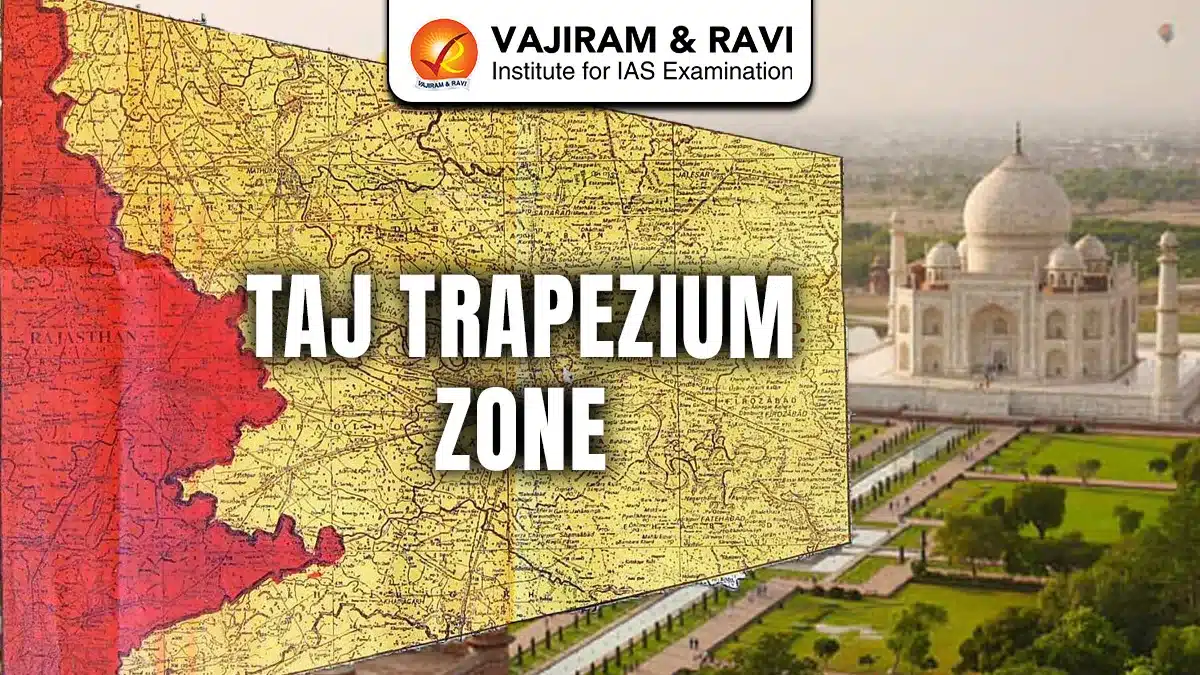
Taj Trapezium Zone (TTZ) is a defined area of 10,400 sq km around the Taj Mahal to protect the monument from pollution.
It spread across 10,400 sq km in Agra, Firozabad, Mathura, Hathras and Etah district, and Rajasthan's Bharatpur District. It comprises monuments including three World Heritage Sites, the Taj Mahal, Agra Fort and Fatehpur Sikri. Taj Trapezium Zone is so named since it is located around the Taj Mahal and is shaped like a trapezoid.
Taj Trapezium Zone Background
Taj Trapezium Zone was created by the supreme court in M.C. Mehta v. Union of India & Ors. Case 1996 in response to a public interest litigation (PIL) filed in supreme court to protect the Taj Mahal from environmental pollution. The Supreme Court banned the use of coal/ coke in industries located in the TTZ with a mandate for switching over from coal/ coke to natural gas, and relocating them outside the TTZ or shutting down. The Supreme Court also directed the creation of the Taj Trapezium Zone Pollution (Prevention and Control) Authority under the Environment (Protection) Act, 1986. The Authority was entrusted with regulating industrial activity, construction practices, vehicular emissions, and other pollution-generating sources in the ecologically sensitive Taj region.
Taj Trapezium Zone Industries Classification
For effective pollution control, industries under the Taj Trapezium Zone have been classified into four categories based on the pollution potential of industries namely Red, Orange, Green, and White.
Highly polluting industries under the Red category are strictly restricted, while only environmentally friendly, non-polluting small, tiny, and micro-scale industries are permitted to operate within the zone, ensuring a balance between conservation and limited economic activity.
The classification is based on a Pollution Index (PI), which considers water pollution, air pollution, and hazardous waste generation :
- Red Category (High Pollution Potential - PI ≥ 60) : These are highly polluting industries. Generally, no new, highly polluting red-category industries are permitted in the TTZ.
- Orange Category (Medium Pollution Potential - PI 41–59) : Moderately polluting industries.
- Green Category (Low Pollution Potential - PI 21–40) : Low pollution potential industries.
- White Category (Practically Non-Polluting - PI ≤ 20) : These industries are allowed to operate with mandatory intimation to the State Pollution Control Board (SPCB) and are considered environment-friendly.
Further in 2015, SC banned felling of trees within a 5 km aerial distance from the Taj Mahal without its prior permission of the Supreme Court.
Taj Trapezium Zone (TTZ) FAQs
Q1: What is the Taj Trapezium Zone (TTZ)?
Ans: TTZ is a 10,400 sq km protected area around the Taj Mahal created to prevent air and environmental pollution that could damage the monument.
Q2: Why is it called the “Taj Trapezium Zone”?
Ans: It is named so because the protected area around the Taj Mahal is trapezoidal in shape.
Q3: Which areas are covered under TTZ?
Ans: It spans parts of Uttar Pradesh—Agra, Firozabad, Mathura, Hathras and Etah districts—and Bharatpur district of Rajasthan.
Q4: Which important monuments lie within the TTZ?
Ans: It includes three UNESCO World Heritage Sites : Taj Mahal, Agra Fort, Fatehpur Sikri
Q5: Which case led to the creation of TTZ?
Ans: TTZ was created following the Supreme Court judgment in MC Mehta v. Union of India (1996) based on a Public Interest Litigation (PIL).
