
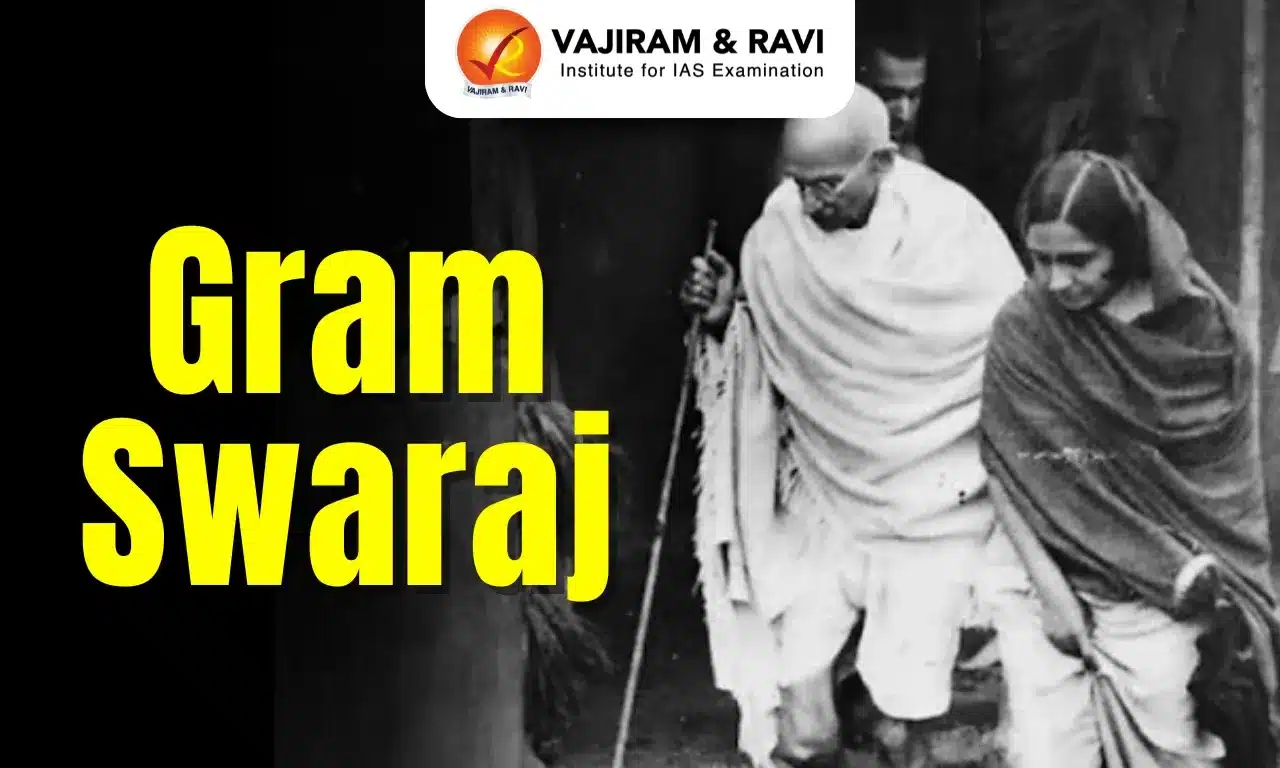
Gram Swaraj Latest News
- Recently a President of a prominent political party criticised the Union government for renaming the MGNREGS as VB-G RAM G ahead of Parliament’s Budget session.
- He alleged that the name change was an attempt to erase Mahatma Gandhi’s presence from public memory and weaken the idea of Gram Swaraj, or village self-rule.
Background to the Remarks on MGNREGS
- Origins of the Employment Guarantee Scheme - The MGNREGS was introduced in 2005 and notified in February 2006. Its objective was to provide basic livelihood security in rural India amid rising concerns, including farmer suicides.
- Addition of Mahatma Gandhi’s Name - The “Mahatma Gandhi” prefix was added to the scheme on October 2, 2009, linking it explicitly to Mahatma Gandhi’s philosophy of village self-reliance and rural empowerment.
- Recent Legislative Changes - In December 2025, the Union government introduced a Bill to repeal the MGNREGA and replace it with VB-G RAM G.
- Ideological Objection - The main opposition party criticised both the repeal and the removal of Gandhi’s name, arguing that it undermines Gandhi’s vision of Gram Swaraj, which emphasised rural self-sufficiency as central to the nation’s well-being.
Gram Swaraj: Gandhi’s Vision of Village Self-Rule
- Across his writings and actions, Mahatma Gandhi envisioned Gram Swaraj as the all-round development and self-reliance of villages.
- He believed excessive urbanisation harmed society and that cities had historically exploited villages, draining their resources and vitality.
- Critique of Urban-Centric Development
- In a June 23, 1946 writing, Gandhi argued that the growth of cities was “unfortunate for mankind,” stating that the prosperity of cities was built on the exploitation of villages.
- He wanted this flow reversed, so prosperity returned to rural India.
- From Thought to Action
- Gandhi’s ideas were reflected in practice.
- His first major satyagraha in Champaran (1917) addressed rural injustice, while Sevagram, the self-sufficient ashram he founded, served as a living experiment in rural self-reliance.
- Village Swaraj as a ‘Complete Republic’
- Writing in Harijan on July 26, 1942, Gandhi described Gram Swaraj as a “complete republic”—independent in meeting its basic needs but interdependent with others where necessary.
- Each village, he said, should prioritise growing its own food and cotton for clothing.
- Social Equality and Non-Violence
- Gandhi’s Gram Swaraj rejected caste hierarchies and graded untouchability.
- Non-violence, along with Satyagraha and non-cooperation, was to be the moral foundation of village life and governance.
- Democratic Village Governance
- Village administration, Gandhi proposed, should rest with a Panchayat of five members, elected annually by adult villagers—men and women alike—forming what he called a “perfect democracy based on individual freedom.”
- Equality Between Village and City
- In a November 13, 1945 letter to Jawaharlal Nehru, Gandhi stressed that every individual must have equal rights and opportunities, arguing for parity between villages and cities in India’s social and economic imagination.
- Together, these ideas form Gandhi’s vision of Gram Swaraj—an ethical, democratic, and self-sufficient village-centred model for India’s development.
What Happened to Gandhi’s Gram Swaraj Vision
- In the years after Independence, India’s development strategy prioritised urban and industrial growth.
- This widened the rural–urban divide and pushed large-scale migration to cities, often resulting in slum settlements and poor living conditions for rural migrants.
- Rural Policies, But Limited Transformation
- Rural-focused measures were not absent.
- Reforms such as the abolition of the Zamindari system (though uneven across states) and employment schemes like Jawahar Rojgar Yojana and the Employment Assurance Scheme sought to address rural distress.
- However, their impact was limited in creating sustained rural livelihoods.
- Infrastructure Gains Without Social Foundations
- While roads and electricity have reached many villages and improved daily life, quality education and healthcare have lagged.
- Persistent caste-based divisions and limited job opportunities mean migration often remains the best path to upward mobility.
- Demographic Change and Migration
- India remains predominantly rural, but the share of people living in villages has declined—from about 82% in 1960 to around 65% today—reflecting long-term migration trends driven by economic necessity.
- Missing Push for Rural Entrepreneurship
- Rural entrepreneurship has not received the policy backing needed to generate large-scale employment.
- As a result, villages remain dependent on external job markets rather than becoming self-sustaining economic units.
- Decentralisation Without True Devolution
- Although the 73rd Constitutional Amendment gave constitutional status to Panchayati Raj institutions, real self-reliance—as envisioned by Gandhi—has remained elusive.
- Financial, political, and administrative powers largely remain concentrated at higher levels of government.
- Mixed Results from Village-Centric Initiatives
- Activists and leaders have attempted grassroots change with mixed outcomes.
- In 2014, PM Modi launched the Sansad Adarsh Gram Yojana, urging MPs to adopt and develop villages.
- However, most MPs showed limited engagement, curbing its impact.
- The Core Constraint: Political Will
- Genuine devolution of power continues to depend on the willingness of higher authorities to relinquish control.
- Without this shift, policy measures and funding alone are insufficient to realise village self-rule.
- A Lifelong Project
- As Mahatma Gandhi himself acknowledged, building a truly self-sufficient village could take a lifetime.
- For India’s 6.74 lakh villages, his vision of Gram Swaraj remains an unfinished and long-term endeavour.
Gram Swaraj FAQs
Q1: What did Gandhi mean by Gram Swaraj?
Ans: Gram Swaraj was Gandhi’s vision of self-reliant villages with local democracy, economic independence, social equality, and panchayat-based governance forming the foundation of India’s development.
Q2: Why did Gandhi oppose urban-centric development under Gram Swaraj?
Ans: Under Gram Swaraj, Gandhi believed cities exploited villages, drained their resources, and created inequality, arguing that prosperity must return to villages for national well-being.
Q3: How was Gram Swaraj reflected in Gandhi’s actions?
Ans: Gram Swaraj shaped Gandhi’s work in Champaran, his writings in Harijan, and the establishment of Sevagram as a living experiment in village self-sufficiency.
Q4: Why did Gram Swaraj weaken after Independence?
Ans: Gram Swaraj weakened as India prioritised industrialisation and urban growth, widening rural–urban gaps, encouraging migration, and limiting sustained investment in rural livelihoods.
Q5: Why has Gram Swaraj remained unfulfilled despite decentralisation?
Ans: Gram Swaraj remains unfulfilled because genuine financial, political, and administrative devolution has not occurred, with higher authorities reluctant to relinquish control to local institutions.
