
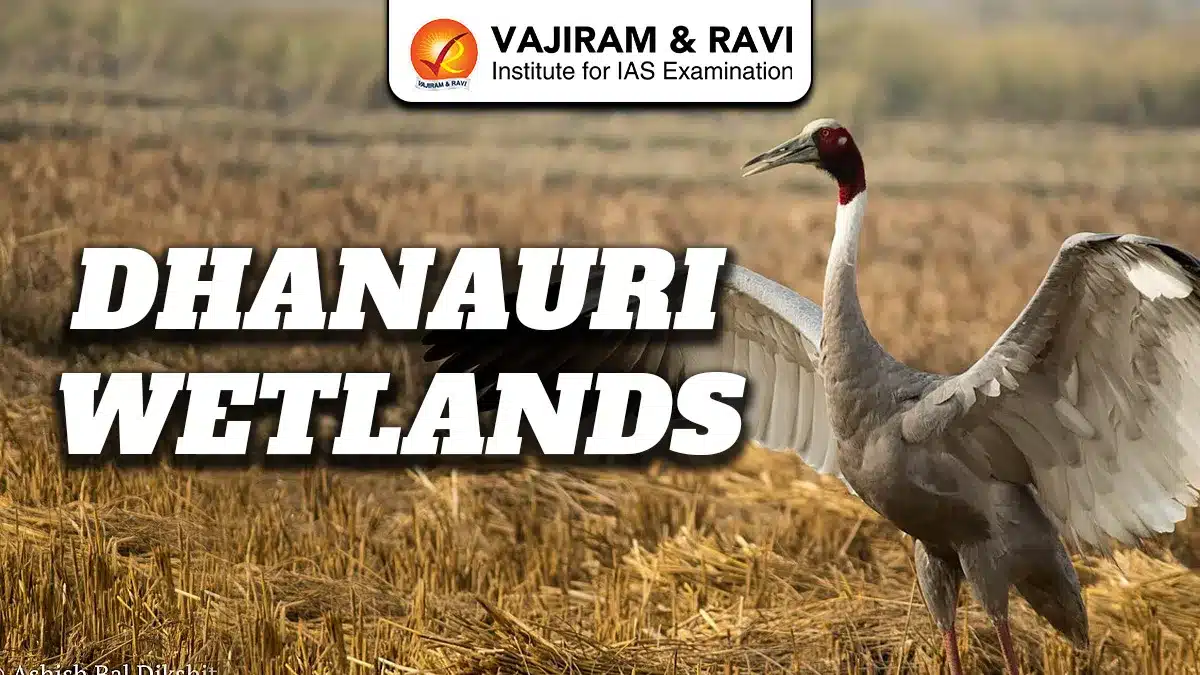
Dhanauri Wetlands is an important bird-watching and conservation area located in Dhanauri village near Dankaur, Uttar Pradesh. It is widely known for being a safe habitat for the Sarus crane, the state bird of Uttar Pradesh. Over the years, Dhanauri has emerged as one of North India’s most significant natural wetlands due to its rich biodiversity and ecological value.
Dhanauri Wetlands
- Location: Dhanauri village near Dankaur, Gautam Buddha Nagar district, Uttar Pradesh
- Conservation Status: A natural wetland recognized as an Important Bird Area (IBA) by BirdLife International and documented by the Bombay Natural History Society (BNHS)
- Hosts a Variety of Bird Species, Including: Common teal, Mallard, Northern pintail, Greylag geese, Bar-headed geese, Woolly-necked stork, Black-necked stork, Painted stork and Eurasian marsh harrier
Dhanauri Wetlands Significance
Dhanauri Wetlands is an ecologically important natural wetland in Uttar Pradesh that supports rich biodiversity, especially the Sarus crane, the state bird. It plays a vital role in conserving endangered bird species and supporting large migratory bird populations.
- Serves as a key habitat for the Sarus crane, with over 150 individuals recorded, aiding species conservation.
- Hosts more than 217 bird species, including resident and migratory birds.
- Provides shelter to 23 endangered, critically endangered, and threatened bird species.
- Acts as an important nesting, breeding, and feeding ground for waterbirds.
- Supports over 50,000 migratory waterfowls during peak migration season (November–March).
- Recognized as an Important Bird Area (IBA) by BirdLife International.
- Documented by the Bombay Natural History Society (BNHS) for its high ecological value.
- Helps in maintaining local ecological balance, groundwater recharge, and flood control.
- Meets several Ramsar Wetland criteria, strengthening its case for international recognition.
Ramsar Wetlands
- The Ramsar Convention, also called the Convention on Wetlands, is an international environmental treaty established in 1971 under UNESCO.
- It is named after Ramsar city in Iran, where the convention was first signed.
- Ramsar sites are wetlands recognized for their global ecological importance under this convention.
- The Montreux Record is a list of Ramsar sites facing ecological threats and requiring special monitoring and conservation efforts.
Ramsar Site Designation Criteria
A wetland is designated as a Ramsar Site based on the following criteria:
- Represents rare, unique, or natural wetland types.
- Supports endangered or threatened species or ecological communities.
- Maintains biodiversity in specific biogeographic regions.
- Provides refuge to species during adverse environmental conditions.
- Regularly supports 20,000 or more waterbirds.
- Sustains at least 1% of the population of a single waterbird species.
- Serves as an important source of food, spawning ground, nursery, or migration route for fish.
Regularly supports 1% of the population of non-avian wetland-dependent animal species.
Dhanauri Wetlands FAQs
Q1: What is Dhanauri Wetlands?
Ans: Dhanauri Wetlands is a natural bird habitat located near Dankaur in Uttar Pradesh, known for its rich bird diversity and Sarus cranes.
Q2: Where is Dhanauri Wetlands located?
Ans: It is located in Dhanauri village near Dankaur in Gautam Buddha Nagar district of Uttar Pradesh.
Q3: Why is Dhanauri Wetlands famous?
Ans: It is famous for hosting a large population of Sarus cranes, the state bird of Uttar Pradesh.
Q4: How many bird species are found in Dhanauri Wetlands?
Ans: More than 217 bird species have been recorded in the wetland.
Q5: What is the importance of Sarus cranes in Dhanauri Wetlands?
Ans: Dhanauri provides a safe breeding and nesting habitat for over 150 Sarus cranes.
