Jal Jeevan Mission Latest News
- A 2024 government-commissioned survey revealed that while nearly 98% of rural households have tap connections under the Jal Jeevan Mission, only about three-fourths receive a reliable and safe water supply.
Overview of Jal Jeevan Mission
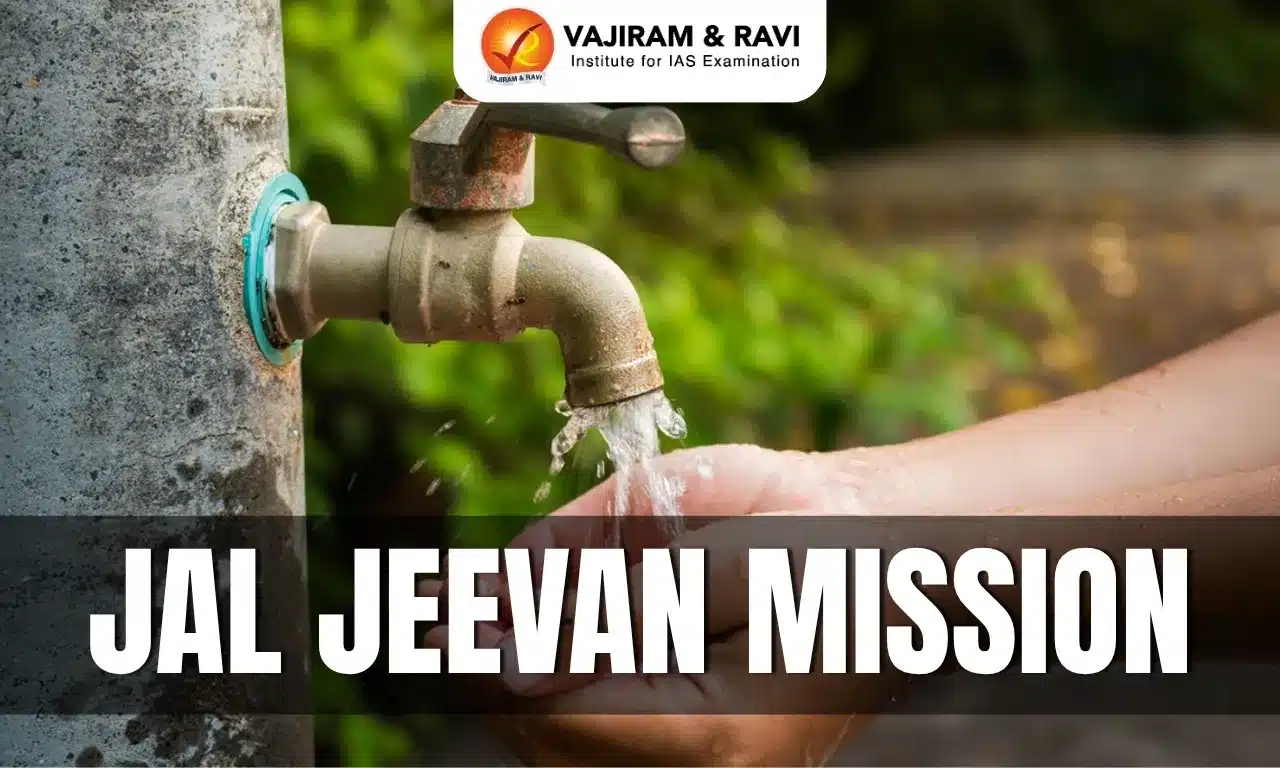
- The Jal Jeevan Mission (JJM), launched in 2019, is a flagship programme of the Government of India aimed at providing Functional Household Tap Connections (FHTCs) to all rural households.
- The scheme seeks to ensure 55 litres of potable water per person per day on a regular basis, with an emphasis on water quality, sustainability of sources, and community participation.
- Unlike earlier water supply programmes that focused primarily on infrastructure creation, JJM adopts a service delivery approach, where functionality, water quality, and regularity are central performance indicators.
- The mission is implemented in partnership with States, with funding shared between the Centre and States.
Current Status of Rural Tap Water Coverage
- According to official data, the Jal Jeevan Mission has expanded tap water coverage at an unprecedented scale.
- From less than 20% rural coverage in 2019, India has reached close to universal household tap connectivity by 2024-25.
- States such as Goa, Gujarat, Andhra Pradesh, and several Union Territories report over 97% tap availability.
- As of early 2026, more than 2.7 lakh villages have been certified as “Har Ghar Jal” villages, indicating that all households and public institutions in these villages have tap connections.
- However, coverage certification is largely based on infrastructure availability and does not always reflect actual water delivery or quality.
Functionality and Water Quality Concerns
- The core objective of the Jal Jeevan Mission is not merely tap installation but a functional and safe water supply.
- The recent Functionality Assessment of Household Tap Connections highlights significant gaps in this regard.
- Only 83% of surveyed households reported receiving water through taps at least once in the previous seven days.
- Even fewer households consistently received the prescribed 55 litres per capita per day, with just 80% meeting the quantity norm.
- Water quality emerged as a critical concern. Tests for E. coli, faecal coliform, and pH levels showed that only 76% of households received water meeting basic safety standards. When availability, regularity, and quality were assessed together, only three-fourths of households were found to be benefiting from the scheme as intended.
Regional Variations in Performance
- The survey revealed sharp inter-State variations. While coastal and better-performing States recorded high functionality, States such as Bihar, Uttar Pradesh, Nagaland, and Sikkim lagged behind on water availability and quantity benchmarks.
- For instance, Bihar reported water flow in only about 61% of households, while Sikkim showed particularly low compliance with per capita water supply norms.
- These disparities underline differences in source sustainability, groundwater availability, terrain, and institutional capacity at the State and district levels.
Financial and Implementation Challenges
- The Jal Jeevan Mission is among the most resource-intensive welfare programmes undertaken by India.
- Since 2019, over Rs. 3.6 lakh crore has been spent on rural water infrastructure.
- However, recent budgetary trends indicate underutilisation of allocated funds, with actual expenditure falling significantly short of provisions in some years.
- The original target of achieving 100% functional coverage by 2024 has now been extended to 2028, acknowledging the complexity of last-mile delivery, operation and maintenance, and source sustainability challenges.
- Estimates suggest that the remaining uncovered and non-functional households may require nearly Rs. 4 lakh crore in additional investment.
Institutional and Monitoring Framework
- To address implementation gaps, the Jal Jeevan Mission relies on multiple monitoring tools, including third-party surveys, village-level water committees, and real-time dashboards.
- The functionality assessment survey conducted in 2024 covered over 2.3 lakh households across certified Har Ghar Jal villages, offering a more nuanced picture beyond official coverage figures.
- However, the Ministry has cautioned that results are not directly comparable with earlier assessments due to changes in methodology and survey scope.
Way Forward for Sustainable Rural Water Supply
- Ensuring the long-term success of the Jal Jeevan Mission requires a shift from infrastructure expansion to system sustainability.
- Key priorities include strengthening local operation and maintenance mechanisms, improving water source recharge, enhancing water quality surveillance, and empowering Panchayats and user committees.
- Greater emphasis on climate-resilient water planning, especially in water-stressed regions, and integration of JJM with sanitation, groundwater management, and health programmes will be essential to translate tap coverage into real welfare gains.
Source: TH
Jal Jeevan Mission FAQs
Q1: What is the primary objective of the Jal Jeevan Mission?
Ans: To provide functional household tap connections with safe drinking water to all rural households.
Q2: What percentage of rural households currently have tap connections?
Ans: About 98% of rural households have tap connections under the scheme.
Q3: How many households receive water meeting quality standards?
Ans: Only around 76% receive water that meets basic quality parameters.
Q4: What is the prescribed water supply norm under JJM?
Ans: 55 litres of potable water per person per day.
Q5: By when has the Jal Jeevan Mission target been extended?
Ans: The target for full functional coverage has been extended to 2028.

