
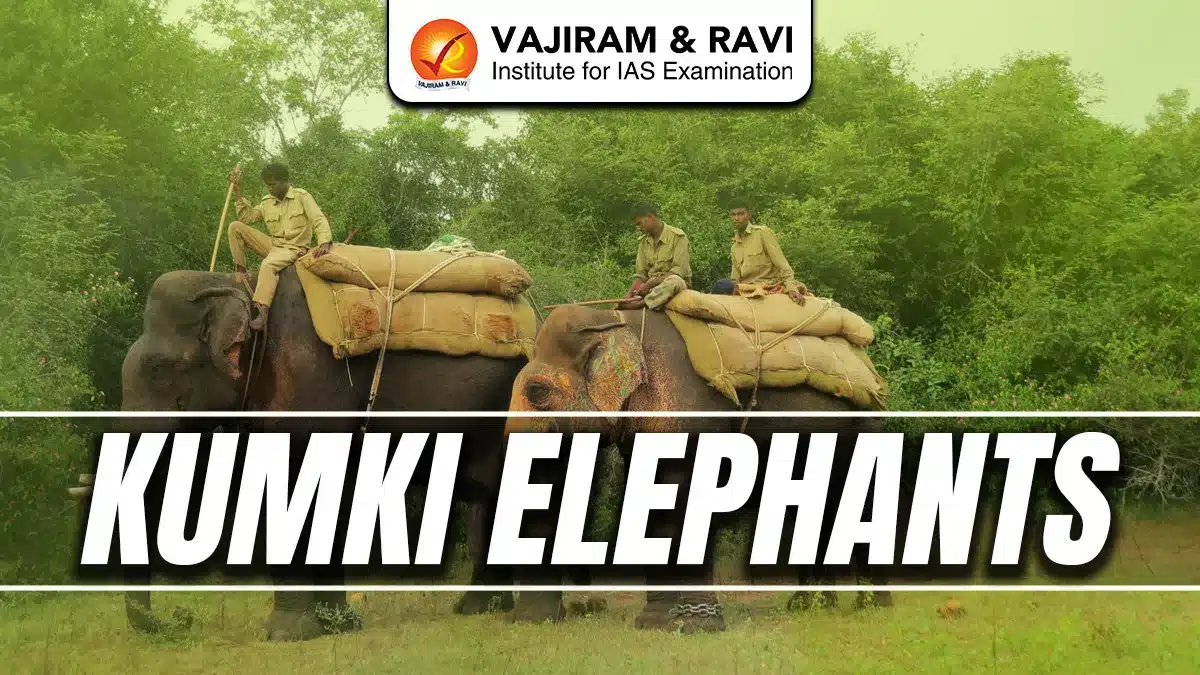
Kumki elephants are trained Asian elephants, used to tame and capture wild elephants. They even help in rescue operations and patrolling safeguarding both the human and wildlife conflicts and interests.
About Kumki Elephant
- The word “Kumki” is derived from Persian word Kumak which means “aid”
- They are trained and domesticated for the purpose of trapping the wild elephants, providing medical aid to injured or trapped wild elephants.
- They are also used to capture, calm and lead wild elephants away from the conflict situation.
- Whenever wild elephants enter human settlements, Kumki elephants are often used to drive them away.
- They are well trained by their Mahouts to follow their foot commands and move silently through the conflict area.
Why was there a need for a Kumki Elephant?
- The increased human-elephant conflict has significantly led to a rise in the number of human fatalities and injuries, thus to control or drive away aggressive elephants, they play a vital role.
- Sometimes elephants get lost from their herd and get trapped or injured, to their rescue comes the Kumki elephant.
- Cost-effective as using trained elephants is more safer than using force or weaponry.
Asian Elephants
- Scientific name: Elephas Maximus
- IUCN Status: Endangered
- Protection: Wildlife (Protection) Act 1972 Schedule I; CITES: Appendix 1
- Habitat: Grasslands, Scrublands, Tropical deciduous forest and Evergreen forests
- Geographical distribution: Indian subcontinent and South-east Asian countries
- Size and appearance: Smaller than African elephants with Twin-domed head, small rounded ears and convex body
- Only male have tusks, while females usually do not have tusks.
- They are a Matriarchal herd usually led by older females.
- The gestation period is about 18-22 months.
- Lifespan: can live up to 65 years
- Significance: Elephants are the Keystone species of the forest ecosystem, maintaining the ecological balance.
Initiatives by India
- India is home to 60% the world’s Asian Elephants.
- MoEFCC launched Project Elephant in 1992 in order to protect elephants, their habitats and their migration corridors.
- India has dedicated 33 Elephant Reserves spanning across 14 states.
- Recently the Wildlife Institute of India (WII) conducted India’s first DNA-based census and released the ‘Status of Elephants in India’ report, estimating 22,446 elephants.
- Western Ghats (Kerala, Karnataka and Tamil Nadu) alone account for 53.17% of India’s elephants.
- Project RE-HAB (Reducing Elephant-Human Attacks using Bees) initiated by Khadi and Village Industries Commission (KVIC) to create “bee-fences” to deter elephants from entering human settlements, thus reducing fatalities from both sides.
- Elephant Species
Elephants are the largest land mammals on earth and have distinctly massive bodies, large ears, and long trunks. There are main 3 subspecies of elephants, two genetically distinct African species and Asian species, their characteristics are as follows:
| Elephant Species | |
|
Species |
Features |
|
|
|
|
|
|
Major threats to Elephants
- Wildlife crime, especially poaching for illegal ivory trade, is the biggest threat to African elephants.
- Habitat loss is the main challenge for Asian elephants, leading to frequent human–elephant conflict.
- Expanding agriculture, settlements, roads, canals, and fencing are fragmenting elephant habitats and blocking migration routes.
- Further the weak enforcement of Wildlife acts encourages the wildlife crimes to continue.
- The increasing effects of climate change has reduced the water and food availability, thus threatening their survival.
Kumki Elephant FAQs
Q1: What is a Kumki Elephant?
Ans: Kumki Elephants are trained and domesticated Asian elephants.
Q2: Why are Kumki elephants needed?
Ans: Kumki elephants help in controlling aggressive and wild elephants, rescue operations and patrolling of forests.
Q3: What is the Conservation status of Asian elephants?
Ans: Asian elephants are classified as Endangered and protected under CITES Appendix I and WPA, 1972 Schedule I.
Q4: Why are they considered as Keystone species?
Ans: They are considered as Keystone species as they ecological balance, disperse seeds, thus protect forests and grasslands.
Q5: What are the major threats to the Elephants?
Ans: The major threats are poaching and illegal ivory trade, habitat loss, human-elephant conflicts and weak law enforcement.
