
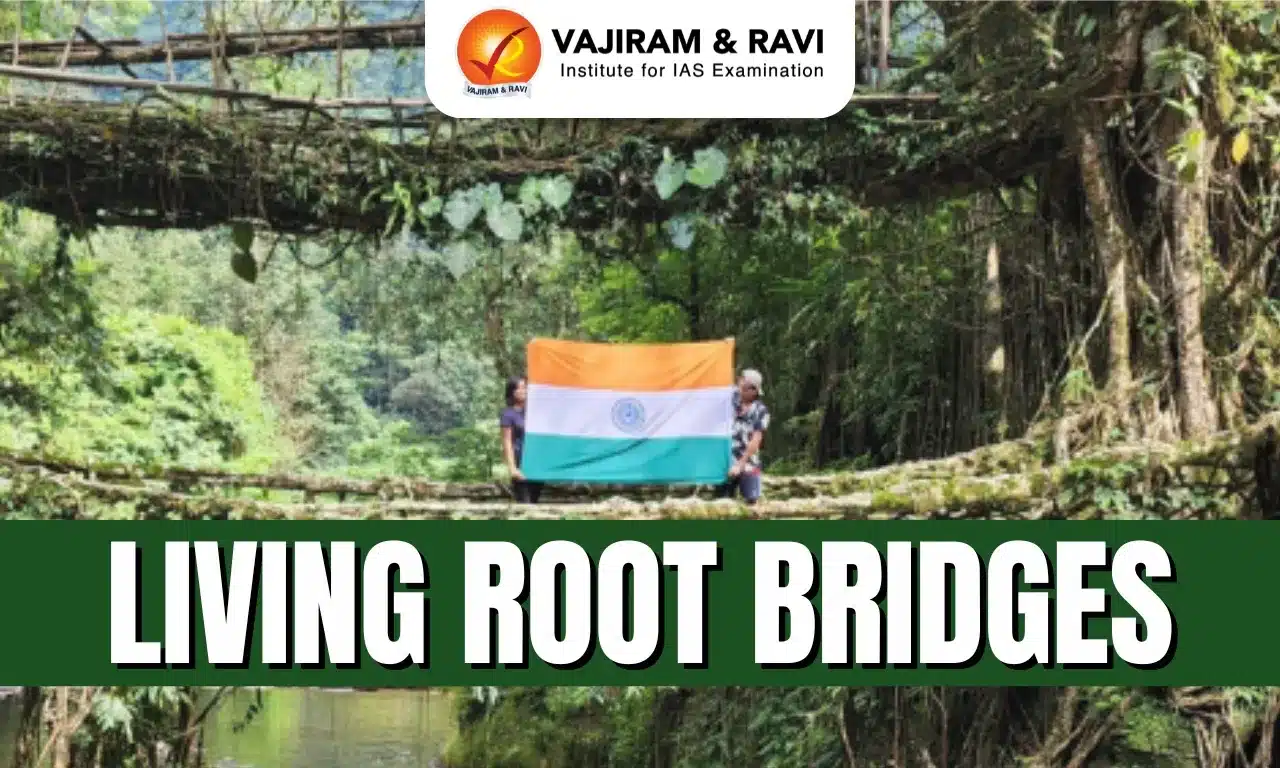
Living Root Bridges Latest News
Recently, India submitted Meghalaya’s living root bridges to UNESCO for World Heritage status.
About Living Root Bridges
- The living root bridges are locally known as Jingkieng Jri or Lyu Chrai.
- These are nestled across the lush southern slopes of the Khasi and Jaintia Hills in Meghalaya.
- These are masterpieces of bioengineering created by indigenous communities.
- These are grown by indigenous Khasi and Jaintia tribes over a time period of 15 to 30 years.
- These bridges range in span from 15 feet to 250 feet, and last for several centuries.
Construction of Living Root Bridges
- The bridges are grown by methods of tree-shaping using the aerial roots of Ficus Elastica (Rubber fig tree/Indian rubber tree).
- The underlying growth process involves recurring inosculation (joining by twining) of Ficus aerial root fibres over a gorge or river.
- The process begins with placing of young pliable aerial roots in hollowed Areca catechu trunks.
- These provide essential nutrition and protection from the weather, and also perform as root guidance systems.
- This assemblage is structurally supported by a bamboo scaffold, which spans the river and performs as a temporary river crossing for the local community.
- Over time, as the aerial roots increase in strength and thickness, the Areca catechu trunks are no longer required.
Source: News On Air
Living Root Bridges FAQs
Q1: What are living root bridges locally known as?
Ans: They are locally known as Jingkieng Jri or Lyu Chrai.
Q2: Where are living root bridges found in India?
Ans: They are found on the southern slopes of the Khasi and Jaintia Hills in Meghalaya.
Q3: Which communities create living root bridges?
Ans: They are created by indigenous Khasi and Jaintia tribes.
Q4: Why are living root bridges considered masterpieces of bioengineering?
Ans: Because they are grown from living tree roots using traditional knowledge over several decades.
Q5: How long does it take to grow a living root bridge?
Ans: It takes about 15 to 30 years to grow a living root bridge.
