
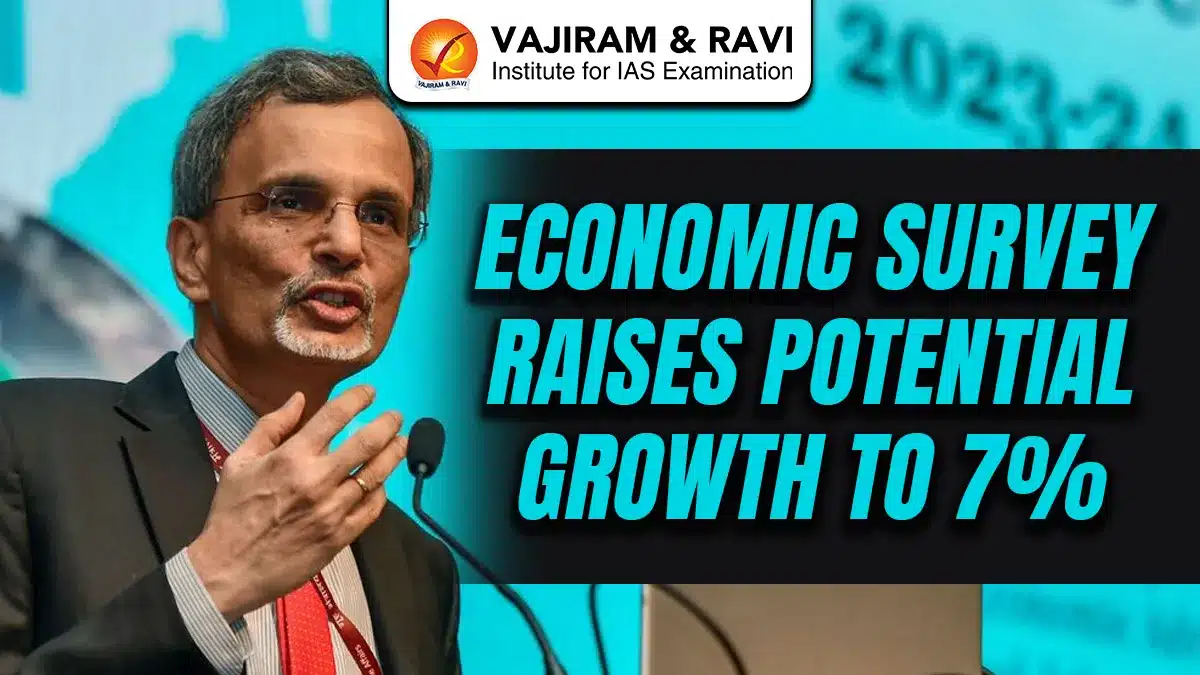
Potential Growth Latest News
- The latest Economic Survey, led by V Anantha Nageswaran, has reassessed India’s long-term economic prospects and raised the country’s potential growth rate from 6.5% to 7%.
- This reassessment comes amid an active debate on India’s current GDP growth trajectory and reflects the Survey’s view of improved structural and medium-term growth capacity of the economy.
What Is Potential Economic Growth and Why It Matters
- A country’s potential growth rate differs from its annual GDP growth.
- While GDP growth measures how fast the economy expands in a given year, potential growth shows the pace at which it can grow without causing high inflation.
- If growth exceeds this level, demand outstrips supply and prices rise; if it falls below, resources remain underused.
- Therefore, to achieve sustainably higher growth, governments must focus on raising the economy’s potential growth rate, not just boosting short-term demand.
What Determines a Country’s Potential Growth Rate
- Capital Stock - Potential growth depends on the size and quality of physical assets—such as roads, bridges, ports, factories, and machinery—that support production and expansion in the economy.
- Labour Input - This includes not just the number of workers, but also their skills, productivity, and capacity, which directly influence how much an economy can produce.
- Total Factor Productivity (TFP) - TFP reflects how efficiently labour and capital are used together. Higher efficiency allows faster growth without inflationary pressure.
India’s Declining Potential Growth: The Trend
- Research by the Reserve Bank of India shows that India’s potential growth rate has declined over time:
- 2003–2008: around 8%, India’s highest growth phase
- 2009–2015: fell to 7%
- Around the Covid-19 period: declined further to 6.5%, as acknowledged by the Chief Economic Adviser.
- This decline underscores the need for sustained reforms to rebuild long-term growth capacity.
Why the Economic Survey Sees Higher Potential Growth
- Reforms Lifting Medium-Term Growth - The Chief Economic Adviser notes that the cumulative impact of recent policy reforms has raised India’s medium-term potential growth to around 7%, reversing earlier declines.
- Manufacturing and Supply-Side Push - Key reforms over the past three years—PLI schemes, FDI liberalisation, and logistics improvements—have strengthened manufacturing capacity and boosted the economy’s ability to expand supply.
- Labour Market Improvements - Measures such as labour law consolidation, lower regulatory compliance, and state-level reforms, along with investments in education, skilling, and apprenticeships, have reduced labour market frictions and improved employability.
- Conditions for Sustained Gains - The Survey stresses that credible increases in potential growth require persistent reforms and macroeconomic stability—conditions it says India currently meets.
- The Caveat: External Risks - Despite domestic strengths, the Survey cautions that geopolitical conflicts and global disruptions could still constrain India’s ability to fully realise its growth potential.
Source: IE
Potential Growth FAQs
Q1: What does potential growth mean in the Economic Survey?
Ans: Potential growth refers to the maximum sustainable growth rate an economy can achieve without triggering high inflation, unlike annual GDP growth which fluctuates year to year.
Q2: Why did India’s potential growth decline earlier?
Ans: India’s potential growth fell from 8% to 6.5% over two decades due to weaker productivity gains, slowing investment, labour market frictions, and efficiency losses highlighted by RBI research.
Q3: Why has potential growth been raised to 7% now?
Ans: The Economic Survey says cumulative reforms over recent years have strengthened supply capacity, lifting India’s medium-term potential growth closer to 7%.
Q4: Which reforms contributed to higher potential growth?
Ans: Manufacturing-focused reforms like PLI schemes, FDI liberalisation, logistics improvements, and labour law consolidation have boosted India’s productive capacity and potential growth.
Q5: What risks could limit India’s potential growth?
Ans: Despite domestic reforms and stability, geopolitical conflicts, global disruptions, and external shocks could prevent India from fully realising its higher potential growth.
