Exercise Agni Pariksha

Exercise Agni Pariksha

Exercise Agni Pariksha Latest News

The Indian Army and Indo-Tibetan Border Police recently conducted Agni Pariksha in Arunachal Pradesh to enhance joint combat capabilities.

About Exercise Agni Pariksha

  • It is a joint training exercise involving personnel from the Indian Army and the Indo-Tibetan Border Police (ITBP).
  • Location: Arunachal Pradesh
  • This first-of-its-kind initiative aimed to enhance inter-force combat synergy and operational integration. 
  • It witnessed spearhead gunners of Spear Corps, along with personnel from artillery regiment, infantry battalions, and the ITBP, participating in a unique collaborative firepower training initiative validated through live artillery firing.
  • The primary objective of the exercise was to familiarise non-artillery personnel with artillery procedures, coordination mechanisms, and the execution of firing missions, thereby improving their understanding of firepower integration in dynamic combat scenarios.
  • During the training, participating infantry and ITBP personnel were systematically trained to independently undertake multiple artillery firing drills under the close supervision and guidance of experienced Spearhead Gunners.

Source: HANS

Exercise Agni Pariksha FAQs

Q1: What is Exercise Agni Pariksha?

Ans: It is a joint training exercise involving personnel from the Indian Army and the Indo-Tibetan Border Police (ITBP).

Q2: Where was Exercise Agni Pariksha conducted?

Ans: It was conducted in Arunachal Pradesh.

Q3: What was the primary objective of Exercise Agni Pariksha?

Ans: To familiarise non-artillery personnel with artillery procedures, coordination mechanisms, and firing mission execution.

Zapotec Civilization

Zapotec Civilization

Zapotec Civilization Latest News

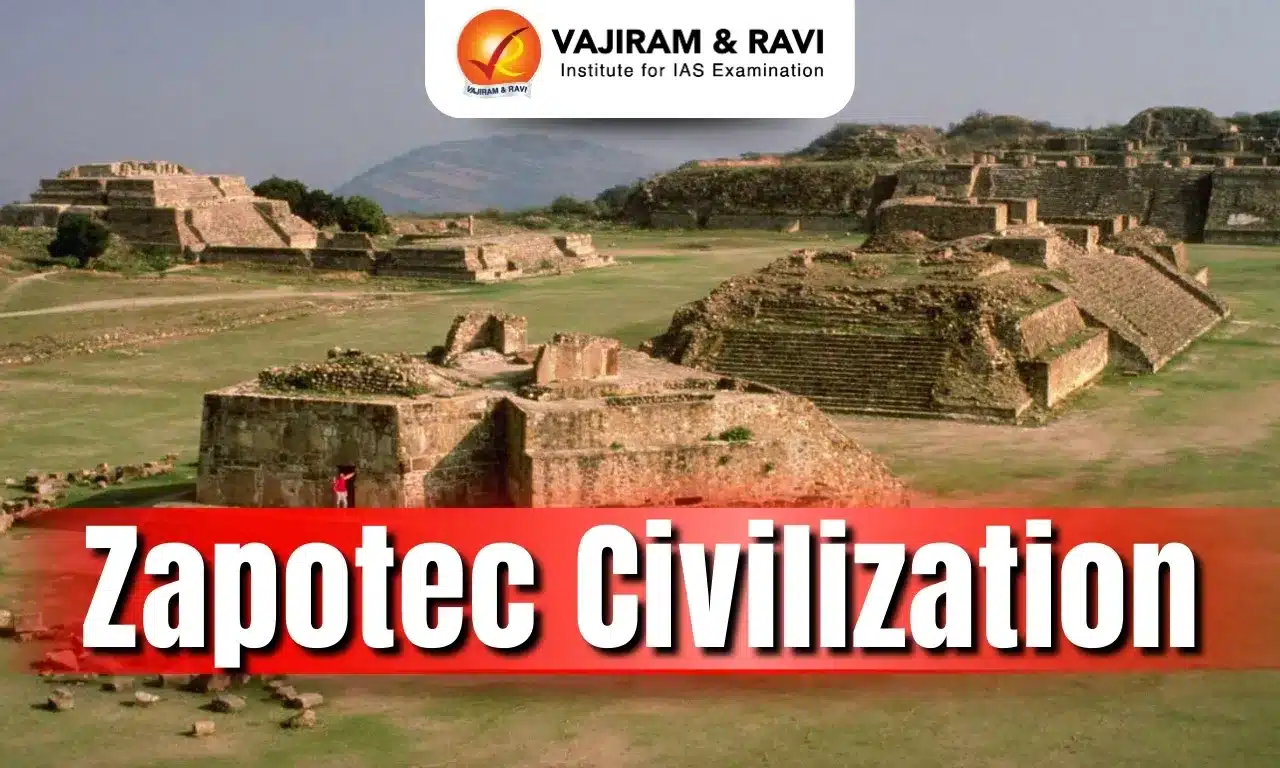
Archaeologists in Mexico recently discovered a 1,400-year-old tomb from the Zapotec culture that features well-preserved details, including a sculpture of a wide-eyed owl with a man in its beak, multicolored murals and calendrical carvings.

About Zapotec Civilization

  • The Zapotec civilization thrived in the Valley of Oaxaca, Mexico, characterized by its high elevation and reliance on irrigation from the Atoyac River and its tributaries. 
  • Emerging from hunter-gatherer societies, the Zapotecs transitioned to agriculture, developing skills in weaving, pottery, and stone masonry.
  • By the Classic period (200 BCE-100 CE), they established a highly centralized state, with Monte Albán as their capital, featuring impressive public architecture and a distinct social hierarchy separating nobles from commoners. 
  • This society was marked by a professional priesthood and a state religion, where rituals included human sacrifice and complex ceremonies. 
  • The Zapotecs also innovated in calendar systems and writing, contributing to Mesoamerican culture. 
  • The Zapotec state was one of the earliest examples of centralized government in Mesoamerica. 
  • It was also one of the first to experience the drawbacks of urban living, particularly the need to conquer others in order to obtain sufficient food to sustain an urban civilization. 
  • The civilization's art and architecture reflect a deep intertwining of religion and political power, influencing subsequent cultures like the Mixtec and Aztec civilizations.
  • Decline
    • Decline around 900 CE shifted the capital to Mitla and later Zaachila. 
    • Conflicts with the Aztecs in the 15th century and submission to Spanish rule in 1521 highlight their resilience amid conquests.
    • Today, their descendants preserve languages and traditions, making the Zapotec legacy a living part of Oaxaca’s cultural tapestry.

Source: LS

Zapotec Civilization FAQs

Q1: Where did the Zapotec civilization thrive?

Ans: The Zapotec civilization thrived in the Valley of Oaxaca in Mexico.

Q2: What was the capital of the Zapotec state?

Ans: Monte Albán was the capital.

Q3: What were the major features of Monte Albán?

Ans: It featured impressive public architecture and a distinct social hierarchy

Q4: How was Zapotec society socially structured?

Ans: Society was divided into nobles and commoners.

Q5: What type of religious system existed among the Zapotecs?

Ans: They had a state religion led by a professional priesthood.

Cytoplasm

Cytoplasm

Cytoplasm Latest News

Early development across vertebrates and insects critically relies on robustly reorganizing the cytoplasm of fertilized eggs into individualized cells.

About Cytoplasm

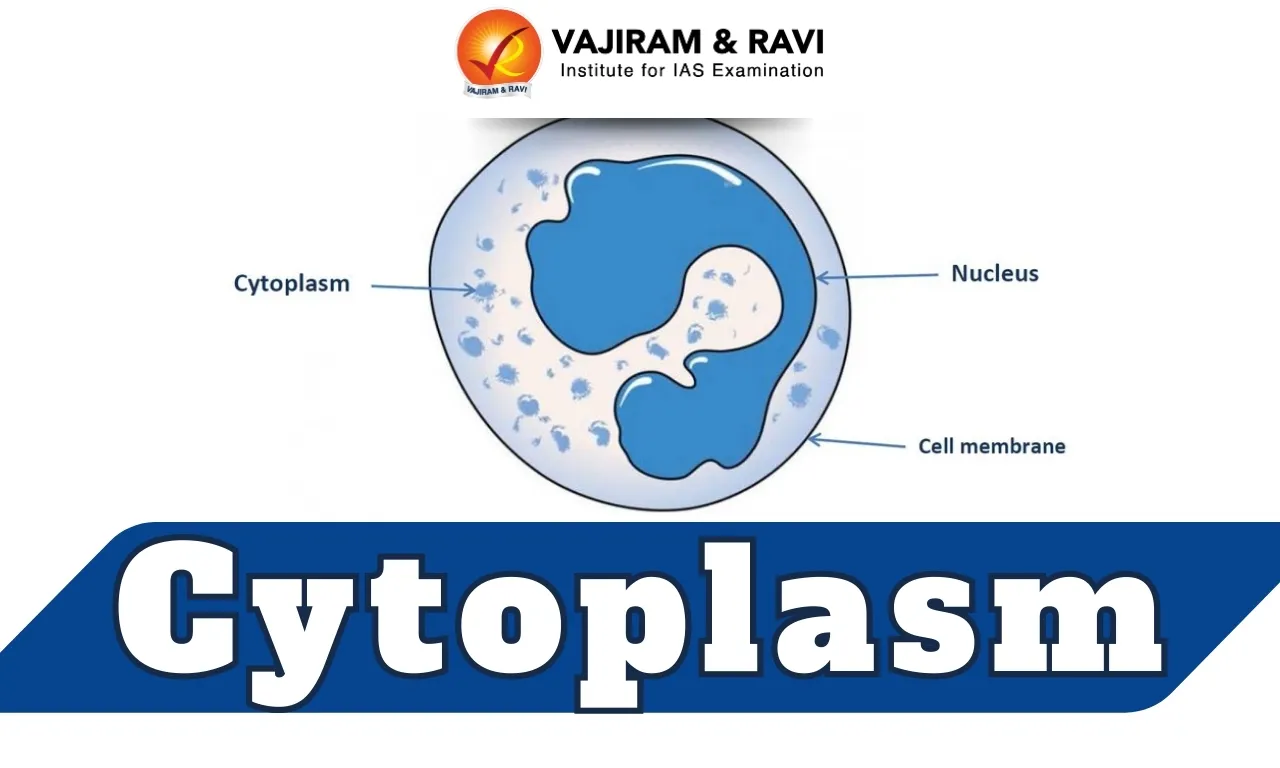
  • Cytoplasm is a thick solution that fills each cell and is enclosed by the cell membrane. 
  • It is mainly composed of water, salts, and proteins. 
  • In eukaryotic cells (i.e., cells having a nucleus), the cytoplasm includes all of the material inside the cell but outside the nucleus, which contains its own watery substance called nucleoplasm. 
  • All of the organelles in eukaryotic cells are located in the cytoplasm. The cytoplasm helps to keep them in place.
    • Among such organelles are the mitochondria, which are the sites of energy production through ATP (adenosine triphosphate) synthesis
    • the endoplasmic reticulum, the site of lipid and protein synthesis; 
    • the Golgi apparatus, the site where proteins are modified, packaged, and sorted in preparation for transport to their cellular destinations; 
    • lysosomes and peroxisomes, sacs of digestive enzymes that carry out the intracellular digestion of macromolecules such as lipids and proteins; 
  • The portion of the cytoplasm surrounding organelles is called cytosol, which is the liquid part of the cytoplasm. 
    • It is composed of about 80 percent water and also contains dissolved salts, fatty acids, sugars, amino acids, and proteins such as enzymes
    • These dissolved substances are needed to keep the cell alive and carry out metabolic processes.
  • Cytoplasm is also the site of most metabolic activities in the cell, and it allows materials to pass easily throughout the cell.
  • Although cytoplasm may appear to have no form or structure, it is actually highly organized. 
    • A framework of protein scaffolds called the cytoskeleton provides the cytoplasm and the cell with their structure.
  • Though prokaryotic cells do not have organelles (they do have ribosomes), they still have cytoplasm.

Source: NT

Cytoplasm FAQs

Q1: What is cytoplasm?

Ans: Cytoplasm is a thick solution that fills each cell and is enclosed by the cell membrane.

Q2: What are the main components of cytoplasm?

Ans: Cytoplasm is mainly composed of water, salts, and proteins.

Q3: What is the watery substance inside the nucleus called?

Ans: It is called nucleoplasm.

Q4: Where are the organelles of eukaryotic cells located?

Ans: All organelles are located in the cytoplasm.

Q5: What is cytosol?

Ans: Cytosol is the liquid part of the cytoplasm surrounding the organelles.

Diplocentrum Papillosum

Diplocentrum Papillosum

Diplocentrum Papillosum Latest News

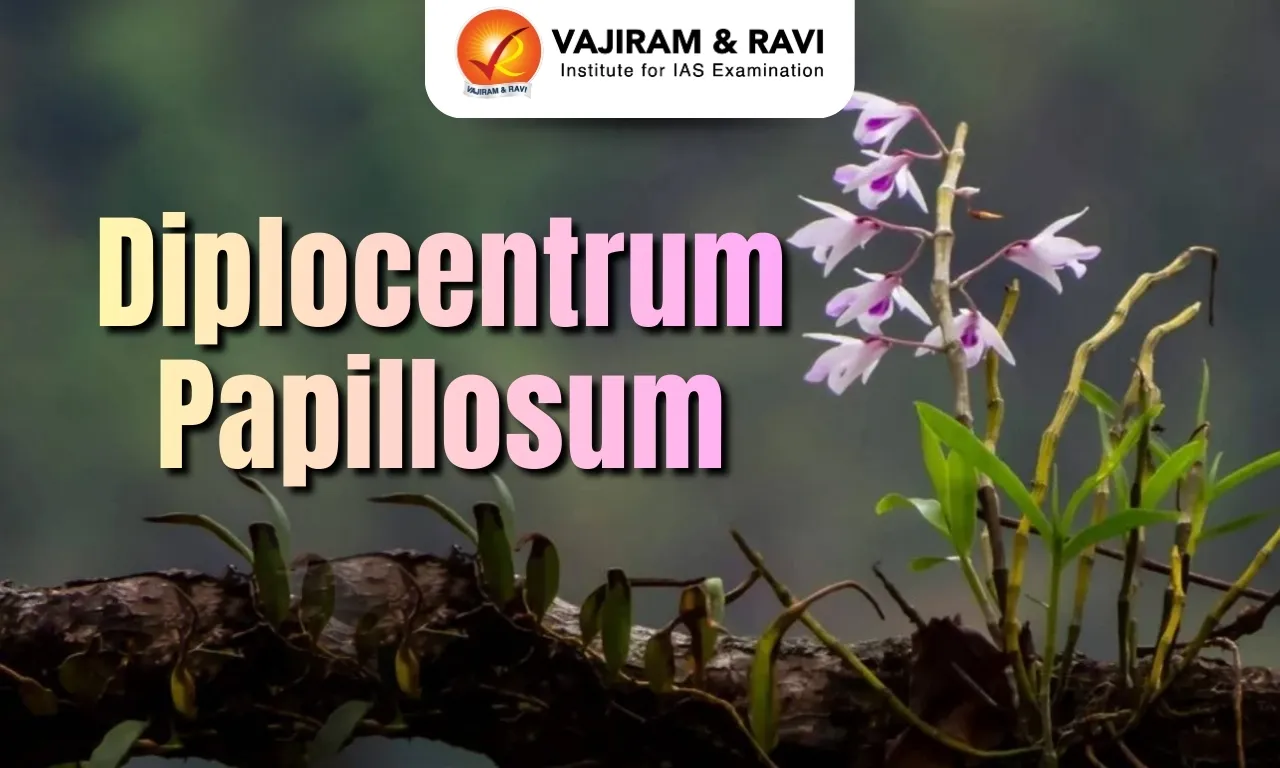
A new orchid species named Diplocentrum papillosum has been recently discovered in Kanthalloor, Marayoor, in the Idukki district, Kerala.

About Diplocentrum Papillosum

  • It is a new species of orchid.
  • It was discovered in the Idukki district, Kerala.
  • Belonging to the Diplocentrum genus, which is found only in the southern ranges of the Western Ghats, the plant has been scientifically named Diplocentrum papillosum, distinguished by the unique characteristics of its flowers.
  • This orchid thrives on rocks and tree branches, with strong roots that help it withstand powerful winds.
  • The specific epithet ‘papillosum’ refers to the papillose character of the flower, which is unique to the Diplocentrum species. 
  • Its unbranched flower clusters, pink and white blooms, and distinctively shaped petals set it apart from other species in the genus.
  • The flowers are both fragrant and visually striking.

Source: ONM

Diplocentrum Papillosum FAQs

Q1: What is Diplocentrum papillosum?

Ans: It is a newly discovered species of orchid.

Q2: Where was Diplocentrum papillosum discovered?

Ans: It was discovered in the Idukki district of Kerala.

Q3: Where is the Diplocentrum genus naturally found?

Ans: It is found only in the southern ranges of the Western Ghats.

Q4: What habitat does Diplocentrum papillosum thrive in?

Ans: It thrives on rocks and tree branches.

Q5: What floral characteristics distinguish Diplocentrum papillosum from other species?

Ans: Its unbranched flower clusters, pink and white blooms, and distinctively shaped petals set it apart.

Punjabi Folk Orchestra

Punjabi Folk Orchestra

Punjabi Folk Orchestra Latest News

The rich musical and spiritual heritage of Punjab will be presented at Bharat Parv 2026 at the historic Red Fort with captivating performances by the Punjabi Folk Orchestra and Qalandri Dhamal.

About Punjabi Folk Orchestra

  • It is a unique ensemble developed using a wide range of traditional Punjabi folk instruments such as Dhol, Dholki, Taal-Koze, Tansari, Flute, Nagara, Chimta, Sap, Kara, and Vanjli.
  • It brings together rhythmic, melodic, and percussive folk instruments into a single, structured musical presentation.
  • These folk melodies have been thoughtfully composed and arranged for orchestral performance, preserving their authentic folk essence while presenting them in a collective and harmonious form.
  • Performance: The orchestra is performed by a group of twelve students, each playing a specific instrumental role.
    • Their performance highlights teamwork, coordination, and a deep understanding of Punjabi folk music traditions.

What is Qalandri Dhamal?

  • It is a traditional Sufi folk dance of Sindh and Punjab.
  • Qalandri Dhamal is a devotional dance expressing love and surrender to God and Sufi saints, most notably associated with the shrine of Lal Shahbaz Qalandar in Sehwan Sharif.

Source: PIB

Punjabi Folk Orchestra FAQs

Q1: What is the Punjabi Folk Orchestra?

Ans: It is a unique musical ensemble developed using a wide range of traditional Punjabi folk instruments.

Q2: Which types of instruments are used in the Punjabi Folk Orchestra?

Ans: It uses rhythmic, melodic, and percussive folk instruments such as Dhol, Dholki, Taal-Koze, Tansari, Flute, Nagara, Chimta, Sap, Kara, Vanjli, and others.

Q3: What makes the Punjabi Folk Orchestra distinct from solo folk performances?

Ans: It brings multiple traditional folk instruments together into a single, structured orchestral presentation.

Q4: What is Qalandri Dhamal?

Ans: It is a traditional Sufi folk dance of Sindh and Punjab.

Paathara Practice

Paathara Practice

Paathara Practice Latest News

Recently, it is observed that the ancient grain storage tradition named Paathara practice or Khoni is fading fast in Srikakulam district.

About Paathara Practice

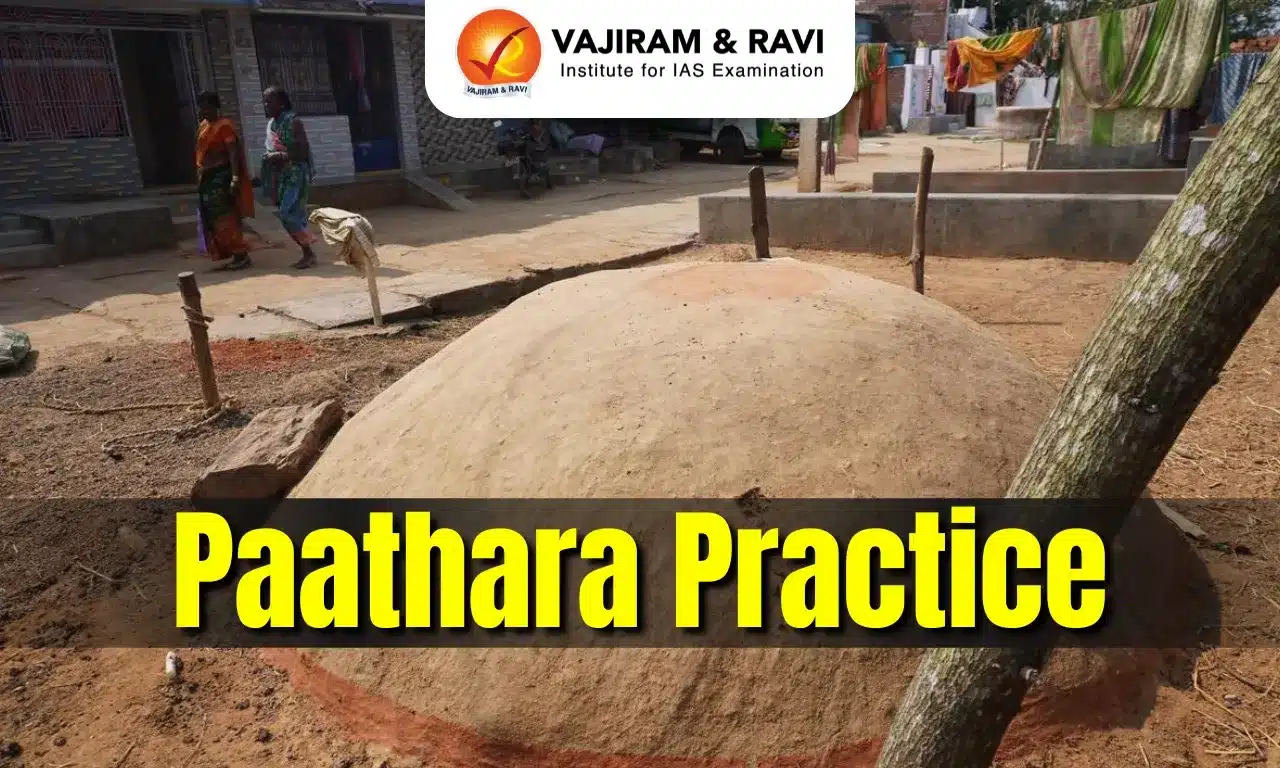
  • It is an ancestral practice of underground grain storage pits.
  • It is a storage pit in which freshly harvested grains, mostly paddy, are stored.
  • It is observed by farmers along the banks of the Mahendratanaya River in the Uddanam region of Srikakulam district, near the Andhra Pradesh–Odisha border.
  • This tradition thrived in the inland, hilly terrain, where underground grain storage was effective.
  • Decline: Lack of space and awareness, as well as changes in rural architecture—have contributed to its decline.

Key Features of Paathara Practice

  • Structure: The pit is dug in a rectangular shape, plastered with straw and clay, and sealed with a layer of cow dung on top.
  • The Paathara was built in front of thatched houses and was an integral part of rural architecture, symbolising a thriving joint family system.
  • Every paddy-growing family stores enough grain for its annual needs.
  • Advantage: The Paath­ara pro­tects grain from rodents, con­tam­in­a­tion, and theft.

Source: TH

Paathara Practice FAQs

Q1: What is the Paathara practice?

Ans: It is an ancestral practice of storing freshly harvested grains in underground storage pits.

Q2: Which crops are mainly stored using the Paathara practice

Ans: Mostly paddy is stored in Paathara pits.

Q3: Where is the Paathara practice traditionally observed?

Ans: It is observed by farmers along the banks of the Mahendratanaya River in the Uddanam region of Srikakulam district near the Andhra Pradesh–Odisha border.

Q4: Why was the Paathara practice suitable for the region?

Ans: It was effective in the inland, hilly terrain where underground grain storage worked well.

Q5: What is the structure of a Paathara pit?

Ans: It is a rectangular pit plastered with straw and clay and sealed with a layer of cow dung on top.

Living Root Bridge

Living Root Bridge

Living Root Bridges Latest News

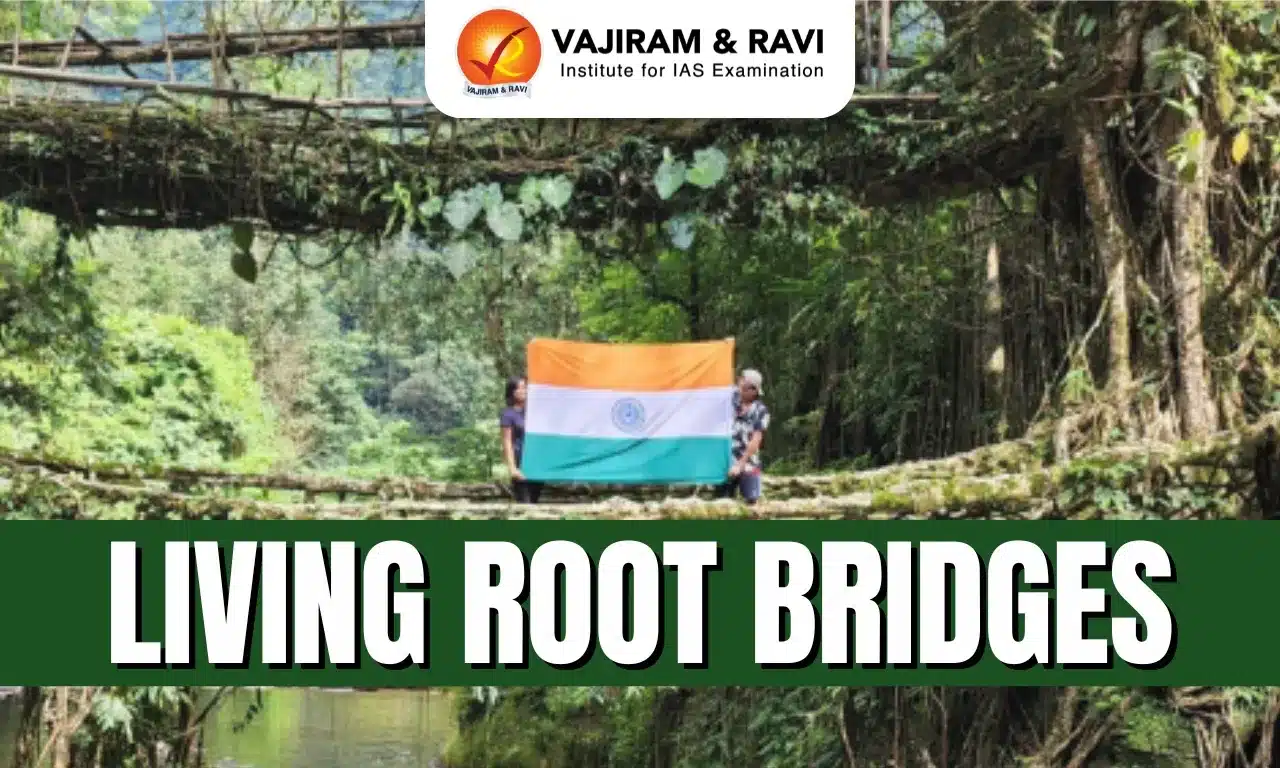
Recently, India submitted Meghalaya’s living root bridges to UNESCO for World Heritage status.

About Living Root Bridges

  • The living root bridges are locally known as Jingkieng Jri or Lyu Chrai.
  • These are nestled across the lush southern slopes of the Khasi and Jaintia Hills in Meghalaya.
  • These are masterpieces of bioengineering created by indigenous communities.
  • These are grown by indigenous Khasi and Jaintia tribes over a time period of 15 to 30 years.
  • These bridges range in span from 15 feet to 250 feet, and last for several centuries.

Construction of Living Root Bridges

  • The bridges are grown by methods of tree-shaping using the aerial roots of Ficus Elastica (Rubber fig tree/Indian rubber tree).
  • The underlying growth process involves recurring inosculation (joining by twining) of Ficus aerial root fibres over a gorge or river.
  • The process begins with placing of young pliable aerial roots in hollowed Areca catechu trunks.
  • These provide essential nutrition and protection from the weather, and also perform as root guidance systems.
  • This assemblage is structurally supported by a bamboo scaffold, which spans the river and performs as a temporary river crossing for the local community.
  • Over time, as the aerial roots increase in strength and thickness, the Areca catechu trunks are no longer required.

Source: News On Air

Living Root Bridges FAQs

Q1: What are living root bridges locally known as?

Ans: They are locally known as Jingkieng Jri or Lyu Chrai.

Q2: Where are living root bridges found in India?

Ans: They are found on the southern slopes of the Khasi and Jaintia Hills in Meghalaya.

Q3: Which communities create living root bridges?

Ans: They are created by indigenous Khasi and Jaintia tribes.

Q4: Why are living root bridges considered masterpieces of bioengineering?

Ans: Because they are grown from living tree roots using traditional knowledge over several decades.

Q5: How long does it take to grow a living root bridge?

Ans: It takes about 15 to 30 years to grow a living root bridge.

Hanle Dark Sky Reserve

Hanle Dark Sky Reserve

Hanle Dark Sky Reserve Latest News

Recently, a rare blood-red auroral activity was captured by the all-sky camera at the Indian Astronomical Observatory in Ladakh's Hanle Dark Sky Reserve.

About  Hanle Dark Sky Reserve

  • Location: It is located at 4,500 metres altitude, in the remote Changthang region of Ladakh.
  • It is part of the Changthang Wildlife Sanctuary, offering Bortle-1 dark skies (the darkest category).
  • It was notified in December 2022 by the Government of Ladakh.
  • It is India’s first International Dark Sky Reserve, centred around the Indian Astronomical Observatory (IAO) at Hanle.
  • It is managed by the Indian Institute of Astrophysics (IIA) under the Department of Science and Technology (DST), Ministry of Science & Technology
  • The reserve aims to curb light pollution and promote astro-tourism benefiting local communities.
  • The reserve is a science-driven socio-economic development project, built on two pillars:
    • Curtailing light pollution in the region
    • Promoting astro-tourism for local livelihood generation
  • The UT Ladakh administration supports the project by funding astro-tourism initiatives and light management plans.
  • Significance of Hanle: Hanle’s pristine dark skies and transparent atmosphere allow observing and photographing faint celestial objects that are often impossible from other locations in India.

Source: ET

Hanle Dark Sky Reserve FAQs

Q1: Where is the Hanle Dark Sky Reserve located?

Ans: It is located at an altitude of about 4,500 metres in the remote Changthang region of Ladakh.

Q2: Which wildlife sanctuary does the Hanle Dark Sky Reserve form a part of?

Ans: It is part of the Changthang Wildlife Sanctuary.

Q3: Why is Hanle Dark Sky Reserve significant at the national level?

Ans: It is India’s first International Dark Sky Reserve.

Q4: Around which major astronomical facility is the reserve centred?

Ans: It is centred around the Indian Astronomical Observatory (IAO) at Hanle.

Q5: Which institution manages the Hanle Dark Sky Reserve?

Ans: It is managed by the Indian Institute of Astrophysics (IIA).

Coking Coal

Coking Coal

Coking Coal Latest News

Recently, the Government of India has notified Coking Coal as a Critical and Strategic Mineral under the Mines and Minerals (Development and Regulation) Act, 1957 (MMDR Act). 

About Coking Coal

  • It is a naturally occurring sedimentary rock found within the earth’s crust.
  • It is also known as Metallurgical coal.
  • Characteristics: It is a type of coal that softens and swells when heated, forming lightweight, porous coke particles, and is characterized by a free swelling index of 1 or greater.
  • It typically contains more carbon, less ash, and less moisture than thermal coal, which is used for electricity generation.
  • Coke is the main product of the high-temperature carbonisation of coking coal. 
  • Coking coal is divided into 3 sub-categories namely, 
    • Primary Coking Coal (Low ash , low Volatile, High Coking property) 
    • Medium Coking Coal (low ash, medium volatile, low caking index)
    • Blendable/ Semi/Weak Coking Coal (low ash, high volatile, very low caking index).
  • Major Producers: The largest producers of coking coal were China, Australia, Russia, USA and Canada.
    • India has an estimated 37.37 billion tonnes of coking coal resources, largely located in Jharkhand, with additional reserves in Madhya Pradesh, West Bengal and Chhattisgarh.

Uses of Coking Coal

  • It is essential for metallurgical processes, as it exhibits caking properties that allow it to fuse into a solid mass during heating.
  • It is an essential ingredient in the production of steel, making it one of the most widely used building materials on earth.

Source: ET

Coking Coal FAQs

Q1: What is coking coal?

Ans: It is a naturally occurring sedimentary rock found within the Earth’s crust and is also known as metallurgical coal.

Q2: Why is coking coal called metallurgical coal?

Ans: Because it is essential for metallurgical processes, especially in steel production.

Q3: What happens to coking coal when it is heated?

Ans: It softens and swells, forming lightweight, porous coke particles.

Q4: How does coking coal differ from thermal coal?

Ans: Coking coal has higher carbon content and lower ash and moisture than thermal coal, which is mainly used for electricity generation.

Q5: What is coke?

Ans: Coke is the main product obtained from the high-temperature carbonisation of coking coal.

East China Sea

East China Sea Latest News

China’s coast guard patrolled Japan-administered islands ‍in the East China Sea almost daily last year, it said recently.

About East China Sea

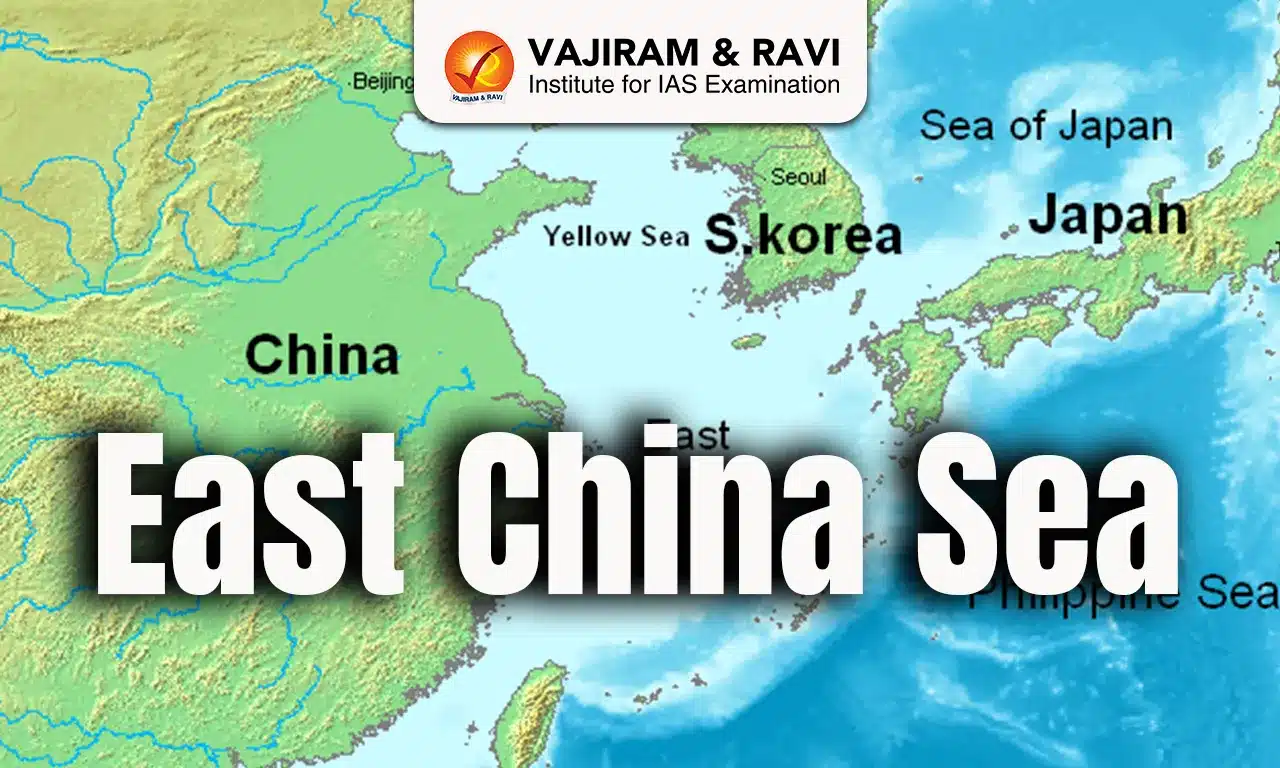
  • It is a marginal sea of the Western Pacific Ocean, located in East Asia.
  • It extends northeastward from the South China Sea, to which it is connected by the shallow Taiwan Strait between Taiwan and mainland China. 
  • The Korea Strait connects it to the Sea of Japan. 
  • To the north, the East China Sea opens up into the Yellow Sea.
  • To the east, you'll find Kyūshū and the Ryukyu Islands of Japan. 
  • The East China Sea and the South China Sea together form the China Sea.
  • In China, people often call it the East Sea.
  • The countries which border the sea include South Korea, Japan, the Republic of China (Taiwan), and the People’s Republic of China.
  • It has an area of about 750,000 sq.km. and is largely shallow; almost three-fourths of the sea is less than 650 feet (200 metres).
  • Rivers: The Yellow River (Huanghe) and the Yangtze River (Changjiang) discharge into the East China Sea.
  • Weather in the region is dominated by the monsoon winds.
  • The region is influenced by the Tsushima and Kuroshio Currents as well as by a strong upwelling area northeast of Taiwan.
  • Islands: The sea contains several islands, with the most significant being the Ryukyu Islands, which are part of Japan, and the Senkaku/Diaoyu Islands.
    • China, Taiwan, and Japan all claim sovereignty over the Senkaku islands, which are under Japanese administration.
  • It has a huge presence of submerged reefs in the northern region, such as Yajiao Rock, Hupijiao Rock, and Socotra Rock.
  • Approximately 35% of global petroleum and petroleum product shipments traveled through the East China Sea in 2023.

Source: TH

East China Sea FAQs

Q1: Where is the East China Sea located?

Ans: It is a marginal sea of the Western Pacific Ocean located in East Asia.

Q2: Which strait connects the East China Sea with the South China Sea?

Ans: The Taiwan Strait connects the East China Sea with the South China Sea.

Q3: Which strait links the East China Sea to the Sea of Japan?

Ans: The Korea Strait connects the East China Sea to the Sea of Japan.

Q4: Which countries border the East China Sea?

Ans: South Korea, Japan, Taiwan, and China.

Q5: Which major rivers discharge into the East China Sea?

Ans: The Yellow River and the Yangtze River.

Budget 2026: Three Big Macro Challenges for India

Budget 2026

Budget 2026 Latest News

  • The Union Budget for 2026–27, to be presented by Nirmala Sitharaman, will outline three core aspects
    • the government’s expectations for economic growth and planned spending across schemes and departments; 
    • projected revenues from tax and non-tax sources; and 
    • the level of borrowing required to bridge the gap between income and expenditure, known as the fiscal deficit.
  • While the Budget formally marks a fresh financial year, it is rarely a blank-slate exercise. 
  • In practice, fiscal realities and policy commitments from previous years significantly limit the scope for major shifts, leaving only constrained room for fundamental change.

Why a New Budget Has Limited Room for Change

  • A Union Budget is constrained by committed expenditures and policy continuity. 
  • Salaries, pensions, and many subsidies cannot be easily altered year to year, nor can tax rates be frequently changed. 
  • Crucially, the Finance Minister’s choices are shaped by the state of government finances in the ongoing year. 
  • Shocks or stresses—such as exports hit by US tariffs—often carry over, setting priorities for the next Budget. 
  • As a result, reviewing the year just ended offers key clues to what the Budget can realistically address.

What Current-Year Data Signals: Three Key Macro Concerns

  • Current-year economic data point to several issues, but at the macroeconomic level, three broad concerns stand out as especially relevant for the upcoming Budget.

1. Weak Nominal GDP Growth: A Key Budget Worry

  • While India’s real GDP growth often makes headlines, it is nominal GDP—the total value of goods and services at current prices—that matters most for Budget-making. 
  • Nominal GDP is the base on which tax revenues, spending plans, and borrowing needs are calculated.

The Budget Arithmetic Problem

  • If nominal GDP grows slower than expected, government revenues fall short. 
  • For example, lower-than-anticipated nominal growth means less tax collection, forcing the government to either:
    • Borrow more, which can crowd out private borrowers and push up interest rates, or
    • Cut spending, potentially reducing funds for R&D, infrastructure, or welfare.

A Sustained Slowdown

  • India’s nominal GDP growth has been decelerating for years. For the current year, it is expected to grow by just 8%, markedly lower than the levels seen over the past two decades. 
  • This is below the 10.1% growth assumed in last year’s Budget and reflects a recent secular slowdown.

Implications for Budget 2026

  • The First Advance Estimates now peg nominal GDP growth at 8%, tightening fiscal space. 
  • The foremost challenge for the Finance Minister is to devise a strategy to lift nominal GDP growth in the coming year to stabilise revenues and avoid difficult trade-offs between borrowing and spending.

2. Weak Tax Buoyancy: Revenues Falling Short of Expectations

  • Tax buoyancy measures how tax revenues respond to economic growth. 
  • A buoyancy of 1 means tax collections rise in line with GDP. If GDP grows 10%, taxes grow 10%. Budgets often assume buoyancy above 1 to fund spending.
  • If nominal GDP grows less than expected and tax buoyancy is lower, revenue shortfalls multiply
  • For instance, slower GDP growth combined with a buoyancy of 0.5 can slash expected additional revenues sharply.

What’s Happening This Year

  • Actual tax collections are lagging Budget assumptions across categories. 
  • Year-to-date growth in taxes trails the government’s targets—and is even below the weak nominal GDP growth rate (around 8%).
  • Data show that while the Budget assumed tax buoyancy of 1.1, the actual buoyancy is closer to 0.6. 
  • In other words, tax revenues are growing at barely half the pace anticipated relative to GDP.

Implications for the Budget

  • Weak tax buoyancy tightens fiscal space. 
  • With revenues underperforming, the government faces tougher choices between higher borrowing and spending restraint, complicating Budget 2026 planning.

3. Weak Private Corporate Investment: A Persistent Growth Challenge

  • A central policy objective of the government has been to expand the role of the private sector under the idea of “Minimum Government”. 
  • Since 2019, this has translated into sharp corporate tax cuts, higher public capital expenditure, and targeted incentives like the Production Linked Incentive (PLI) scheme to lower costs and crowd in private investment.
  • When investment did not respond as expected, the government shifted focus to boosting demand—raising income tax exemptions and cutting GST rates—to improve sales prospects and create a stronger business case for private investment.

Investment Still Below Pre-Pandemic Levels

  • Despite these measures and strong headline GDP growth, data show that private corporate investment remains below pre-pandemic (2019) levels. 
  • Firms are hesitant to invest widely, largely because sales growth has not been strong enough to justify fresh capacity creation.
  • Adding to concerns, foreign investors have also reduced exposure to India in recent periods
  • This has put pressure on the rupee, creating economic and political challenges for Nirmala Sitharaman.

The Budget Dilemma

  • The key question for the upcoming Budget is how to revive private investment—what additional incentives or reforms can restore confidence, lift demand, and persuade both domestic and global investors to commit capital more decisively.

Source: IE | HT

Budget 2026 FAQs

Q1: Why is Budget 2026 not a blank-slate exercise?

Ans: Budget 2026 is constrained by committed spending, fixed tax structures, and ongoing fiscal realities, leaving limited scope for sharp policy shifts despite the start of a new financial year.

Q2: Why does nominal GDP matter more for Budget 2026?

Ans: For Budget 2026, nominal GDP determines tax revenues, spending capacity, and borrowing needs; slower nominal growth directly reduces fiscal space even if real GDP growth appears strong.

Q3: How does weak tax buoyancy affect Budget 2026?

Ans: Weak tax buoyancy means tax collections grow slower than GDP, worsening revenue shortfalls in Budget 2026 and forcing tougher choices between higher borrowing and spending cuts.

Q4: Why is private investment a concern for Budget 2026?

Ans: Despite tax cuts, capex push, and PLI schemes, private corporate investment remains below pre-pandemic levels, limiting growth momentum and complicating Budget 2026 objectives.

Q5: What is the key dilemma facing Budget 2026?

Ans: The central dilemma in Budget 2026 is how to revive growth amid weak revenues, slowing nominal GDP, low tax buoyancy, and hesitant domestic and foreign private investors.

Economic Survey Raises Potential Growth to 7%

Economic Survey Raises Potential Growth to 7%

Potential Growth Latest News

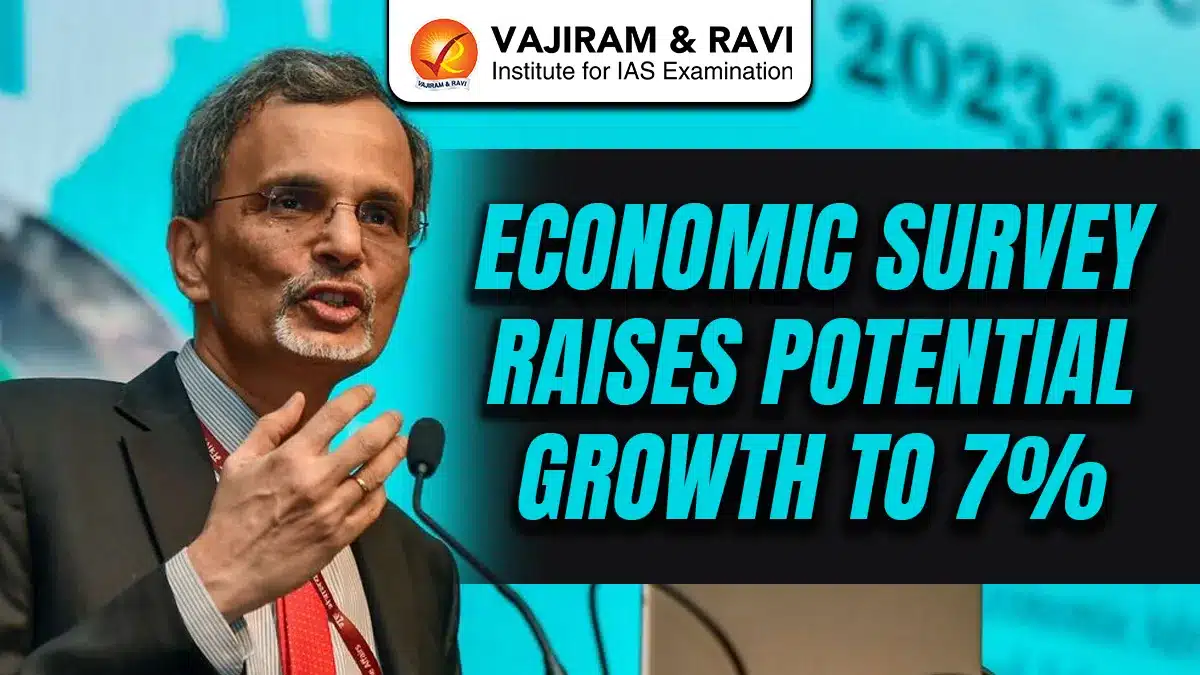
  • The latest Economic Survey, led by V Anantha Nageswaran, has reassessed India’s long-term economic prospects and raised the country’s potential growth rate from 6.5% to 7%. 
  • This reassessment comes amid an active debate on India’s current GDP growth trajectory and reflects the Survey’s view of improved structural and medium-term growth capacity of the economy.

What Is Potential Economic Growth and Why It Matters

  • A country’s potential growth rate differs from its annual GDP growth. 
  • While GDP growth measures how fast the economy expands in a given year, potential growth shows the pace at which it can grow without causing high inflation
  • If growth exceeds this level, demand outstrips supply and prices rise; if it falls below, resources remain underused. 
  • Therefore, to achieve sustainably higher growth, governments must focus on raising the economy’s potential growth rate, not just boosting short-term demand.

What Determines a Country’s Potential Growth Rate

  • Capital Stock - Potential growth depends on the size and quality of physical assets—such as roads, bridges, ports, factories, and machinery—that support production and expansion in the economy.
  • Labour Input - This includes not just the number of workers, but also their skills, productivity, and capacity, which directly influence how much an economy can produce.
  • Total Factor Productivity (TFP) - TFP reflects how efficiently labour and capital are used together. Higher efficiency allows faster growth without inflationary pressure.

India’s Declining Potential Growth: The Trend

  • Research by the Reserve Bank of India shows that India’s potential growth rate has declined over time:
    • 2003–2008: around 8%, India’s highest growth phase
    • 2009–2015: fell to 7%
    • Around the Covid-19 period: declined further to 6.5%, as acknowledged by the Chief Economic Adviser.
  • This decline underscores the need for sustained reforms to rebuild long-term growth capacity.

Why the Economic Survey Sees Higher Potential Growth

  • Reforms Lifting Medium-Term Growth - The Chief Economic Adviser notes that the cumulative impact of recent policy reforms has raised India’s medium-term potential growth to around 7%, reversing earlier declines.
  • Manufacturing and Supply-Side Push - Key reforms over the past three years—PLI schemes, FDI liberalisation, and logistics improvements—have strengthened manufacturing capacity and boosted the economy’s ability to expand supply.
  • Labour Market Improvements - Measures such as labour law consolidation, lower regulatory compliance, and state-level reforms, along with investments in education, skilling, and apprenticeships, have reduced labour market frictions and improved employability.
  • Conditions for Sustained Gains - The Survey stresses that credible increases in potential growth require persistent reforms and macroeconomic stability—conditions it says India currently meets.
  • The Caveat: External Risks - Despite domestic strengths, the Survey cautions that geopolitical conflicts and global disruptions could still constrain India’s ability to fully realise its growth potential.

Source: IE

Potential Growth FAQs

Q1: What does potential growth mean in the Economic Survey?

Ans: Potential growth refers to the maximum sustainable growth rate an economy can achieve without triggering high inflation, unlike annual GDP growth which fluctuates year to year.

Q2: Why did India’s potential growth decline earlier?

Ans: India’s potential growth fell from 8% to 6.5% over two decades due to weaker productivity gains, slowing investment, labour market frictions, and efficiency losses highlighted by RBI research.

Q3: Why has potential growth been raised to 7% now?

Ans: The Economic Survey says cumulative reforms over recent years have strengthened supply capacity, lifting India’s medium-term potential growth closer to 7%.

Q4: Which reforms contributed to higher potential growth?

Ans: Manufacturing-focused reforms like PLI schemes, FDI liberalisation, logistics improvements, and labour law consolidation have boosted India’s productive capacity and potential growth.

Q5: What risks could limit India’s potential growth?

Ans: Despite domestic reforms and stability, geopolitical conflicts, global disruptions, and external shocks could prevent India from fully realising its higher potential growth.

Jal Jeevan Mission – Coverage Versus Functionality in Water Supply

Jal Jeevan Mission Latest News

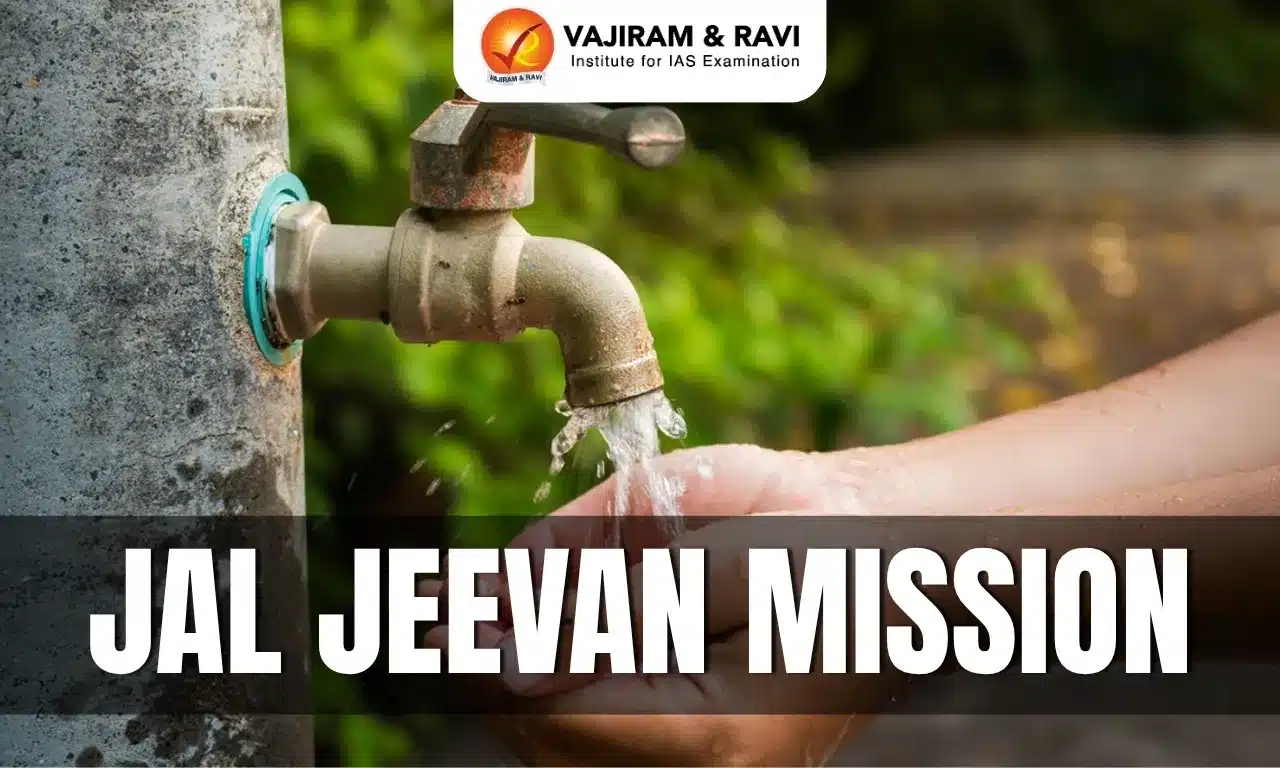
  • A 2024 government-commissioned survey revealed that while nearly 98% of rural households have tap connections under the Jal Jeevan Mission, only about three-fourths receive a reliable and safe water supply. 

Overview of Jal Jeevan Mission

  • The Jal Jeevan Mission (JJM), launched in 2019, is a flagship programme of the Government of India aimed at providing Functional Household Tap Connections (FHTCs) to all rural households. 
  • The scheme seeks to ensure 55 litres of potable water per person per day on a regular basis, with an emphasis on water quality, sustainability of sources, and community participation.
  • Unlike earlier water supply programmes that focused primarily on infrastructure creation, JJM adopts a service delivery approach, where functionality, water quality, and regularity are central performance indicators. 
  • The mission is implemented in partnership with States, with funding shared between the Centre and States.

Current Status of Rural Tap Water Coverage

  • According to official data, the Jal Jeevan Mission has expanded tap water coverage at an unprecedented scale. 
  • From less than 20% rural coverage in 2019, India has reached close to universal household tap connectivity by 2024-25.
  • States such as Goa, Gujarat, Andhra Pradesh, and several Union Territories report over 97% tap availability. 
  • As of early 2026, more than 2.7 lakh villages have been certified as “Har Ghar Jal” villages, indicating that all households and public institutions in these villages have tap connections.
  • However, coverage certification is largely based on infrastructure availability and does not always reflect actual water delivery or quality.

Functionality and Water Quality Concerns

  • The core objective of the Jal Jeevan Mission is not merely tap installation but a functional and safe water supply
  • The recent Functionality Assessment of Household Tap Connections highlights significant gaps in this regard.
  • Only 83% of surveyed households reported receiving water through taps at least once in the previous seven days. 
  • Even fewer households consistently received the prescribed 55 litres per capita per day, with just 80% meeting the quantity norm.
  • Water quality emerged as a critical concern. Tests for E. coli, faecal coliform, and pH levels showed that only 76% of households received water meeting basic safety standards. When availability, regularity, and quality were assessed together, only three-fourths of households were found to be benefiting from the scheme as intended. 

Regional Variations in Performance

  • The survey revealed sharp inter-State variations. While coastal and better-performing States recorded high functionality, States such as Bihar, Uttar Pradesh, Nagaland, and Sikkim lagged behind on water availability and quantity benchmarks.
  • For instance, Bihar reported water flow in only about 61% of households, while Sikkim showed particularly low compliance with per capita water supply norms. 
  • These disparities underline differences in source sustainability, groundwater availability, terrain, and institutional capacity at the State and district levels.

Financial and Implementation Challenges

  • The Jal Jeevan Mission is among the most resource-intensive welfare programmes undertaken by India. 
  • Since 2019, over Rs. 3.6 lakh crore has been spent on rural water infrastructure. 
  • However, recent budgetary trends indicate underutilisation of allocated funds, with actual expenditure falling significantly short of provisions in some years.
  • The original target of achieving 100% functional coverage by 2024 has now been extended to 2028, acknowledging the complexity of last-mile delivery, operation and maintenance, and source sustainability challenges. 
  • Estimates suggest that the remaining uncovered and non-functional households may require nearly Rs. 4 lakh crore in additional investment.

Institutional and Monitoring Framework

  • To address implementation gaps, the Jal Jeevan Mission relies on multiple monitoring tools, including third-party surveys, village-level water committees, and real-time dashboards. 
  • The functionality assessment survey conducted in 2024 covered over 2.3 lakh households across certified Har Ghar Jal villages, offering a more nuanced picture beyond official coverage figures.
  • However, the Ministry has cautioned that results are not directly comparable with earlier assessments due to changes in methodology and survey scope.

Way Forward for Sustainable Rural Water Supply

  • Ensuring the long-term success of the Jal Jeevan Mission requires a shift from infrastructure expansion to system sustainability. 
  • Key priorities include strengthening local operation and maintenance mechanisms, improving water source recharge, enhancing water quality surveillance, and empowering Panchayats and user committees.
  • Greater emphasis on climate-resilient water planning, especially in water-stressed regions, and integration of JJM with sanitation, groundwater management, and health programmes will be essential to translate tap coverage into real welfare gains.

Source: TH

Jal Jeevan Mission FAQs

Q1: What is the primary objective of the Jal Jeevan Mission?

Ans: To provide functional household tap connections with safe drinking water to all rural households.

Q2: What percentage of rural households currently have tap connections?

Ans: About 98% of rural households have tap connections under the scheme.

Q3: How many households receive water meeting quality standards?

Ans: Only around 76% receive water that meets basic quality parameters.

Q4: What is the prescribed water supply norm under JJM?

Ans: 55 litres of potable water per person per day.

Q5: By when has the Jal Jeevan Mission target been extended?

Ans: The target for full functional coverage has been extended to 2028.

Enquire Now