
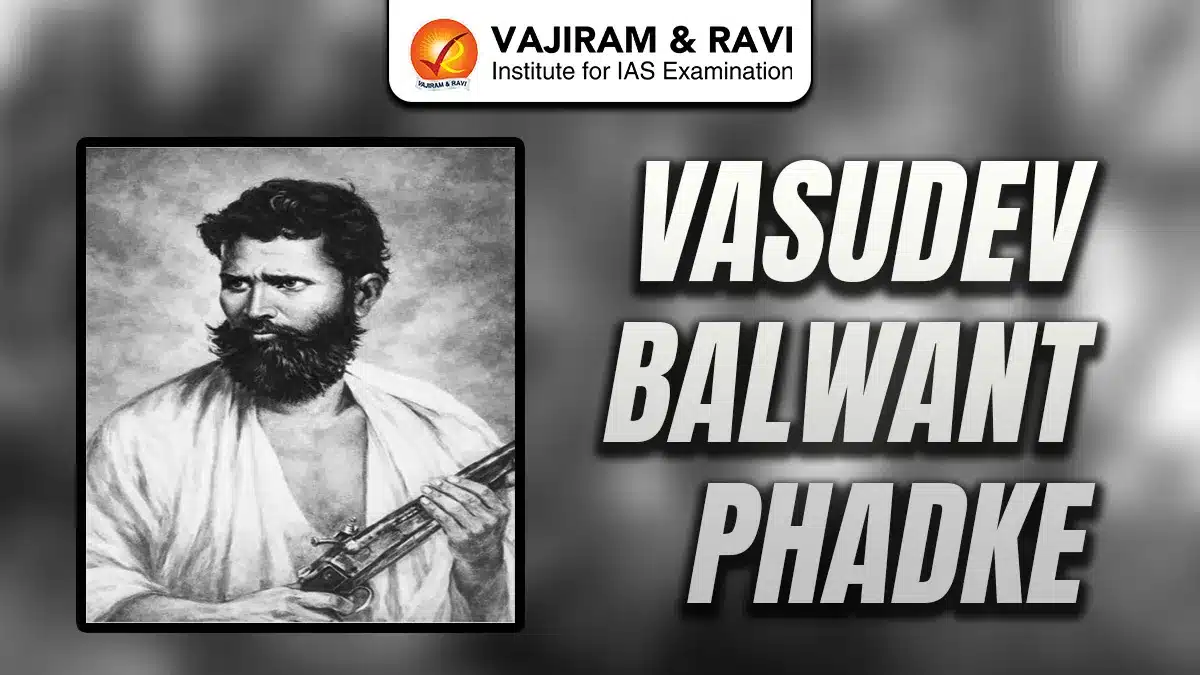
Vasudev Balwant Phadke (1845-1883) is celebrated as one of the first Indian revolutionaries who advocated armed resistance against British colonial rule. He was known as the “Father of the Revolutionary Movement in Maharashtra,” Phadke combined public awareness, patriotic mobilization, and revolutionary tactics to lay the foundation for future freedom fighters. His life story is a testament to courage, vision, and sacrifice for the nation. He was also known as “Father of Indian Armed Rebellion”.
Vasudev Balwant Phadke Early Life and Education
Vasudev Balwant Phadke was born on November 4, 1845, in Shirdon village, Thane district, Maharashtra. His family hailed from Kelshi in the Konkan region. Phadke was among the early graduates of Bombay University in 1862, after which he worked in various government institutions, including Grant Medical College and the Commissariat Examiner’s Office in Mumbai. In 1865, he moved to Pune and joined the Military Finance Office.
Despite being a family man with a promising career, Phadke became a vocal critic of British rule. In the mid-1870s, he would run through Pune streets striking a thali (plate) with a ladle to announce his public speeches at Shaniwar-wada grounds, calling for the ouster of the British and India’s freedom. This was revolutionary at a time when public political life was limited to constitutional reforms advocated by the Bombay Presidency Association and Poona Sarvajanik Sabha.
Vasudev Balwant Phadke Contribution
Vasudev Balwant Phadke was a pioneering revolutionary who introduced organized armed resistance against British rule in India. His actions marked a shift from constitutional politics to direct revolutionary struggle, especially in Maharashtra.
- He was among the earliest leaders to openly call for the expulsion of the British through armed rebellion.
- He mobilized peasants and common people, spreading political awareness beyond elite circles.
- Phadke was possibly the first Indian to undertake political tours to propagate nationalist ideas.
- He formed secret revolutionary groups to spread patriotism and plan armed actions.
- He organized India’s first revolutionary militia (1879), laying the foundation for armed movements.
- He conducted raids on British treasuries and outposts to fund revolutionary activities.
- He issued a proclamation against exploitative British economic policies, creating nationwide impact.
- He inspired a culture of patriotism and sacrifice in Maharashtra before leaders like Tilak emerged.
- Phadke is regarded as the Father of the Revolutionary Movement in Maharashtra, influencing later revolutionaries.
Formation of Secret Revolutionary Groups
Vasudev Balwant Phadke realized that public speeches alone could not trigger a mass uprising, so he shifted to building a secret and well-organized revolutionary network to challenge British rule.
- He created a four-tier organizational structure to spread nationalism and plan revolutionary action.
- The first group secretly organized meetings of school students outside school premises to instill patriotic ideas.
- The second group consisted of roving bands that sang patriotic songs in the mornings, creating public awareness.
- The third group, an evening choir, used satirical and emotional songs to criticize British rule and highlight India’s suffering.
- The fourth and core group planned armed revolutionary activities, including raids and resistance against the government.
- Phadke emphasized physical training, setting up camps like the one at Gultekdi Hill near Pune, inspired by Maratha martial traditions.
- His method relied on emotional, spiritual, and cultural appeal to awaken patriotism among the masses.
This secret network marked one of the earliest organized revolutionary movements in India, laying the groundwork for future armed resistance against colonial rule.
Vasudev Balwant Phadke Legacy
Vasudev Balwant Phadke’s legacy lies in pioneering revolutionary nationalism in India through armed resistance against British rule at a time when organized political movements had not yet emerged. He mobilized peasants and tribal communities, highlighting the link between colonial exploitation and popular suffering. His actions inspired later revolutionaries by proving that resistance could go beyond petitions and protests. Arrested in 1879, he was sentenced to life imprisonment and deported to Aden jail. Phadke died there in 1883, but his sacrifice remains a powerful symbol of early militant resistance in India’s freedom struggle.
Vasudev Balwant Phadke FAQs
Q1: Who was Vasudev Balwant Phadke?
Ans: Vasudev Balwant Phadke was an early Indian revolutionary who led an armed struggle against British rule in the 19th century.
Q2: Why is Vasudev Balwant Phadke called the first revolutionary of India?
Ans: He is considered India’s first revolutionary because he organized an armed revolt against the British much before the rise of organized national movements.
Q3: Which region was associated with Phadke’s activities?
Ans: His revolutionary activities were mainly concentrated in Maharashtra, especially in the Pune region.
Q4: What inspired Vasudev Balwant Phadke’s revolutionary ideas?
Ans: He was inspired by Indian epics, the 1857 Revolt, and the economic exploitation of peasants by British policies.
Q5: What was the main objective of Phadke’s movement?
Ans: His main objective was to overthrow British rule through armed resistance and protect peasants from oppression.
