
Delhi Declaration Latest News
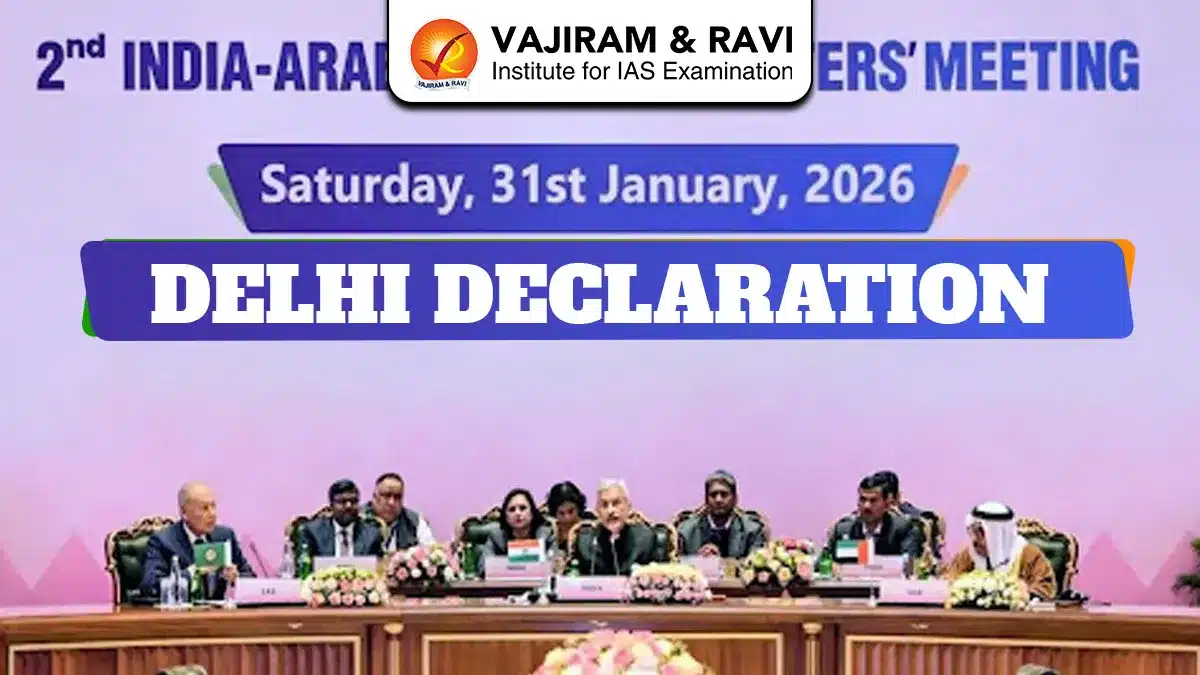
- India hosted the second India–Arab Foreign Ministers’ Meeting in New Delhi, bringing together 22 members of the League of Arab States a decade after the first such meeting in Bahrain.
- The talks took place against a backdrop of heightened regional tensions in the Middle East, including strained US–Iran relations, growing differences between Saudi Arabia and the UAE, and renewed US-led efforts on the Israel–Palestine issue.
- The resulting Delhi Declaration outlined shared positions and commitments between India and the Arab League, reaffirming India’s balanced and active approach to Middle East diplomacy while seeking to deepen political and strategic cooperation with Arab states.
Regional Conflicts and What the Delhi Declaration Signals
- The Delhi Declaration strongly stresses respect for the sovereignty, unity and territorial integrity of Sudan, Libya and Somalia, while rejecting any external interference.
- This reflects a shared India–Arab League position in favour of internationally recognised governments rather than rival or breakaway authorities.
Middle East Power Rivalries in the Background
- These conflicts are shaped by a broader power tussle within the Middle East.
- On one side are countries aligned with Saudi Arabia, and on the other a camp associated with the UAE and Israel, with US backing.
- Though these camps are not officially acknowledged, their differences play out clearly in conflict zones.
- Sudan: The UAE is widely accused of backing the Rapid Support Forces, which have fought the Sudanese government, set up a parallel authority, and carried out large-scale violence against civilians.
- Libya: The UAE has long supported Khalifa Haftar’s Libyan National Army, which opposes the UN-recognised government in Tripoli. Saudi Arabia and other Arab states have instead focused more on reconciliation.
- Somalia: Israel is the only UN member to recognise Somaliland, a breakaway region. The UAE’s acceptance of Somaliland passports in 2025 has gone against the wider Arab League position.
- India clearly rejected any recognition of Somaliland and aligned with the Arab League’s stance.
India’s Clear Alignment
- India joined the Arab League in explicitly supporting recognised governments in Sudan and Libya and condemning violence against civilians.
- This marks a firm diplomatic position amid regional divisions.
A Shift in Language on Yemen
- On Yemen, India and the Arab League explicitly condemned Houthi attacks on shipping in the Red Sea.
- This is a subtle but important shift for India, which in recent years avoided naming the Houthis directly.
- The declaration’s emphasis on Yemen’s unity also aligns with Saudi Arabia’s stance against UAE-backed southern secessionist groups.
Cautious Tone on Syria
- The declaration says little on Syria, limiting itself to praising counter-terrorism efforts against Islamic State.
- This mirrors India’s careful and low-key engagement with post-Assad Syria, where contacts have remained largely diplomatic and exploratory.
- Overall, the Delhi Declaration shows India tilting towards stability, recognised governments, and Saudi-aligned positions on key conflicts, while maintaining a balanced and cautious approach in especially sensitive theatres like Syria.
Principal Conflicts: What the Delhi Declaration Says — and Avoids
- Silence on the US-Led Board of Peace - The Delhi Declaration makes no reference to the Donald Trump–led Board of Peace (BoP).
- Although several Gulf states have joined the BoP, India has not yet accepted the invitation extended, signalling caution about formally associating with the initiative.
- Clear Preference on Israel–Palestine - Instead of the BoP, the declaration explicitly backs the Arab Peace Initiative (2002).
- This framework supports land-for-peace—Arab recognition of Israel in exchange for an independent Palestinian state based on pre-1967 borders.
- While the declaration also notes the outcomes of the 2025 Sharm el-Sheikh summit (the only place the US role is mentioned), the emphasis on the Arab Peace Initiative reveals India’s and the Arab League’s core preference.
- Backing Peace, Not a New Framework - India and Arab states support efforts to end the violence in Gaza, including US mediation, but stop short of endorsing the broader logic of President Trump’s plan for resolving the Israel–Palestine issue. Both sides reiterate support for Palestinian sovereignty.
- Avoiding Escalation with Iran - The declaration avoids mentioning the most destabilising flashpoint: the US military build-up around Iran and the risk of a wider conflict. This omission appears deliberate, allowing countries to manage bilateral approaches without public confrontation.
- Key Arab League states, led by Saudi Arabia, are working to discourage US military action against Iran.
- India’s outreach shows New Delhi’s effort to keep channels open with Iran while navigating US sanctions.
- Notably, India’s Budget 2026–27 carries no allocation for Chabahar Port, despite a 10-year operational agreement signed in 2024.
- This underscores India’s continued vulnerability to US sanctions and the careful balancing reflected throughout the Delhi Declaration.
What the Delhi Declaration Reveals About India’s Middle East Diplomacy
- The Delhi Declaration reinforces cooperation between India and the Arab League across five core pillars—economy, energy, education, media, and culture—identified since their institutional engagement began in 2002.
- It builds on robust India–Arab trade exceeding $240 billion, underscoring the economic depth of the partnership.
- More broadly, the declaration crystallises India’s diplomatic approach to the Middle East and the Gulf.
- While New Delhi maintains strong partnerships across competing geopolitical blocs, these ties remain transactional and compartmentalised, without altering India’s broader regional positions.
- On sensitive geopolitical questions, India consistently favours long-standing, norm-based stances aimed at preserving regional stability and avoiding endorsement of actions that could deepen conflict or disruption.
Source: IE
Delhi Declaration FAQs
Q1: What is the Delhi Declaration?
Ans: The Delhi Declaration is a joint statement adopted at the India–Arab Foreign Ministers’ Meeting outlining shared positions on regional conflicts, sovereignty, and cooperation.
Q2: Why is the Delhi Declaration important for India’s Middle East policy?
Ans: The Delhi Declaration clarifies India’s balanced approach, supporting sovereignty, recognised governments, and regional stability without aligning with any one power bloc.
Q3: What conflicts are addressed in the Delhi Declaration?
Ans: The Delhi Declaration addresses Sudan, Libya, Somalia, Yemen, Israel–Palestine, and Syria, focusing on unity, non-interference, and protection of civilians.
Q4: What does the Delhi Declaration say about Israel and Palestine?
Ans: The Delhi Declaration supports the Arab Peace Initiative and Palestinian sovereignty while backing efforts to end violence without endorsing new external frameworks.
Q5: How does the Delhi Declaration reflect India’s diplomatic style?
Ans: The Delhi Declaration shows India’s preference for norm-based diplomacy, transactional partnerships, and avoiding actions that could destabilise the Middle East.
