
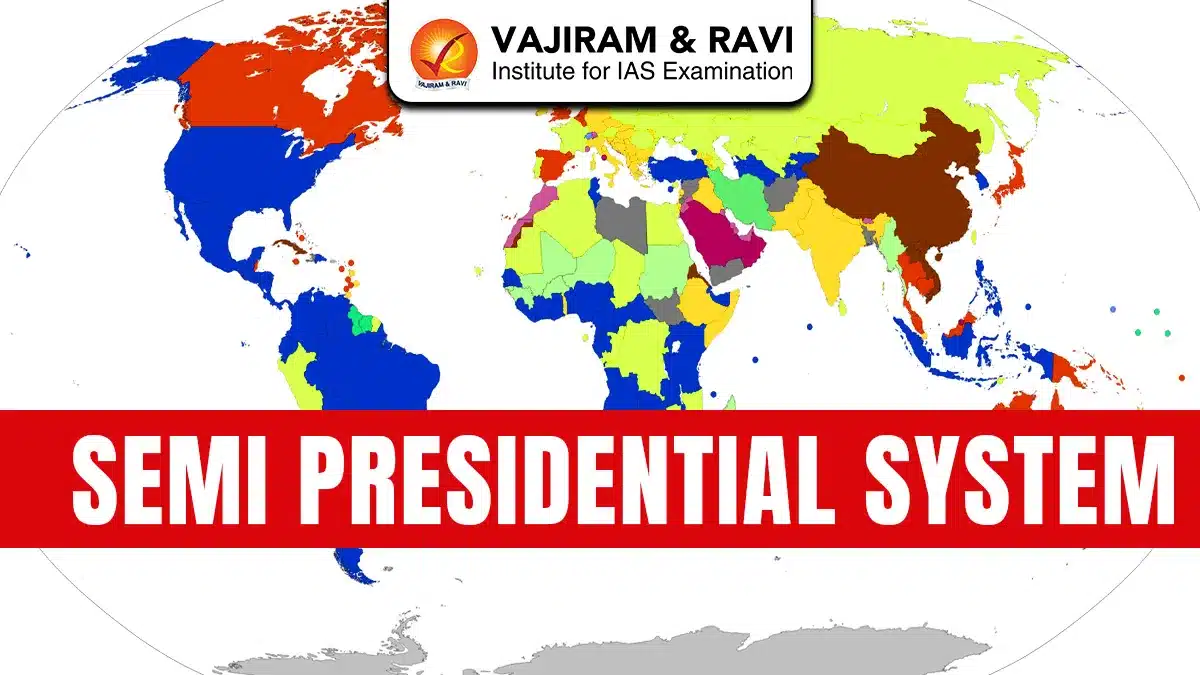
The Semi Presidential System is a form of government in which executive power is shared between a directly elected President and a Prime Minister, who is responsible to the legislature. It combines elements of presidential democracy with parliamentary democracy.
Semi Presidential System Origin
The semi-presidential system was formally introduced in France in 1958 under the Fifth Republic.
Currently, several countries in the world follow a semi-presidential system of government. Prominent examples include France, Sri Lanka, Ukraine, Portugal, Haiti, Azerbaijan, the Democratic Republic of the Congo, Mauritania, Namibia, Lithuania etc
Semi Presidential System Features
The features of Semi Presidential System include:
- Dual Executive: Executive Power is divided between the president and the prime minister. The President is the head of state while the Prime Minister is head of government.
- Directly Electled President: The President is directly elected by the people and enjoys independent democratic legitimacy.
- Wide Presidential powers: The President possesses substantial constitutional powers, particularly in matters of defence, foreign policy, and emergencies.
- Responsible Prime Minister: The Prime Minister and Council of Ministers are responsible to the legislature and can be removed by a vote of no-confidence.
- Cohabitation: A situation, often in France, where the president and prime minister are from opposing political parties, which can lead to tense power-sharing or conflict.
Semi-Presidential System Merits
- Political Stability: The directly elected President provides political stability in case of removal of the prime minister.
- Prevent Concentration of Power: Sharing of executive authority between President and Prime Minister prevents concentration of power in a single office.
- Accountable Government: Prime Minister and Council of Ministers remain responsible to the legislature, ensuring parliamentary accountability.
- Efficient Decision-Making: The President can act decisively in emergencies, foreign policy, and defence matters.
Semi-Presidential System Demerits
- Ambiguity in Executive Authority: Overlapping powers of President and Prime Minister may lead to conflict and administrative confusion.
- Risk of Authoritarianism: A dominant President may bypass parliamentary controls and concentrate power.
- Policy Paralysis during Cohabitation: If the President and PM belong to rival parties, decision-making may be slowed or blocked.
- Unclear Accountability: Public may be uncertain about whether the President or Prime Minister is responsible for governance failures.
- Unsuitability for Weak Democracies: Requires strong institutions and political culture; weak states may experience instability and constitutional crises.
Different System of Government
Presidential, semi-presidential, and parliamentary systems represent three major systems of democratic governance. The differences between them are discussed below.
| Basis | Presidential system | Semi Presidential system | Parliamentary System |
|
Nature of Executive |
Single Executive - executive power is concentrated in a single authority (President) |
Dual Executive - executive authority is shared between a directly elected President and a Prime minister. |
Dual executive - executive power is exercised by the Prime Minister and Council of Ministers while the Head of State performs a largely ceremonial role. |
|
Head of State & Head of Government |
The President acts as both Head of State and Head of Government . |
President is Head of State with real powers while Prime minister is Head of Government |
The President is the nominal Head of State whereas the Prime Minister is the real head of government. |
|
Election |
The President is directly elected |
President is directly elected while Prime Minister is appointed from the majority in legislature |
President is indirectly elected or hereditary while Prime Minister is chosen from among the members of the legislature |
|
Executive Accountability |
Not accountable to the legislature |
President is not accountable to the legislature but Prime Minister is accountable to legislature |
The President is generally a nominal/ceremonial executive and is not directly accountable to the legislature, while the Prime Minister and Council of Ministers (the real executive) are directly accountable. The President acts on the advice of the council, and accountability to Parliament lies with the PM and CoM |
|
Tenure |
President enjoys a fixed tenure irrespective of legislative support |
President has fixed tenure but Prime Minister’s tenure depends on parliamentary confidence |
Tenure of executive is not fixed and continues as long as it commands majority support. |
|
Removal |
The President can be removed only through impeachment |
The Prime Minister can be removed by non-confidence motion while the President can be removed only through impeachment |
The Prime Minister and council of ministers can be removed at any time through no-confidence motion. The President can be removed only through impeachment on grounds mentioned in constitution |
|
Examples |
United States of America, Brazil, Argentina etc |
France, Russia, Sri Lanka etc |
India, Britain, Australia, Canada etc |
Semi-Presidential System FAQs
Q1: What is a semi-presidential system of government?
Ans: A semi-presidential system of government is a form of democracy in which executive power is shared between a directly elected President and a Prime Minister who is responsible to the legislature.
Q2: Which countries currently follow a semi-presidential system?
Ans: Countries such as France, Portugal, Sri Lanka, Ukraine, Lithuania, and Timor-Leste follow a semi-presidential form of government.
Q3: How is the semi-presidential system different from the parliamentary system?
Ans: Unlike the parliamentary system, where the President or Monarch is only ceremonial, the semi-presidential system gives the President real and substantive powers alongside the Prime Minister.
Q4: How is the semi-presidential system different from the presidential system?
Ans: Unlike the presidential system, where the President alone exercises executive authority, the semi-presidential system divides executive power between the President and a Prime Minister who is accountable to Parliament.
Q5: What is meant by “cohabitation” in a semi-presidential system?
Ans: Cohabitation refers to a situation where the President and the Prime Minister belong to different political parties, leading to power-sharing and sometimes institutional conflict.
