
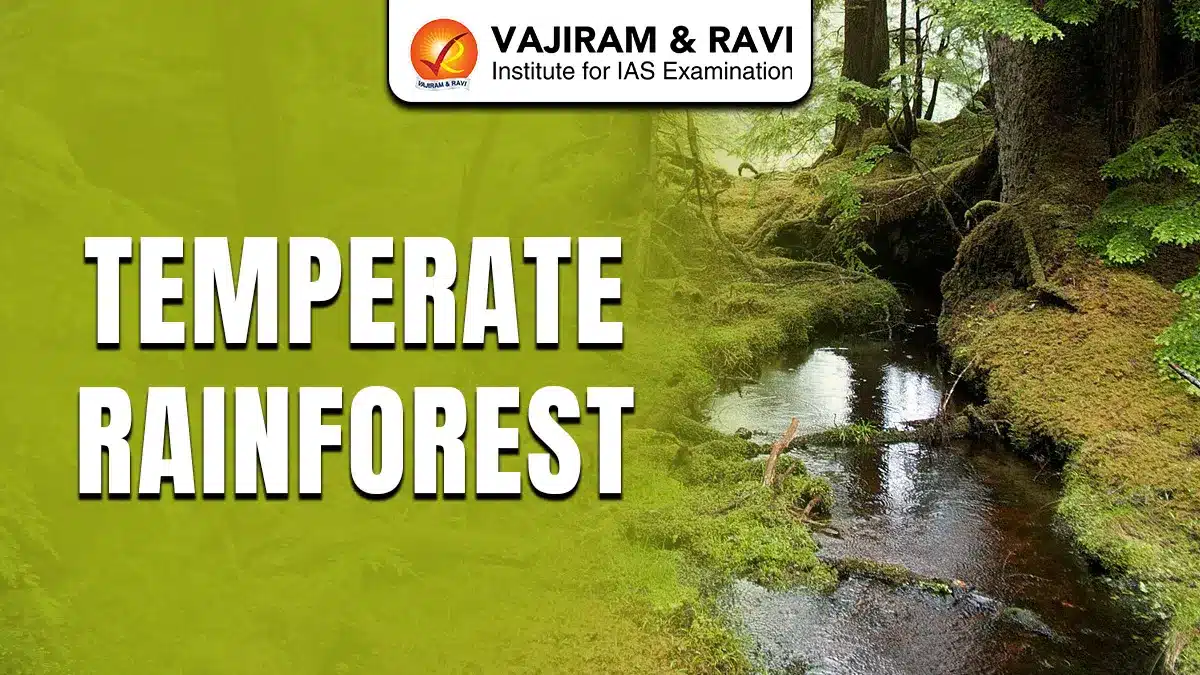
Temperate Rainforest is a rainforest biome that exists in the temperate region climate. They receive heavy rainfall throughout the year but have a lower average temperature as compared to Tropical Rainforest. They have dense vegetation, which is crucial to maintain the ecological balance.
Temperate Rainforest Location
- Temperate Rainforest is mainly located between 40° to 60° in both Northern and Southern Hemisphere.
- They are primarily located along the western coast of the continents, close to the oceans.
- Some of the major locations are:
- North America: Pacific Northwest (USA and Canada). It is the home to the world's largest temperate rainforests.
- South America: Southern Chile
- Europe: Western Coastal region (UK and Norway)
- Asia: in some parts of Japan
- Oceania: Southern Australia and New Zealand
- The longest stretch of tropical rainforest can be found in northern California north to Alaska and along the coast of Southern Chile.
- They extend about 1,200 miles from Oregon to Alaska.
- India does not have any true Temperate Rainforest but some regions of Himalayas show similar characteristics.
Temperate Rainforest Climate
- The overall climate of Temperate Rainforest varies from mild to moderate and does not experience any extreme heat or cold.
- The climate is pleasant throughout the year as the temperature rarely rises above 27°C in summer and does not fall below 0° in winters.
- The two major seasons over here are short, dry but foggy summers and long, wet winters.
- Due to continuous rainfall, winters are cold and wet, with the ocean winds keeping the temperature moderate.
- While the summers are dry, cool and foggy and the fog further adds to the moisture pushing the growth of the plantation even when there is no rainfall.
- The oceanic winds play a major role in keeping the climate moderate, by absorbing the heat in summer and releasing the heat in winters.
- The mountain ranges contribute to the orographic rainfall and block the extreme continental effects.
Temperate Rainforest Temperature and Precipitation
- The temperature in these regions varies moderately due to Oceanic influence.
- In winters the temperature does not fall below 0°C.
- In summers the temperature varies in the range of 25°C to 27°C.
- The absence of extreme temperature supports the growth of rich vegetation.
- The precipitation is very high in these regions, usually varying from 150-300 cm annually.
- Rainfall in these regions are well distributed throughout the year, thus there is no specific dry season.
- Winters are the wettest with prolonged rainfall and Summers are comparatively drier but the fog adds to the moisture requirement.
Temperate Rainforest Seasons
- Temperate Rainforests experience two main seasons rather than four distinct seasons.
- The winter season is long, cool, and very wet, receiving maximum annual rainfall.
- Summer season is short, cool, and relatively dry, but marked by frequent fog formation.
Temperate Rainforest Natural Vegetation
- Temperate Rainforests have a comparatively simpler structure than the tropical rainforests.
- They have two important layers - the upper tree layer (canopy) and a few very tall trees rising above it.
- The lower layers are less dense, allowing more sunlight to reach the ground.
- Because of better light availability, the floor of the forest supports rich plant growth.
- Mosses, ferns, lichens, and small plants grow widely on the soil, rocks, and tree trunks.
- During the spring season, trees usually do not have fully grown leaves, so sunlight easily reaches the ground.
- This helps ground plants to grow, flower, and bear fruits early in the season.
- As the canopy becomes thicker later, shade-loving plants begin to grow.
- These plants are specially adapted to survive in low-light conditions.
- Common trees found in temperate rainforests include oak, beech, birch, maple, walnut, elm, aspen, and sycamore.
- Many trees are deciduous, shedding leaves in winter, which further increases sunlight on the forest floor.
- Overall, the vegetation remains green and healthy due to high rainfall and mild temperatures.
Temperate Rainforest Wildlife
- Temperate rainforests have fewer large mammals as compared to tropical rainforests as the vegetation is seasonal and forest layers are simpler than the tropical rainforests.
- Despite this, they support a wide variety of animal life.
- Small mammals such as raccoons, porcupines, red foxes, white-tailed deer, and opossums are commonly found.
- Animals depend heavily on seasonal food sources like nuts and winged seeds during summer.
- Fruits from trees such as apple, gooseberry, hawthorn, and rose ripen together in late summer and help animals store fat for winter.
- Amphibians and reptiles like frogs, salamanders, and turtles thrive due to high moisture levels.
- Bird life is rich, including woodpeckers, cardinals, hawks, owls, and songbirds.
- Insects and spiders are found in large numbers and play an important role in the food chain.
- Many animals show seasonal behaviour, such as migration, hibernation, or food storage, to survive cold winters.
- Overall, wildlife in temperate rainforests is well adapted to cool climate, high rainfall, and seasonal changes.
Temperate Rainforests Climate Risks
- The rising global temperature poses a serious threat to the mild and stable climate of the temperate rainforests.
- The rapidly changing rainfall pattern has reduced the winter rainfall and has made the summer more drier.
- The warming of oceans has reduced the fog formation in the summers thus reinforcing the dryness in summer.
- This prolonged long dry period has increased the water stress to the vegetation and has affected the forest health severely.
- The rising warmer weather is contributing to the growth of invasive pests and pathogens.
- The rising sea level is increasing the coastal soil salinity and increases the chances of flooding.
Temperate Rainforests Ecological Significance
- The Temperate Rainforest is home to many rare and endemic plant and animal species.
- They act as an excellent source of carbon sink, thus reducing the impact of climate change.
- As it supports a mild, cool and stable climate reducing the temperature extremities, thus providing pleasant weather.
- Dense vegetation and roots prevents soil erosion.
- Coastal rainforest reduces the risks of flooding and lessens the impact of storms and other climate vulnerabilities.
- Many temperate rainforests are declared as UNESCO World Heritage sites, recognizing their significant contribution in maintaining the ecological balance.
Temperate Rainforests Declared as UNESCO World Heritage Sites
- Gondwana Rainforests of Australia
- These are the most extensive and rich areas containing many ancient vegetation from the historic Gondwana Supercontinent.
- Tasmanian Wilderness (Australia)
- This region has witnessed severe glaciation episodes and constitute one of the last expanses of temperate rainforests in the world. The remains of the limestone caves date back to more than 20,00 years.
- Hyrcanian Wilderness (Iran/Azerbaijan)
- This unique forest massif along the Caspian sea in Azerbaijan and Iran. The history of these forests dates back to as long as 25 to 50 million years, when they usually covered most of the Northern Temperate region.
- Yakushima (Japan)
- It is located in the interior of Yaku Island, at the meeting point of the Oriental biotic and the Palaearctic region, thus exhibiting a rich floral range.
- Olympic National Park (USA)
- It is located in the north-west of Washington State. It is known for its diverse ecosystems. The park includes 100 km of wilderness coastline and offers a best habitat for anadromous fish species as eleven major rivers drain the Olympic mountains.
- Redwood National and State Parks (USA)
- It comprises the region of coastal mountains bordering the Pacific Ocean north of San Francisco, which is covered with coastal redwood trees exhibiting the tallest and most impressive trees in the world.
Temperate Rainforests FAQs
Q1: What are temperate rainforests?
Ans: A temperate rainforest is a rainforest biome in the temperate regions of the world.
Q2: Where are they found?
Ans: Temperate rainforests are mostly located between 40° to 60° latitude in both Northern and Southern hemispheres.
Q3: Does India have a temperate rainforest?
Ans: India does not have a true temperate rainforest although some himalayan regions do exhibit similar characteristics.
Q4: What is the climate of the temperate rainforest?
Ans: The climate is mild and moderate, as the winter temperature does not fall below 0°C and in Summers also the temperature range is 25–27°C.
Q5: What kind of vegetation is supported by the temperate rainforests?
Ans: The vegetation is very simple consisting of 2 layers, one is Canopy and the other is emergent trees. Common trees: oak, beech, birch, maple, walnut, elm, aspen, sycamore

