
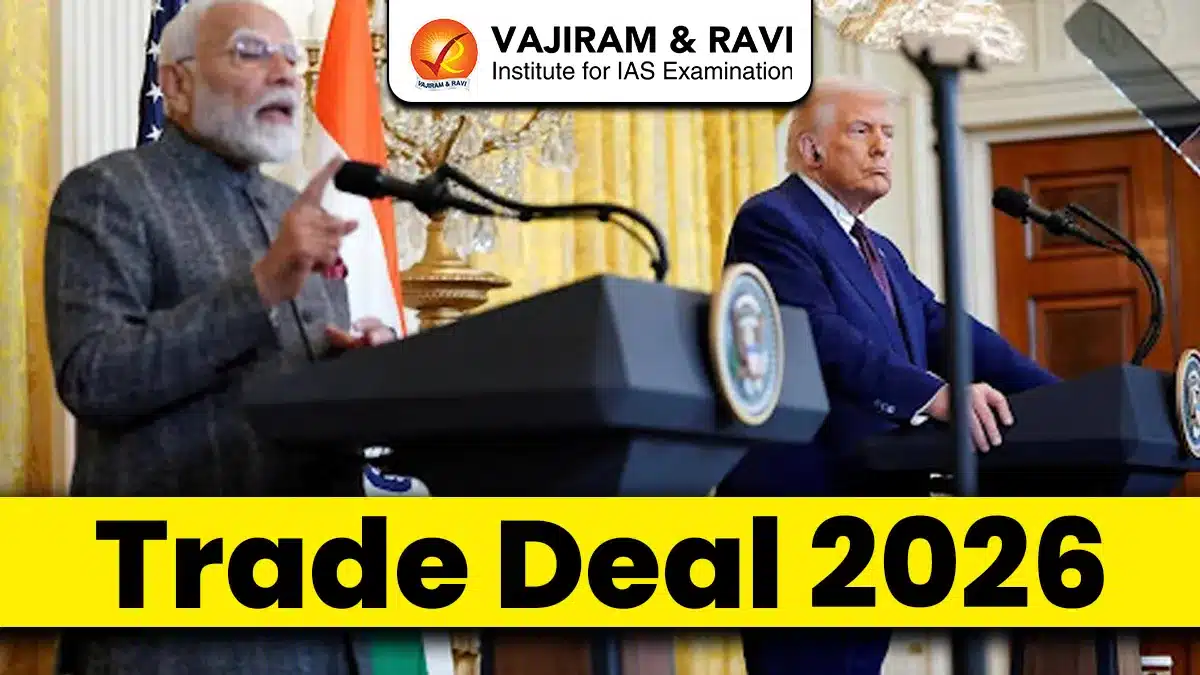
Trade Deal 2026 Latest News
- India has committed to importing goods worth $100 billion annually from the U.S. for five years as part of a broader trade understanding that also involves significant tariff reductions.
Background: India-U.S. Trade Relations
- India and the United States share a rapidly expanding trade relationship, shaped by strategic convergence, supply chain realignments, and geopolitical considerations.
- The U.S. is India’s largest trading partner, accounting for a substantial share of India’s exports in services, pharmaceuticals, engineering goods, and IT.
- However, trade ties have also witnessed friction, particularly over tariffs, market access, digital trade, and agriculture.
- In August 2025, the U.S. raised tariffs on Indian goods to 50%, citing trade imbalances.
- This escalation set the stage for renewed negotiations aimed at stabilising bilateral trade while protecting domestic interests.
Key Features of the India-U.S. Trade Deal
- Large-Scale Import Commitment
- India has committed to importing $100 billion worth of U.S. goods annually for five years, more than double the $45.62 billion imported in FY25. The imports will primarily include:
- Energy products (oil, gas, coal), Aircraft and aircraft parts, Technology and high-value manufactured goods, Precious metals, Nuclear-related equipment and Selected agricultural products
- India has committed to importing $100 billion worth of U.S. goods annually for five years, more than double the $45.62 billion imported in FY25. The imports will primarily include:
- Tariff Reduction by the United States
- As part of the understanding, the U.S. agreed to reduce tariffs on Indian goods to 18%, down from the earlier 50%.
- This rollback improves market access for Indian exporters and restores competitiveness in sectors such as engineering goods, textiles, and auto components.
- Protection of Sensitive Sectors
- Despite opening its market to a wide range of U.S. products, India has maintained explicit protection for sensitive sectors, including:
- Genetically modified agricultural products, the dairy sector, Poultry, maize, cereals, and corn
- This calibrated approach reflects India’s long-standing policy of shielding small farmers and food security from external shocks.
- Despite opening its market to a wide range of U.S. products, India has maintained explicit protection for sensitive sectors, including:
Agriculture and Market Access Framework
- India has allowed quota-based or limited access for select agricultural commodities such as cotton, pulses, chestnuts, and onions.
- Market access has also been extended to apples, wine, spirits, and beer, products already permitted under trade agreements with other partners like the EU and New Zealand.
- The government has consistently reiterated that no compromise has been made on farmer welfare.
Strategic and Economic Rationale
- Addressing Trade Imbalances
- The deal aims to reduce persistent U.S. trade deficits in goods, particularly in agriculture.
- For India, the arrangement helps ease tariff pressure while ensuring continuity of access to the U.S. market.
- Energy Security and Diversification
- Large-scale energy imports from the U.S. support India’s energy diversification strategy, reducing overdependence on volatile regions and strengthening long-term supply stability.
- Geopolitical Significance
- Beyond economics, the deal reinforces India-U.S. strategic alignment amid shifting global trade patterns, decoupling pressures, and competition with China.
- Trade is increasingly being used as a tool of diplomacy and strategic reassurance.
Concerns and Criticisms
- Fiscal and Trade Deficit Risks
- Committing to fixed import values may constrain India’s trade flexibility and widen the merchandise trade deficit if exports do not grow proportionately.
- Farmer and MSME Concerns
- Farmer groups have expressed apprehensions that surplus U.S. agricultural produce could eventually seek deeper access to Indian markets, affecting domestic prices and livelihoods.
- Absence of a Formal FTA
- Despite its scale, the arrangement stops short of a full-fledged Free Trade Agreement (FTA), leaving uncertainties about dispute resolution mechanisms and long-term enforceability.
Way Forward
- India will need to closely monitor implementation, ensure safeguard mechanisms remain robust, and simultaneously push for export expansion in services, manufacturing, and technology.
- Strengthening domestic competitiveness and productivity will be critical to maximising gains from the deal.
Trade Deal 2026 FAQs
Q1: What is the core commitment under the India–U.S. Trade Deal?
Ans: India will import $100 billion worth of U.S. goods annually for five years.
Q2: Which sectors dominate India’s planned imports from the U.S.?
Ans: Energy, aircraft parts, technology goods, precious metals, and select agricultural products.
Q3: How did the U.S. respond to tariffs under the deal?
Ans: The U.S. reduced tariffs on Indian goods from 50% to 18%.
Q4: Are Indian farmers protected under the agreement?
Ans: Yes, sensitive sectors like dairy, GM crops, and staples remain protected.
Q5: Is this deal a formal Free Trade Agreement?
Ans: No, it is a large trade understanding, not a comprehensive FTA.
