
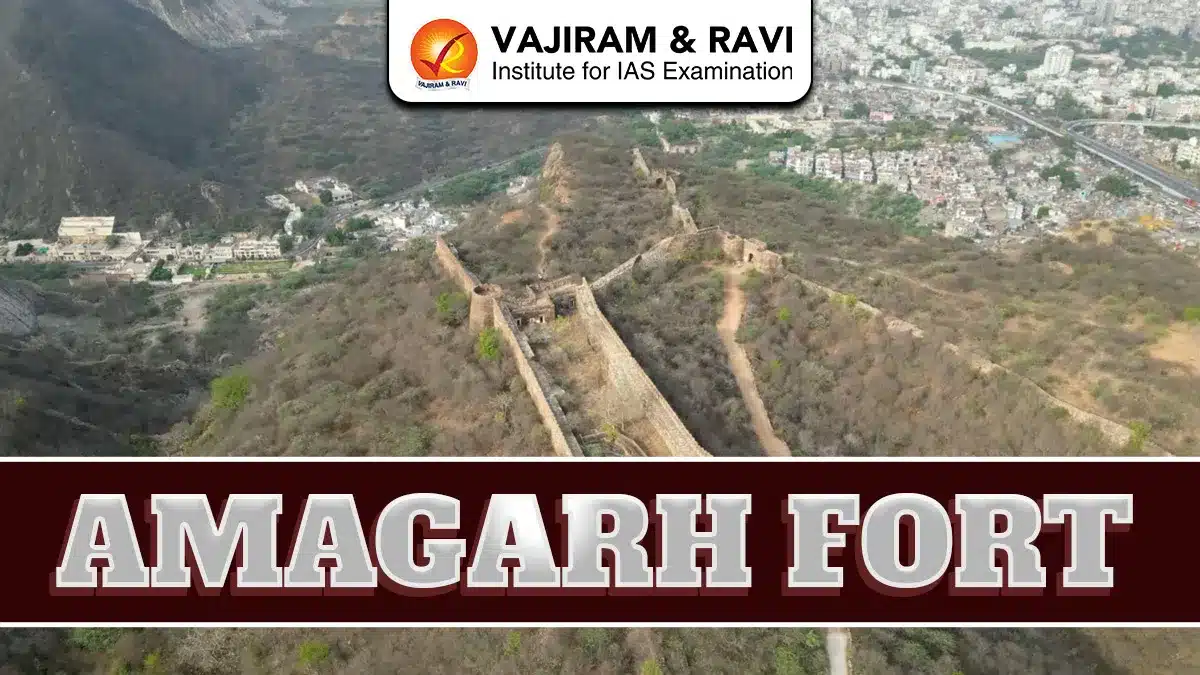
Amagarh Fort is a historical fort located near Jaipur, Rajasthan. The Fort is at the centre of a conflict between the tribal Meena community and local Hindu groups.
Amagarh Fort History
The origin of Amagarh Fort is debated. Members of the Meena community, an ancient tribal group recognised as a Scheduled Tribe in Rajasthan, claim that the Amagarh Fort was built by a Meena ruler from the Nadla gotra, now known as Badgoti Meenas, well before the rise of Rajput powers in the region.
While some historians believe that the present form of the Amagarh Fort was given in the 18th century by Maharaja Sawai Jai Singh II, founder of Jaipur city.
Amagarh Fort Recent Controversy
In the year 2021, Amagarh Fort became the centre of controversy when a saffron flag was hoisted at the site. Members of the Meena community protested, stating that their tribal religious symbols and cultural identity were being ignored. The situation led to clashes, police intervention, filing of FIRs, and restrictions on public access to the fort.
Amagarh Fort Cultural Significance
For the Meena community, Amagarh Fort is not just a military or architectural site, but a holy place where ancestral deities like Amba Mata, Bhairu ji, and Shiv Parivar are worshipped
About Meena Community
- The Meena community is one of the oldest tribal communities of India, mainly found in Rajasthan.
- Meenas are recognised as a Scheduled Tribe (ST) under the Indian Constitution.
- The word ‘Meena’ is believed to be derived from the Sanskrit word ‘Mina’, meaning fish, which was their ancient symbol. The fish symbol of the Meenas is still visible in the emblem of Jaipur state.
- Historically, Meenas were early rulers of eastern Rajasthan, especially the Dhundhar region (present-day Jaipur and surroundings). The Meena community predated the Kachwaha Rajputs in the Jaipur–Amer region.
- The community followed a clan system (gotras), with strong kinship ties.
- Meenas worship nature, ancestors, and tribal deities, showing elements of animism. Important deities worshipped by Meenas include Amba Mata, Bhairav Ji, Shiva, and local tribal gods.
- During medieval times, Meena power declined due to the expansion of Rajput kingdoms, especially the Kachwahas.
About Maharaja Sawai Jai Singh II
- Maharaja Sawai Jai Singh II was a ruler of Amber (Amer) in Rajasthan.
- He belonged to the Kachwaha Rajput dynasty.
- He became ruler of Amber at the age of 11 after his father Maharaja Bishan Singh died on 31 December 1699.
- The title “Sawai” means one and a quarter. The title was bestowed by Emperor Aurangzeb on 11-year-old Jai Singh II due to his wit and intelligence.
- He was a vassal ruler under the Mughal Empire, especially during the reigns of Aurangzeb, Bahadur Shah I, Jahandar Shah, and Muhammad Shah. Mughal emperor Muhammad Shah bestowed upon him the title of Saramad-i-Rajaha-i-Hind, Raj Rajeshvar, Shri Rajadhiraj and Maharaja Sawai.
- He founded the city of Jaipur in 1727. Recently, it has been declared a UNESCO World Heritage Site.
- Jai Singh II shifted his capital from Amber to Jaipur due to water scarcity and growing population.
- He was a great patron of science, mathematics, and astronomy. He translated several astronomical works into Sanskrit. He built Jantar Mantar observatories at five locations:Jaipur, Delhi, Ujjain, Mathura, Varanasi.
- Jai Singh II constructed the Samrat Yantra, the world’s largest stone sundial.
- He wrote the astronomical text “Zij-i Muhammad Shahi”.
- Jai Singh II followed a policy of religious tolerance. He abolished certain taxes like Jaziya in his kingdom.
Amagarh Fort FAQs
Q1: Where is Amagarh Fort located?
Ans: Amagarh Fort is located near Jaipur in Rajasthan.
Q2: Who is believed to have originally built Amagarh Fort?
Ans: The Meena community claims it was built by a Meena ruler before the rise of the Rajputs.
Q3: Which ruler is credited with the present structure of the fort?
Ans: Many historians attribute the present form of the fort to Maharaja Sawai Jai Singh II in the 18th century.
Q4: Why is Amagarh Fort culturally important to the Meena community?
Ans: It is a sacred site where they worship ancestral deities like Amba Mata, Bhairu ji, and Shiv Parivar.
Q5: Who founded the City of Jaipur.
Ans: Sawai Jai Singh II founded the city of Jaipur in 1727.
