
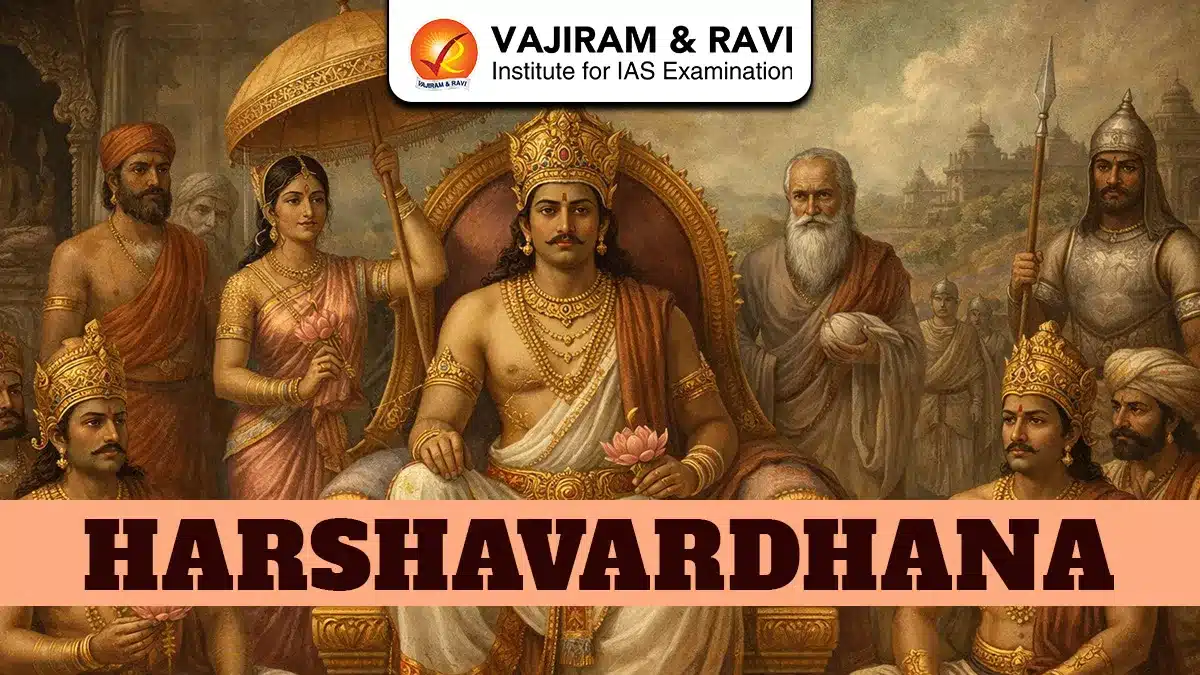
Harshavardhana was one of the most powerful rulers of early medieval India and the last great emperor of North India. After the fall of the Gupta Empire, King Harshavardhana was able to bring much of northern India under his control.
Harshavardhana Sources
- Harshacharita by Banabhatta, the court poet of Harsha, provides detailed information about Harsha’s lineage, early life, military campaigns, court life, and administration.
- Si-Yu-Ki by the Chinese pilgrim Xuanzang (Hiuen Tsang) gives an account of Harsha’s reign, administration, religious policy, and social conditions.
- Sanskrit plays written by Harsha namely Ratnavali, Nagananda, and Priyadarshika, also provide useful information.
- Copper plate inscriptions issued during Harsha’s reign provide information about land grants and administrative practices.
- The Madhuben plate inscription and the Sonpat inscription are helpful in knowing the chronology of Harsha.
- Banskhera inscription contains the signature of Harsha
Harshavardhana Early Life
- Harshavardhana, popularly known as Harsha, belonged to the Pushyabhuti (Vardhana) dynasty.
- Pushyabhutis were the feudatories of the Guptas. They called themselves Vardhanas. After the Hun invasions they assumed independence.
- The first important king of Pushyabhuti dynasty was Prabhakaravardhana. His capital was Thaneswar, north of Delhi. He assumed the title Maharajadhiraja and Paramabhattaraka.
- Harshavardhana was the son of Prabhakaravardhana, the Pushyabuti king of Thanesvar. Harsha’s mother was Yasomati. Harsha’s elder brother Rajyavardhana ruled over Thaneswar while Harsha’s sister Rajyasri was given in marriage to Grihavarman of Kannauj.
- Following the murder of Grihavarman of Kannauj and Rajyasri’s confinement, Rajyavardhan attacked Kannauj and defeated the Malava ruler Devagupta but was killed by Sasanka, the ruler of Gauda through treachery. In these circumstances, Harsa ascended the throne at Kannauj in 606 AD and adopted the title of Rajaputra instead of maharaja and took another name Shiladitya.
- Harshvardhana ruled large parts of North India from his capital at Thanesar initially and later Kannauj.
- He maintained diplomatic relations with China. In 641 AD, he sent an envoy to Tai-Tsung, the Tang emperor of China. Hiuen-Tsang, a Chinese pilgrim visited India during Harsha’s reign.
Harshavardhana Military Conquests
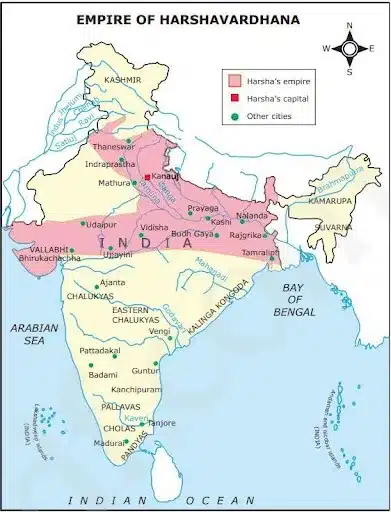
After the fall of the Gupta Empire, King Harshavardhana was able to bring much of northern India under his control. His rule spread over the present states of Punjab, Bengal, and Orissa and covered the entire Indo-Gangetic plain, with the Narmada River marking the southern boundary.
- In his first expedition, Harsha drove out Sasanka from Kanauj. He made Kanauj his new capital. This made him the most powerful ruler of north India.
- Harsha fought against Dhuruvasena II of Valabhi and defeated him. Dhuruvasena II became a vassal.
- The most important military campaign of Harsha was against the Western Chalukya ruler Pulakesin II. Harsha with an ambition to extend his kingdom south of the Narmada river marched against the Chalukya ruler. But the Aihole inscription of Pulakesin II mentions the defeat of Harsha by Pulakesin, who after this achievement assumed the title Paramesvara.
- Harsha led another campaign against the ruler of Sindh, which was an independent kingdom. But, it is doubtful whether his Sind campaign was a successful one.
- Nepal had accepted Harsha’s overlordship. Harsha established his control over Kashmir and its ruler sent tributes to him.
- He also maintained cordial relations with Bhaskaravarman, the ruler of Assam.
- Harsha’s last military campaign was against the kingdom of Kalinga in Orissa and it was a success.
Thus Harsha established his hold over the whole of north India. The regions of modern Rajasthan, Punjab, Uttar Pradesh, Bihar and Orissa were under his direct control. But his sphere of influence was much more extensive. The peripheral states such as Kashmir, Sind, Valabhi and Kamarupa acknowledged his sovereignty.
Harshavardhana Administration
- The administration of Harsha was organized on the same lines as the Guptas did.
- The king was the supreme head of government. He ruled according to the ideals laid down in the Dharmashastras. He also kept in close touch with the common man through tours of inspection in which he travelled incognito.
- He appointed the ministers and important officers of the state and led the armies in battle.
- The council of ministers played an important role in the selection of the king as well as framing the foreign policy of the empire. The prime minister was of the most important position.
- Some of the key officials of Harshvardhana administration were as follows:
| Key Official | Work |
|
Avanti |
Minister for Foreign Relations and War |
|
Simhananda |
Commander in Chief |
|
Kuntala |
Chief Cavalry Officer |
|
Skandagupta |
Chief Commandant of Elephant Forces |
|
Dirghadhvajas |
Royal Messengers |
|
Banu |
Keeper of Records |
|
Mahaprathihara |
Chief of the Palace Guard |
|
Sarvagata |
Secret Service Department |
Provincial Administration
- The empire was divided into several provinces.
- Each province was divided into Bhuktis and each Bhukti was divided into several Vishayas (districts). Each vishaya was further divided into Pathakas. Each such area was divided into several villages for the sake of administration convenience.
Revenue Administration
- Land revenue was the main source of income, generally around one-sixth of produce.
- The crown land was divided into four parts:
- Part I for carrying out affairs of the state
- Part II for paying the ministers and officers of the crown
- Part III for rewarding men of letters
- Part IV for charity to religious institutions
- Bhaga: Land tax paid in kind.
- Hiranya: Tax paid by farmers and merchants in cash.
Judicial Administration
- Mimamsakas were appointed to dispense justice.
- Banishment and the cutting of limbs of the body were the usual punishments.
- Trial by ordeals was in practice
- Life imprisonment for violations of laws and for plotting against the king.
Military Administration
- Harsha paid great attention to discipline and strength of the Army. The Army consisted of elephants, cavalry, and infantry. Horses were imported
- Ordinary soldiers were known as Chatas and Bhatas. Cavalry officers were called Brihadisvaras. Infantry officers were known as Baladhikritas.
Society under Harshavardhana
Both Bana and Hiuen Tsang portray the social life in the times of Harsha.
- The fourfold division of the society – Brahmin, Kshatriya, Vysya and Sudra – was prevalent.
- The Brahmins were the privileged section of the society and they were given land grants by the kings.
- The Kshatriyas were the ruling class and the Vysyas were mainly traders. Hiuen Tsang mentions that the Sudras practiced agriculture.
- There existed many sub castes.
- The position of women was not satisfactory. The institution of Swyamvara (the choice of choosing her husband) had declined. Remarriage of widows was not permitted, particularly among the higher castes. The system of dowry had also become common. The practice of sati was also prevalent.
- Hiuen Tsang mentions three ways of disposal of the dead – cremation, water, burial and exposure in the woods.
Economy under Harshavardhana
- The economy became increasingly more feudal and self-sufficient.
- Trade and commerce had declined during Harsha’s period. This is evident from the decline of trade centres, less number of coins, and slow activities of merchant guilds.
- The decline of trade in turn affected the handicrafts industry and agriculture.
- Since there was no large-scale demand for goods, the farmers began to produce only in a limited way. This led to the rise of a self-sufficient village economy.
Cultural Progress under Harshvardhana
- The art and architecture of Harsha’s period are very few and mostly followed the Gupta style.
- Hiuen Tsang describes the glory of the monastery with many storeys built by Harsha at Nalanda. He also speaks of a copper statue of Buddha with eight feet in height.
- The brick temple of Lakshmana at Sirpur with its rich architecture is assigned to the period of Harsha.
- Harsha was a great patron of learning. His biographer Banabhatta adorned his royal court. Besides Harshacharita, he wrote Kadambari.
- Other literary figures in Harsha’s court were Matanga Divakara and the famous Barthrihari, who was a poet, philosopher and grammarian. Harsha himself authored three plays - Ratnavali, Priyadarsika and Nagananda.
- Nalanda University flourished during Harsha’s reign, attracting students from China, Korea, and Southeast Asia. Hiuen Tsang visited the Nalanda University and remained as a student for some time
- Sanskrit was the primary language of learning, alongside Pali and Prakrit.
Religion under Harshvardhana
- Harsha was initially a Shaivite, but later became a follower of Mahayana Buddhism. Despite this shift, he continued to respect and patronise Brahmanical traditions.
- He followed a policy of religious tolerance, supporting Buddhist, monasteries, Brahmanas and Jain institutions. Once in five years he convened a gathering of representatives of all religions and honoured them with gifts and costly presents.
- He erected thousands of stupas and established travellers’ rests all over his kingdom. He also erected monasteries at the sacred places of Buddhists.
- He prohibited animal slaughter on certain occasions, reflecting Buddhist influence.
- During his reign, the famous religious festival called ‘Makamokshaparishad’ was organised every 5 years at Prayag, lasting for 4 days. On the first 3 days, Ganesh, Shiva, and Buddha were worshipped and the 4th day was reserved for charitable purposes.
- Harsha organised grand religious assemblies at Kannauj and Prayaga. At the Prayaga Assembly, held every five years, he distributed accumulated wealth in charity, often ending as a pauper.
Decline of Harshavardhana empire
Aihole Inscription mentioned the defeat of Harshavardhana by the Chalukya king Pulakesin II in 637AD. He did not have any heirs; his empire collapsed and disintegrated rapidly into small states.
Harshavardhana FAQs
Q1: Harshavardhana belonged to which dynasty?
Ans: Harshavardhana belonged to the Pushyabhuti (Vardhana) dynasty.
Q2: What were the capitals of Harsha?
Ans: Thanesar (initial capital) and later Kannauj.
Q3: Which Chinese pilgrim visited Harsha’s court?
Ans: Xuanzang (Hiuen Tsang) visited Harsha’s court.
Q4: Which ruler defeated Harsha in the south?
Ans: Pulakesin II of the Chalukya dynasty at the Narmada River.
Q5: Which literary works are associated with Harsha?
Ans: Sanskrit plays such as Ratnavali, Nagananda, and Priyadarshika are associated with Harsha.
