
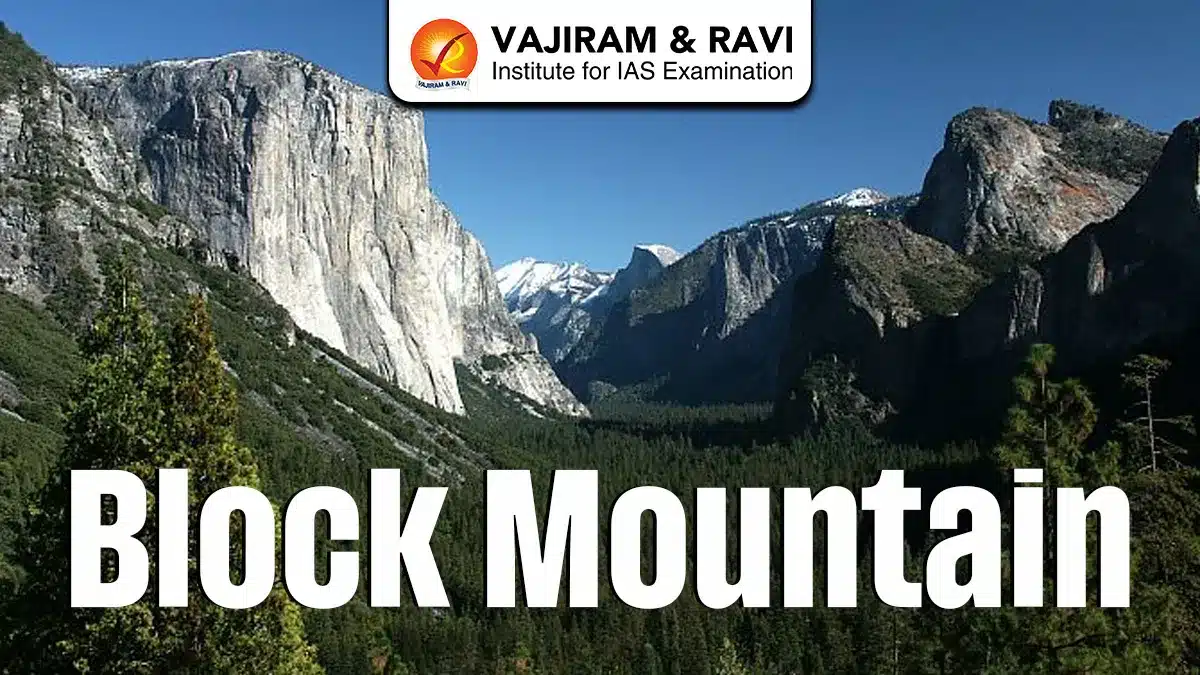
Mountains are large natural elevations of the Earth’s surface formed due to internal geological forces. They mainly originate through folding, faulting, volcanic activity or erosion. Based on origin, mountains are classified as fold mountains, Block Mountains, volcanic mountains and residual mountains. Block Mountains form specifically due to faulting caused by tensional forces in the Earth’s crust. When the crust stretches, it breaks into large blocks, some of which rise while others sink. These uplifted blocks are called Block Mountains, making them structurally different from folded ranges.
Block Mountain
Block Mountains, also known as Fault Block Mountains, develop when large sections of the Earth’s crust move vertically along faults under tensional tectonic forces. These movements do not bend rock layers but fracture them, producing massive blocks with steep sides and relatively flat tops. The raised blocks are called horsts, while the lowered blocks are known as grabens. These Mountains are commonly associated with rift zones and earthquake prone regions, as fault movement releases stored tectonic energy during crustal adjustment processes.
Block Mountain Types
Block Mountains are mainly classified based on the nature of fault movement and the tilting of crustal blocks during tectonic activity.
- Lifted Block Mountains: These form when a central crustal block rises between two parallel normal faults, creating steep fault scarps on both sides with a flat or gently undulating summit.
- Tilted Block Mountains: These develop when one side of the block is lifted along a fault while the other side slopes gradually, producing asymmetrical mountain profiles common in extensional landscapes.
Block Mountain Features
Block Mountains possess distinct physical and geological features that reflect their tectonic origin and fault controlled structure.
- Fault Controlled Structure: They are formed entirely by normal faulting, not folding, with clearly visible fault scarps marking zones of vertical crustal displacement.
- Steep Slopes and Flat Tops: Most Block Mountains show steep, straight slopes along fault lines and comparatively flat or gently tilted summits.
- Horst and Graben Association: Block Mountains exist alongside grabens, forming alternating uplifted and down dropped crustal blocks across rifted landscapes.
- Uniform Rock Composition: Each block usually consists of similar rock types, indicating uplift of intact crustal sections rather than deformed strata.
- Seismic Activity Zones: These mountains commonly occur in earthquake prone regions because fault movement releases tectonic stress accumulated within the crust.
Read about: Types of Mountains
Block Mountain Formation
Block Mountains form due to large scale faulting triggered by tensional forces that stretch the Earth’s crust beyond its elastic limit. The process of formation of the Block Mountains has been listed below:
- Horizontal stretching of the lithosphere creates stress zones that fracture rigid crustal rocks along parallel fault planes.
- Under tension, normal faults form where one block moves downward relative to the other, allowing vertical displacement.
- When a block between two faults moves upward or remains stationary while adjacent blocks sink, it forms an elevated horst.
- Down dropped blocks between horsts create grabens, often evolving into rift valleys, basins, or elongated depressions.
- Uneven fault movement can tilt blocks, producing one steep fault scarp and one gentle slope, shaping tilted Block Mountains.
Block Mountain Examples
Block Mountains in India and the world occur especially in tectonically active or rift related regions. Major Examples of Block Mountains Globally has been mentioned here:
- Vindhya Range (India): A major Block Mountain system formed by faulting in central India, rising as a horst north of the Narmada graben.
- Satpura Range (India): Located south of the Narmada Valley, this range represents an uplifted block bounded by faults and associated with rift tectonics.
- Narmada Valley (India): A classic graben between the Vindhya and Satpura horsts, illustrating large scale block faulting in the Indian shield region.
- Black Forest (Germany): An uplifted horst formed during Rhine Rift Valley development, characterized by steep western escarpments and fault controlled relief.
- Vosges Mountains (France): A parallel horst to the Black Forest, uplifted during rifting, with sharp fault scarps facing the Rhine graben.
- Sierra Nevada (USA): A tilted Block Mountain created by normal faulting along the North American Plate, featuring a steep eastern escarpment.
- Harz Mountains (Germany): An ancient Block Mountain uplifted by faulting, displaying steep slopes and clear tectonic boundaries.
- East African Rift Region: Extensive fault block systems where horsts and grabens form large rift valleys, highlighting active continental extension processes.
Block Mountain FAQs
Q1: What is a Block Mountain?
Ans: A block mountain is formed when large crustal blocks rise due to faulting under tensional forces in the Earth’s crust.
Q2: What are Horsts and Grabens?
Ans: Horsts are uplifted crustal blocks forming block mountains, while grabens are down dropped blocks forming valleys or basins.
Q3: How are Block Mountain formed?
Ans: Block mountains are formed mainly by tensional tectonic forces that stretch and fracture the Earth’s crust.
Q4: What are the Block Mountains found in India?
Ans: The Vindhya Range and the Satpura Range are classic examples of block mountains in India.
Q5: How are Block Mountains different from Fold Mountains?
Ans: Block mountains form by faulting, whereas fold mountains form by compression and folding of the rock layers.
