
El Chichon Volcano

El Chichon Volcano

El Chichon Volcano Latest News

Unusual changes inside the crater of Chichón volcano in southern Mexico have raised fresh concerns among volcanologists.

About El Chichon Volcano

  • El Chichón, also known as Chichonal, is a stratovolcano situated in the forested terrain of north-central Chiapas, Mexico.
  • It is the youngest volcano in the northwestern part of the 150-km-long Chiapanecan volcanic arc.
  • This volcano is made up of several lava domes and a tuff ring. A tuff ring is a low, wide ring of volcanic ash and rock. 
  • El Chichón sits between two larger volcanic areas: the Trans-Mexican Volcanic Belt and the Central America Volcanic Arc.
  • It is one of the most active volcanoes located in Mexico. 
  • It has produced at least 12 major volcanic eruptions during the past 8000 years. 
  • El Chichón became very well known for its eruption in 1982
    • The 1982 eruption  was the biggest disaster in modern Mexican history. 
    • The powerful 1982 explosive eruptions of high-sulfur, anhydrite-bearing magma were accompanied by devastating pyroclastic flows and surges and destroyed the summit lava dome.
    • The eruptions created a new 1-kilometer-wide crater that now contains an acidic crater lake.

Source: IDR

El Chichon Volcano FAQs

Q1: Where is El Chichón Volcano located?

Ans: El Chichón Volcano is located in the forested terrain of north-central Chiapas, Mexico.

Q2: What type of volcano is El Chichón?

Ans: El Chichón is a stratovolcano.

Q3: Between which two major volcanic regions is El Chichón located?

Ans: It lies between the Trans-Mexican Volcanic Belt and the Central America Volcanic Arc.

Q4: Which eruption brought global attention to El Chichón Volcano?

Ans: The 1982 eruption brought worldwide attention to the volcano.
Project Vault

Project Vault

Project Vault Latest News

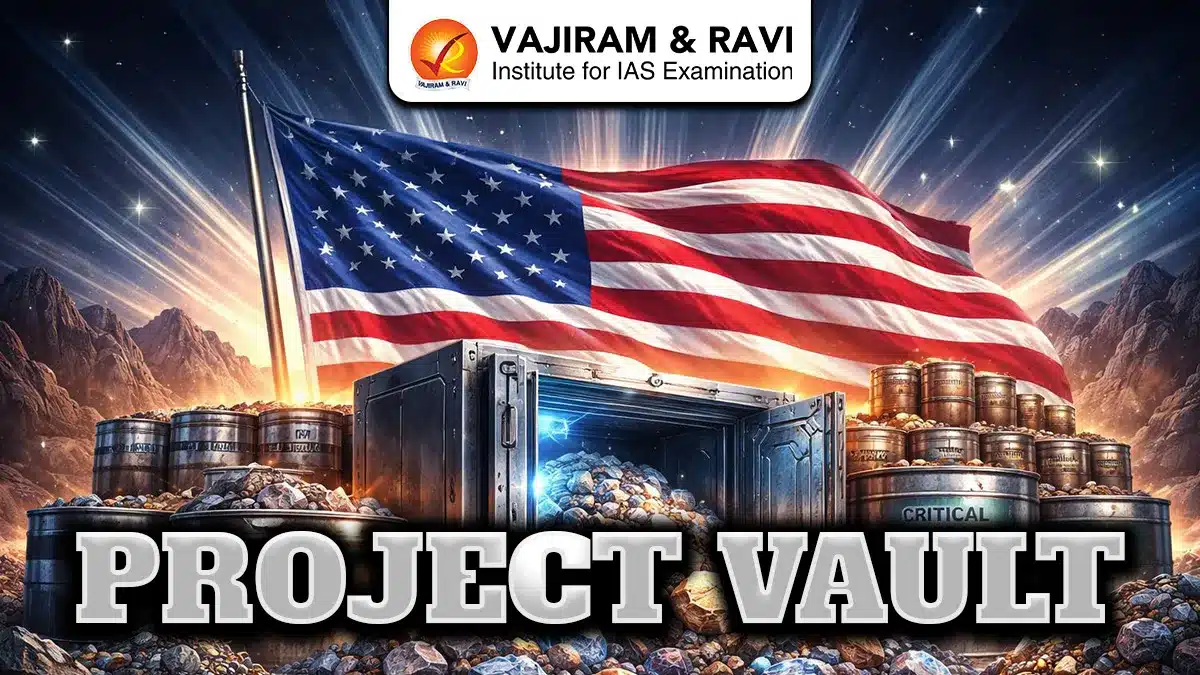
The US government recently rolled out Project Vault, a $12 billion scheme to stockpile rare earths and critical minerals, aiming to shield American companies from global supply disruptions.

About Project Vault

  • It is a $12 billion scheme launched by the United States to stockpile rare earths and critical minerals, aiming to shield American companies from global supply disruptions.
  • It is a public-private partnership that will buy and store critical minerals and rare earth elements. 
    • These minerals are used in products such as smartphones, batteries, jet engines, and electric vehicles. 
  • The project is similar to the US Strategic Petroleum Reserve, which stores emergency oil supplies. However, instead of crude oil, Project Vault will focus on minerals.
  • It will combine $1.67 billion in private seed funding with another $10 billion from the US government’s Export-Import Bank.
  • How will the stockpiling system work?
    • Companies will make an initial commitment to buy materials later at a fixed inventory price. They will also pay some upfront fees
    • Based on these commitments, companies can give Project Vault a list of the materials they need. The project will then purchase and store those materials.
    • Manufacturers will pay a carrying cost that covers loan interest and storage expenses.
  • When can companies access the stored minerals?
    • Companies will be allowed to use their stored materials as long as they replace what they take out. 
    • In case of a major supply disruption, firms will be able to access their entire stockpile.
    • A key feature of the plan is that companies must agree to repurchase the same amount of materials in the future at the same price.

Source: BS

Project Vault FAQs

Q1: What is Project Vault?

Ans: It is a $12 billion United States initiative to stockpile rare earths and critical minerals.

Q2: What is the main objective of Project Vault?

Ans: The main objective is to shield U.S. companies from supply chain disruptions of critical minerals and rare earth elements.

Q3: What kind of partnership model does Project Vault follow?

Ans: It follows a public–private partnership model.

Q4: What costs do manufacturers bear while using Project Vault?

Ans: Manufacturers pay a carrying cost, covering loan interest and storage expenses.

BRICS Centre for Industrial Competencies

BRICS Centre for Industrial Competencies

BRICS Centre for Industrial Competencies Latest News

Recently, India joined the BRICS Centre for Industrial Competencies (BCIC) at Vanijya Bhavan, New Delhi.

About BRICS Centre for Industrial Competencies

  • It was launched in partnership with the United Nations Industrial Development Organization (UNIDO).
  • Objective: It serves as a one-stop centre providing integrated support services to manufacturing companies and Micro, Small and Medium Enterprises (MSMEs) across BRICS countries.
  • It is a network-driven initiative under UNIDO, supporting SMEs, industrial modernization, and digital transformation in BRICS.
  • It focuses on strengthening Industry 4.0 competencies.
  • Implementation: The National Productivity Council (NPC) has been designated as the India Centre for BRICS Industrial Competencies. 

Key Facts about BRICS

  • It is a group of major emerging economies that work together for economic cooperation, development, and global governance reforms.
  • The acronym ‘BRIC’ was coined by Jim O’Neill (Goldman Sachs economist) in 2001 to denote four emerging economies – Brazil, Russia, India, and China.
  • BRIC held its first meeting in 2006 during the G8 Outreach Summit and its first standalone summit in Russia in 2009.
  • With the inclusion of South Africa in 2010, BRIC became BRICS.
  • Aim: To strengthen South-South cooperation and increase the voice of developing countries at the global level.
  • Member Countries: Brazil, Russia, India, China, South Africa, Saudi Arabia, United Arab Emirates, Iran, Egypt, Ethiopia, and Indonesia.

Source: PIB

BRICS Centre for Industrial Competencies FAQs

Q1: What is the BRICS Centre for Industrial Competencies?

Ans: A one-stop centre for manufacturing companies and MSMEs.

Q2: What is the objective of the BRICS Centre for Industrial Competencies?

Ans: To support capacity building and manufacturing-related initiatives

AI Stack

AI Stack

AI Stack Latest News

India is anchored in the vision of AI for Humanity and building a robust AI stack is both a technological priority and a social commitment for India.

About AI Stack

  • An AI stack is the complete set of tools and systems that work together to build and run AI applications. 
  • It makes artificial intelligence work in the real world, from the apps people use every day to the data, computing power, networks etc.
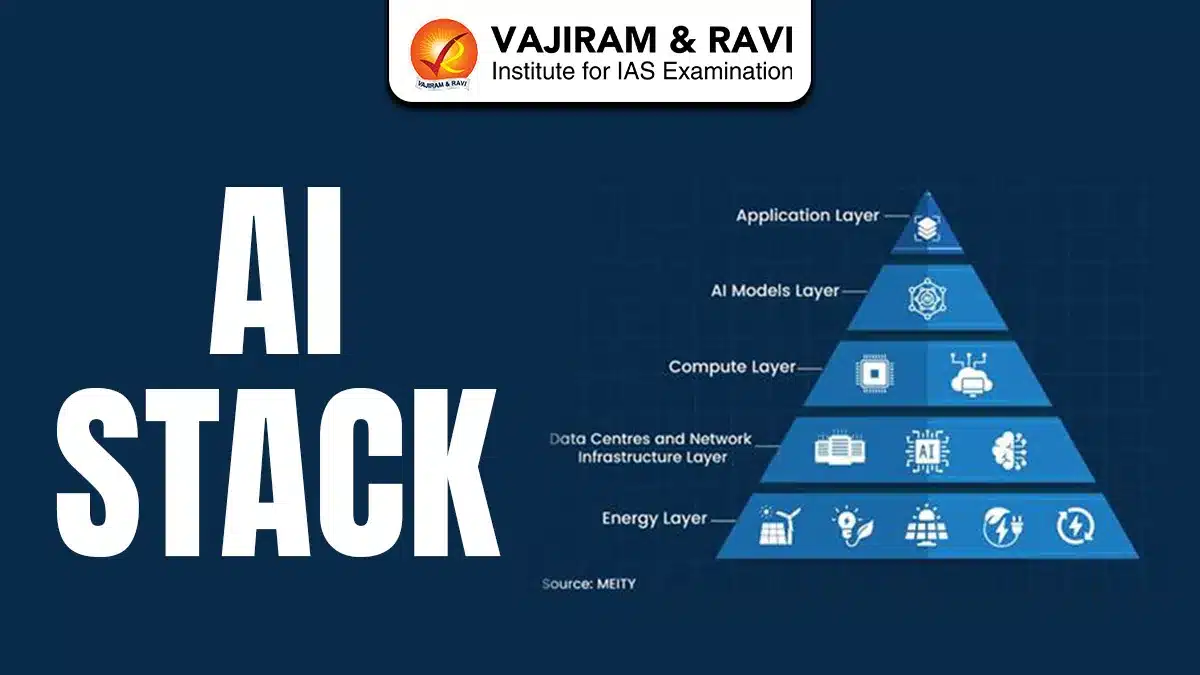
  • It is made up of five layers
    • Application Layer
      • It represents the user-facing component of the AI stack.
      • It includes AI-powered apps and services such as health diagnostic tools, farming advisory platforms, chatbots, and language translation applications.
      • This layer turns complex AI processes into simple, user-friendly services that people can easily use.
    • AI model layer
      • It acts as the brain of AI systems. AI models are trained on data to recognize patterns, make predictions, and take decisions.
      • It is the core intelligence that determines how effectively applications can understand, predict, and respond to real-world needs. 
      • Example: They help detect diseases from X-rays, predict crop yields, translate languages, or answer questions through chatbots.
    • Compute layer
      • It provides the computing power required to train and run AI models. During training, computers process vast amounts of data so the model can learn and improve. 
      • It is the critical enabler that determines the scale, speed, and sophistication of AI innovation.
    • Data Centres and Network Infrastructure Layer
      • Data centres are where AI systems are stored and operated, while networks like the internet, broadband, and 5G move data between users, computers, and AI models.
      • The data centres and network infrastructure layer provides the foundational backbone that enables AI systems to operate at scale and in real time. 
    • Energy Layer: It keeps the entire AI stack running. AI data centres consume large amounts of electricity because powerful computers are needed to train and operate AI systems.

Source: PIB

AI Stack FAQs

Q1: What is the primary goal of Artificial Intelligence?

Ans: To create machines that can think and act like humans

Q2: Which technology enables AI systems to learn from data?

Ans: Machine Learning

Nalsarovar Bird Sanctuary

Nalsarovar Bird Sanctuary

Nalsarovar Bird Sanctuary Latest News

Nalsarovar Bird Sanctuary has recorded over five lakh birds across 200 species in its latest census, a sharp 21% jump from 4.12 lakh in 2024, largely due to the absence of boating, reduced tourist movement, and minimal noise pollution over the past two years.

About Nalsarovar Bird Sanctuary

  • It is located approximately 64 km west of Ahmedabad in Gujarat.
  • Nal Sarovar literally translates to ‘Tap Lake’. 
  • It is a natural lake with shallow waters and muddy lagoons, dotted by 36 islets.
  • Spread over an area of 120.82 sq.km., this sanctuary is a paradise for bird watchers and nature enthusiasts. 
  • The history of Nalsarovar dates back to the 15th century, when the lake was created as a result of the construction of a check dam across the Sabarmati River. 
  • The lake was initially used for irrigation and as a source of drinking water for nearby villages.
  • Over time, the lake became an important habitat for a variety of bird species, and local communities recognized its ecological significance. 
  • In the early 20th century, the British colonial administration recognized the importance of Nalsarovar as a wetland ecosystem and established it as a protected area.
  • In 1969, the Gujarat government declared Nalsarovar a bird sanctuary to primarily protect its bird population.
  • It was declared as a Ramsar site on 24 September 2012. 
  • Flora
    • The sanctuary area has 48 species of algae and 72 species of flowering plants. 
    • The common aquatic plants are Cyperus sp., Scirpus sp., Typha ungustata, Eleocharis palustris, Ruppia, Potamogeton, Vallisnaria, Naias, Chara, etc.
    • It also includes locally famous ‘pilu’ trees which harbor a red berry type edible fruit.
  • Fauna
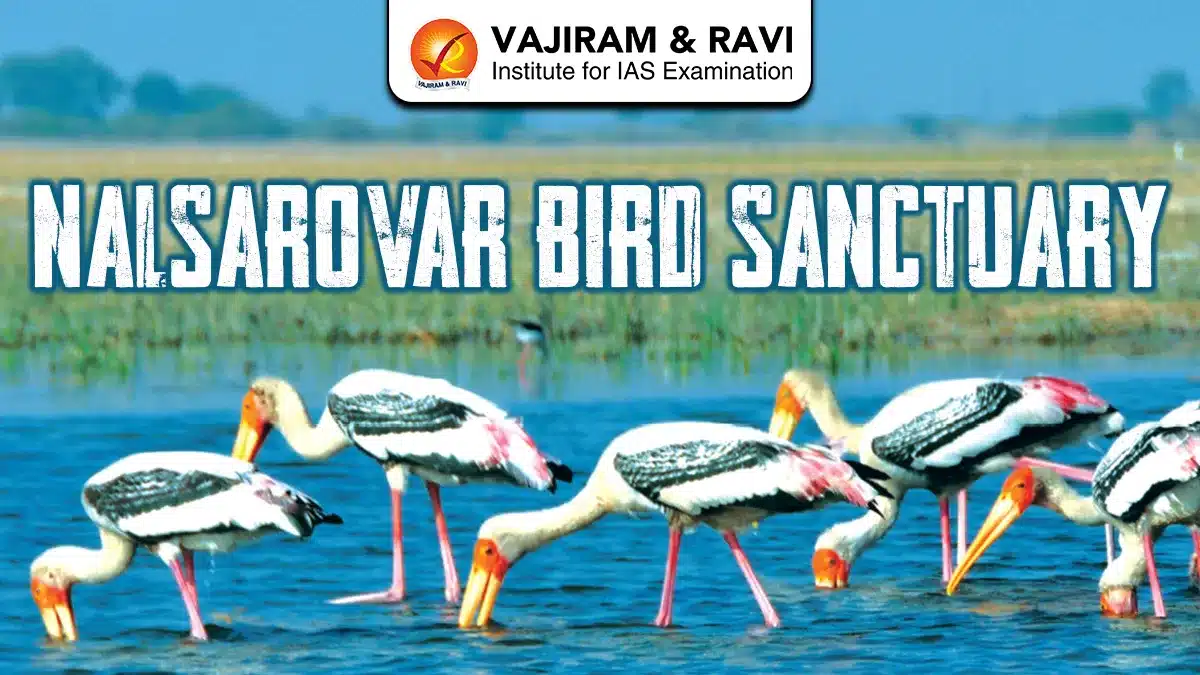
    • It’s home to over 250 species of birds, including beautiful migratory birds that travel from places as far away as Europe and Siberia. 
    • Apart from these, typical species like pelicans, ducks, herons, and storks can be found easily.
    • Other animals: On southern or southwestern fringes, small herds of wild ass can be seen. Mongoose, jungle cat, Indian fox, jackal, wolf, and hyena are also there.

Source: TOI

Nalsarovar Bird Sanctuary FAQs

Q1: Where is Nalsarovar Bird Sanctuary located?

Ans: It is located about 64 km west of Ahmedabad in Gujarat.

Q2: What type of water body is Nalsarovar Bird Sanctuary?

Ans: It is a natural lake with shallow waters and muddy lagoons, dotted with 36 islets.

Q3: When was Nalsarovar designated as a Ramsar site?

Ans: It was designated as a Ramsar site on 24 September 2012.

Yuva Sahakar Scheme

Yuva Sahakar Scheme

Yuva Sahakar Scheme Latest News

Recently, the Ministry of Cooperation provided details of financial assistance released to cooperatives along with beneficiaries for financial year 2022- to 2025 under Yuva Sahakar Scheme.

About Yuva Sahakar Scheme

  • Yuva Sahakar – Cooperative Enterprise Support and Innovation Scheme” aims to encourage newly formed cooperative societies with new and/or innovative ideas.
  • It encourages young entrepreneur Cooperative Societies which are in operation for a minimum of 3 months.
  • Loan Facility: The loan provided under the scheme is a long-term loan (up to 5 years) and as an incentive, NCDC provides 2% interest subvention on its applicable rate of interest on term loan for the project activities.
  • Implementation: It is being implemented by National Cooperative Development Corporation (NCDC) across the country.

Features of Yuva Sahakar Scheme

  • NCDC has produced a dedicated fund with liberal traits entitling youth to avail the scheme.
  • It is linked with Rs.1000 crores of the Cooperative Start-up and Innovation Fund that has been authorised by the NCDC.
  • It provides more incentives to the cooperatives working in the North-Eastern region and the aspirational districts.
  • Exclusive benefits are provided for women, Scheduled Caste and Scheduled Tribe candidates.
  • Yuva Sahakar Scheme is a part of Sahakar 22, a Mission for Doubling Farmers’ Income by 2022.

Source: PIB

Yuva Sahakar Scheme FAQs

Q1: What is the objective of Yuva Sahakar Scheme?

Ans: Encourage young entrepreneur cooperative societies

Q2: Who implements Yuva Sahakar Scheme?

Ans: National Cooperative Development Corporation

Bharat Taxi

Bharat Taxi

Bharat Taxi Latest News

The Union Cooperation Minister will launch India’s first cooperative-based ride-hailing platform, “Bharat Taxi,” at Vigyan Bhavan, New Delhi. 

About Bharat Taxi

  • Bharat Taxi is India’s first cooperative-led ride-hailing platform registered under the Multi-State Cooperative Societies Act, 2002.
  • It is a government-supported initiative developed under the Union Ministry of Cooperation and the National e-Governance Division (NeGD).
  • It is India’s first cooperative taxi network, allowing drivers to become shareholders and co-owners.
  • Promoted: It is being jointly promoted by leading cooperative and financial institutions including NCDC, IFFCO, AMUL, KRIBHCO, NAFED, NABARD, NDD Band NCEL.

Key Features of Bharat Taxi Initiative

  • Driver-Owned Fleet: Drivers can purchase shares and become cooperative members, giving them transparency and decision-making power.
  • Zero Commission: Unlike private cab aggregators that take a large cut, Bharat Taxi transfers the full fare to the driver.
  • Transparent, No-Surge Pricing: Fares will remain predictable, with no surge charges.
  • Platform Integration & Technical Architecture: Integration of the Bharat Taxi platform with national digital platforms such as DigiLocker, UMANG, and API Setu.
  • Security, Compliance & Infrastructure: Ensuring adherence to Government of India’s data protection norms and cybersecurity standards and advising on robust technical infrastructure.

Source: PIB

Bharat Taxi FAQs

Q1: What is Bharat Taxi?

Ans: India's first national-level cooperative ride-hailing platform

Q2: What is unique about Bharat Taxi's business model?

Ans: It follows a zero-commission model

Denotified, Nomadic and Semi-Nomadic Tribes (DNTs)

Denotified, Nomadic and Semi-Nomadic Tribes (DNTs)

Denotified, Nomadic and Semi-Nomadic Tribes (DNTs) Latest News

Denotified tribes, nomadic tribes, and semi-nomadic tribes across the country are coming together to push for a “separate column” for themselves in the 2027 Census.

About Denotified, Nomadic and Semi-Nomadic Tribes (DNTs)

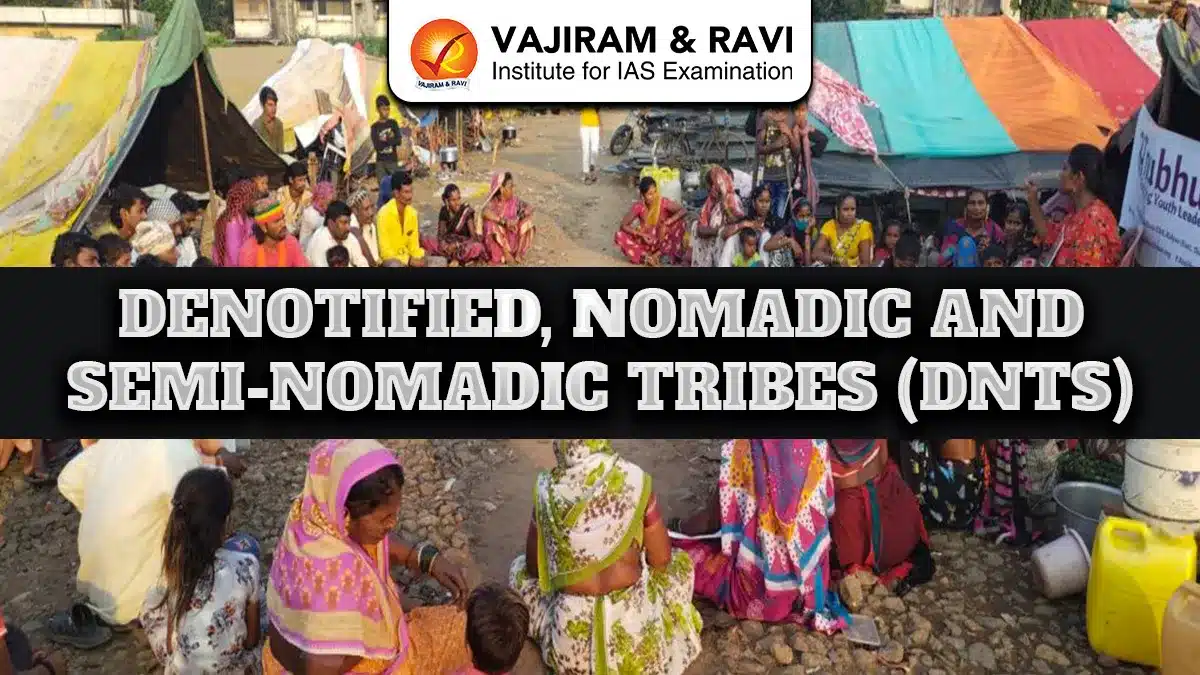
  • Denotified Tribes (DNTs) are those communities which were once notified under the Criminal Tribes Acts, enforced by the British Raj between l871 and I947. 
    • Once a tribe becomes “Notified” as criminal, all its members were required to register with the local magistrates, failing which they would be charged with a ‘crime’ under the Indian Penal Code. 
  • After Independence, this Act was repealed in 1952, and the communities were “denotified”, hence the name. 
  • A few of these communities which were listed as denotified were also nomadic.
    • Nomadic tribes are the communities who usually do not have land and move from one place to another for livelihood.
  • The DNTs are among the most neglected, marginalised, and economically deprived communities, with most living a life of destitution.
  • Historically, these communities never had access to private land or home ownership and used forests and grazing lands for their livelihood and residential use. 

Status of DNTs in India

  • In India, roughly 10 percent of the population are DNTs.
  • In 2014, the Ministry of Social Justice and Empowerment constituted a National Commission for De-notified, Nomadic, and Semi-Nomadic Tribes (NCDNT) under the chairmanship of Bhiku Ramji Idate for a period of three years- 
    • to prepare a state-wise list of castes belonging to  DNTs  
    • to suggest appropriate measures in respect of Denotified and Nomadic Tribes that may be undertaken by the Central Government or the State Government. 
  • NCDNT submitted its report on 08.01.2018.  
  • As per the report, a total of 1235 communities have been identified as DNTs across the country.
  • Based on the Commission’s recommendations, the ministry constituted the Development and Welfare Board for Denotified, Nomadic, and Semi-Nomadic Communities (DWBDNCs) in 2019. 
  • The Board has been mandated to formulate and implement welfare and development programmes for these communities. 
  • The Renke Commission (2008) was earlier commissioned to identify and list the DNT communities.

Scheme for Economic Empowerment of DNTs (SEED)

  • It was launched by the Ministry of Social Justice and Empowerment for the welfare of DNT communities. 
  • It is being implemented by DWBDNCs.
  • It has been formulated for families having income from all sources of Rs 2.50 lakh or less per annum and not availing any such benefits from a similar scheme of the Centre or state government.
  • Aim: To provide free competitive exam coaching, health insurance, housing assistance, and livelihood initiatives at the community level, and financial assistance for construction of houses will be provided to the members of DNTs Communities.
  • An amount of 200 crore has been allocated for this scheme — to be spent over five years from FY2021-22 to FY2025-26.

Source: TH

Denotified, Nomadic and Semi-Nomadic Tribes (DNTs) FAQs

Q1: Who are Denotified Tribes (DNTs)?

Ans: Denotified Tribes are communities that were once notified as “criminal tribes” under the Criminal Tribes Acts during British rule.

Q2: During which period were the Criminal Tribes Acts enforced in India?

Ans: They were enforced between 1871 and 1947.

Q3: When were the Criminal Tribes Acts repealed in independent India?

Ans: The Acts were repealed in 1952.

Q4: Who are Nomadic Tribes?

Ans: Nomadic tribes are communities that generally do not own land and move from place to place for livelihood.

Hakki Pikki Tribe

Hakki Pikki Tribe

Hakki Pikki Tribe Latest News

Eight members of Karnataka’s Hakki Pikki tribal community, who had travelled to Central Africa for the sale of herbal products, are now facing a serious crisis after their visas expired.

About Hakki Pikki Tribe

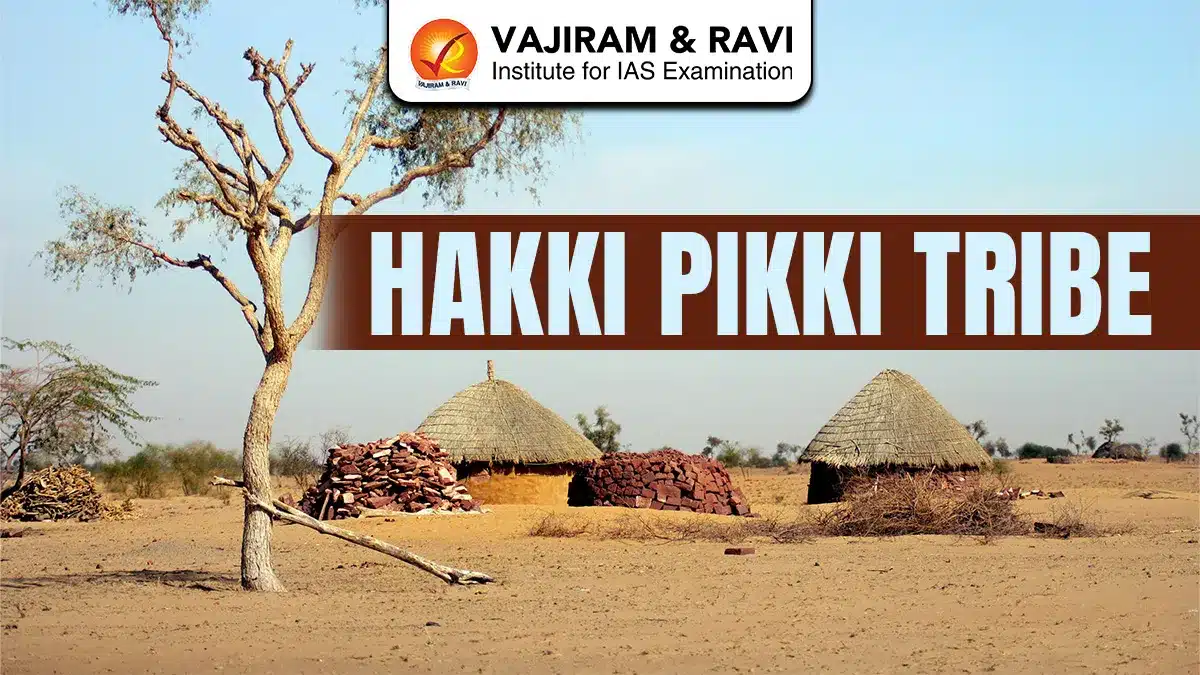
  • ‘Hakki-Pikki’ is one of the major tribal communities in Karnataka.
  • According to the 2011 census, the Hakki Pikki population in Karnataka is 11,892.
  • In Kannada, the word ‘Hakki’ stands for ‘bird' and ‘Pikki’ stands for the verb ‘to catch’. 
  • Therefore, the community is known as the ‘bird catcher,’ which is their traditional occupation.
  • They  believe their original ancestor was the legendary Ranapratap Singh and that they are from a Kshatriya or warrior background. 
  • They believe their ancestors migrated to southern India after being defeated by the Moghuls. 
  • They are recognized as a Scheduled Tribe in India.
  • Language:
    • Despite being surrounded by Dravidian languages and living in southern India, the community speaks an Indo-Aryan language. 
    • Their mother tongue was designated 'Vaagri' by scholars.
    • They communicate in 'Vaagri' at home but speak in Kannada when conducting daily business.
    • UNESCO has listed ‘Vaagri’ as one of the endangered languages.
  • Occupation:
    • After the implementation of stricter wildlife laws, the tribe changed its occupation from hunting to selling spices, flowers, Ayurveda formulations, and herbal oils.
    • They began doing odd jobs like working in fields and sharpening knives and sickles by riding around towns.
    • They are renowned for their indigenous medicines. The community resided in the dense jungles for a long time and created its own plant- and herb-based medicine systems.
    • They now travel globally to sell these products, especially in the African continent, where there is a demand for cheaper alternatives to Western medicine.
  • Rituals and Customs:
    • The tribe follows Hindu traditions and celebrates Hindu festivals.
    • They follow a clan-based social structure and practice endogamy within their clan.
    • The tribe prefers cross-cousin marriages.
    • The society is matriarchal, where the groom gives dowry to the bride’s family.

Source: HANS

Hakki Pikki Tribe FAQs

Q1: Who are the Hakki Pikki tribe?

Ans: The Hakki Pikki are a major tribal community of Karnataka, recognized as a Scheduled Tribe in India.

Q2: What does the term ‘Hakki-Pikki’ mean?

Ans: In Kannada, ‘Hakki’ means bird and ‘Pikki’ means to catch, so the term refers to ‘bird catchers’.

Q3: What is the mother tongue of the Hakki Pikki tribe?

Ans: Their mother tongue is known as ‘Vaagri’.

Q4: What are the current occupations of the Hakki Pikki tribe?

Ans: They sell spices, flowers, Ayurvedic formulations, herbal oils, and also work as farm labourers and tool sharpeners.

Q5: What is the Hakki Pikki tribe particularly renowned for?

Ans: They are renowned for their indigenous plant- and herb-based medicine systems.

SAMRIDH Programme

SAMRIDH Programme

SAMRIDH Programme Latest News

Recently, the union Minister of State for Electronics and Information Technology informed the Lok Sabha about the SAMRIDH Programme.

About SAMRIDH Programme

  • The Startup Accelerator of MeitY for Product Innovation, Development, and Growth (SAMRIDH) is a flagship programme of the Ministry of Electronics & IT (MeitY).
  • Aim: It aims to support existing and upcoming Accelerators to select and accelerate potential IT-based startups to scale. 
  • Among others, the program focuses on accelerating the startups by providing customer connect, investors connect and connect to international markets.
  • Support: The program supports 300 tech Start-Ups in 3-year duration with cohort size of 5-10 StartUps.
    • In the first round of cohort, 22 Accelerators spread across 12 states are supporting 175 startups, selected through a multilevel screening process.
  • Financial Support: It provides financial support of ₹2 lakh per startup to selected accelerators, along with matching funding to startups up to a maximum of ₹40 lakh.
  • Implementation: It is being implemented by MeitY Start-up Hub (MSH), Digital India Corporation (DIC).

Source: PIB

SAMRIDH Programme FAQs

Q1: Who implements the SAMRIDH Programme?

Ans: MeitY Start-up Hub (MSH)

Q2: What is the maximum funding provided to startups under the SAMRIDH Programme?

Ans: ₹40 lakh

Enquire Now