
Vayu Shakti 2026

Vayu Shakti 2026

Vayu Shakti 2026 Latest News

The Indian Air Force will conduct Vayu Shakti 2026, a major air combat exercise near the Pakistan border, showcasing its full spectrum of offensive and defensive capabilities in a simulated war environment.

About Vayu Shakti 2026

  • It is a major air combat exercise of the Indian Air Force (IAF).
  • It will be held Pokaran Field Firing Range in Rajasthan’s Jaisalmer district and is expected to be the IAF’s largest air combat drill of the year. 
  • Airbases and assets of the IAF’s Western and South Western Air Commands will participate in the exercise. 
  • All units have been fully activated, with more than 100 aircraft expected to take part.
  • Almost all frontline fighter aircraft and air defence systems that were part of Operation Sindoor will be deployed during the exercise. 
  • These include Rafale, Su-30 MKI, Tejas, MiG-29, Jaguar, Mirage-2000 and Hawk aircraft, which will be seen engaging ground and aerial targets with precision. 
  • The MiG-21, now retired from IAF service, will not feature in the exercise for the first time. 
  • The indigenous Prachand attack helicopter will also participate, firing rockets during live drills.
  • The exercise will be conducted in a simulated wartime scenario and monitored through the IAF’s Integrated Air Command and Control System (IACCS), which enables real-time tracking and coordination of air operations. 
  • Inputs from long-range, medium-range and short-range radars will be integrated to generate a comprehensive air picture for both offensive and defensive missions.
  • Drones and loitering munitions used during Operation Sindoor will also be deployed.

Source: IT

Vayu Shakti 2026 FAQs

Q1: What is Vayu Shakti 2026?

Ans: Vayu Shakti 2026 is a major air combat exercise of the Indian Air Force (IAF).

Q2: Which IAF commands will participate in Vayu Shakti 2026?

Ans: The Western Air Command and the South Western Air Command.

Q3: Which fighter aircraft will be seen engaging ground and aerial targets during the Vayu Shakti 2026 exercise?

Ans: Rafale, Su-30 MKI, Tejas, MiG-29, Jaguar, Mirage-2000 and Hawk aircraft.

Q4: Where will Vayu Shakti 2026 be conducted?

Ans: It will be held at the Pokaran Field Firing Range in Rajasthan’s Jaisalmer district.

SPHEREx Mission

SPHEREx Mission

SPHEREx Mission Latest News

NASA’s SPHEREx mission turned its infrared gaze on interstellar comet 3I/ATLAS recently, adding to the deep pool of information the agency has gathered on what is only the third such object to be discovered passing through our solar system.

About SPHEREx Mission

  • It is a NASA Astrophysics mission launched on March 11, 2025.
  • The Spectro-Photometer for the History of the Universe, Epoch of Reionization and Ices Explorer (SPHEREx) telescope is a megaphone-shaped telescope.
  • It will provide an all-sky spectral survey. 
  • It will survey the sky in optical as well as near-infrared light, which, though not visible to the human eye, serves as a powerful tool for answering cosmic questions.
  • Over a two-year planned mission, the SPHEREx Observatory will collect data on more than 450 million galaxies along with more than 100 million stars in the Milky Way in order to explore the origins of the universe.
  • With this capability, SPHEREx will produce a three-dimensional map of the universe unlike any other. 
  • Scientists will use this map to answer big questions about the early universe, the history of galaxies, and the prevalence of life-sustaining molecules in planet-forming regions of space.
  • It also will identify targets for more detailed study by future missions, such as NASA's James Webb Space Telescope and Wide Field Infrared Survey Telescope.

Source: SCN

SPHEREx Mission FAQs

Q1: What is the SPHEREx Mission?

Ans: SPHEREx is a NASA Astrophysics mission.

Q2: When was the SPHEREx Mission launched?

Ans: It was launched on March 11, 2025.

Q3: What kind of survey will SPHEREx conduct?

Ans: It will provide an all-sky spectral survey.

Q4: How long is the planned mission duration of SPHEREx?

Ans: The planned mission duration is two years.

Q5: What major cosmic questions will scientists address using the SPHEREx map?

Ans: Questions about the early universe, galaxy history, and life-sustaining molecules in planet-forming regions.

Michelangelo

Michelangelo

Michelangelo Latest News

A foot sketch by Michelangelo was recently sold for £16.9 million, exceeding expectations.

About Michelangelo

  • Michelangelo (1475 - 1564) was an Italian Renaissance sculptor, painter, architect, and poet. 
  • He is recognized as one of the most creative and influential artists in the history of Western art.
  • He was active mainly in Florence and Rome, two major cultural and political centers in fifteenth- and sixteenth-century Europe. 
  • He received the support of important patrons, including members of the ruling Medici family of Florence and, for a crucial decade, the leader of the Roman Catholic Church, Julius II. 
  • His creations were revered and coveted particularly for their ingenious compositions and their powerful representation of the muscular human body.
  • Michelangelo worked in marble sculpture all his life and in the other arts only during certain periods.
  • His most celebrated creations have become icons of world culture: the monumental marble David in Florence; the Sistine Chapel ceiling; and the soaring dome of Saint Peter’s Basilica, both in Rome.
  • In addition to his visual art, he engaged in poetry and architectural projects, shaping the cultural fabric of Rome.

Source: MINT

Michelangelo FAQs

Q1: Who was Michelangelo?

Ans: Michelangelo was an Italian Renaissance sculptor, painter, architect, and poet.

Q2: When did Michelangelo live?

Ans: He lived from 1475 to 1564.

Q3: Which powerful family supported Michelangelo in Florence?

Ans: Members of the ruling Medici family supported him.

Q4: Which famous sculpture by Michelangelo is located in Florence?

Ans: The monumental marble David is located in Florence.

Q5: Which famous painted work by Michelangelo is in Rome?

Ans: The Sistine Chapel ceiling in Rome.

Mehao Wildlife Sanctuary

Mehao Wildlife Sanctuary

Mehao Wildlife Sanctuary Latest News

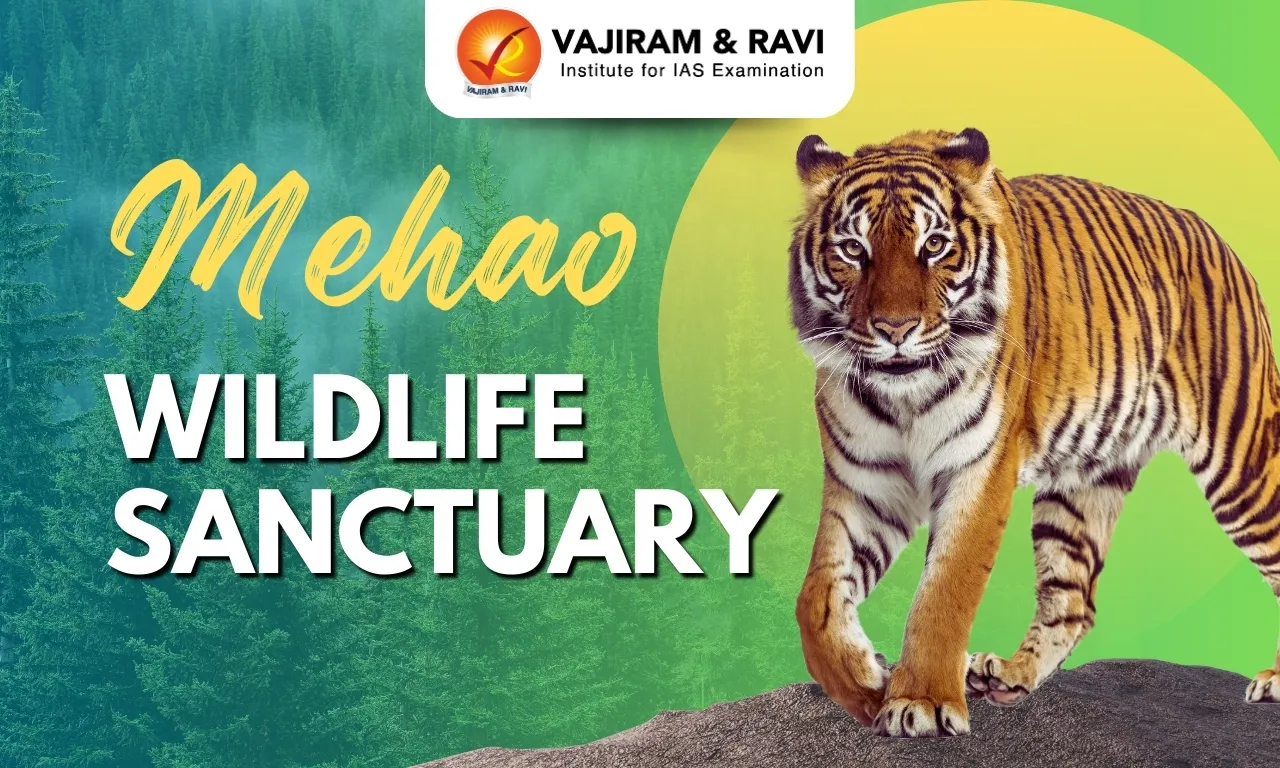
Recently, the Arunachal Pradesh government granted permission to capture the tiger that killed a head constable along the Roing–Mayodia road inside Mehao Wildlife Sanctuary. 

About Mehao Wildlife Sanctuary

  • Location: It is located in the state of Arunachal Pradesh.
  • It is named after its beautiful and mesmerizing ‘Mehao Lake’ situated in the core zone of the sanctuary.
  • Terrain: The terrain is entirely hilly, varying in altitude from 400 m to 3,560 m. 
  • Major perennial rivers and streams that flow through the sanctuary are Ashupani, Deopani, Enjopan, Diphu and Jowe.
  • This Sanctuary consists of four forest types: Tropical Evergreen Forests, Sub-Tropical & Temperate Forests, Temperate Broad Leave Forest and Temperate Conifer Forest 
  • Flora: Important tree species are HollocK, Khokan, Mekai, Simul. The bamboo of the variety Dendrocalamus Hamiltonii is found in abundance.
    • The medicinal plants Coptis Teeta (Mishmi Teeta) is an endemic species and Taxus baccata are available here.
  • Fauna: Clouded leopard, marbled cat, wild dog, spotted linsang, Himalayan Black Bear and Red Panda are some of the prominent species found in the sanctuary.

Source: Hub Network

Mehao Wildlife Sanctuary FAQs

Q1: Where is Mehao Wildlife Sanctuary located?

Ans: Arunachal Pradesh

Q2: What is Mehao Wildlife Sanctuary known for?

Ans: Biodiversity hotspot

Mt Aconcagua

Mt Aconcagua

Mt Aconcagua Latest News

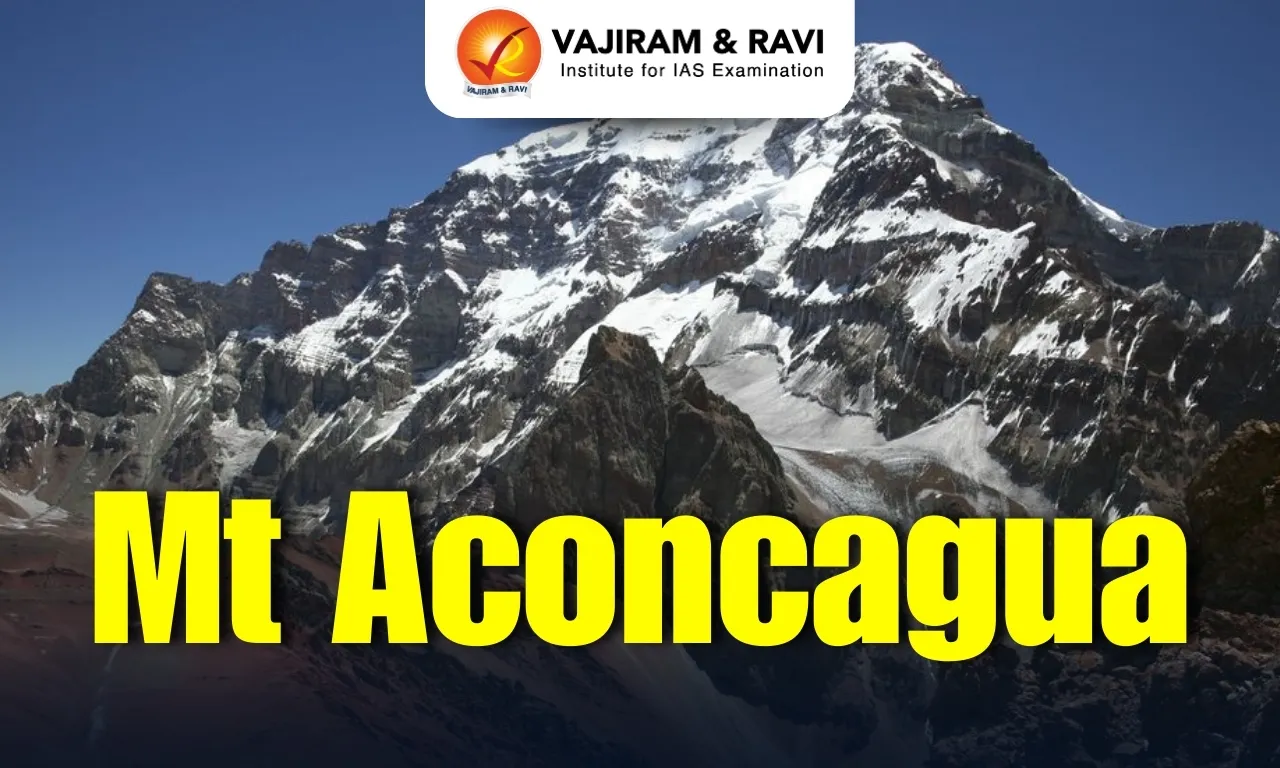
Recently, the Defence Minister flagged off a joint mountaineering expedition to Mount Aconcagua in Argentina from New Delhi.

About Mt Aconcagua

  • Location: It is located in Argentina (near the border with Chile).
  • It is the highest mountain in South America and the tallest mountain outside of Asia.
  • It is one of the mountains in the Principle Cordillera, a mountain range in the Andes making up the boundary between Argentina and Central Chile.
  • It is considered as one of the world's “Seven Summits” (each of the seven tallest mountains in each continent).
    • Aconcagua is of volcanic origin, but it is not itself an active volcano.
  • Formation of Mt Aconcagua: The Mountain was formed when the heavier Nazca Plate dived beneath the South American Plate through a process known as subduction.
  • It is a folded mountain composed of sedimentary and metamorphic rock.
  • Climate Zones on the Mountain: Dry and desert-like with sparse vegetation, Alpine desert zone and arctic conditions at the top.
  • The mountain also contains glaciers, of which Ventisquero Horcones Inferior is the largest.

Source: PIB

Mt Aconcagua FAQs

Q1: Where is Mt Aconcagua located?

Ans: Argentina

Q2: How was Mt Aconcagua formed?

Ans: Subduction of Nazca Plate

Lake Urmia

Lake Urmia

Lake Urmia Latest News

Recently, after the communal prayer in Tehran, the government mounts cloud seeding in the lake Urmia basin.

About Lake Urmia

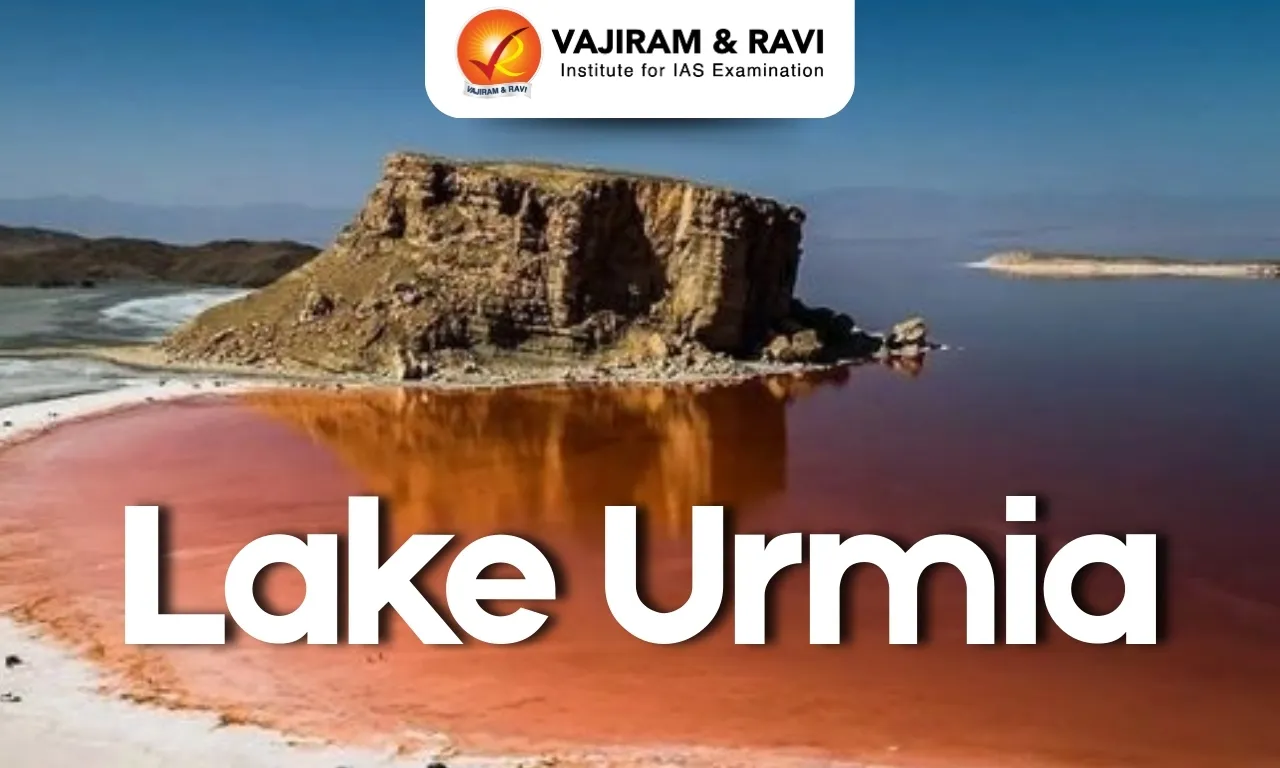
  • Location: It is one of the largest inland lakes located in northwestern Iran.
  • Its waters have no outlet, they are highly saline and it is one-fourth as salty as the Dead Sea.
  • The basin is surrounded by mountains in the west and north, by plateaus in the south, and by plateaus and volcanic cones in the east.
  • It is located 4,183 feet above sea level.
  • Source of Water: The main water feeding this lake are the Talkheh River in the northeast and the twin rivers Zarīneh and Sīmīneh in the south.
  • Lake Urmia is home to a number of diatoms, phytoplankton (algae). and bacteria.
  • Protection Status: It is designated as a Ramsar Site and part of UNESCO’s Man and the Biosphere Programme (MAB).

Source: DTE

Lake Urmia FAQs

Q1: Where is Lake Urmia located?

Ans: Northwestern Iran

Q2: What is unique about Lake Urmia's water?

Ans: Highly saline

Gulf Cooperation Council

Gulf Cooperation Council

Gulf Cooperation Council Latest News

Recently, India and the Gulf Cooperation Council (GCC) have signed the Terms of Reference for a Free Trade Agreement in New Delhi.

About Gulf Cooperation Council

  • It is a regional political and economic alliance established in 1981.
  • Member countries: It comprises Bahrain, Kuwait, Oman, Qatar, Saudi Arabia, and the United Arab Emirates (UAE).
  • Objective: To foster economic, security, cultural, and social cooperation among its members.
  • Background: It was formed in response to escalating regional tensions, particularly the Iranian Revolution (1979) and the Iran-Iraq War (1980–1988).
  • Headquarters: Riyadh, Saudi Arabia.

Organizational Structure of the Gulf Cooperation Council

  • Supreme council
    • It is the highest authority of the GCC, composed of the heads of the member states.
    • Its presidency rotates alphabetically according to the names of the countries.
    • It convenes in a regular session annually.
  • Ministerial council
    • It is composed of foreign ministers or their representatives from member states.
    • It proposes policies and implements decisions of the Supreme Council.
  • Secretariat general: Its responsibilities include preparing studies to enhance cooperation, coordination, and integration in joint Gulf projects and initiatives.

India –GCC Free Trade Agreement

  • Key exports from India to GCC include engineering goods, rice, textiles, machinery, gems and jewelry.
  • Key sectors of imports from GCC primarily comprise crude oil, LNG, petrochemicals, and precious metals such as gold. 

Source: News On Air

Gulf Cooperation Council FAQs

Q1: What is the Gulf Cooperation Council?

Ans: A regional intergovernmental organization

Q2: What is the primary goal of GCC?

Ans: Enhance economic cooperation among members

Hudson River

Hudson River

Hudson River Latest News

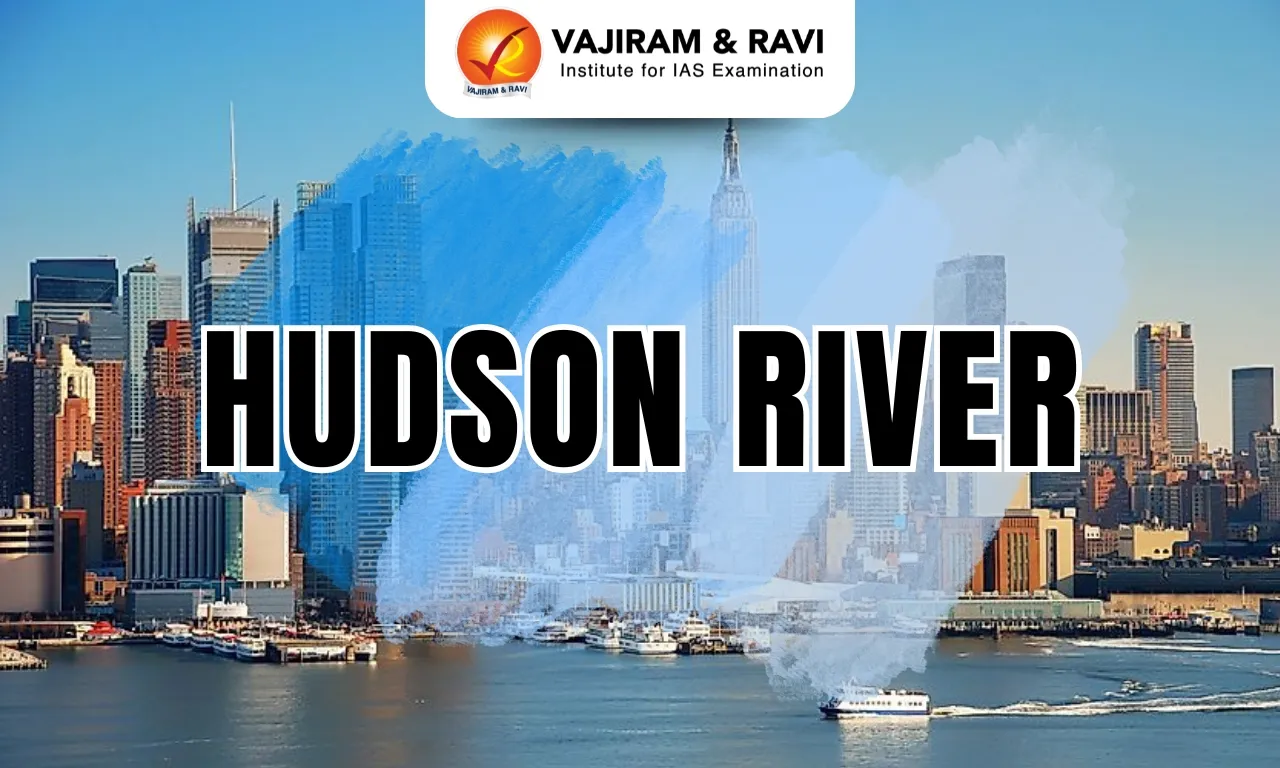
New York and New Jersey recently sued the Trump administration for freezing $16 billion in federal funding for a new rail tunnel under the Hudson River between the two States.

About Hudson River

  • It is a river in New York State, United States. 
  • It flows almost entirely within New York State, the exception being its final segment, where it forms the boundary between New York and New Jersey for 34 km.
  • It was named after British explorer Henry Hudson, who sailed up the river in 1609. 
  • It originates in several small postglacial lakes in the Adirondack Mountains near Mount Marcy (1,629 metres), the highest point in New York, and flows about 507 km through the eastern part of the state. 
  • Lake Tear of the Clouds is regarded as the source of its main headstream, the Opalescent River.
  • The water from the Hudson River flows into the Upper New York Bay that is situated between New York City and New Jersey. 
  • At the New York Harbor, the Hudson River drains into the Atlantic Ocean.
  • Due to the glaciation and the rising sea levels, the lower portion of the river is a tidal estuary that occupies the Hudson fjord.
  • Together with the Mohawk River, its major tributary, it forms one of the US's most important waterways.

Source: TH

Hudson River FAQs

Q1: Hudson River flows through which country?

Ans: It is a river in New York State, United States.

Q2: Who was the Hudson River named after?

Ans: It was named after British explorer Henry Hudson.

Q3: Where does the Hudson River originate?

Ans: It originates in several small postglacial lakes in the Adirondack Mountains near Mount Marcy (1,629 metres), the highest point in New York.

Q4: How long is the Hudson River?

Ans: The Hudson River flows for about 507 km.

Sarus Crane

Sarus Crane

Sarus Crane Latest News

According to a government census conducted across 68 forest divisions of Uttar Pradesh, the population of sarus cranes in the state has gone up by 634 or 3.1% in a year.

About Sarus crane

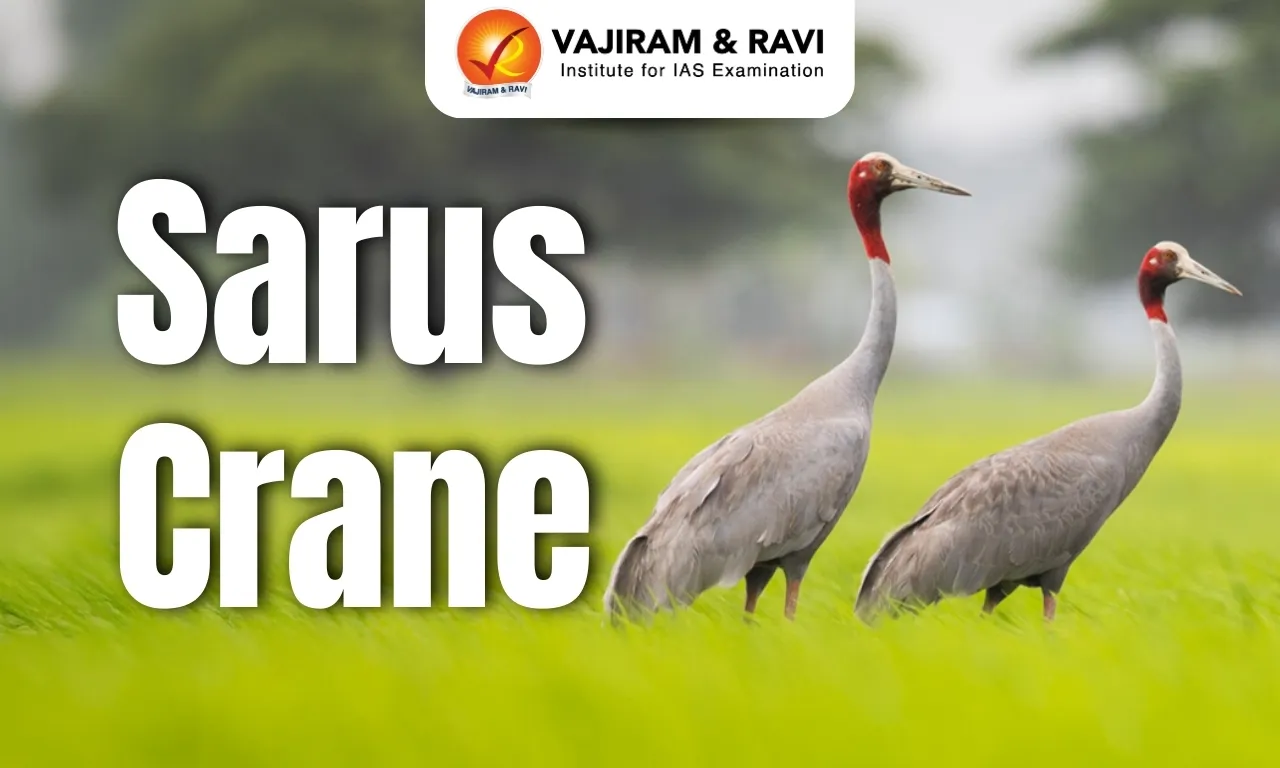
  • It is the tallest flying bird in the world.
  • Habitat: They live mainly in wetlands such as canals, marshes, and ponds, sometimes near humans.
  • Distribution: They live in Southeast Asia, northern India, and northern Australia.
    • In India, most sarus cranes are widely distributed along the Gangetic plain and in eastern Rajasthan in the northern states of India. Population densities decrease going to the south.
  • This species is not known to be migratory.

Features of Sarus Crane

  • It has a predominantly grey plumage with a naked red head and upper neck and pale red legs.
  • They are regarded as the least social crane species, found mostly in pairs or small groups of three or four. 
  • They are monogamous birds and mate mate for life.
  • Nests are constructed on water in natural wetlands or in flooded paddy fields.
  • Lifespan: It has been estimated that cranes in general can live 30 to 40 years.

Conservation Status of Sarus Crane

  • IUCN: Vulnerable
  • CITES: Appendix II
  • Wildlife (Protection) Act 1972: Schedule IV

Source: HT

Sarus crane FAQs

Q1: What is the conservation status of Sarus Crane in India?

Ans: Vulnerable

Q2: Where is the Sarus Crane mainly found in India?

Ans: Indo-Gangetic Plain

Repo Rate, Meaning, Importance, Impact, Current Rate, Latest News

Repo Rate

Repo Rate News

The Reserve Bank of India (RBI) conducted its first Monetary Policy Committee (MPC) meeting of 2026, during which RBI Governor Sanjay Malhotra announced that the key policy rate, known as the repo rate, will remain unchanged at 5.25%. The inflation for FY 2025-26 is at 2.1%.

Basis Points Meaning

  • Basis points (bps) are a standard financial unit used to measure small changes in interest rates, yields, or other percentage-based values.
  • They provide precision when expressing movements in financial indicators. For example, a 25 bps hike means a 0.25% increase.
  • Basis points are widely used to describe changes in interest rates on loans, savings, bonds, and other financial instruments, ensuring clarity where even minor shifts matter.

RBI Repo Rate

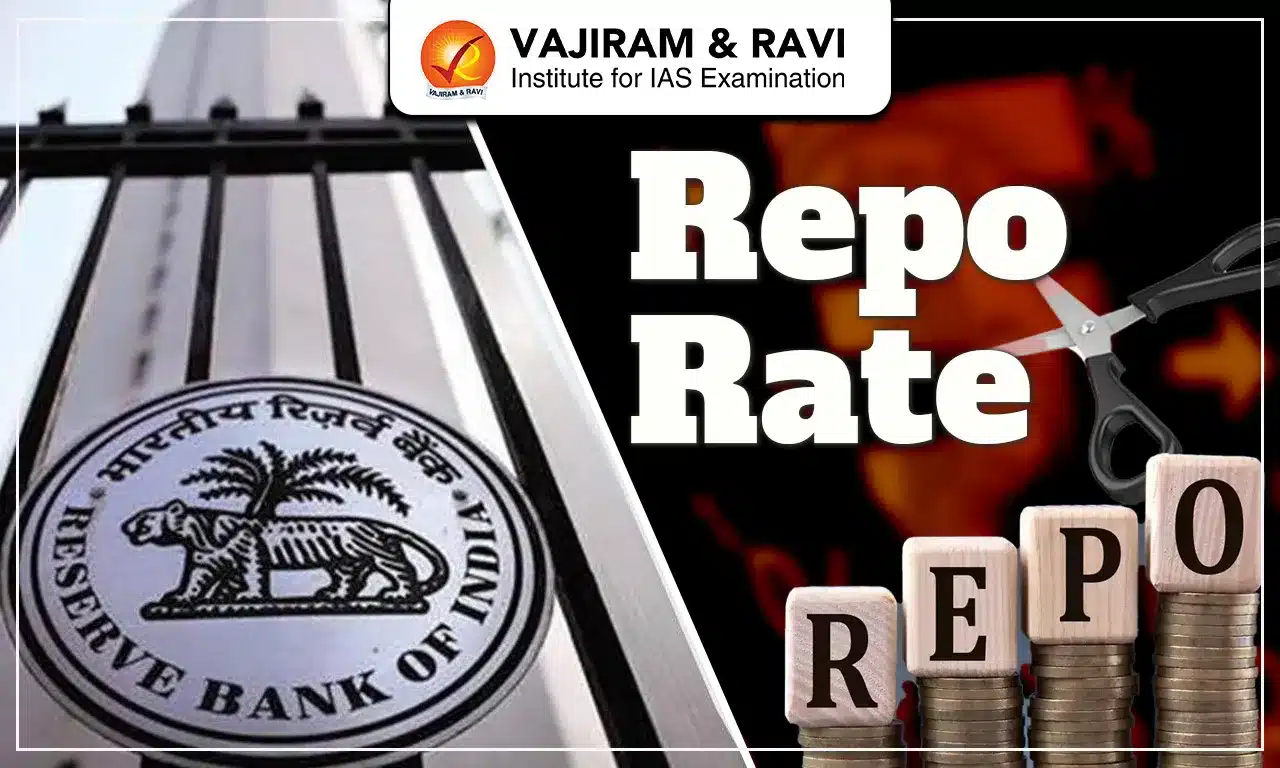
  • The repo rate is the interest rate at which the RBI lends short-term funds to commercial banks against government securities. 
  • It serves as a primary tool for the RBI to regulate liquidity, control inflation, and influence overall economic activity.
  • By adjusting the repo rate, RBI can either encourage banks to borrow more (by lowering the rate) or discourage borrowing (by raising the rate), thus influencing the money supply in the economy.
  • The reverse repo rate is the interest rate at which the central bank (such as the RBI) borrows surplus funds from commercial banks, thereby absorbing excess liquidity from the system. 
    • It is the opposite of the repo rate, where commercial banks borrow from the central bank.

Also Read: RBI Monetary Policy 2025

Impact of RBI Repo Rate Cut

  • Lower Borrowing Costs: Commercial banks benefit from reduced borrowing costs, enabling them to offer loans at more competitive interest rates.
  • Fixed Deposit (FD) Interest Rates: Banks likely lower FD rates after a repo rate cut, as their own cost of funds decreases. This means new FDs may offer lower returns, while existing FDs remain unaffected until maturity
  • Enhanced Credit Flow: Lower interest rates encourage increased borrowing by businesses and consumers, stimulating investment and consumption.
  • Boost to Real Estate and Infrastructure: Due to more affordable financing options, sectors like real estate and infrastructure may see heightened activity.
  • Support Amid Global Challenges: The RBI's accommodative stance aims to bolster the Indian economy against global uncertainties, such as increased U.S. tariffs impacting exports.

Repo Rate FAQs

Q1: What is the repo rate?

Ans: The repo rate is the interest rate at which commercial banks borrow money from the RBI by pledging government securities.

Q2: What is the current repo rate?

Ans: As of December 05, 2025, the RBI repo rate is 5.25%.

Q3: What is the repo rate of RBI in 2025?

Ans: In December 2025, the RBI reduced the repo rate to 5.25% during its December Monetary Policy Committee meeting.

Q4: What is the current reverse repo rate?

Ans: As of December 05, 2025, the reverse repo rate is 3.35%.

Jagannath Temple

Jagannath Temple

 Jagannath Temple Latest News

The president, who is on a six-day tour to Odisha and Chhattisgarh, offered prayers at the Shree Jagannath Temple in Puri recently.

About Jagannath Temple

  • It is a Hindu temple located in Puri, Odisha.
  • It is dedicated to Lord Jagannath, a form of the Hindu deity Vishnu.
  • It is believed to have been built during the reign of King Anantavarman Chodaganga Deva, of the Eastern Ganga dynasty, in the 12th century.
  • However, the completion of the temple happened in 1230 AD under Anangbheema Deva III, who also installed the deities in the shrine.
  • Ratha Yatra is a Hindu festival associated with Lord Jagannath temple.
  • It is also one of the four sacred pilgrimage sites, known as the Chaar Dhaams, that hold great significance for Hindus.

Jagannath Temple Architecture

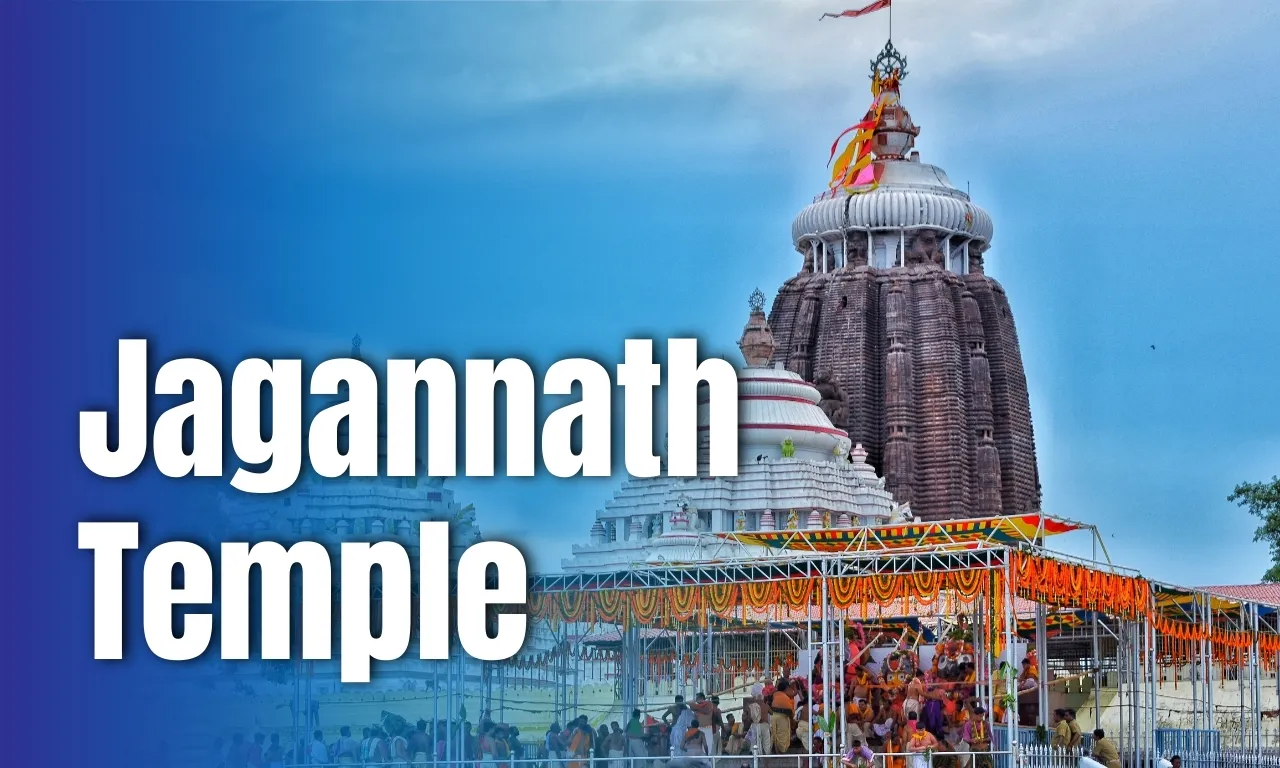
  • It is a striking example of Kalinga architecture, a distinct style prevalent in the Odisha region.
  •  The entire temple complex is enclosed within two concentric walls.
  • The temple complex includes shrines, gardens, and sacred tanks, creating a serene atmosphere for devotion.
  • The main temple is located at the center of the inner courtyard on a raised platform.
  • It is constructed in such a way that no shadow of the temple falls on the ground at any time of the day.
  • At the pinnacle of the temple, there is a 20-foot-high chakra (wheel) that is positioned in a way to be visible from any part of the city.
  • Unlike other temples of the region, the carvings on the temples are predominantly of gods and goddesses.

Source: NOA

Jagannath Temple FAQs

Q1: Where is the Jagannath Temple located?

Ans: The Jagannath Temple is located in Puri, Odisha.

Q2: During whose reign was the Jagannath Temple built?

Ans: It was built during the reign of King Anantavarman Chodaganga Deva.

Q3: Which major Hindu festival is associated with the Jagannath Temple?

Ans: The Ratha Yatra festival is associated with the temple.

Q4: Which architectural style does the Jagannath Temple represent?

Ans: It is an example of Kalinga architecture.

Enquire Now