
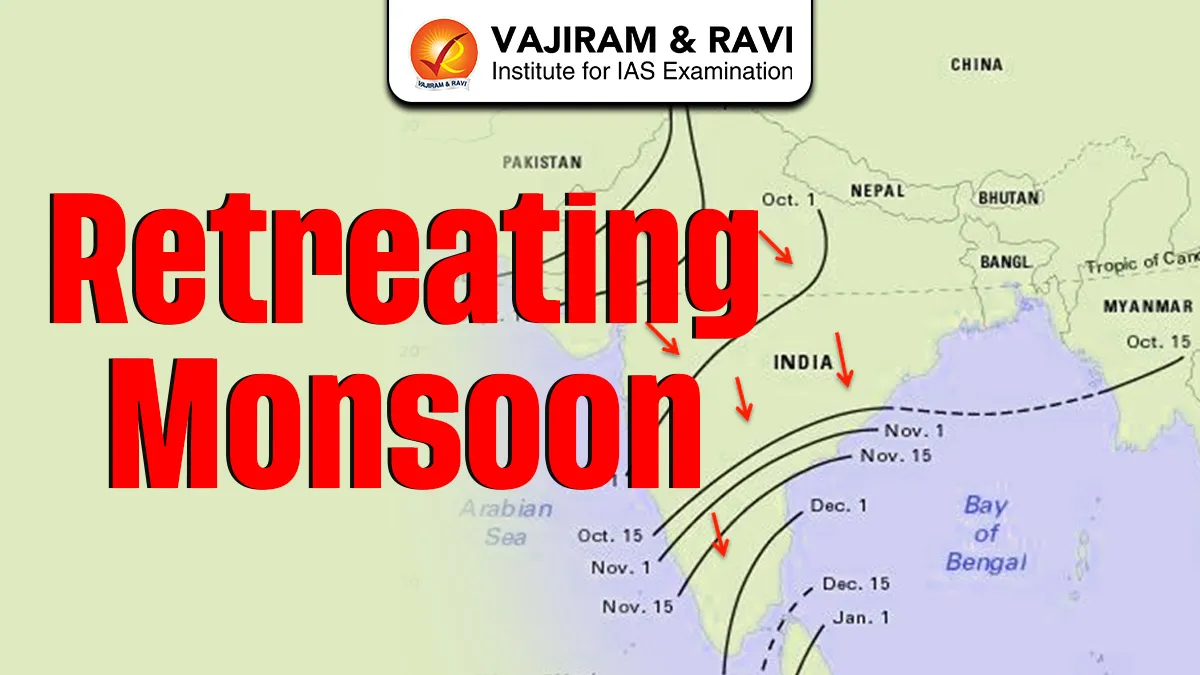
The Retreating Monsoon is the period when the monsoon winds start moving back from India. It generally occurs from October to November and brings less rainfall, with clear skies in many places. This season mainly affects the eastern and southern parts of India.
About Retreating Monsoon
- When the Southwest Monsoon ends, the Northeast Monsoon starts around October.
- It is also called the Retreating Monsoon because the monsoon winds begin to move back from India.
- During this time, the land cools faster than the sea, creating high pressure over land and low pressure over the sea.
- Due to this pressure change, winds change their direction and start blowing from land to sea.
- These winds pass over the Bay of Bengal, collect moisture, and bring rain to Tamil Nadu, south Andhra Pradesh and parts of Sri Lanka.
- This rainfall is very important because these areas receive little rain during the Southwest Monsoon and depend on this season for water and farming.
Retreating Monsoon’s Features
- Time and Season
- The Northeast Monsoon occurs from October to December.
- It happens after the Southwest Monsoon and marks the beginning of winter.
- Wind Pattern
- During this season, winds blow from the northeast towards India.
- These winds are different from the southwest winds of the earlier monsoon.
- Areas of Rainfall
- Rainfall mainly occurs along the southeastern coast of India.
- Tamil Nadu and parts of Andhra Pradesh receive most of the rain.
- Nature of Rainfall
- The rainfall is generally less widespread than the Southwest Monsoon.
- However, the rain can be heavy in some areas.
- Effect on Climate
- The weather becomes cooler and more pleasant after the hot summer.
- This season helps reduce heat and humidity.
- Importance for Water and Agriculture
- It helps in refilling lakes, tanks and reservoirs.
- It is very important for farming in regions that get little rain earlier.
- Uneven Rainfall
- Some regions receive good rainfall, while nearby areas may remain dry.
- The amount of rain can change from year to year.
Temperature during Retreating Monsoon
- As the monsoon winds withdraw, clouds slowly disappear and the sky becomes clear.
- Because of clear skies, the day temperature begins to fall compared to the rainy season.
- Nights become cooler, while days can still be warm.
- Due to the absence of the clouds, the difference between day and night temperature increases.
- Overall, the weather becomes dry, pleasant and cooler, especially in northern and central India.
Pressure and Winds during the Retreating Monsoon
- When the monsoon starts withdrawing, the monsoon trough becomes weak and slowly moves towards the south.
- The difference in air pressure is small, so strong winds are not formed.
- The beginning of the Northeast Monsoon is not sudden or very clear, unlike the Southwest Monsoon.
- During this season, winds do not follow any fixed pattern over the whole country.
- In many places, local pressure conditions decide the wind direction, making the weather calm and dry in most regions.
Precipitation during the Retreating Monsoon
- After the Southwest Monsoon ends, most parts of India become dry as the humidity and clouds reduce.
- Tamil Nadu and southern parts of Andhra Pradesh receive most of their rain during this season, making it their main rainy period.
- Kerala also gets a small secondary rainfall in October-November.
- The northeast winds pass over the Bay of Bengal, pick up moisture and bring rain to the southeastern coast.
- Some parts of northeastern India like Assam, Meghalaya, Mizoram, Arunachal Pradesh and Tripura also receive rain.
- Other areas like the eastern slopes of Western Ghats, northern plains, Odisha, Madhya Pradesh, Andhra Pradesh and Tamil Nadu get rainfall due to this monsoon.
- Overall, the retreating monsoon replenishes water in regions that get little rain during the Southwest Monsoon and is important for agriculture and water supply.
Cyclone during the Retreating Monsoon
- During the Retreating Monsoon, tropical cyclones are common, especially in the Bay of Bengal.
- The most active months for cyclones are October and the first half of November.
- Usually the cyclones are formed between 8°N and 14°N in the Bay of Bengal and move west or northwest at first, but many later curve northeast.
- About half of these cyclones hit the eastern coast of India, affecting Tamil Nadu, Andhra Pradesh, Odisha and West Bengal.
- Some cyclones move across the southern peninsula into the Arabian Sea, where they may weaken first but then gain strength again.
- Cyclones from the Arabian Sea form slightly northward and mostly move away from the coast, but a few strike Maharashtra or Gujarat.
- These storms often bring heavy rainfall and can cause serious damage to life, property and agriculture, especially in river deltas like Godavari, Krishna and Kaveri.
- In northern India, the retreating monsoon season also sees Western Disturbances, which bring cloudy weather, light rain or snow in higher areas like Jammu & Kashmir, Himachal Pradesh and Kumaon Hills.
Impact of the Retreating Monsoon
- The Retreating Monsoon brings rainfall to southern and eastern India, especially Tamil Nadu, Andhra Pradesh and Kerala, which is very important for farming and crops.
- It helps fill rivers, lakes, tanks and reservoirs, providing water for irrigation, drinking, and daily needs.
- The rainfall reduces the heat left after summer, making the weather cooler and more comfortable.
- Farmers can grow crops like rice, pulses, and sugarcane because of this season.
- Cyclones sometimes hit the eastern and southern coasts, bringing heavy rain, strong winds and occasional damage to houses, roads, and crops.
- It helps maintain soil moisture, supports vegetation growth and is important for the regional climate balance.
- In northern India, lighter rains or snow from Western Disturbances also improve water availability and prevent dry conditions.
October Heat
- October and November mark the transition from the rainy Southwest Monsoon to the dry winter season.
- During this time, the monsoon withdraws, skies become clear and daytime temperatures rise.
- Nights remain cool and comfortable, but the days can feel hot and humid.
- Since the land is still wet from the monsoon, the combination of heat and moisture makes the weather feel oppressive during the day.
- This hot and sticky period in October is commonly called “October Heat” and is noticeable especially in northern and central India.
Retreating Monsoon Significance
- The Retreating Monsoon brings rainfall to regions like Tamil Nadu and Andhra Pradesh which get less rain during the Southwest Monsoon.
- It fills rivers, lakes, tanks and reservoirs, ensuring water for drinking, irrigation and farming.
- The rain supports the growth of winter crops (rabi crops) and helps farmers with agriculture and food production.
- It cools down the hot weather after summer, making the climate more pleasant.
- It helps to maintain soil moisture and vegetation, keeping the environment healthy.
It is important for regional climate balance and also affects water availability in both southern and eastern India.
Retreating Monsoon FAQs
Q1: What is a Retreating Monsoon?
Ans: The Retreating Monsoon, which is also called the North-East Monsoon occurs when the Monsoon winds start withdrawing from India, usually during the period of October to December.
Q2: Why is it called a North-East Monsoon?
Ans: It is called the North-East Monsoon because the direction of the winds is from North-east to India.
Q3: Which area gets the Maximum rain during the retreating monsoon?
Ans: The Retreating Monsoon brings rainfall to southern and eastern India, especially Tamil Nadu, Andhra Pradesh and Kerala.
Q4: What is “October Heat”?
Ans: In October, after the monsoon withdraws, the weather can feel hot and sticky because the land is still wet and the sun is strong. This period is called October Heat.
Q5: How does the retreating monsoon affect agriculture?
Ans: It fills rivers, tanks, and reservoirs, provides water for irrigation, and supports winter crops (rabi crops).
