
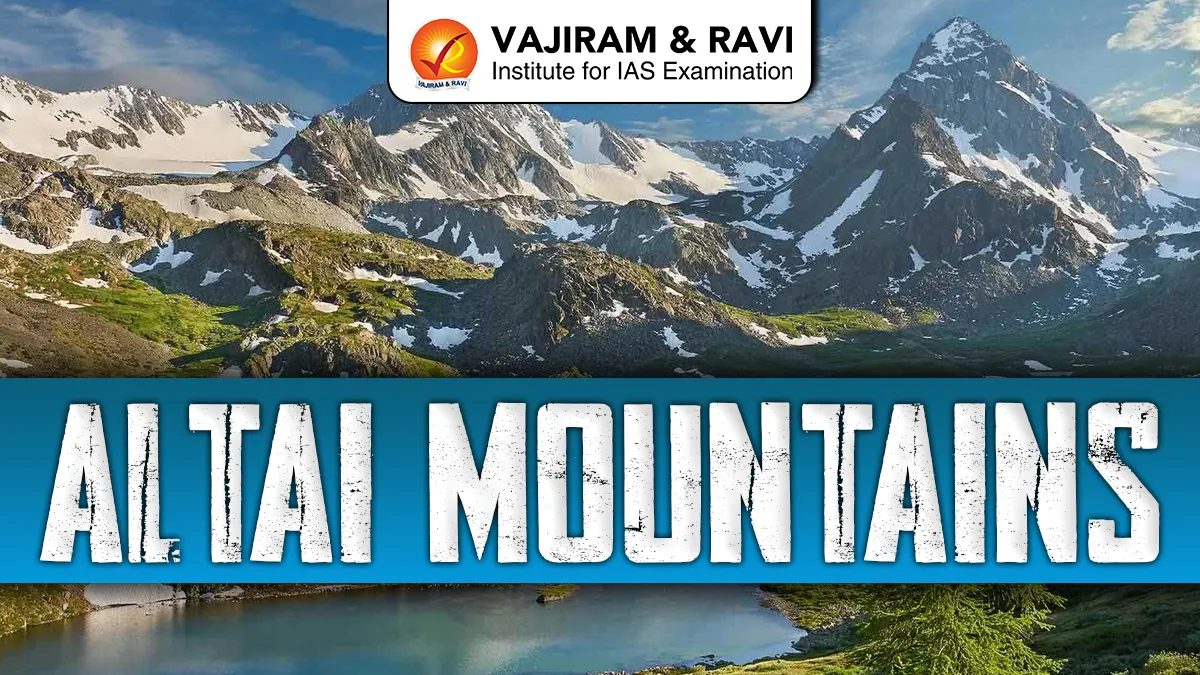
The Altai Mountains are a major mountain system located in Central Asia, forming a natural junction between Russia, China, Mongolia, and Kazakhstan. Located at the crossroads of four countries, the Altai region holds strategic significance in terms of border management, resource sharing, and regional cooperation in Central Asia.
Altai Mountains Location
- The Altai mountains are located in Russia, Mongolia, Kazakhstan and a small part in north-western China.
- It lies between the Sayan Mountains to the north and the Gobi Desert to the south.
Altai Mountains Geology
- The Altai Mountains are ancient fold mountains, formed primarily during the Paleozoic era.
- They are composed mainly of igneous and metamorphic rocks and are rich in minerals such as gold, copper, and other metals.
- Despite being geologically old, parts of the region still experience minor tectonic activity.
Altai Mountains Relief and Peaks
- The mountains are rugged and high, with steep slopes and deep valleys.
- The highest peak is Mount Belukha (about 4,506 metres). It is located in Russia and is covered with permanent snow and glaciers.
- Glaciers at higher elevations, make Altai mountains an important source of freshwater.
Altai Mountains Climatic Significance
The Altai Mountains play a crucial role in shaping the climate of Central Asia and adjoining regions.
- The Altai act as a natural barrier between the cold Siberian region in the north and the arid Central Asian plains in the south. They block the movement of cold air masses and influence regional temperature patterns.
- Moist air masses from the west and northwest rise along the mountain slopes. This leads to orographic rainfall and snowfall on the windward sides.
- The leeward slopes, especially toward Mongolia and Xinjiang, receive much less rainfall, leading to the formation of semi-arid and arid climates in parts of Central Asia.
Also Read: Arakan Yoma Mountain
Altai Mountains Drainage
The Altai Mountains act as an important water divide in Central Asia, giving rise to several major river systems that flow into the Arctic Ocean basin and the inland basins of Central Asia. Major rivers such as the Ob, Irtysh, Yenisei, and Katun originate from this region.
It also has numerous glacial and tectonic lakes. These lakes are important for regional ecology, freshwater supply, and tourism. Major lakes of Altai region are Lake Teletskoye in Russia, Lake Markakol in Kazakhstan, Kanas Lake in China, Tavan Bogd Glacial Lake in Mongolia
Altai Mountains Ecology and Biodiversity
- The Altai region supports diverse ecosystems, ranging from alpine meadows and coniferous forests (taiga) to steppe grasslands.
- It is home to rare species such as the snow leopard, Altai argali (wild sheep), brown bear, and lynx.
- Parts of the Altai are recognised as a UNESCO World Heritage Site for their ecological value.
Altai Mountains FAQs
Q1: Where are the Altai Mountains located?
Ans: They are located in Central Asia, at the junction of Russia, Mongolia, Kazakhstan, and north-western China.
Q2: What is the highest peak of the Altai Mountains?
Ans: The highest peak is Mount Belukha, with an elevation of about 4,506 metres, located in Russia.
Q3: What is the geological nature of the Altai Mountains?
Ans: They are ancient fold mountains formed mainly during the Paleozoic era and composed largely of igneous and metamorphic rocks rich in minerals.
Q4: Why are the Altai Mountains climatically important?
Ans: They act as a barrier between cold Siberia and arid Central Asia, cause orographic precipitation, and create rain-shadow regions in Mongolia and Xinjiang.
Q5: Which major rivers originate from the Altai region?
Ans: Important rivers such as the Ob, Irtysh, Yenisei, and Katun originate from or are connected to the Altai mountain system.

