
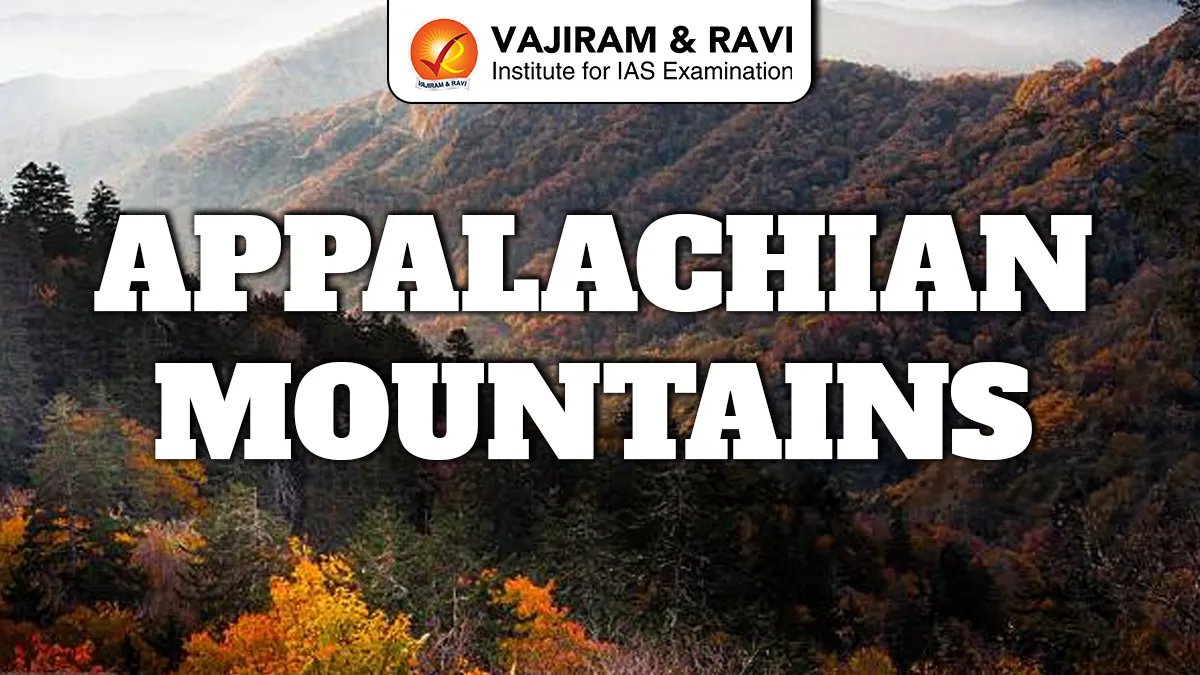
The Appalachian Mountains are an old mountain range in eastern North America, stretching from Canada to Alabama (U.S.A). They have rounded peaks, dense forests and rich wildlife. These mountains are important for minerals, timber, water resources and have influenced rivers, climate and human settlements in the region.
Appalachian Mountains
The Appalachian Mountains are a major highland system in eastern North America and are considered the eastern counterpart of the Rocky Mountains. They stretch for about 2,000 miles, from Newfoundland and Labrador in Canada to central Alabama in the USA. The range acts as a natural barrier between the eastern Coastal Plains and the Interior Lowlands, influencing settlement and development. The region is known for its natural beauty, unique culture and also faces challenges like economic hardship and environmental issues.
Appalachian Mountains Physical Features
Physiography
- The Appalachian Mountains are divided into three regions: Northern, Central, and Southern Appalachians.
- Northern Appalachians include ranges like the Long Range, White Mountains, and Green Mountains, with Mount Washington as a major peak.
- Central Appalachians consist of the Catskill and Allegheny ranges and parts of the Blue Ridge, spread across the northeastern United States.
- Southern Appalachians include the Blue Ridge, Great Smoky, Cumberland, and Unaka Mountains, and contain the highest peak, Mount Mitchell (2,037 m).
- The Great Appalachian Valley (Shenandoah–Cumberland–Tennessee) and limestone caves are key physical features important for settlement and development.
Geology
- The Appalachian Mountains are very old fold mountains, shaped by tectonic movements, uplift, and long-term erosion by rivers and ice.
- Eastern and northern Appalachians (Old Appalachia) have ancient crystalline and metamorphic rocks from the Precambrian period, with no fossils.
- Western Appalachians (New Appalachia) consist of younger sedimentary rocks from the Paleozoic era and contain rich coal deposits, especially from the Carboniferous period.
- Alleghenian orogeny and glaciation formed parallel ridges, valleys, and water gaps; northern areas were glaciated, while southern areas remained biodiversity-rich.
Drainage
- The Appalachian Mountains have a dense drainage system, with highest water availability in the southern Appalachians due to heavy rainfall.
- Major rivers include the New River and Tennessee River; rivers drain into the Mississippi system, Atlantic Ocean, and Gulf of Mexico.
- Lack of large natural lakes in the south leads to frequent floods and landslides, especially during heavy rain and hurricanes.
- Forest cover helps control runoff, while deforestation increases flood risk.
- The Tennessee Valley Authority (TVA) developed dams and reservoirs for flood control, power generation, irrigation, and regional development.
Climate
- The Appalachian Mountains have a temperate and humid climate, varying with latitude and altitude.
- Northern and high-altitude areas experience very cold, near Arctic conditions, while the southern lowlands have a milder climate.
- Heavy snowfall occurs in the northern ranges and on high southern peaks like Mount Mitchell; Mount Washington has extreme weather.
- This climate supports dense forests, rich water resources, and human activities across the region.
Flora and Fauna
- The Appalachian Mountains are richly forested, with some of the world’s finest deciduous forests, especially in the south.
- Northern Appalachians have coniferous and hardwood trees, while the southern region shows very high plant diversity.
- The southern Appalachians are a biodiversity hotspot with many endemic plant species.
- Wildlife includes black bear, deer, moose, elk, and rich birdlife, especially in the Great Smoky Mountains.
Appalachian Mountains FAQs
Q1: Where are the Appalachian Mountains located?
Ans: The Appalachian Mountains are located in eastern North America, extending from Newfoundland and Labrador in Canada to Alabama in the USA.
Q2: How are the Appalachian Mountains divided physiographically?
Ans: They are divided into three regions:Northern Appalachians, Central Appalachians and Southern Appalachians.
Q3: Which is the highest peak of the Appalachian Mountains?
Ans: Mount Mitchell (2,037 m) in North Carolina, located in the Southern Appalachians, is the highest peak.
Q4: What is the Great Appalachian Valley?
Ans: It is a long valley system including the Shenandoah, Cumberland, and Tennessee valleys, important for agriculture, transport, and development, including the TVA project.
Q5: Which major rivers drain the Appalachian region?
Ans: Important rivers include the New River, Tennessee River, Kanawha River, while some rivers flow into the Atlantic Ocean and the Gulf of Mexico.

