
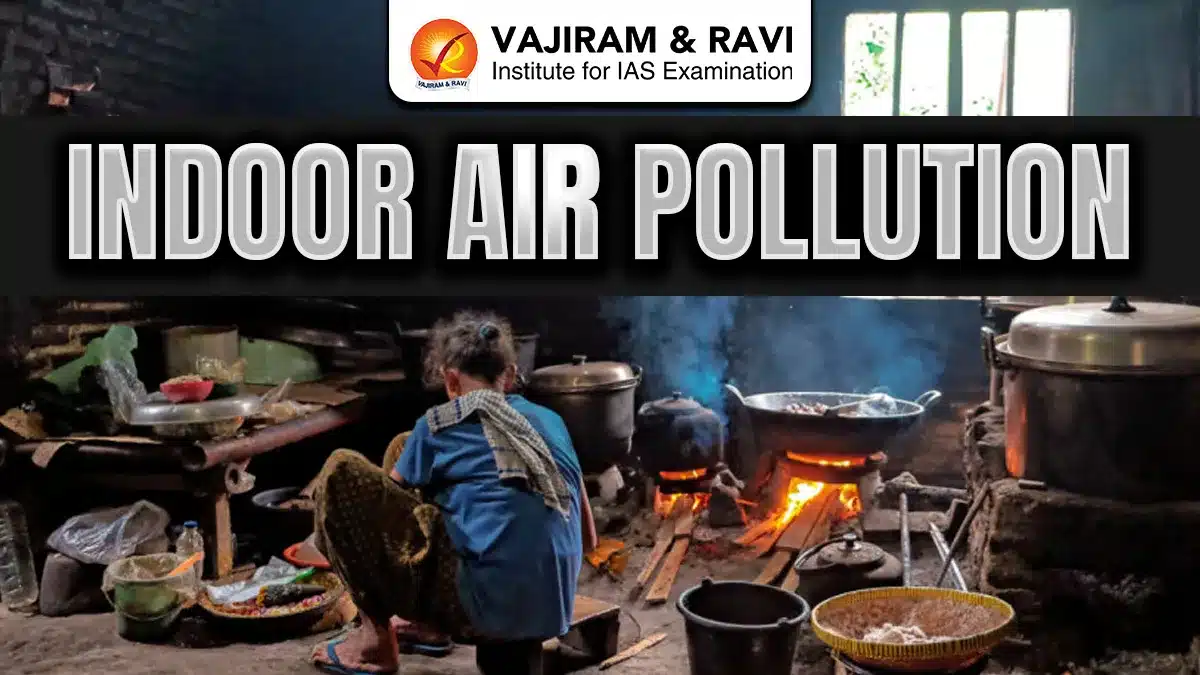
Indoor Air Pollution refers to contamination of air inside homes, offices, and other enclosed spaces by harmful particulate matter. While pollution outdoors poses a significant health risk for people, worsening indoor air quality has also become a pressing issue that needs to be addressed.
Indoor Air Pollution Sources
Indoor air pollution can be in the form of particulate matter like soot and dust mites or gases like carbon monoxide, nitrogen oxide, and sulphur dioxide that are emitted from cooking, heating, or cleaning solutions. Benzene emerged as the most dangerous, followed by carbon monoxide, VOCs and radon.
Key Sources of Indoor Pollution are:
- Combustion: Cooking and heating using kerosene, wood, or coal releases fine particulate matter, carbon monoxide, and other harmful gases.
- Household Products: Paints, varnishes, cleaning agents, and air fresheners release Volatile Organic Compounds (VOCs) such as benzene, toluene, and formaldehyde.
- Tobacco Smoke: Major source of Carbon monoxide, Fine particulate matter, Carcinogenic compounds like benzene.
- Building Materials & Furnishings: Asbestos, formaldehyde in pressed wood products.
- Construction Dust: Dust from nearby construction sites or home renovation significantly increases indoor particulate matter. The total volume of construction and demolition dust has gone up from 150 million tonnes in 2016 to 300 million tonnes today. By 2030, this is expected to go up to 430 million tonnes.
- Biological Agents: Biological pollutants such as dust mites, mould, pollen, and infectious agents produced in stagnant water, mattresses, and carpets can all contribute to an increase in asthma symptoms
- Other Sources: Radon gas (from the ground) and pesticides.
Indoor Air Pollution Risk
Annually almost four million deaths are attributed to indoor air pollution worldwide. According to WHO, household air pollution was responsible for an estimated 2.9 million deaths per year in 2021, including over 309000 deaths of children under the age of 5. In India approximately 4-6 per cent of the national burden of disease is attributed to indoor air pollution.
Poor indoor air quality causes immediate and long-term health problems.
- Immediate Health Problems: Poor Indoor Air Quality (IAQ) is linked to sick building syndrome, which triggers headaches, fatigue and irritation
- Long-term Effects: Increased risk of chronic obstructive pulmonary disease (COPD), asthma, stroke, ischemic heart disease, and lung cancer.
This indoor pollution poses a significant risk, especially for vulnerable populations such as children, women, and domestic workers, who tend to spend more time indoors
Indoor Air Pollution Prevention and Mitigation
Indoor Air Pollution can be prevented and mitigated through following steps:
- Source Control: Identify and remove the source of pollution first. Avoid Indoor smoking, Incense sticks, candles, mosquito coils and Kerosene etc
- Improve Ventilation: Proper ventilation helps remove polluted indoor air and replace it with fresh, clean air from outside.
- Cleaning: Regularly clean to reduce dust mites and mold. Many conventional cleaning products contain harmful chemicals that cause indoor air pollution. To avoid this, choose green cleaners made with natural ingredients like white vinegar, baking soda, borax, citrus fruit, and essential oils.
- Maintenance: Ensure stoves and heaters are properly vented and serviced.
- Indoor Plants: Indoor plants English ivy, pothos, bamboo palm and peace lily help to purify the air by absorbing contaminants and releasing oxygen. Additionally, indoor plants help to improve indoor air quality by increasing humidity and reducing dust levels.
- Choose low-emitting building materials and furnishings: Materials and furnishings which emit lower levels of volatile organic compounds (VOCs) like bamboo, wool carpets, and latex paint.
Governments and international bodies are increasingly focusing on indoor air pollution (IAP), recognizing it as a "silent killer".
Government and National-Level Initiatives
As one of the most affected nations, India has implemented comprehensive strategies to curb indoor pollution:
- Pradhan Mantri Ujjwala Yojana (PMUY): A major initiative to provide free LPG connections to women from below-poverty-line households, drastically reducing reliance on solid fuels for cooking.
- National Clean Air Programme (NCAP): Launched in 2019, this program sets targets for reducing particulate matter (PM10 and PM2.5) concentrations by 40% by 2026, including city-specific action plans that address domestic fuel usage.
- Subsidies and Financial Support: Governments have introduced subsidies for clean fuels (LPG) and improved, low-emission cookstoves to make them affordable for low-income families.
- Building Regulations and Codes: Incorporation of air quality management rules into building by-laws to improve ventilation, including requirements for proper kitchen exhaust systems.
- "Pay-As-You-Go" (PAYG) Models: Initiatives in countries like Kenya and India allow users to pay for clean energy (such as LPG or solar) in smaller, manageable increments, overcoming high upfront costs.
- Monitoring and Surveillance: Deployment of IoT-based, low-cost sensors and "Sameer" app for real-time monitoring of indoor and outdoor air quality
Global and Intergovernmental Efforts
International organizations, led by the World Health Organization (WHO) and the UN Environment Programme (UNEP), are driving global action:
- WHO Indoor Air Quality Guidelines: These provide science-based guidance on tackling pollutants like radon, benzene, and carbon monoxide, recommending a maximum value of 100 Bq/m³ for radon in homes.
- Sustainable Development Goal 7 (SDG 7): Aims to ensure access to affordable, reliable, and modern energy for all by 2030, directly addressing the need for clean cooking solutions.
- The Climate and Clean Air Coalition (CCAC): The Climate and Clean Air Coalition (CCAC) is a global partnership of governments, organizations, businesses, and civil society, convened by UNEP, focused on reducing Short-Lived Climate Pollutants (SLCPs) like methane, black carbon, and HFCs. It promotes actions such as replacing traditional wood stoves with cleaner alternatives to reduce black carbon emissions.
UPSC CSE PYQs
In the context of proposals to the use of hydrogen enriched CNG (H-CNG) as fuel for buses in public transport, consider the following statements: (2019)
- The main advantage of the use of H-CNG is the elimination of carbon monoxide emissions.
- H-CNG as fuel reduces carbon dioxide and hydrocarbon emissions.
- Hydrogen up to one-fifth by volume can be blended with CNG as fuel for buses.
- H-CNG makes the fuel less expensive than CNG.
Which of the statements given above is/are correct?
(a) 1 only
(b) 2 and 3 only
(c) 4 only
(d) 1, 2, 3 and 4
Ans: (b)
Consider the following: (2019)
- Carbon monoxide
- Methane
- Ozone
- Sulphur dioxide
Which of the above are released into the atmosphere due to the burning of crop/biomass residue?
(a) 1 and 2 only
(b) 2, 3 and 4 only
(c) 1 and 4 only
(d) 1, 2, 3 and 4
Ans: (d)
Indoor Air Pollution FAQs
Q1: What is indoor air pollution?
Ans: Indoor air pollution is the contamination of air inside homes, offices, or other enclosed spaces by harmful particles and gases from sources like cooking, smoking, chemicals, and dust.
Q2: What are the main sources of indoor air pollution?
Ans: Major sources include Biomass and kerosene cooking, Tobacco smoke, Household chemicals and paints, Building materials, Construction dust, Mould, dust mites, and pests, Radon and pesticides.
Q3: Why is indoor air pollution dangerous?
Ans: It causes both short-term and long-term health problems such as headaches, irritation, and fatigue, asthma and COPD, heart disease and stroke, and lung cancer. Globally, millions of deaths each year are linked to indoor air pollution.
Q4: Who is most affected by indoor air pollution?
Ans: Children, Women involved in cooking, Elderly people, Domestic workers are most affected by indoor air pollution as they spend more time indoors.
Q5: How can indoor air pollution be reduced?
Ans: Use clean fuels like LPG or electricity, Improve ventilation, Avoid indoor smoking and chemical-heavy products, clean regularly to reduce dust and mould, maintain stoves and heaters properly etc

