India-Malaysia Relations Latest News
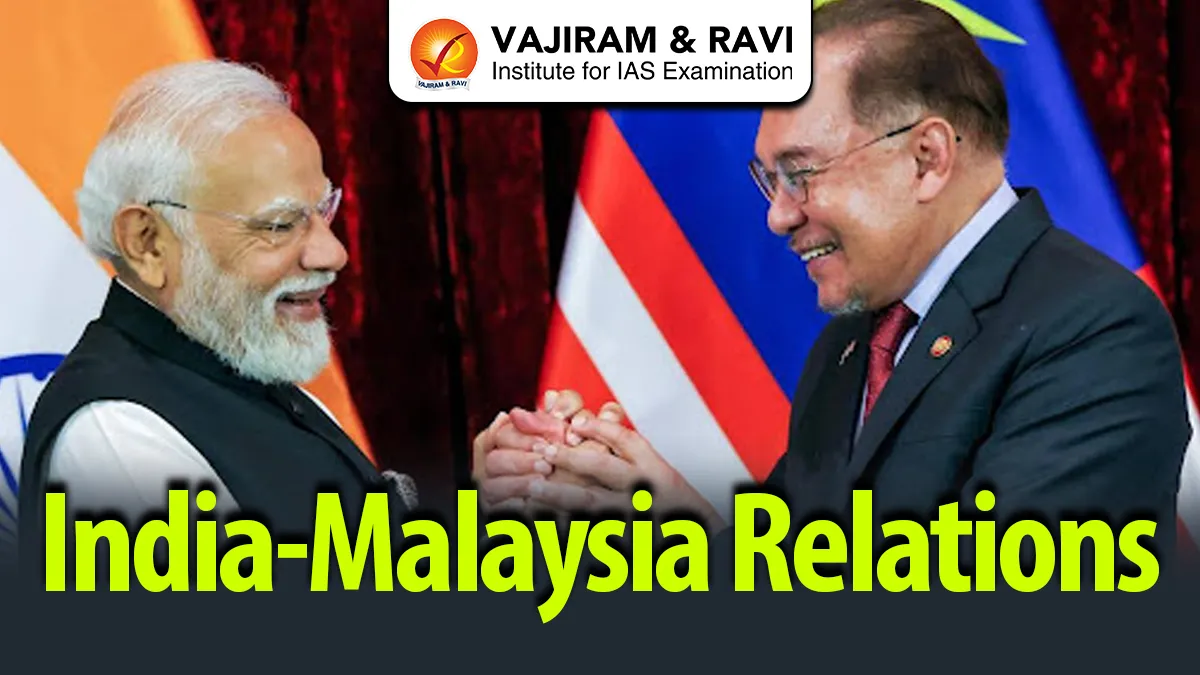
- India and Malaysia signed multiple agreements during Prime Minister Narendra Modi’s visit to Kuala Lumpur in February 2026, marking a strategic deepening of bilateral ties.
India-Malaysia Bilateral Relationship
- Historical and Civilisational Links
- India and Malaysia share deep civilisational connections dating back over two millennia, shaped by trade, religion, language, and cultural exchanges across the Indian Ocean.
- Elements of Indian culture, including Sanskrit influences and Hindu-Buddhist traditions are visible in Malaysia’s historical evolution.
- Modern diplomatic relations were established soon after India’s independence, with consistent political engagement since then.
- Political and Diplomatic Engagement
- India and Malaysia elevated their relationship to a Comprehensive Strategic Partnership in 2024, reflecting growing political trust.
- High-level visits, regular foreign office consultations, and cooperation at multilateral forums such as the United Nations and ASEAN-led platforms form the backbone of diplomatic engagement.
- Malaysia has supported India’s demand for permanent membership of a reformed UN Security Council, reinforcing political convergence.
- Trade and Economic Cooperation
- Malaysia is India’s 3rd largest trading partner within ASEAN. Between April 2000 and March 2025, Malaysia invested about US$ 1.27 billion in India.
- Bilateral trade between the two countries stood at US$ 19.86 billion in 2024-25, comprising Indian exports worth US$ 7.32 billion and imports valued at US$ 12.54 billion.
- Owing to its strategic location along the Strait of Malacca and the South China Sea, Malaysia is a key pillar of India’s Act East Policy and an important partner in India’s maritime connectivity strategy.
- India’s major exports include petroleum products, engineering goods, meat and dairy products, and organic chemicals, while India’s major imports from Malaysia consist of vegetable oils, machinery, electrical equipment, and minerals.
- Defence and Security Cooperation
- Defence ties have expanded steadily through joint exercises, maritime cooperation, and capacity building.
- As maritime neighbours in the Indian Ocean and Indo-Pacific region, both countries share concerns over freedom of navigation, maritime security, and non-traditional threats such as piracy and terrorism.
- Intelligence sharing and counter-terrorism cooperation have gained prominence in recent years.
- Diaspora and People-to-People Ties
- The Indian diaspora in Malaysia, numbering over 2 million, plays a crucial role in strengthening bilateral ties.
- Persons of Indian Origin are active in Malaysia’s politics, business, education, and culture.
- Educational exchanges, tourism, and cultural diplomacy further enhance people-to-people relations.
- Shared Regional and Global Platforms
-
- Both countries actively engage through ASEAN, the East Asia Summit, and the Indian Ocean Rim Association (IORA).
- India recognises ASEAN centrality in the Indo-Pacific, while Malaysia supports India’s Act East Policy, creating strategic alignment at the regional level.
News Summary
- During Prime Minister Narendra Modi’s visit to Kuala Lumpur, India and Malaysia agreed to significantly broaden cooperation across multiple high-priority sectors.
- The two sides signed 11 agreements and MoUs, covering areas such as defence cooperation, semiconductors, digital technologies, health, and energy
- A major highlight was the framework agreement on semiconductor collaboration, reflecting both countries’ intent to integrate into global supply chains for advanced manufacturing.
- India invited Malaysian investment in electronics, AI, renewable energy, and healthcare, while showcasing domestic reforms aimed at improving ease of doing business.
- Both leaders strongly reaffirmed a zero-tolerance approach to terrorism, explicitly condemning cross-border terrorism and calling for global cooperation against terror financing, radicalisation, and misuse of emerging technologies.
- Prime Minister Modi stressed that there would be “no double standards, no compromise” on terrorism.
- Defence cooperation is set to expand further, particularly in maritime security, intelligence sharing, and joint capacity-building initiatives.
- The two sides also agreed to enhance cooperation in multilateral fora, including the UN and the Financial Action Task Force (FATF).
- Another notable development was the decision to promote trade settlement in local currencies, the Indian Rupee and Malaysian Ringgit, to reduce transaction costs and dependence on third-country currencies.
- Malaysia reiterated its support for India’s permanent membership in a reformed UNSC.
- India also announced the establishment of a new Indian Consulate General in Malaysia, aimed at improving consular services and strengthening diaspora engagement.
- The visit underscored the strategic convergence between the two countries on Indo-Pacific stability, ASEAN centrality, and reform of global governance institutions.
India-Malaysia Relations FAQs
Q1: What is the current status of India-Malaysia relations?
Ans: India and Malaysia share a Comprehensive Strategic Partnership with expanding cooperation in trade, defence, and technology.
Q2: Why is semiconductor cooperation significant between India and Malaysia?
Ans: It helps both countries integrate into global value chains for advanced manufacturing and reduce supply-chain vulnerabilities.
Q3: How does Malaysia support India at global forums?
Ans: Malaysia backs India’s permanent membership in a reformed UN Security Council.
Q4: What role does the Indian diaspora play in Malaysia?
Ans: The Indian diaspora strengthens political, economic, and cultural ties between the two countries.
Q5: Why is local currency trade settlement important?
Ans: It reduces dependence on foreign currencies and lowers transaction costs in bilateral trade.

