
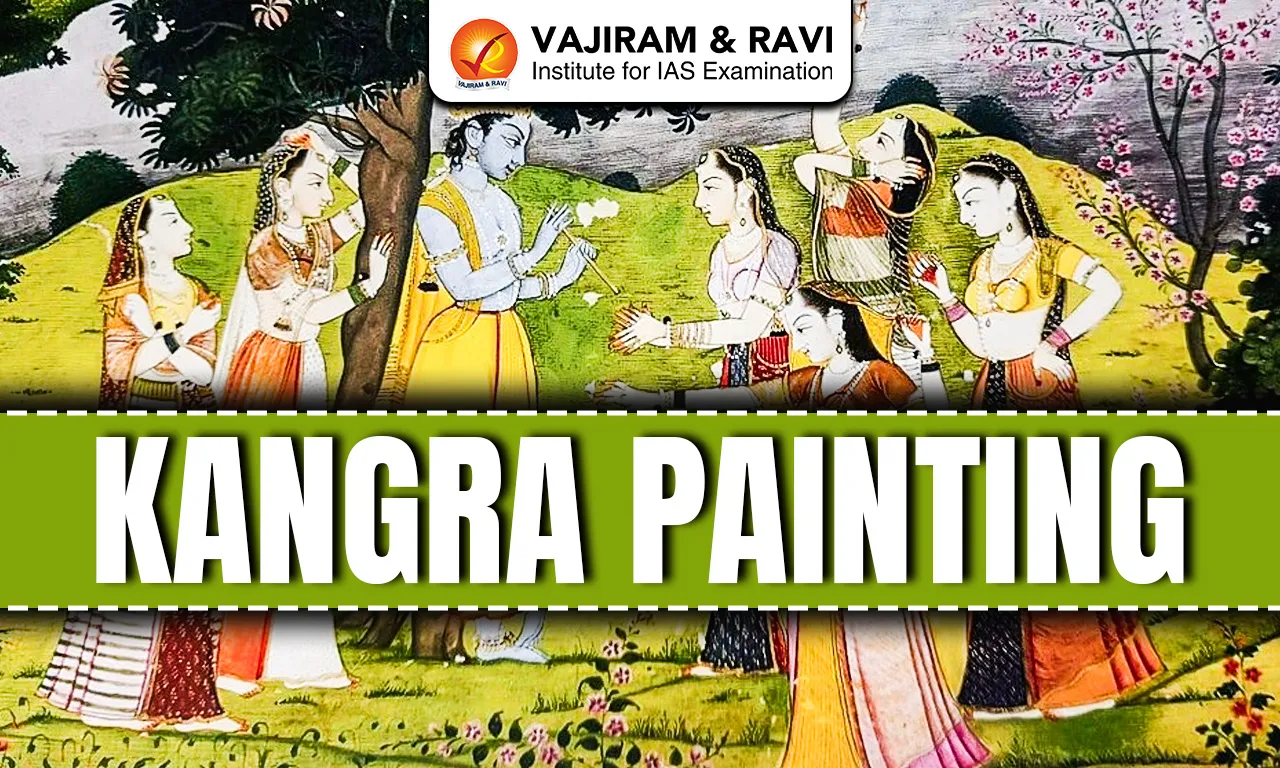
Kangra Painting is a famous pictorial type of Pahari art form, which is developed and named after the Kangra region of Himachal Pradesh, a former princely state which patronized the art form. The major themes of these paintings are nature and Krishna’s life.
Kangra Painting Background
- Kangra Painting developed in the mid-18th century (around 1740–1750 CE) in the hill regions of present-day Himachal Pradesh, after the decline of the Basohli school of painting. It became so influential that the Pahari style later came to be known as Kangra Painting
- It began at Haripur-Guler under the patronage of Raja Govardhan Chand (1744–1773).
- After the invasions of Nadir Shah in 1739 and Ahmad Shah Abdali, many painters who were trained in Mughal style of painting moved from the plains to the hills.
- These artists found support from hill rulers and developed a new painting style influenced by nature.
- Under Parkash Chand (1773–1790), Kangra Painting continued to grow.
- The art reached its peak during the rule of Raja Sansar Chand (1775–1823), the greatest patron of Kangra Painting.
- Famous texts like Gita Govinda, Bhagavata Purana, Bihari’s Sat Sai, the romantic tale of Nala and Damyanti and Keshav Das’Raskapriya and Kavipriya were illustrated during this period.
- Kangra Paintings are known for fine lines, bright colours and detailed work, which were done using thin squirrel-hair brushes.
- The artists usually did not mention their names, showcasing selfless dedication to the art.
- The Kangra Painters used pure red, yellow and blue colours which had maintained their brilliance even after many years.
Read about: Mughal Paintings
Kangra Painting Features
Central Theme
- The main theme of Kangra Painting is love and emotion.
- Love between man and woman is shown through figures like Radha–Krishna and Shiva–Parvati.
- Paintings are lyrical, graceful and full of rhythm and beauty.
- Themes also include seasons, music (ragas) and romantic devotion (bhakti).
Religious and Literary Influence
- Many paintings show stories from the Ramayana, Mahabharata and Puranas.
- Famous literary works like Gita Govinda, Rasikapriya, Sat Sai, Rasmanjari are painted in detail.
- These paintings reflect religious faith, moral values and cultural awareness.
Depiction of Nature
- Kangra Paintings are famous for lush green landscapes.
- Hills, trees, rivers, streams, birds and animals are shown beautifully.
- Nature is shown as calm, fresh and full of life.
Human Figures and Expression
- Female figures are shown with grace, softness and beauty.
- The Nayika is usually Radha, shown with gentle facial features.
- The Nayak is mostly Krishna, shown with divine charm.
- Hill rulers were sometimes painted as heroic figures or Nayaks.
Use of Colours and Brushwork
- Natural colours made from minerals and plants are used.
- Soft and cool colours create a peaceful and pleasing effect.
- The brushwork is very fine, delicate and smooth.
Artistic Style
- Kangra Paintings are realistic and detailed, showing careful observation.
- Different shades of green are used to show plants and forests.
- Distant hills are painted in soft pink or light colours.
Themes Over Time
- Over time, themes expanded to include night scenes, storms, clouds, and lightning.
- These added depth, mood and emotion to the paintings.
Kangra Painting Decline and Revival
- Kangra Painting, though culturally important, is facing decline due to urbanisation, modern lifestyle and loss of traditional practices.
- To protect and preserve this art, Kangra Painting was given the Geographical Indication (GI) tag in 2012, which recognises its heritage value and supports artisans.
- Today, Kangra Paintings are preserved in museums and collections worldwide, and its global recognition was highlighted in the 2022 G20 Bali Submit, when a Kangra miniature was gifted by the Indian Prime Minister to the US President.
Read about: Miniature Paintings
Kangra Painting Significance
- Kangra Painting is an important part of India’s cultural and artistic heritage.
- It reflects Indian values like love, devotion, beauty of nature and spiritual faith.
- The paintings help us understand the social life, beliefs and traditions of hill regions.
- Kangra art shows a high level of skill in colour use, fine lines and detailed work.
- It connects art with literature by illustrating stories from epics and classical poetry.
- Kangra Painting has influenced later Indian artists and styles.
Its GI tag and global recognition help preserve traditional art and support local artists.
Kangra Painting FAQs
Q1: What is Kangra Painting?
Ans: A Pahari style of miniature painting from Kangra, Himachal Pradesh, mainly showing nature and Krishna’s life.
Q2: When and where did Kangra Painting develop?
Ans: It developed in the mid-18th century (1740–1750 CE) in Himachal Pradesh after the decline of the Basohli school.
Q3: Who were the major patrons of Kangra Painting?
Ans: Raja Govardhan Chand, Raja Parkash Chand and Raja Sansar Chand.
Q4: What are the main themes of Kangra Paintings?
Ans: Love, devotion, Radha–Krishna, nature, seasons, music and religious stories.
Q5: What are the main features of Kangra Painting?
Ans: Fine lines, soft natural colours, detailed landscapes and graceful human figures.

