
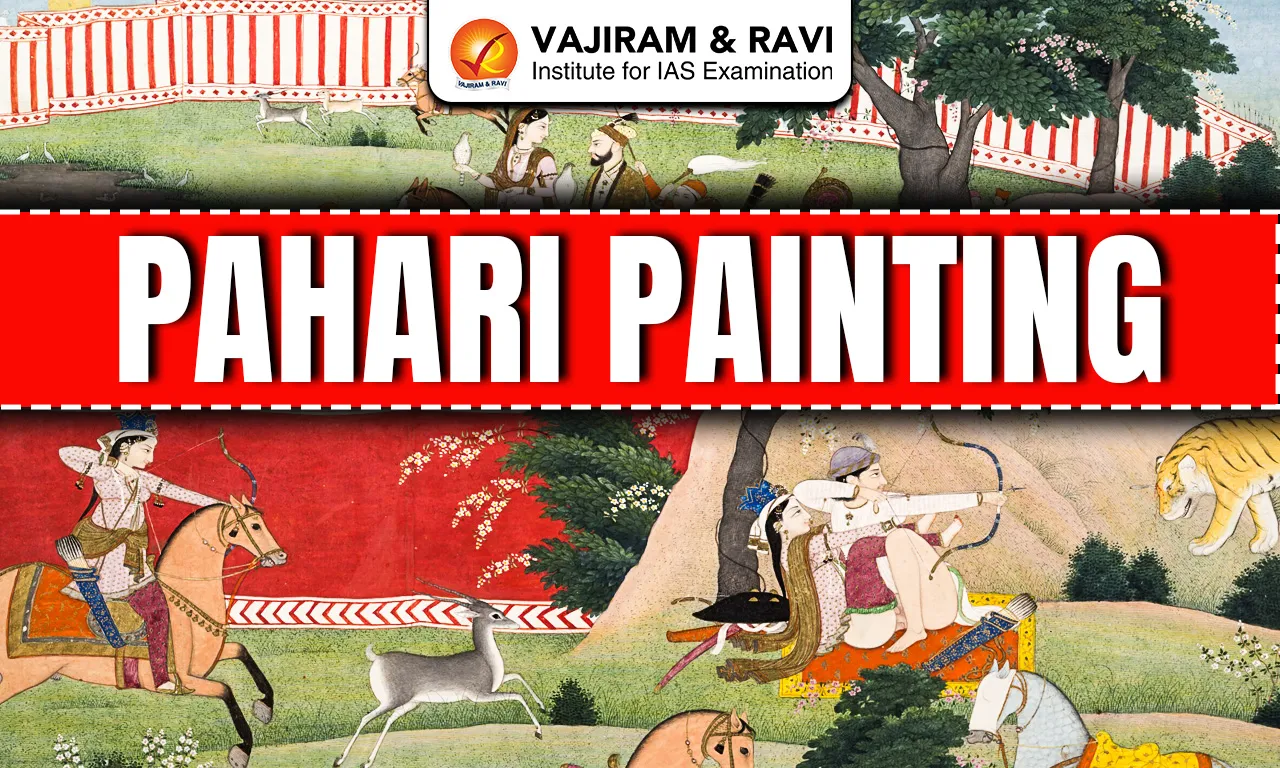
Paharai Painting is a school of artform that was developed in the hilly regions of Northern India especially the states of Himachal Pradesh adjoining areas. These paintings were mainly patronized by the local rulers and their themes revolved around nature, love and religious stories.
Pahara Painting Background
- Pahari Painting means painting from the hilly regions of North India.
- It developed in the sub-Himalayan regions from Jammu to Garhwal between the 17th and 19th centuries (1690–1900).
- These paintings were mainly done in miniature form and used for books and manuscripts.
- Pahari Painting grew under the patronage of Rajput hill rulers in states like Basohli, Guler, Kangra, Chamba, Mandi and Garhwal.
- It was influenced by Mughal and Rajasthani painting, especially after Mughal artists moved to the hills due to decline of Mughal patronage.
- Over time, Pahari Painting developed its own unique style, different from Mughal art.
Read about: Mughal Paintings
Pahari Painting Evolution
The Pahari School of Painting developed gradually over time, influenced by regional traditions and external artistic styles. It evolved through different phases, beginning with bold early styles and later achieving refinement and lyrical beauty. These stages of development are discussed below.
Early Phase-Basohli Style (1690-mid-18th century)
- The Basohli style is the earliest form of Pahari painting.
- It is known for bold lines, strong colours and powerful expressions.
- Themes included religious stories, especially Krishna legends.
Transitional Phase-Pre-Kangra / Guler Style (1740–1775)
- This phase acted as a bridge between Basohli and Kangra styles.
- Colours became softer and figures more natural and refined.
- Mughal influence became stronger in landscape and perspective.
Mature Phase-Kangra Style (after 1770)
- The Kangra style represents the peak of Pahari painting.
- It reached its height under Raja Sansar Chand (1775–1823).
- Paintings became delicate, lyrical, and full of emotion.
- Themes focused on Radha-Krishna, inspired by Gita Govinda.
Pahari Painting Features
- Pahari Paintings mainly show themes from mythology, religion and literature, along with court life and nature.
- The love of Radha and Krishna is the most important and common subject in Pahari art.
- Paintings usually have many figures and all figures appear lively and expressive.
- Each figure is painted with different colours and careful detailing, showing artistic skill.
- Pahari art introduced new techniques and styles over time, becoming more refined and delicate.
- Nainsukh, a famous painter of the mid-18th century, played an important role in shaping this style and his family continued the tradition.
- The paintings are known for fine lines, soft colours and balanced composition.
- Nature such as hills, rivers, trees, birds and animals is shown beautifully in the background.
- Pahari Paintings should not be identified only by region, as political boundaries often changed during that period.
- The style reflects love, devotion, beauty and harmony, making it an important part of Indian art history.
Read about: Miniature Paintings
Different Styles of Pahari Painting
Pahari painting developed in different hill regions under various rulers, which led to the growth of distinct local styles. These styles differ in themes, colours and techniques, and are discussed below.
Basholi Painting
- Basohli painting is an early style of the Pahari school, which developed in the Basohli region of Jammu and Kashmir between the late 17th and 18th centuries, mainly under the patronage of Raja Kirpal Pal.
- It is known for its bold lines, strong facial expressions, large eyes and very bright colours like red, yellow, green and brown, which give the paintings a powerful look.
- A special feature of Basohli paintings is the decorative jewellery made with raised white paint and shiny green beetle wings to show an emerald effect.
- The main themes include Rasamanjari, Ramayana, Bhagavata Purana, Ragamala, Goddess (Devi) forms and royal court scenes.
- Artists later carried this style to other hill regions such as Chamba, Kullu, Guler and Kangra and this helped in the development of later Pahari styles like the Kangra school.
Guler Painting
- The Guler school of Pahari Painting developed in the early 18th century under the patronage of Raja Govardhan Chand of the Kangra royal family.
- This style marked a shift from the bold Basohli style to a soft, refined and natural look, showing calm expressions and fine details.
- Guler paintings use light and cool colours and show the influence of Mughal painting, especially in realistic faces and nature scenes.
- Pandit Seu and his sons Manak and Nainsukh were the main artists; Nainsukh is especially known for realistic portraits of Raja Balwant Singh of Jasrota.
- Important themes include Bhagavata Purana, portraits and Gita Govinda and this style later developed into the Kangra school of painting.
Kangra Painting
- The Kangra School of painting developed in the late 18th century under the patronage of Raja Sansar Chand (1775-1823) of the Katoch dynasty. Artists from Guler, including Manaku and his family, came to Kangra and helped this style grow.
- The main centres of this painting were Tira Sujanpur, Alampur and Nadaun, located along the River Beas, which became important hubs of artistic activity.
- Kangra paintings are known for their soft, graceful and poetic style, with fine lines, delicate expressions, and bright but soothing colours. The female figures are shown with calm faces and a straight nose in line with the forehead, which is a special feature.
- The paintings mostly show stories from Krishna’s life, especially Radha-Krishna, along with themes from Bhagavata Purana, Gita Govinda, Ragamala and Nala-Damayanti. Scenes of royal court life were also painted.
- Fattu, Purkhu and Khushala were important Kangra painters. The art spread to nearby hill regions but started declining after 1805 due to wars and political troubles.
Garhwal Painting
- The Garhwal School of painting began when artists from other hill regions settled in Srinagar (Garhwal).
- In the beginning, the style was influenced by Mughal painting, but later it adopted the simple and soft style of Kangra painting.
- Garhwal paintings are closely related to the Guler-Kangra tradition, especially in their natural and calm landscapes.
- A special feature of Garhwal paintings is the use of cloudy skies, mist and foggy hills, which give a peaceful and emotional feel.
Chamba Painting
- Chamba paintings are known for beautiful and graceful female figures with a warm and charming look.
- These paintings mainly use bright red and blue colours and show good colour mixing.
- The style shows influence of Mughal art and also elements from Deccan and Gujarat schools.
- Earlier, Basohli style influenced Chamba painting, but later it moved closer to the Guler-Kangra style.
Mandi Painting
- Mandi paintings developed under Raja Sidh Sen (1684-1727).
- This school is famous for Tantric themes and the worship of the Goddess (Devi).
- The Goddess is shown in fierce and powerful forms, using dark colours like red, black and blue.
- Human figures, including kings, are often shown with exaggerated features, giving the paintings a bold and dramatic look.
Jammu Painting
- Jammu paintings are very similar to the Kangra style, especially in their soft and graceful look.
- This school is famous for the Shangri Ramayana, painted in the late 17th and early 18th centuries.
- Human figures are shown as tall, slim and well-shaped, with clear facial features.
- The paintings often show hilly landscapes and nature, using light but bright colours.
Jasrota Painting
- Jasrota paintings mainly developed in Jammu and Kashmir.
- They mostly show royal life, such as court scenes, kings’ activities and symbolic events.
- These paintings are known for their simple and realistic style.
Mankot Painting
- Mankot paintings are also found in Jammu and Kashmir.
- Early works look similar to the Basohli style, with bright colours and bold themes.
- Over time, artists used softer colours and showed more realistic portraits.
Pahari Painting FAQs
Q1: What is Pahari Painting?
Ans: It is a style of miniature painting from the hilly regions of North India developed between the 17th-19th centuries.
Q2: Who patronized Pahari Paintings?
Ans: They were patronised by Rajput hill rulers of Himachal Pradesh and nearby regions.
Q3: What are the main themes of Pahari Painting?
Ans: Mythology, Radha-Krishna, nature, literature and court life.
Q4: What is special about Basohli Painting?
Ans: Bold colours, strong lines and beetle-wing jewellery effect.
Q5: Who were the famous Pahari painters?
Ans: Pandit Seu, Manak, Nainsukh, Fattu and Purkhu.

