
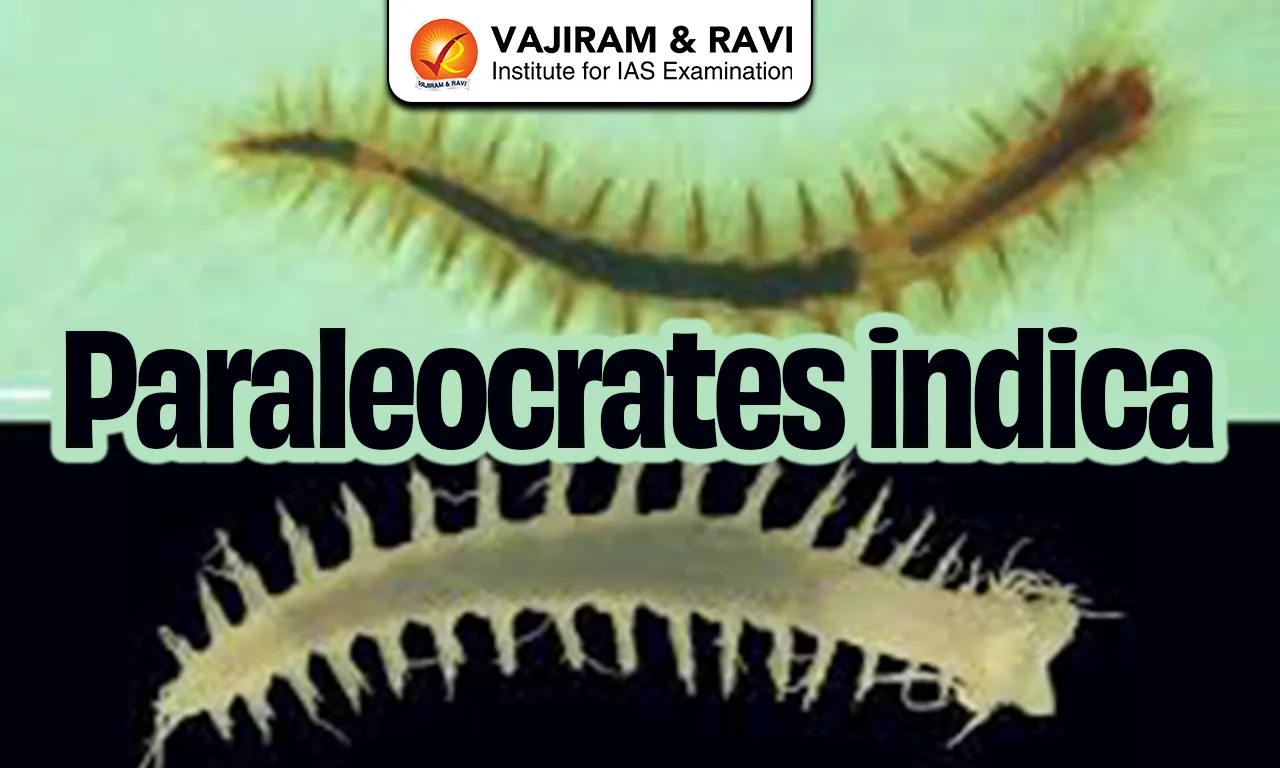
Paraleocrates Indica Latest News
Researchers recently discovered a new species of marine worm named Paraleocrates indica hiding in the muddy banks of the Champa Estuary in the Bay of Bengal.
About Paraleocrates Indica
- It is a new species of marine worm discovered in the muddy banks of the Champa Estuary in the Bay of Bengal.
- It marks the first time this rare group of creatures has ever been recorded in Indian waters.
- It is a type of muddy bristle worm in the family Hesionidae, known for its colourful bodies and often symbiotic relationships with other sea life, such as starfish.
- This discovery is only the third known species within its specific genus worldwide.
- To the naked eye, the worm appears reddish and measures between 14 and 35 millimetres in length.
- The most striking characteristic of Paraleocrates indica is its eyes: its front pair of eyes is a staggering five times larger than the back pair.
- It also sports a pair of fang-shaped jaws, one on the top and one on the bottom, and a set of long, sensitive antennae that help it navigate its murky home.
- It is distinguished from its closest relatives, P. djangkarensis and P. wesenberglundae, in Indonesia and the Gulf of Oman, by its specific bristle count.
- It has significantly fewer bristles (called neurochaetae) per bundle and features unique single-pointed blades on its appendages that lack the protective guards found on other species.
Source: RM
Paraleocrates Indica FAQs
Q1: What is Paraleocrates indica?
Ans: It is a newly discovered species of marine worm.
Q2: Where was Paraleocrates indica discovered?
Ans: In the muddy banks of the Champa Estuary in the Bay of Bengal.
Q3: What type of worm is Paraleocrates indica?
Ans: A muddy bristle worm belonging to the family Hesionidae.
Q4: What are Hesionidae worms generally known for?
Ans: Their colourful bodies and symbiotic relationships with other marine organisms such as starfish.
Q5: What is the most striking physical feature of Paraleocrates indica?
Ans: Its front pair of eyes is five times larger than the back pair.

