
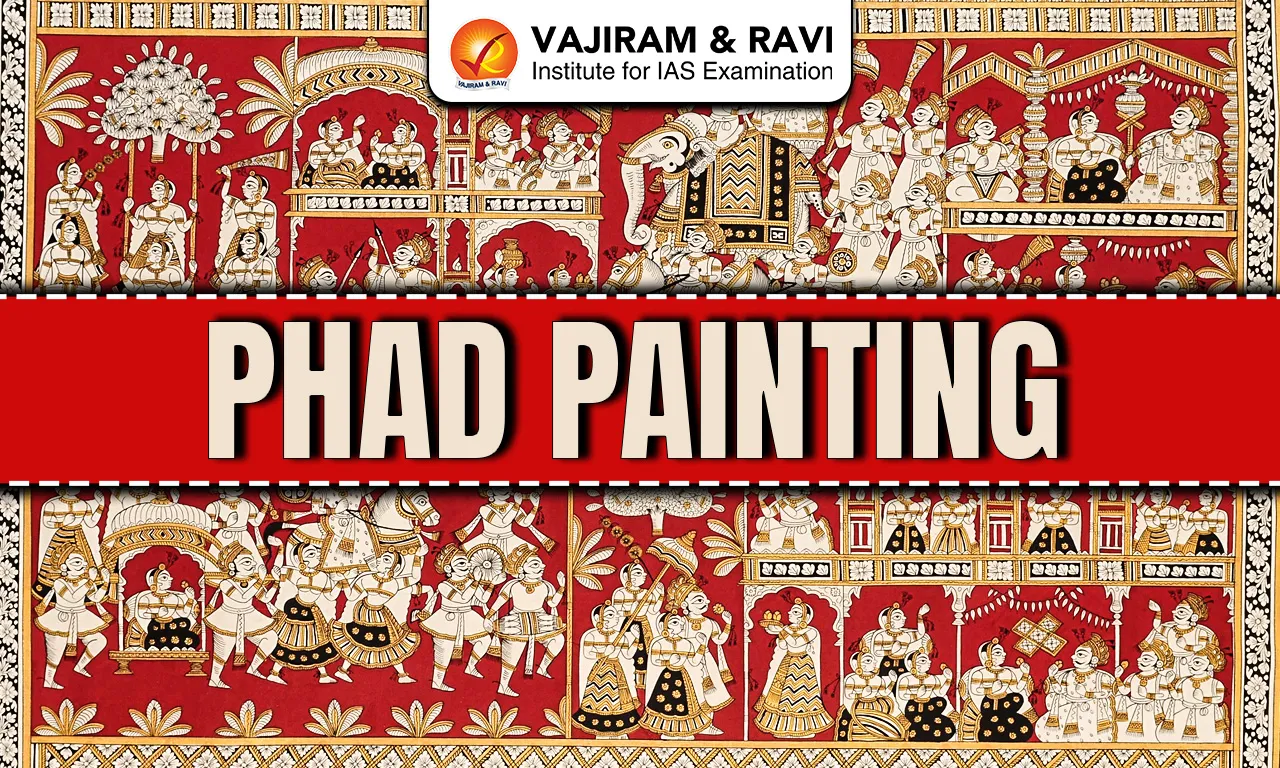
Phad Painting is a traditional religious scroll painting style of Rajasthan, deeply rooted in folk devotion and storytelling. It is practised mainly in the Mewar-Bhilwara region. It is painted on long cotton cloth called Phad and used as a mobile shrine during ritual performances. These scrolls visually narrate heroic legends of local folk deities like Pabuji and Devnarayan, worshipped by pastoral communities. Phad Painting combines art, music, poetry and ritual, making it both a visual and performative tradition. Its sacred nature, fixed iconography and narrative continuity give it a unique place in India’s cultural heritage.
Phad Painting Historical Background
Phad Painting originated around the 14th century in Shahpura, Rajasthan, evolving alongside folk heroic ballads called veergatha.
- The earliest Phads depicted Pabuji of the Rabari community and Devnarayan of the Gurjar community, treating each painted scroll as a sacred shrine during worship and performances.
- Priest singers known as Bhopas and Bhopis travelled village to village, using Phads as visual aids while narrating stories overnight through song, dance and ritual narration.
- For centuries, Phad Painting was practised exclusively by the Joshi Clan, who were authorised to paint these sacred scrolls under strict traditional rules.
Also Read: Santhal Painting
Phad Painting Technique
Phad Painting follows a precise, ritualised process that ensures durability, vibrancy and sacred purity of the scroll.
- Preparation of Cloth: Coarse cotton or khadi cloth is soaked overnight, dried, coated with a primer of flour and gum and burnished with a stone to achieve a smooth, glossy surface.
- Use of Natural Pigments: Colours are derived from minerals and vegetable sources, applied using local gum (kheriya gond), which helps maintain colour brightness for decades.
- Sequential Painting Method: Artists sketch compositions in yellow first, then fill colours systematically, ensuring hierarchical scaling of figures based on social and divine importance.
- Final Ritual Completion: The painting is symbolically brought to life by drawing the pupil in the central deity’s eye, marking the spiritual completion of the Phad.
Also Read: Kangra Painting
Phad Painting Features
Phad Paintings are instantly recognisable due to their fixed visual grammar, narrative density and symbolic structure.
- Narrative Composition: Scenes are arranged horizontally around a central deity, depicting multiple episodes simultaneously rather than in linear sequence, allowing continuous storytelling.
- Distinct Visual Style: Figures are shown frontally with faces in profile, painted in orange tones, while garments use red, yellow, blue and green for contrast and clarity.
- Defined Borders and Colours: Every Phad has red cloth edges and black-white floral borders, reinforcing its sacred frame and separating the divine narrative from the outside world.
- Sacred Treatment: Phads are worshipped like temples, ritually purified before performances and traditionally immersed in Pushkar Lake when worn out, preserving their religious sanctity.
- Project PARI 2024: Under Ministry of Culture’s Project PARI, Phad Painting inspired murals feature in Delhi’s public spaces, created by 150+ artists, showcasing folk art in modern urban settings during the 46th World Heritage Committee meeting.
Phad Painting FAQs
Q1: What is Phad Painting?
Ans: Phad Painting is a traditional religious scroll painting of Rajasthan, painted on long cloth to narrate stories of folk deities like Pabuji and Devnarayan through visual storytelling.
Q2: Which communities are associated with Phad Painting traditions?
Ans: Phad Paintings are linked with the Joshi artist community and are traditionally performed by Bhopas and Bhopis for Rabari and Gurjar communities during ritual storytelling.
Q3: What materials are used in Phad Painting?
Ans: Phad Paintings use hand prepared cotton cloth, natural mineral and vegetable pigments, flour gum primer and local gums, ensuring durability and long lasting colour vibrancy.
Q4: Why are Phad Paintings considered sacred?
Ans: Each Phad is treated as a mobile temple, worshipped during performances, ritually purified and symbolically brought to life by completing the deity’s eyes.
Q5: How is Phad Painting relevant in modern India?
Ans: Phad Painting inspires contemporary public art initiatives like Project PARI (2024), where traditional styles are adapted into murals and installations for wider public engagement.

