
Sarvam AI, Founder, Model, Significance, Challenges, Vision

Sarvam AI

Sarvam AI Latest News

The government has selected Bengaluru-based start-up Sarvam to build the country’s first indigenous artificial intelligence (Sarvam AI) large language model (LLM) amid waves made by China’s low cost model DeepSeek.

Introduction of Sarvam AI

  • In a landmark move to bolster India’s strategic autonomy in artificial intelligence (AI), Bengaluru-based start-up Sarvam AI has been selected to build the country’s first homegrown sovereign large language model (LLM). 
  • The project, undertaken under the government’s ambitious ₹10,370 crore IndiaAI Mission, aims to create a robust AI infrastructure fully developed, deployed, and optimized within India. 
  • This development marks a critical step toward ensuring India’s leadership in the AI domain and promoting domestic innovation through indigenous capabilities.

Sarvam AI Model Initiative Overview

  • The government chose Sarvam after a rigorous selection process involving 67 applicants. The start-up will receive extensive support, including access to 4,000 high-end GPUs for six months to build the model from scratch. 
  • The GPUs will be provided through companies such as Yotta Data Services, Tata Communications, and E2E Networks, which were separately empanelled to create AI data centres in India.
  • The model, to be built entirely using local talent and infrastructure, will have 70 billion parameters, positioning it to compete with some of the best global AI models. 
  • According to Sarvam, the LLM will focus on advanced reasoning, voice-based tasks, and fluency in Indian languages, making it uniquely suited for India's diverse population.

Model Variants Under Development

  • Sarvam AI plans to develop three key variants of its LLM:
    • Sarvam-Large: Designed for advanced reasoning and complex generation tasks.
    • Sarvam-Small: A lightweight model optimized for real-time interactive applications.
    • Sarvam-Edge: A compact model tailored for on-device processing, enabling AI capabilities on mobile and IoT devices.
  • These variants aim to cater to a wide range of applications, from citizen services to enterprise solutions, ensuring adaptability across various use cases.

Strategic Significance of the Project

  • This initiative goes beyond technological advancement; it is a strategic move to establish critical national AI infrastructure
  • The company emphasized that the goal is to create multi-modal, multi-scale foundation models that are not just functional but deeply integrated with Indian languages and societal needs.
  • For citizens, this means AI systems that feel familiar and culturally relevant. 
  • For enterprises, it unlocks the potential to harness AI capabilities without concerns over data sovereignty, as all processes will remain within India's borders.

The IndiaAI Mission and National AI Infrastructure

  • The IndiaAI Mission, approved by the Union Cabinet, is focused on scaling India's AI ecosystem by investing in compute capacity, skilled research talent, datasets, AI applications, and trusted AI practices. 
  • One of its key initiatives is the IndiaAI Compute Capacity program, which aims to deploy over 10,000 GPUs to democratize access to AI resources for startups, researchers, and institutions.
  • To facilitate greater participation, especially by smaller companies, the government has also eased eligibility norms for accessing these resources, offering GPU services at globally competitive subsidized rates.
  • Sarvam’s selection to develop the first sovereign AI model exemplifies the mission’s objective of nurturing homegrown champions capable of competing on the global stage.

Sarvam AI Challenges and Opportunities

  • While the opportunity is historic, building a population-scale LLM is a complex challenge. 
  • It demands seamless integration of vast datasets, engineering innovations to handle diverse languages and dialects, and fine-tuning for cultural and contextual understanding.
  • Additionally, unlike some global LLMs that are open-sourced, Sarvam’s model is expected to be closely managed and fine-tuned specifically for Indian use cases
  • This positions it as a secure and specialized alternative in an era where data privacy and localized solutions are paramount.

Future Prospects

  • Sarvam’s success could unlock a universe of possibilities, from enabling AI-driven citizen services in rural areas to building enterprise-grade AI applications with localized intelligence. 
  • It sets the foundation for India to not merely consume global AI solutions but to become a co-creator and leader in AI innovation.
  • With investments from prominent venture capitalists like Lightspeed Venture Partners and Peak XV Partners, Sarvam is well-resourced to deliver on this ambitious national mission.

Source: IE | TH

[youtube url="https://www.youtube.com/watch?v=qswEBHoWZMM" width="560" height="315"]

Sarvam AI FAQs

Q1: What is Sarvam AI’s project about?

Ans: Sarvam AI has been selected to build India’s first indigenous large language model under the IndiaAI Mission.

Q2: What are the main features of Sarvam’s AI model?

Ans: The model focuses on reasoning, supports voice tasks, and is fluent in multiple Indian languages.

Q3: How is the government supporting Sarvam AI?

Ans: Sarvam will get access to 4,000 GPUs and dedicated infrastructure to develop the model from scratch.

Q4: What is the strategic importance of this project?

Ans: It enhances India’s AI sovereignty, promotes domestic innovation, and ensures secure, localized AI solutions.

Q5: What are the different versions of the Sarvam model?

Ans: Sarvam is developing Sarvam-Large, Sarvam-Small, and Sarvam-Edge for different use cases.

Copernicus Sentinel-2 Mission

Copernicus Sentinel-2 Mission

Copernicus Sentinel-2 Mission Latest News

The European Space Agency (ESA)'s Copernicus Sentinel-2 mission recently released a stunning high-resolution image of the 2026 Winter Olympic venues across northern Italy.

About Copernicus Sentinel-2 Mission

  • It is an Earth observation satellite mission developed by the European Space Agency (ESA).
  • It is part of Copernicus - the European Union’s Earth observation program.
  • It aims at monitoring variability in land surface conditions.
  • It comprises a land monitoring constellation of two polar-orbiting satellites placed in the same sun-synchronous orbit.
  • The twin satellites S-2B and S-2C have a wide swath width (290 km) and a high revisit time. This capability will support monitoring of changes on the Earth's surface.
  • It delivers high-resolution optical multispectral imagery across 13 spectral bands in the visible to shortwave infrared.
  • This data supports a wide range of applications, including precision agriculture, food security, ecosystems monitoring, disaster management (e.g., volcanoes, wildfires, floods, landslides), water quality assessment, and observing anthropogenic methane emissions.

Key Facts about Copernicus Programme

  • It is the Earth observation component of the European Union’s Space programme.
  • This initiative is headed by the European Commission (EC) in partnership with the European Space Agency (ESA).
  • It offers information services that draw from satellite Earth observation and in-situ (non-space) data.
  • The programme consists of a complex set of systems that collect data from multiple sources, including Earth Observation satellites, in-situ sensors like ground stations, and airborne and sea-borne sensors. 
  • Users have free and open access to a great deal of this data, which is also processed to provide a set of services based on reliable and near-real-time information.
  • ESA has developed a new family of satellites, called Sentinels, specifically for the operational needs of Copernicus.

Source: IT

Copernicus Sentinel-2 Mission FAQs

Q1: What is the Copernicus Sentinel-2 Mission?

Ans: It is an Earth observation satellite mission developed by the European Space Agency (ESA).

Q2: What is the primary objective of the Sentinel-2 Mission?

Ans: To monitor variability in land surface conditions.

Q3: What type of satellite constellation does Sentinel-2 use?

Ans: A land monitoring constellation of two polar-orbiting satellites.

Q4: What kind of imagery does Sentinel-2 provide?

Ans: High-resolution optical multispectral imagery.

Giant Phantom Jellyfish

Giant Phantom Jellyfish

 Giant Phantom Jellyfish Latest News

Scientists on a month-long deep-sea expedition off Argentina’s coast documented a rare giant phantom jellyfish recently.

About Giant Phantom Jellyfish

  • It is a rare and mysterious deep-sea jellyfish known for its ghostly, translucent appearance. 
  • It is among the largest jellyfish.
  • Scientific Name: Stygiomedusa gigantea
  • It is in the Ulmaridae family. 
  • It is believed to be widespread throughout the world’s oceans, except in the Arctic Ocean. 
  • Unlike most jellyfish, it lacks tentacles. Instead, they use ribbon-like arms to grab prey, typically plankton or small fish, and pull them into their mouths.
  • This mauve-coloured jellyfish can grow to a colossal size: the bell can be more than one metre (3.3 feet) across, and the animal's four ribbon-like 'oral arms' can reach lengths of more than 10 metres (33 feet).
  • But despite their massive size, the elusive creatures have been spotted only about 120 times since the first specimen was collected in 1899
  • That’s because they prefer to lurk in the “midnight zone,” a part of the ocean ranging from 3,300 to 13,100 feet deep, that is shrouded in complete darkness.
  • Their bodies being made of either spongy tissue or jelly allows the species to withstand the enormous deep ocean pressure of 40,000 kPa (5,800 pounds per square inch).

Source: NDTV

Giant Phantom Jellyfish FAQs

Q1: What is the Giant Phantom Jellyfish?

Ans: It is a rare deep-sea jellyfish known for its ghostly, translucent appearance.

Q2: Why is the Giant Phantom Jellyfish considered one of the largest jellyfish?

Ans: Because its bell can exceed one metre in diameter and its oral arms can grow over 10 metres long.

Q3: Does the Giant Phantom Jellyfish have tentacles like most jellyfish?

Ans: No, it lacks tentacles.

Q4: How does the Giant Phantom Jellyfish capture its prey?

Ans: By using ribbon-like oral arms to grab prey and pull it into its mouth.

Lyriothemis Keralensis

Lyriothemis Keralensis

Lyriothemis Keralensis Latest News

Researchers recently confirmed the discovery of a new species of dragonfly, Lyriothemis keralensis, from the low-lying coastal regions of Kerala.

About Lyriothemis Keralensis

  • It is a new species of dragonfly.
  • It was discovered in the low-lying coastal regions of Kerala.
  • Commonly called the Slender Bombardier, Lyriothemis keralensis was distinguished from its Northeast Indian relative, Lyriothemis acigastra, after extensive research. 
  • It has a slender abdomen, a uniquely shaped tail, and distinct genital structures. 
  • Males display a deep blood-red abdomen with black markings, while the slightly broader females show yellow and black colouration. 
  • The species measures about three centimetres in length.
  • Unlike many dragonflies found in forest areas, the Slender Bombardier prefers human-modified landscapes. 
  • It thrives in irrigation ecosystems such as pineapple and rubber plantations and is commonly seen in shaded canals and seasonal pools within agricultural areas.
  • It is a seasonal resident, emerging during the monsoon and retreating as rainfall declines.

Source: TOI

Lyriothemis keralensis FAQs

Q1: What is Lyriothemis keralensis?

Ans: It is a newly discovered species of dragonfly.

Q2: Where was Lyriothemis keralensis discovered?

Ans: In the low-lying coastal regions of Kerala.

Q3: What is the common name of Lyriothemis keralensis?

Ans: Slender Bombardier.

Q4: What key physical features distinguish Lyriothemis keralensis?

Ans: A slender abdomen, uniquely shaped tail, and distinct genital structures.

Q5: Which type of habitat does the Slender Bombardier prefer?

Ans: Human-modified landscapes rather than forest areas.

Kordofan Region

Kordofan Region

Kordofan Region Latest News

A drone attack by Sudan’s Rapid Support Forces struck a vehicle carrying displaced families near Rahad in North Kordofan, killing at least 24 people, including eight children and two infants.

About Kordofan Region

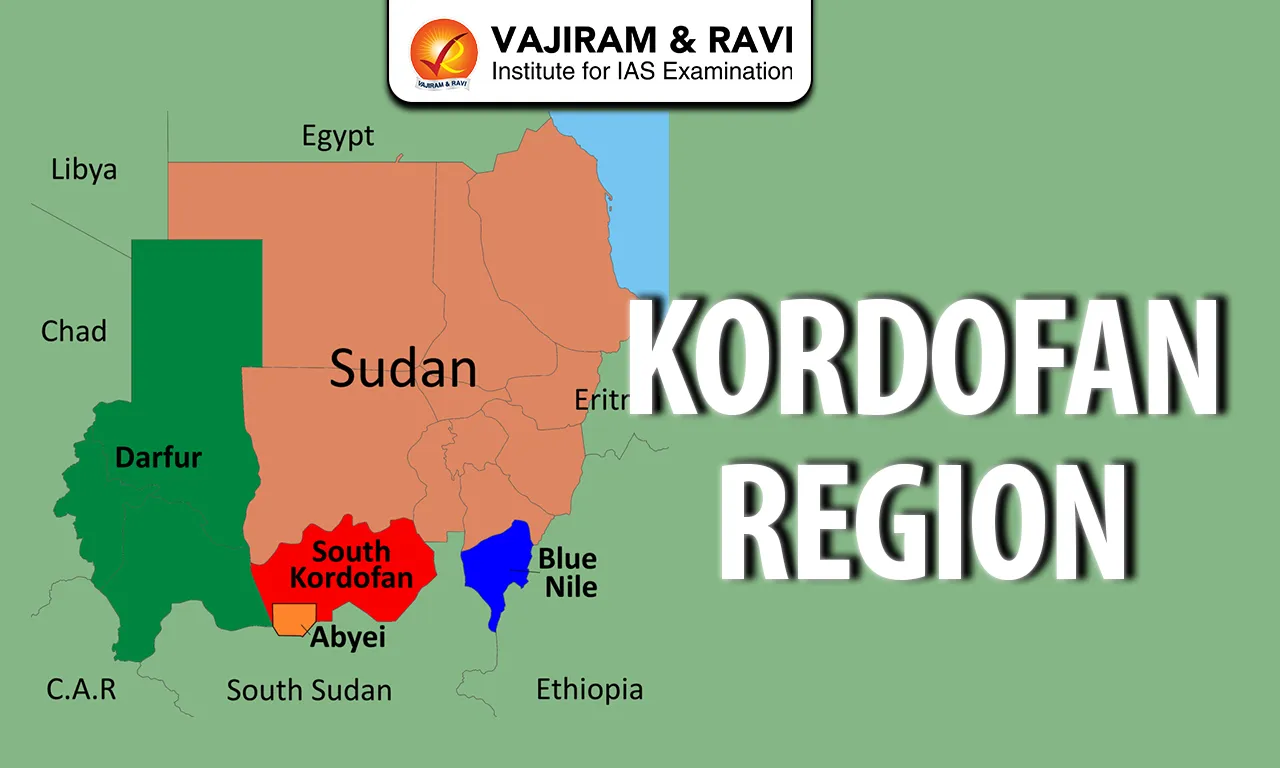
  • It is a region constituting the central and southern area of Sudan. 
  • It lies between the Darfur region on the west and the valley of the White Nile River on the east.
  • It covers an area of about 390,000 sq.km.
  • The region is divided into three federal states: North Kordofan (capital: El Obeid), South Kordofan (capital: Kadugli), and West Kordofan (capital: Al Fula).
  • The northern part of the region is desert and has sandy soils and little physiographic relief. 
  • There is some acacia scrub, desert grass, and thorny shrub; the landscape becomes increasingly more open and barren toward the north. 
  • The southern section of Kordofan is a level or gently undulating clay plain, with the scattered granitic Nuba Mountains rising in the east to an elevation of about 900 metres. 
  • Traditionally the area is known for the production of gum arabic. Other crops include groundnuts, cotton, and millet.
  • Most of the people in Kordofan are Arabs. Minorities include the Nubian, Beja, Daju, Zaghawa, and Darfunj peoples. 
  • It has been a conflict-prone area, especially since Sudan’s civil wars.
  • It is a strategic region due to:
    • Proximity to South Sudan.
    • Oil fields in West Kordofan.

Source: FPJ

Kordofan Region FAQs

Q1: What is the Kordofan Region?

Ans: It is a region constituting the central and southern area of Sudan.

Q2: Between which two major regions does Kordofan lie?

Ans: Between the Darfur region in the west and the White Nile River valley in the east.

Q3: What are the physical characteristics of northern Kordofan?

Ans: Desert landscape with sandy soils, little relief, and sparse vegetation.

Q4: Which ethnic group forms the majority population of Kordofan?

Ans: Arabs

Q5: Which minority communities live in the Kordofan Region?

Ans: Nubian, Beja, Daju, Zaghawa, and Darfunj peoples.

Paraleocrates Indica

Paraleocrates Indica

Paraleocrates Indica Latest News

Researchers recently discovered a new species of marine worm named Paraleocrates indica hiding in the muddy banks of the Champa Estuary in the Bay of Bengal.

About Paraleocrates Indica

  • It is a new species of marine worm discovered in the muddy banks of the Champa Estuary in the Bay of Bengal.
  • It marks the first time this rare group of creatures has ever been recorded in Indian waters.
  • It is a type of muddy bristle worm in the family Hesionidae, known for its colourful bodies and often symbiotic relationships with other sea life, such as starfish. 
  • This discovery is only the third known species within its specific genus worldwide.
  • To the naked eye, the worm appears reddish and measures between 14 and 35 millimetres in length.
  • The most striking characteristic of Paraleocrates indica is its eyes: its front pair of eyes is a staggering five times larger than the back pair. 
  • It also sports a pair of fang-shaped jaws, one on the top and one on the bottom, and a set of long, sensitive antennae that help it navigate its murky home.
  • It is distinguished from its closest relatives, P. djangkarensis and P. wesenberglundae, in Indonesia and the Gulf of Oman, by its specific bristle count
    • It has significantly fewer bristles (called neurochaetae) per bundle and features unique single-pointed blades on its appendages that lack the protective guards found on other species.

Source: RM

Paraleocrates Indica FAQs

Q1: What is Paraleocrates indica?

Ans: It is a newly discovered species of marine worm.

Q2: Where was Paraleocrates indica discovered?

Ans: In the muddy banks of the Champa Estuary in the Bay of Bengal.

Q3: What type of worm is Paraleocrates indica?

Ans: A muddy bristle worm belonging to the family Hesionidae.

Q4: What are Hesionidae worms generally known for?

Ans: Their colourful bodies and symbiotic relationships with other marine organisms such as starfish.

Q5: What is the most striking physical feature of Paraleocrates indica?

Ans: Its front pair of eyes is five times larger than the back pair.

Key Facts about Greece

Key Facts about Greece

Greece Latest News

Greek Defence Minister Nikos and Indian Defence Minister will hold a bilateral meeting at the Manekshaw Centre in New Delhi to enhance defence cooperation.

About Greece

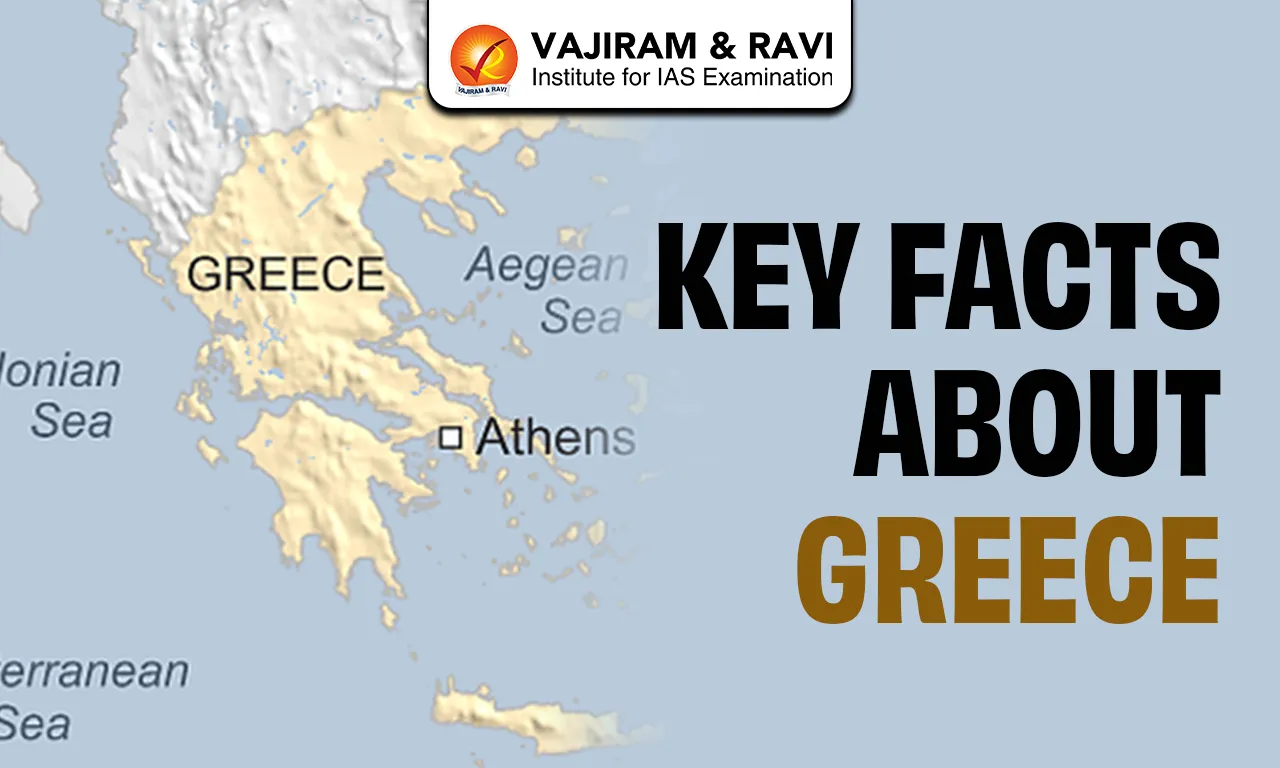
  • Location: It is located on the southern edge of the Balkan Peninsula.
  • Bordering Countries: It is bordered by 4 nations namely, North Macedonia and Bulgaria in the north, Albania in the northwest, and Turkey in the northeast.
  • Bordering Seas: It is also bounded by the Aegean Sea in the east, Ionian Sea in the west and the Mediterranean Sea in the south.
  • Capital:  Athens

Geographical features of Greece

  • Terrain: It is predominantly mountainous, with approximately 80% of its terrain consisting of mountains or hills, making it one of the most mountainous countries in Europe. 
  • Climate: The climate of Greece is typically Mediterranean.
  • Major Mountain:  Pindus mountain range on the mainland contains one of the world's deepest gorges, Vikos Gorge, which plunges 3,600 feet (1,100 meters).
  • Highest Peak: The highest Greek mountain is Mount Olympus, rising to 2,918 meters.
  • Major Rivers: Maritsa, Struma and Vardar etc.
  • Natural Resources:  It mainly consists of petroleum, magnetite, lignite, bauxite, hydropower, and marble.

Source: TH

Greece FAQs

Q1: What is the capital of Greece?

Ans: Athens

Q2: Where is Greece located?

Ans: Southeast Europe

Sawalkote Hydroelectric Project

Sawalkote Hydroelectric Project

Sawalkote Hydroelectric Project Latest News

India recently started work on the Sawalkote Hydroelectric Project on the River Chenab in Jammu and Kashmir—the first such new project to get the green light from the government after the abrogation of the Indus Water Treaty.

About Sawalkote Hydroelectric Project

  • It is a 1,856-MW run-of-the-river hydropower project on the Chenab River in the Ramban District of Jammu and Kashmir. 
  • It will be the largest hydroelectric project in the Union Territory and one of the biggest in North India.
  • The project has been in the planning stage since the 1980s and has undergone multiple revisions to address environmental, ecological, and technical concerns.
  • The project will be built by the National Hydroelectric Power Corporation (NHPC).
  • It will comprise nine turbines and an underground power station. 
  • It will feature a Roller Compacted Concrete Gravity Dam at a height of 192.5 metres.
  • It will produce around 8000 million units of electricity every year.
  • The plant will ensure reliable power supply to the region, particularly during the harsh winter months, when electricity demand peaks and shortages are common.
  • It also has the potential to turn J-K into a power-surplus region, creating scope for exporting surplus energy to the national grid.
  • By regulating the flow of the Chenab River, the Sawalkote project could contribute to flood mitigation downstream, while also ensuring better water management for agriculture and domestic use.
  • It is a key part of India’s plan to fully utilise its share of water from the western rivers under the 1960 Indus Waters Treaty (IWT). 
  • It is the first major hydropower project on the Indus rivers to be accorded environmental clearance following India’s suspension of the Indus Waters Treaty (IWT) on April 23, 2025, following the Pahalgam terror attack.

Source: NEWS18

Sawalkote Hydroelectric Project FAQs

Q1: What is the Sawalkote Hydroelectric Project?

Ans: It is a 1,856-MW run-of-the-river hydropower project.

Q2: On which river is the Sawalkote project being built?

Ans: On the Chenab River.

Q3: Where is the Sawalkote Hydroelectric Project located?

Ans: In the Ramban District of Jammu and Kashmir.

Q4: Which organisation is responsible for constructing the Sawalkote project?

Ans: The National Hydroelectric Power Corporation (NHPC).

Indian National Centre for Ocean Information Services (INCOIS)

Indian National Centre for Ocean Information Services (INCOIS)

Indian National Centre for Ocean Information Services (INCOIS) Latest News

Indian National Centre for Ocean Information Services (INCOIS) will be launching three new ocean information services: JellyAIIP, SAMUDRA 2.0 Mobile App, and SIVAS along with a new logo during the foundation day celebrations.

About Indian National Centre for Ocean Information Services (INCOIS)

  • It was established as an autonomous body in 1999 under the Ministry of Earth Sciences (MoES).
  • It is located in Hyderabad, Telangana.
  • Mandate: It is mandated to provide ocean information and advisory services to society, industry, government agencies and the scientific community through sustained ocean observations and constant improvements through systematic and focussed research.
  • It is a permanent member of UNESCO's Intergovernmental Oceanographic Commission (IOC).
  • It established the Indian Tsunami Early Warning Centre (ITEWC) which provides tsunami alerts within 10 minutes, serving India and 28 Indian Ocean countries.
  • Initiatives of INCOIS:
    • It has developed the Search and Rescue Aided Tool (SARAT) to assist the Indian Coast Guard, Navy and Coastal Security Police, in locating individuals or objects lost at sea.
    • INCOIS has also established the SynOPS visualization platform which integrates real-time data to strengthen response coordination during extreme events.

What are JellyAIIP, SAMUDRA 2.0 Mobile App, and SIVAS?

  • JellyAIIP (Jellyfish Aggregation Information Interactive Portal): It is a national web-based platform for reporting and visualising jellyfish aggregation, swarming, and stranding events along the Indian coast, with geospatial mapping, hotspot analysis, and multilingual first-aid guidance.
  • SAMUDRA 2.0 Mobile App: It is an upgraded multilingual advisory platform delivering ocean information and early warnings to fishermen and maritime users.
  • SIVAS: Swell-Surge Inundation Vulnerability Advisory System, is a coastal inundation early warning service designed to provide advance alerts on swell-surge flooding events, currently operational for the Kerala coast, with multilingual forecast bulletins.

Source: TH

Indian National Centre for Ocean Information Services (INCOIS) FAQs

Q1: What is the primary objective of INCOIS?

Ans: To provide ocean information and advisory services

Q2: Where is INCOIS located?

Ans: Hyderabad

AI Impact Summit 2026: India Eyes a Larger Role in the Global AI Economy

AI Impact Summit 2026

AI Impact Summit 2026 Latest News

  • India will host the AI Impact Summit 2026 from February 16 to 20, marking the first time this global AI governance forum is being held in the Global South.
  • The summit aims to generate actionable, long-term policy recommendations rather than impose immediate binding regulations. It seeks to align AI governance with inclusive growth, sustainability, and social impact.

Background: Evolution of Global AI Summits

  • The summit builds on a series of international meetings on AI governance.
  • The Bletchley Park AI Safety Summit (2023) focused on identifying catastrophic AI risks.
  • The Seoul Summit (2024) widened the agenda to include innovation and inclusivity.
  • The Paris AI Action Summit (2025) shifted attention to implementation and economic opportunities.
  • Each iteration has gradually expanded the scope beyond safety towards practical and developmental concerns.

India’s Distinct Approach

  • Unlike earlier summits centred on regulation and risk containment, India is steering the discussion towards “People, Planet, and Progress.” 
  • The focus is on developing AI solutions that address real-world challenges, especially in developing countries. 
  • This reflects India’s dual role as an emerging AI power and a representative voice of the Global South.
  • Through this summit, India is positioning itself to secure a larger role in shaping global AI governance and capturing greater economic and developmental benefits from the technology.

India AI Impact Summit 2026: What to Expect

  • Scale and Significance - The AI Impact Summit 2026 has been described by Union IT Minister Ashwini Vaishnaw as the largest such global gathering so far, with strong international interest and participation.
  • High-Level Global Participation - The summit is expected to host representatives from over 100 countries, including 15–20 heads of government, more than 50 ministers, and over 40 CEOs of leading global and Indian companies. 
    • Prime Minister Narendra Modi will inaugurate the event, host a dinner, and address a CEO roundtable.
  • Diverse Stakeholders - Participants will include governments, industry leaders, researchers, civil society organisations, and international institutions, highlighting the summit’s multi-stakeholder approach to AI governance and development.
  • Key Themes and Deliberations - The summit will feature working groups and discussions on major issues such as AI’s impact on jobs, trust and safety frameworks for AI systems, and the application of AI across key industries.
  • India’s AI Push and Model Launches - As part of the Rs 10,370 crore IndiaAI Mission, the government will launch several indigenous AI language models during the summit, including foundational and small language models.
  • Startup and Innovation Showcase - The event will showcase over 500 AI startups and host around 500 sessions alongside the main programme, making it one of the most comprehensive global forums focused on artificial intelligence.

Opening Up to China at the AI Impact Summit

  • Chinese Participation at the Summit - China is expected to send a delegation to the AI Impact Summit, following a formal invitation extended by India last year as both countries seek to strengthen domestic AI capabilities.
  • Summit Format and Invitations - The AI Summit is not a formal multilateral grouping. Participation is determined by the host country, giving India the discretion to invite China despite geopolitical sensitivities.
  • Precedents from Earlier Summits - When the UK hosted the first AI Safety Summit, it faced opposition from allies and domestic lawmakers over inviting China, but proceeded nonetheless. China also participated in the subsequent summits in Seoul and Paris.
  • Signal of Easing India–China Ties - India’s invitation to China reflects a gradual thaw in bilateral relations. Earlier this year, direct flights between the two countries resumed after a gap of more than five years.
  • Trade and Supply Chain Developments - China has also begun clearing applications from firms supplying rare earth components to Indian automobile manufacturers, easing earlier restrictions imposed amid global trade tensions.

Hardware and Energy: India’s Key AI Constraints

  • Dependence on Imported Computing Hardware - A major disadvantage for India in the AI race is the lack of domestically produced advanced hardware. Access to high-end GPUs, which power AI systems, depends largely on imports, limiting self-reliance.
  • Hopes from India–US Tech Trade - The proposed interim India–US trade deal offers some relief. It is expected to significantly expand trade in technology products, including GPUs and data centre equipment, and deepen joint technology cooperation.
  • Policy Push for Data Centres - India has announced a tax holiday until 2047 for foreign companies setting up data centres. This aims to attract global players and build domestic AI infrastructure, even as reliance on imported hardware continues.
  • Budget Signals and AI Mission - In the Union Budget 2026–27, the allocation for subsidising compute under the IndiaAI Mission was halved. This came alongside strong growth in electronics manufacturing and iPhone exports, indicating shifting priorities.
  • Energy Needs and Nuclear Power - Powering AI data centres is emerging as a critical challenge. The government is exploring nuclear energy as a long-term solution.

Source: IE

AI Impact Summit 2026 FAQs

Q1: Why is the AI Impact Summit 2026 significant for India?

Ans: The AI Impact Summit 2026 is significant because it is the first global AI governance summit in the Global South, positioning India as a leader in shaping inclusive AI norms.

Q2: How does the AI Impact Summit 2026 differ from earlier AI summits?

Ans: Unlike safety-focused meetings, the AI Impact Summit 2026 emphasises people-centric AI, development outcomes, jobs, sustainability, and practical governance aligned with emerging economies’ needs.

Q3: What outcomes does India seek from the AI Impact Summit 2026?

Ans: Through the AI Impact Summit 2026, India aims to influence global AI governance, attract investment, showcase startups, launch indigenous AI models, and gain economic benefits.

Q4: What challenges will be highlighted at the AI Impact Summit 2026?

Ans: The AI Impact Summit 2026 will address hardware dependence, GPU shortages, energy constraints, workforce disruption, and the need for trust and safety frameworks for AI systems.

Q5: Why is China’s participation important at the AI Impact Summit 2026?

Ans: China’s presence at the AI Impact Summit 2026 signals easing tensions, inclusivity in AI governance, and India’s intent to host balanced, geopolitically sensitive global technology dialogue.

Claude’s Cowork Plugins Trigger a SaaS Market Shock Across Global Tech

Claude’s Cowork Plugins

Claude’s Cowork Plugins Latest News

  • Recently, Anthropic released 11 open-source plugins for Claude Cowork, its AI workplace tool. Unlike regular chatbots, Cowork works like a digital colleague. It can read files, write documents, review contracts, and complete tasks across legal, finance, sales, and marketing with little human input.
  • A few days later, Anthropic launched Claude Opus 4.6. This new model can manage and coordinate multiple AI agents to carry out complex work such as financial research and due diligence.
  • This marked a major leap in autonomous AI capabilities, enabling AI agents to independently handle complex workplace tasks across sectors.
  • Markets reacted sharply. Global software stocks saw heavy losses, with major US SaaS firms and Indian IT companies witnessing steep declines. 
  • The sell-off reflected fears that autonomous AI could replace large teams, threatening traditional, headcount-driven business models—especially in India’s IT outsourcing industry.

About SaaS

  • Software as a Service (SaaS) is a cloud-based software delivery model where applications are hosted by a vendor and accessed by users over the internet, typically via a web browser. 
  • Instead of installing and maintaining software locally, users subscribe to the service, allowing for easier access, automatic updates, and flexible, pay-as-you-go pricing.

‘SaaSpocalypse’: Why AI Is Being Seen as an Existential Threat to SaaS

  • The term “SaaSpocalypse” reflects market fears that advanced AI is not just improving software but replacing it altogether
  • As AI agents perform tasks autonomously, the traditional per-user SaaS pricing model looks vulnerable.
  • This has triggered a sharp selloff in software stocks, with investors questioning whether businesses will still pay for large software licences when AI can deliver the same outcomes with fewer people and tools
  • While analysts warn that markets may be overreacting, the episode highlights a real structural shift in how software value is created and priced.

Real-World AI Disruption Across Professional Services

  • The direction of AI-driven disruption has been visible for years. In March 2023, Bloomberg launched BloombergGPT, a domain-specific financial model trained on an unprecedented volume of proprietary data. 
  • It outperformed general AI models on core financial tasks, proving that specialised AI could decisively augment — and eventually automate — expert work.

From tools to autonomous agents

  • BloombergGPT assisted professionals within a closed system. 
  • The newer shift, seen with Claude Cowork, takes this further by deploying AI as autonomous agents that operate across enterprises, executing workflows with minimal human input. 
  • This transition from “AI-assisted” to “AI-operated” systems has unsettled markets.

Legal services: automation shock

  • Claude’s legal plugins automate contract review, NDA screening, and compliance tracking — tasks that form the backbone of legal services. 
  • The impact was immediate: Thomson Reuters saw its steepest ever single-day stock fall, while LegalZoom, RELX, and Wolters Kluwer suffered sharp declines.

Financial services: AI runs the back office

  • Goldman Sachs’ partnership with Anthropic marks a turning point. 
  • Unlike earlier AI tools that supported analysts, Claude-based agents are being used to automate trade accounting, compliance, and client onboarding
  • This move triggered selloffs in firms like FactSet, S&P Global, and Moody’s.

Healthcare: agentic AI at scale

  • Cognizant’s collaboration with Palantir embeds AI agents into the TriZetto healthcare platform, which processes over half of US medical claims. 
  • These systems now handle routing, claims adjudication, and supply chains, with humans intervening only in exceptions.

Workforce implications

  • Industry leaders are openly acknowledging disruption. Anthropic’s CEO has warned that AI could displace half of entry-level white-collar jobs within five years. 
  • Salesforce’s CEO has said the company will not hire more engineers or lawyers due to AI efficiency gains.

Coding as a leading indicator

  • AI’s impact is already visible in software development. Experts report most of the coding are now done by AI agents, with humans editing the output. 
  • Research suggests AI may author 20% of public GitHub commits by year-end, signalling a broader shift in knowledge work.

India Inc’s AI Pivot: Incremental Moves in a Fast-Moving Disruption

  • Indian IT companies have begun responding to AI-driven disruption, but largely through cautious, incremental investments. 
  • The core challenge is speed. Autonomous AI agents are rapidly automating the very high-volume, repetitive tasks that underpin India’s outsourcing model. 
    • As global clients embed AI directly into operations — from banks deploying agentic workflows to defence agencies consolidating software under single platforms — the traditional argument of slow enterprise adoption is losing credibility.
  • To stay relevant, Indian IT firms must shift from labour-based delivery to AI deployment partnerships. 
  • Their competitive advantage lies in deep domain expertise across sectors like banking, insurance and healthcare. 
  • Combining this knowledge with leading AI platforms  offer a viable path forward in an era where AI is reshaping services at unprecedented speed.

Jobs at Risk, Roles Rewritten: How AI Is Reshaping Indian IT Employment

  • The near-term impact on Indian IT jobs is unsettling. 
  • Firms are cutting headcount, freezing fresher hiring, and automating entry-level roles in testing, maintenance and compliance — the traditional backbone of the outsourcing model. These trends signal genuine disruption, not just cyclical slowdown.
  • At the same time, a new layer of opportunity is emerging. 
  • Autonomous AI systems operating in regulated sectors still require Human-in-the-Loop (HITL) oversight — people to validate decisions, manage exceptions, ensure compliance, and uphold ethical and governance standards. 
  • These roles rely on domain expertise and judgment rather than routine coding.
  • The shift points to three growth avenues: AI deployment partnerships within enterprises, HITL operations centres for regulated industries, and large-scale reskilling to prepare engineers to design, supervise and govern AI systems. 
  • The employment challenge is real — but so is the chance to redefine the nature of tech work in India.

Source: TH | LM

Claude’s Cowork Plugins FAQs

Q1: Why have Claude’s Cowork plugins triggered a SaaS market shock?

Ans: Claude’s Cowork plugins triggered a SaaS market shock because autonomous AI agents can replace multiple software tools and teams, undermining traditional per-user SaaS business models.

Q2: How are Claude’s Cowork plugins different from earlier AI tools?

Ans: Claude’s Cowork plugins go beyond assistance by autonomously executing workflows across legal, finance, and sales functions, marking a shift from AI-assisted to AI-operated systems.

Q3: What sectors are most affected by Claude’s Cowork plugins?

Ans: Claude’s Cowork plugins are disrupting legal services, financial back offices, healthcare administration, and software development, leading to sharp selloffs in SaaS and IT stocks.

Q4: Why are Indian IT companies vulnerable to Claude’s Cowork plugins?

Ans: Claude’s Cowork plugins threaten India’s labour-intensive outsourcing model by automating repetitive, high-volume tasks that traditionally relied on large entry-level IT workforces.

Q5: What opportunities exist despite disruption from Claude’s Cowork plugins?

Ans: Despite disruption, Claude’s Cowork plugins create opportunities in AI deployment partnerships, Human-in-the-Loop oversight, AI governance roles, and large-scale reskilling in India’s IT sector.

India-Malaysia Relations – Expanding Cooperation

India-Malaysia Relations

India-Malaysia Relations Latest News

  • India and Malaysia signed multiple agreements during Prime Minister Narendra Modi’s visit to Kuala Lumpur in February 2026, marking a strategic deepening of bilateral ties.

India-Malaysia Bilateral Relationship

  • Historical and Civilisational Links
    • India and Malaysia share deep civilisational connections dating back over two millennia, shaped by trade, religion, language, and cultural exchanges across the Indian Ocean. 
    • Elements of Indian culture, including Sanskrit influences and Hindu-Buddhist traditions are visible in Malaysia’s historical evolution. 
    • Modern diplomatic relations were established soon after India’s independence, with consistent political engagement since then.
  • Political and Diplomatic Engagement
    • India and Malaysia elevated their relationship to a Comprehensive Strategic Partnership in 2024, reflecting growing political trust. 
    • High-level visits, regular foreign office consultations, and cooperation at multilateral forums such as the United Nations and ASEAN-led platforms form the backbone of diplomatic engagement. 
    • Malaysia has supported India’s demand for permanent membership of a reformed UN Security Council, reinforcing political convergence.
  • Trade and Economic Cooperation
    • Malaysia is India’s 3rd largest trading partner within ASEAN. Between April 2000 and March 2025, Malaysia invested about US$ 1.27 billion in India. 
    • Bilateral trade between the two countries stood at US$ 19.86 billion in 2024-25, comprising Indian exports worth US$ 7.32 billion and imports valued at US$ 12.54 billion
    • Owing to its strategic location along the Strait of Malacca and the South China Sea, Malaysia is a key pillar of India’s Act East Policy and an important partner in India’s maritime connectivity strategy. 
    • India’s major exports include petroleum products, engineering goods, meat and dairy products, and organic chemicals, while India’s major imports from Malaysia consist of vegetable oils, machinery, electrical equipment, and minerals.
  • Defence and Security Cooperation
    • Defence ties have expanded steadily through joint exercises, maritime cooperation, and capacity building. 
    • As maritime neighbours in the Indian Ocean and Indo-Pacific region, both countries share concerns over freedom of navigation, maritime security, and non-traditional threats such as piracy and terrorism. 
    • Intelligence sharing and counter-terrorism cooperation have gained prominence in recent years.
  • Diaspora and People-to-People Ties
    • The Indian diaspora in Malaysia, numbering over 2 million, plays a crucial role in strengthening bilateral ties. 
    • Persons of Indian Origin are active in Malaysia’s politics, business, education, and culture. 
    • Educational exchanges, tourism, and cultural diplomacy further enhance people-to-people relations.
  • Shared Regional and Global Platforms
    • Both countries actively engage through ASEAN, the East Asia Summit, and the Indian Ocean Rim Association (IORA)
    • India recognises ASEAN centrality in the Indo-Pacific, while Malaysia supports India’s Act East Policy, creating strategic alignment at the regional level.

News Summary

  • During Prime Minister Narendra Modi’s visit to Kuala Lumpur, India and Malaysia agreed to significantly broaden cooperation across multiple high-priority sectors. 
  • The two sides signed 11 agreements and MoUs, covering areas such as defence cooperation, semiconductors, digital technologies, health, and energy 
  • A major highlight was the framework agreement on semiconductor collaboration, reflecting both countries’ intent to integrate into global supply chains for advanced manufacturing. 
  • India invited Malaysian investment in electronics, AI, renewable energy, and healthcare, while showcasing domestic reforms aimed at improving ease of doing business.
  • Both leaders strongly reaffirmed a zero-tolerance approach to terrorism, explicitly condemning cross-border terrorism and calling for global cooperation against terror financing, radicalisation, and misuse of emerging technologies. 
  • Prime Minister Modi stressed that there would be “no double standards, no compromise” on terrorism.
  • Defence cooperation is set to expand further, particularly in maritime security, intelligence sharing, and joint capacity-building initiatives. 
  • The two sides also agreed to enhance cooperation in multilateral fora, including the UN and the Financial Action Task Force (FATF).
  • Another notable development was the decision to promote trade settlement in local currencies, the Indian Rupee and Malaysian Ringgit, to reduce transaction costs and dependence on third-country currencies. 
  • Malaysia reiterated its support for India’s permanent membership in a reformed UNSC.
  • India also announced the establishment of a new Indian Consulate General in Malaysia, aimed at improving consular services and strengthening diaspora engagement. 
  • The visit underscored the strategic convergence between the two countries on Indo-Pacific stability, ASEAN centrality, and reform of global governance institutions.

Source: TH | DH

India-Malaysia Relations FAQs

Q1: What is the current status of India-Malaysia relations?

Ans: India and Malaysia share a Comprehensive Strategic Partnership with expanding cooperation in trade, defence, and technology.

Q2: Why is semiconductor cooperation significant between India and Malaysia?

Ans: It helps both countries integrate into global value chains for advanced manufacturing and reduce supply-chain vulnerabilities.

Q3: How does Malaysia support India at global forums?

Ans: Malaysia backs India’s permanent membership in a reformed UN Security Council.

Q4: What role does the Indian diaspora play in Malaysia?

Ans: The Indian diaspora strengthens political, economic, and cultural ties between the two countries.

Q5: Why is local currency trade settlement important?

Ans: It reduces dependence on foreign currencies and lowers transaction costs in bilateral trade.

Sahyadri Tiger Reserve (STR)

Sahyadri Tiger Reserve (STR)

Sahyadri Tiger Reserve (STR) Latest News

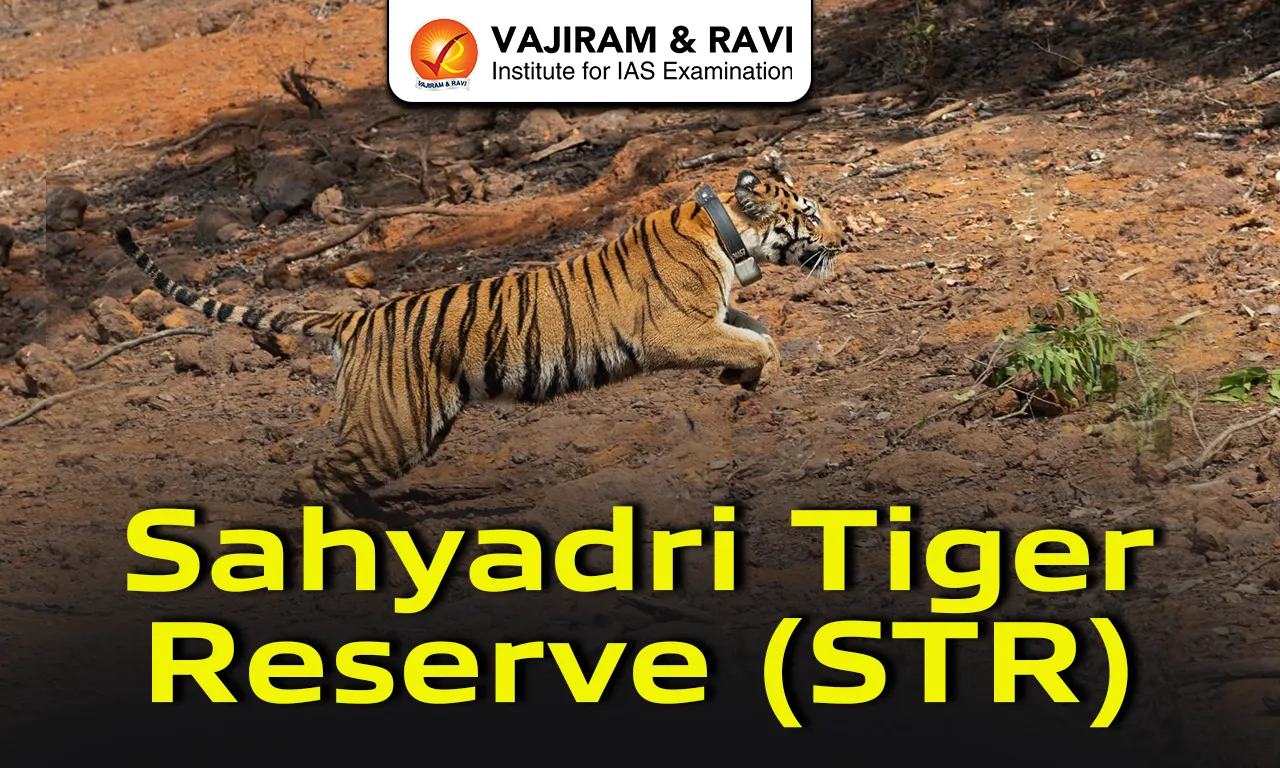
In a significant boost to tiger conservation in western Maharashtra, a third tigress was released into the wild at the Sahyadri Tiger Reserve (STR) recently.

About Sahyadri Tiger Reserve (STR)

  • It is located in the Sahyadri Ranges of the Western Ghats in Maharashtra.
  • It is the northernmost tiger habitat in the Western Ghats.
  • It is the first tiger reserve of Western Maharashtra and the fourth tiger reserve of the State.
  • It is spread over two protected areas of Koyana Sanctuary (KWLS) and Chandoli National Park (CNP).
  • The central portion of STR is occupied by the “Shivsagar” reservoir of the Koyana River and the “Vasant Sagar” reservoir of the Warana River.
  • The habitat of Sahyadri is composed of woodlands, grasslands, and plateaus, the latter locally referred to as “Sadaa”, which are lateritic in nature with considerable habitat value. 
  • Vegetation
    • The forest cover here is that of moist evergreen, semi-evergreen, moist, and dry deciduous vegetation.
    • It is the only place where climax and near-climax vegetation are plentiful and prospects of adverse anthropogenic influence in the future are minimal.
  • Flora:
    • Dense tree cover includes species such as teak, bamboo, Indian laurel, and jamun.
    • Medicinal plants like Asparagus racemosus and Aegle marmelos grow abundantly.
    • Unique Western Ghats endemics, including rare orchids and shrubs, flourish in the reserve’s humid microclimates.
  • Fauna:
    • It is home to the endangered species of top carnivores such as Tiger, Wild dog, and Leopard. 
    • The herbivores include Gaur, Sambar, Four Horned Antelope, Mouse Deer, and Giant Squirrel. 
    • The habitat also supports hornbills, and many other endemic birds.

Source: HT

Sahyadri Tiger Reserve (STR) FAQs

Q1: Where is the Sahyadri Tiger Reserve located?

Ans: In the Sahyadri Ranges of the Western Ghats in Maharashtra.

Q2: What is the geographical significance of Sahyadri Tiger Reserve in the Western Ghats?

Ans: It is the northernmost tiger habitat in the Western Ghats.

Q3: Which two protected areas together form the Sahyadri Tiger Reserve?

Ans: Koyana Wildlife Sanctuary and Chandoli National Park.

Q4: Which major reservoirs occupy the central portion of Sahyadri Tiger Reserve?

Ans: Shivsagar reservoir on the Koyana River and Vasant Sagar reservoir on the Warana River.

Q5: What types of forest vegetation are present in Sahyadri Tiger Reserve?

Ans: Moist evergreen, semi-evergreen, moist deciduous, and dry deciduous forests.

Peregrine Falcon

Peregrine Falcon

Peregrine Falcon Latest News

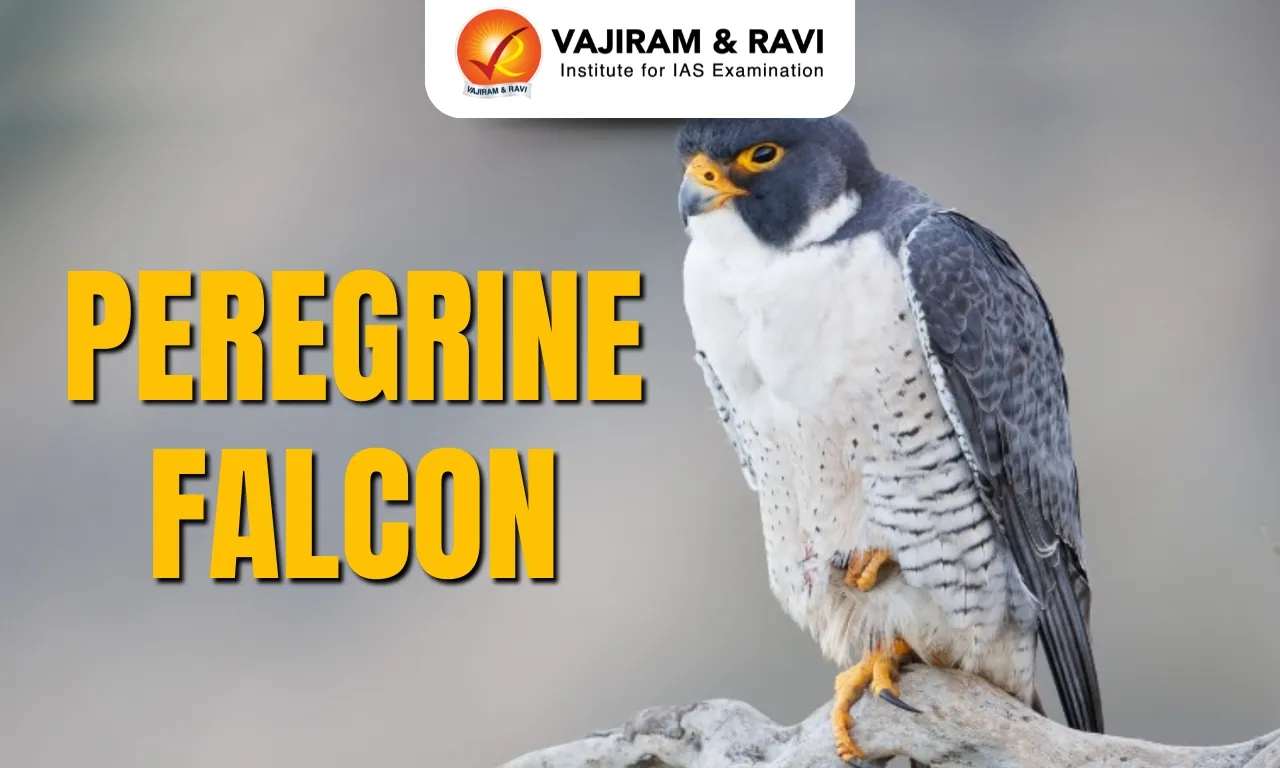
Recently, a wildlife researcher has made a historic sighting of a Siberian peregrine falcon in central Australia, where this subspecies has never been recorded before.

About Peregrine Falcon

  • It is a large cosmopolitan raptor in the family Falconidae.
  • Distribution: It is found on all continents except Antarctica, and on many oceanic islands.
  • Habitat:
    • They prefer open habitats, such as grasslands, tundra, and meadows.
    • They are most common in tundra and coastal areas and rare in sub-tropical and tropical habitats. They nest on cliff faces and crevices.

Characteristics of Peregrine Falcon

  • It is renowned for its speed during its characteristic hunting stoop (high-speed dive), making it the fastest bird in the world, as well as the fastest member of the animal kingdom.
  • They are active during the day. When not breeding they are primarily solitary and establish and defend territories.
  • Ecological role: They are high level predators, peregrine falcons play an important role in regulating populations of their prey, particularly pigeons and doves.
  • Conservation status: IUCN Red List: Least Concern.

Source: Live Science

Peregrine Falcon FAQs

Q1: What is the IUCN conservation status of Peregrine Falcon?

Ans: Least Concern

Q2: Where do we find Peregrine Falcon?

Ans: In all continent except Antarctica.

Thwaites Glacier

Thwaites Glacier

Thwaites Glacier Latest News

Scientists have raised concerns over the Thwaites Glacier, as it is melting at an unprecedented rate because of climate change fueled by human activities. 

About Thwaites Glacier

  • Location: It is a large glacier in West Antarctica, about the size of a large country.
  • Scientists have often called it the “Doomsday Glacier”.
  • It’s a wide and fast-flowing glacier, roughly the size of Florida or Great Britain.
  • It is one of the most vulnerable and important glaciers in the world in terms of future global sea-level rise.
  • It contributes 4% to global annual sea-level rise, and its collapse could destabilise the West Antarctic Ice Sheet, which would cause catastrophic sea-level rise. 

Impact of Melting of Thwaites Glacier

  • It has been becoming thinner, retreating, and contributing to sea-level rise.
  • If it weakens beyond a point, other glaciers may lose ice faster as well, further increasing sea-level rise.
  • Higher sea levels will cause coasts to flood more easily, worsen erosion, increase storm surges, and threaten cities, low-lying islands, and ports.
  • Significance: It is one of the most important places on the earth for those trying to understand how sea levels will rise in future.

Source: NDTV

Thwaites Glacier FAQs

Q1: Where is Thwaites Glacier located?

Ans: West Antarctica

Q2: What is happening to Thwaites Glacier?

Ans: It's melting

Enquire Now