
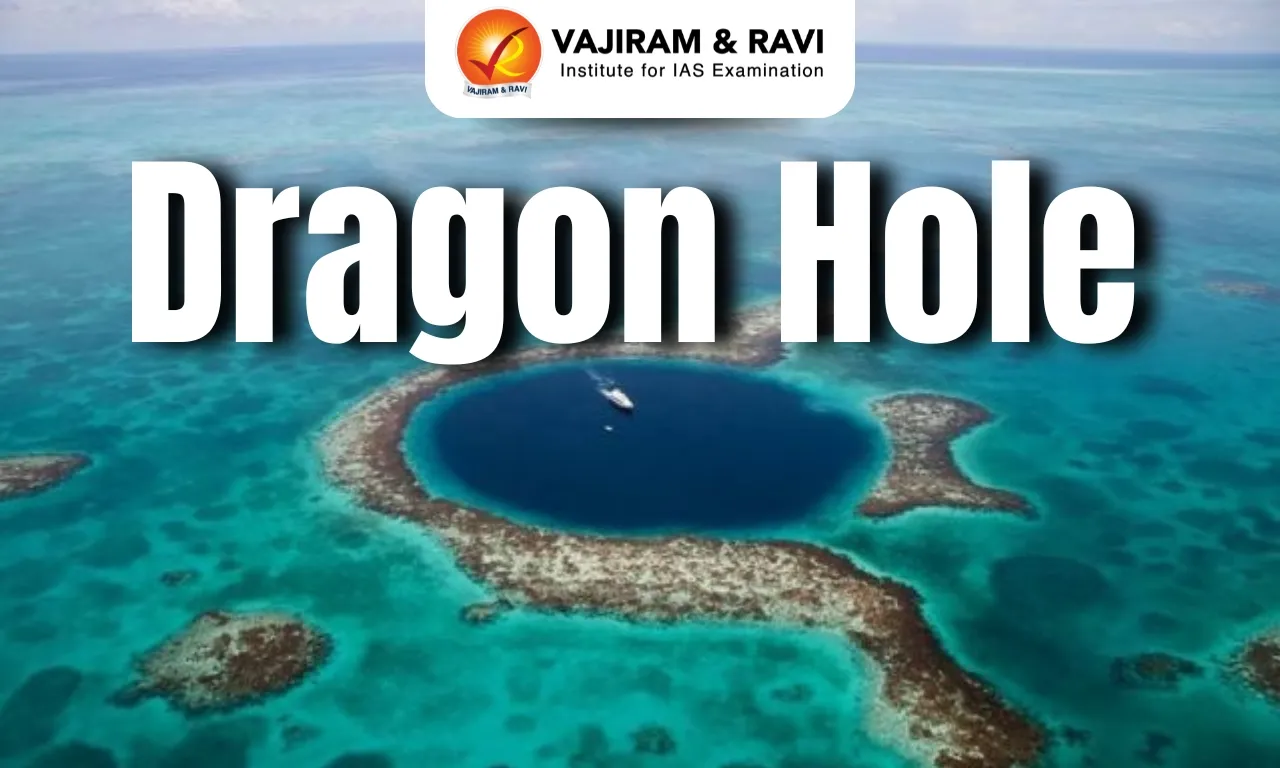
Dragon Hole Latest News
The Sansha Yongle Blue Hole, also known as the Dragon Hole, sits in the South China Sea and has drawn scientific attention for more than a decade.
About Dragon Hole
- The Dragon Hole is the popular name for the Sansha Yongle Blue Hole, a massive marine sinkhole in the South China Sea.
- Blue holes are steep-sided underwater cavities, often formed in limestone landscapes, that later flooded as sea levels rose.
- It is the deepest known underwater sinkhole in the world.
- It is about 25 kilometers from the Discovery Reef in the South China Sea.
- The local fishermen call it the‘eye’of the South China Sea.
- It is believed to be 301.19 meters deep, beating Dean's Blue Hole in the Bahamas by almost 100 meters.
- The almost vertical blue hole measures 130 meters in diameter at its surface entrance and 36 meters at its very bottom, where there is literally no water flow or exchange with the rest of the ocean.
- Water in the lower part of a deep blue hole like Dragon Hole is stagnant and anoxic with nearly no water circulation and thus unfavorable for most sea life, but nonetheless can support large colonies of bacteria.
- However, at least 20 ocean species thrive in the upper section of the hole, where there is a unique ecosystem characterized by ample oxygen and nutrients.
Source: TOI
Dragon Hole FAQs
Q1: What is the Dragon Hole?
Ans: The Dragon Hole is the popular name for the Sansha Yongle Blue Hole, a massive marine sinkhole.
Q2: Where is the Dragon Hole located?
Ans: It is located in the South China Sea.
Q3: Why is the Dragon Hole significant globally?
Ans: It is the deepest known underwater sinkhole in the world.
Q4: What is the estimated depth of the Dragon Hole?
Ans: It is believed to be about 301.19 metres deep.

