India-Seychelles Relations Latest News
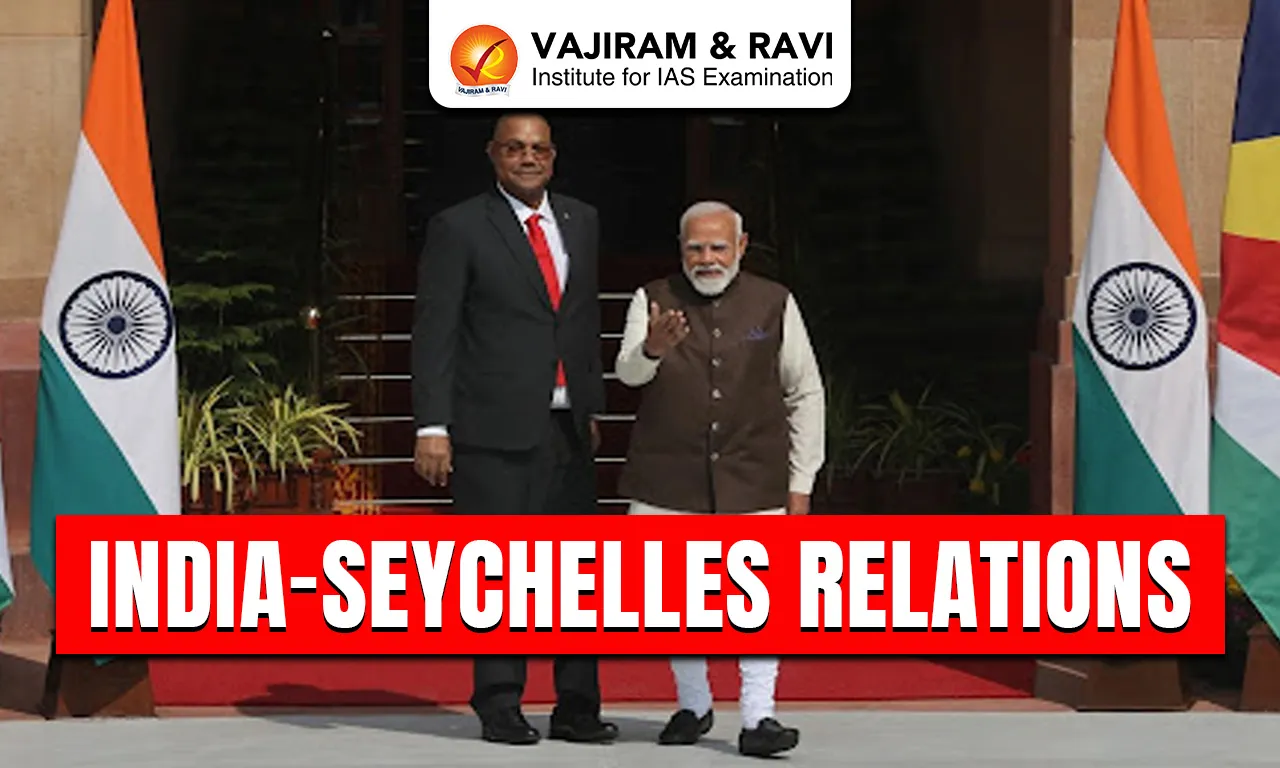
- The Indian Prime Minister and Seychelles President (Patrick Herminie) held bilateral talks in New Delhi, marking 50 years of diplomatic relations and coinciding with the 50th anniversary of Seychelles’ independence.
- The visit—within 100 days of President Herminie’s victory—underscores the strategic weight Seychelles attaches to India amid evolving geopolitics in the Western Indian Ocean Region (WIOR).
- The two countries adopted a Joint Vision for Sustainability, Economic Growth and Security through Enhanced Linkages (SESEL) and signed multiple agreements across sectors.
Strategic and Maritime Cooperation - The Core Pillar
- Defence and maritime security:
- It remains the central pillar of bilateral ties, and collaboration includes -
- Maritime surveillance
- Defence capacity development
- Counter-piracy operations
- Combating international crime and maritime threats
- Protection of critical Sea Lines of Communication (SLOCs)
- The cooperation assumes greater importance given rising piracy and economic offences in the strategic Indian Ocean Region (IOR), and growing geopolitical contestation in the region.
- It remains the central pillar of bilateral ties, and collaboration includes -
- Colombo Security Conclave (CSC):
- Seychelles was welcomed as a full member of the CSC.
- Originally formed in 2011 by India, Sri Lanka, and Maldives; CSC later expanded to include Mauritius and Bangladesh.
- The inclusion of Seychelles strengthens regional efforts towards -
- Maritime domain awareness
- Regional stability
- Cooperative security architecture in the IOR
- This aligns with India’s broader SAGAR doctrine and Vision MAHASAGAR (Mutual and Holistic Advancement for Security and Growth Across Regions).
Joint Vision (SESEL) - Broadening the Partnership
- The adopted Joint Vision for Sustainability, Economic Growth and Security through Enhanced Linkages (SESEL) expands cooperation beyond security into sustainable development.
- Key areas of cooperation:
- Marine research and ocean governance: Ocean observation, maritime scientific research, data-sharing mechanisms.
- Climate action and renewable energy: Cooperation in renewable energy solutions, climate resilience initiatives for small island developing states (SIDS).
- Health cooperation: Pharmacopoeial collaboration, strengthening healthcare systems.
- Digital transformation: Support in digital governance and capacity-building, enhancing e-governance frameworks.
- Meteorological cooperation: Technical and scientific collaboration between meteorological authorities.
- Capacity-building: Training programmes for Seychelles civil servants, institutional strengthening initiatives.
- Cultural and people-to-people ties: Cultural Exchange Programme (2026–2030); tourism cooperation, with India emerging as a growing market.
Economic and Developmental Assistance
- Special economic package: India announced a $175 million Special Economic Package, comprising $125 million Line of Credit (rupee-denominated) - remaining amount as grant assistance.
- The package will support:
- Public housing, infrastructure, mobility, maritime security, and capacity-building.
- This reflects India’s model of development partnership without conditionalities, especially for small island nations.
Geostrategic Significance
- WIOR: Critical for global trade and energy flows. Seychelles’ strategic location enhances India’s maritime reach.
- Countering extra-regional influence: Strengthening ties helps balance growing external powers’ presence in the IOR. Reinforces India’s role as a net security provider.
- Blue economy and SIDS diplomacy: Seychelles, as a Small Island Developing State (SIDS), is central to climate diplomacy, sustainable ocean governance, and blue economy initiatives.
- People-centric diplomacy: Shared democratic values, historical and cultural linkages, and emphasis on inclusive development.
India-Seychelles Relations
- Overview:
- Today, India-Seychelles relations embody close friendship, understanding and cooperation.
- Diplomatic ties were established with Seychelles after its independence in 1976.
- With a significant presence of Indian Diaspora in Seychelles, cultural contacts between the two countries have been primarily community-driven with support from the two governments.
- Key aspects:
- Trade: India exported goods worth US$ 64.88 million and imported goods worth US$ 8.96 million from Seychelles during 2022-23.
- Energy and environment: A Blue Economy Protocol between India and Seychelles was signed in 2015.
- Development assistance: An important aspect of bilateral cooperation revolves around various development assistance programs extended to Seychelles under ITEC, ICCR and IAFS.
- Defence and security: India is a key security partner for Seychelles, helping with coastal surveillance, radar systems, and joint exercises like 'LAMITIYE'.
Challenges
- Geopolitical competition in the IOR: Rising strategic competition may complicate smaller states’ balancing strategies.
- Climate vulnerability of Island States: Seychelles faces existential risks from climate change, sea-level rise, and extreme weather events.
- Maritime security threats: Piracy resurgence; drug trafficking; Illegal, Unreported and Unregulated (IUU) fishing
- Economic dependence on tourism: Seychelles’ economy remains vulnerable to global shocks.
Way Forward
- Institutionalising: Maritime Domain Awareness (MDA) through real-time data-sharing.
- Deepening: Blue Economy cooperation, including sustainable fisheries and marine biodiversity protection.
- Expanding: Renewable energy partnerships tailored to SIDS needs.
- Strengthening: Multilateral maritime frameworks, particularly through the CSC and IORA.
- Enhancing: Digital and governance partnerships for resilient institutions.
- Leveraging: India’s Vision MAHASAGAR and SAGAR doctrine to build a cooperative Indian Ocean architecture.
Conclusion
- The India–Seychelles partnership is evolving from a traditional defence relationship into a multidimensional strategic partnership encompassing sustainability, digital transformation, climate action, and economic growth.
- As maritime neighbours in the Indian Ocean, their collaboration contributes not only to bilateral development but also to the broader architecture of peace, stability, and inclusive growth in the WIOR.
- In the emerging geopolitics of the Indo-Pacific, Seychelles remains a key pillar of India’s maritime vision, reinforcing India’s aspiration to be a credible and responsible security and development partner in the region.
Source: IE
India–Seychelles Relations FAQs
Q1: What is the strategic significance of Seychelles in India’s Indian Ocean policy framework?
Ans: Seychelles’ strategic location in the Western Indian Ocean makes it central to India’s SAGAR and Vision MAHASAGAR initiatives.
Q2: What is the role of the Colombo Security Conclave in strengthening maritime cooperation in the Indian Ocean Region?
Ans: It institutionalises regional maritime collaboration through maritime domain awareness, counter-piracy coordination, etc.
Q3: How does the India–Seychelles Joint Vision (SESEL) reflect a shift?
Ans: The SESEL framework expands ties beyond defence to renewable energy, climate resilience, digital transformation, health, etc.
Q4: What is the importance of India’s development partnership model in its engagement with SIDS?
Ans: India’s concessional Lines of Credit and grant-based assistance without conditionalities enhance goodwill, sustainable development, etc.
Q5: What are the major maritime security challenges in the WIOR and India’s response to them?
Ans: Rising piracy, IUU fishing, trafficking, and geopolitical competition are addressed through defence cooperation, maritime surveillance, etc.

