
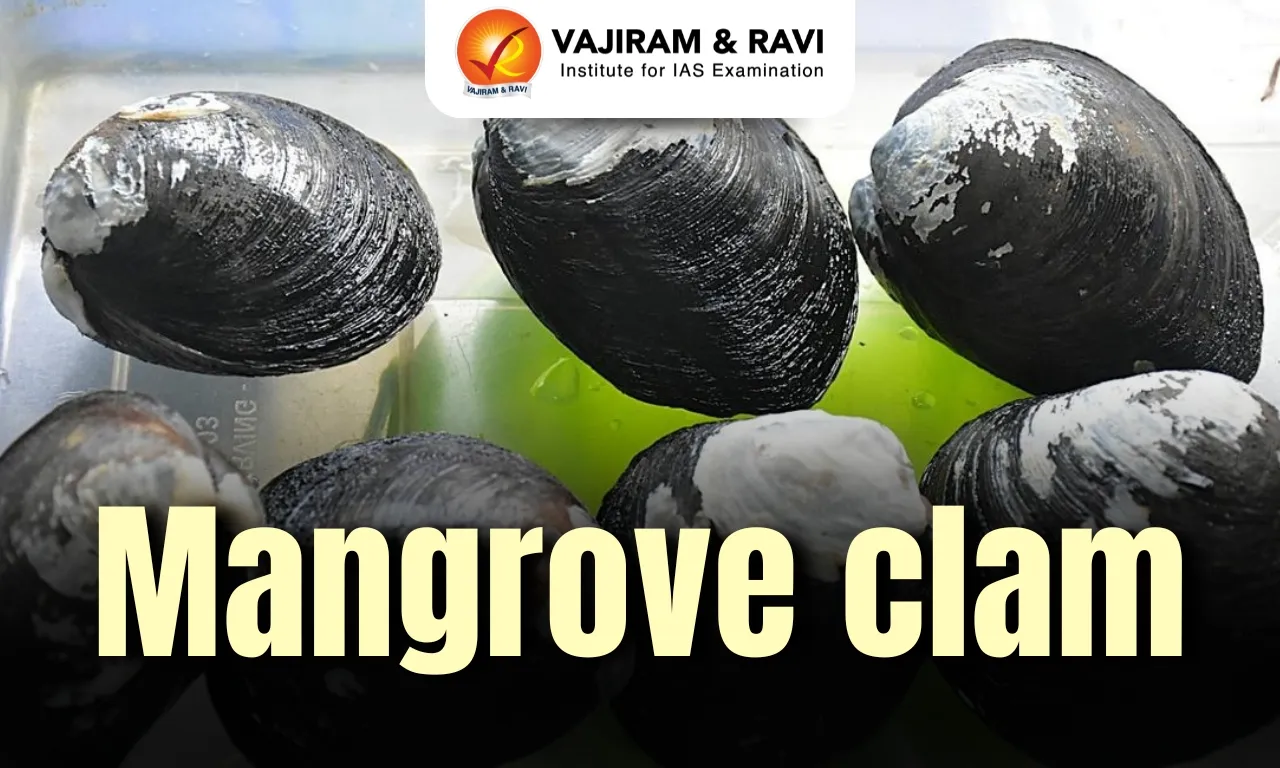
Mangrove Clam Latest News
Recently, the ICAR–Central Marine Fisheries Research Institute (CMFRI) has successfully achieved captive breeding of the mangrove clam (Geloina erosa).
About Mangrove Clam
- Mangrove clams, commonly known as mud clams, locally called 'Kandal Kakka' in northern Kerala.
- It belongs to the genus Polymesoda or Geloina.
- Habitat: They are found in muddy, brackish, and even nearly freshwater regions within mangrove swamps.
- Distribution: These are widely distributed in the Indo-Pacific region.
Characteristics of Mangrove Clam
- It is a burrowing bivalve inhabiting organic-rich muddy substrates in intertidal mangrove ecosystems.
- This species displays remarkable tolerance, enabling them to thrive across a broad spectrum of salinity levels.
- Life cycle: The life cycle of the clam consists of four distinct phases: larval stage, spat, juvenile and adult clam.
- Feeding behavior: It is a filter-feeding species, primarily active during low-tide immersion stages characterized by frequent inundation.
- Ecological Role: It plays a crucial ecological role by recycling nutrients, stabilising sediments and strengthening mangrove ecosystems,
- It provides food security and livelihoods in coastal regions.
- Threats: In India, particularly along the east coast and in island regions, wild stocks have been steadily declining due to indiscriminate harvesting, habitat degradation, pollution and coastal development.
Source: Business Line
Mangrove clam FAQs
Q1: Where are Mangrove Clams typically found?
Ans: Mangrove forests
Q2: What is a clam's primary food source?
Ans: Organic particles in the correct size range are either plankton, detritus (decaying plant material), or bacteria.

